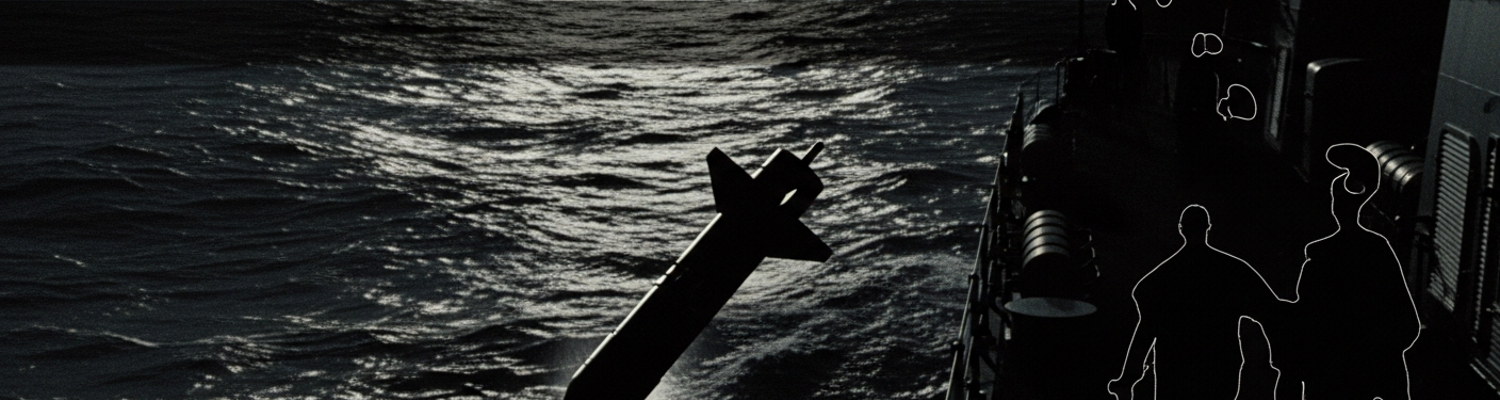

The Atlantic Becomes a Minefield
By early 1942, the war arrived off the American coast. German U-boats, executing Operation Paukenschlag, were not just sinking ships with torpedoes. They were covertly seeding the approaches to major ports with a weapon the U.S. Navy was unprepared to face. The German Magnetmine, an influence mine designed to rest on the seabed, detected the magnetic field of a ship passing overhead. A sensitive dipping needle would register the metallic hull's distortion of the Earth's magnetic field, close a circuit, and detonate a payload of Hexanite. Unlike the horned mines of the previous war that required physical contact, this weapon killed from a distance.
German engineers were already developing more complex triggers. Acoustic sensors calibrated to the sound signature of a ship’s propellers were being paired with magnetic fuzes. This created a dual-trigger system that was exponentially harder to sweep. The Kriegsmarine began deploying these combined-influence mines in the vital shipping lanes of the Western Hemisphere.
Initial deployments fell to the U-boat force. Submarines used their torpedo tubes to eject the mines in the approaches to Chesapeake Bay, New York Harbor, and Jacksonville. The devices settled into the shallow coastal seabed, invisible and beyond the reach of conventional moored minesweeping gear. U-boat captains could turn a harbor entrance into a kill zone without firing a single torpedo. This tactic represented a significant operational shock, undermining the assumption that American territorial waters were secure. The objective was to sever the logistical chain supplying Britain and to disrupt the coastal convoy routes connecting American industrial centers. The losses began to mount.
First Contact and Structural Failure
The first direct education the United States Navy received on the reality of advanced German influence mines came from the violent destruction of merchant vessels. On June 15, 1942, the destroyer USS Lansdale (DD-426) was escorting a coastal convoy off North Carolina when a tanker, the Robert C. Tuttle, erupted in a column of water and flame. The ship had not been struck by a torpedo. It had passed over a magnetic-acoustic mine. Archival evidence from the damage reports shows the detonation lifted the 500-foot vessel, breaking its keel and buckling the hull structure. The ship sank in minutes. This incident was a brutal confirmation of a threat that had been growing for months. German U-boats had turned the approaches to major American ports into lethal fields, and existing sweeping techniques were obsolete.
The physical damage inflicted by these non-contact weapons was distinct. A contact mine punches a localized hole in a hull. An influence mine detonating on the seabed creates an expanding gas bubble and a powerful pressure wave. This shockwave strikes the entire length of the ship's bottom simultaneously. The primary effect is a violent whipping motion that forces the bow and stern downwards while the center is heaved upwards, a stress known as hogging. The gas bubble then collapses, creating a void that the ship falls into, reversing the stress into a sagging motion. This rapid flexure broke the backs of ships.
Damage control reports from affected vessels detail catastrophic structural failure. The main keel would buckle or fracture. Longitudinal support beams would tear. Hull plating ripped open along its seams. Inside the ship, the shock was disorienting. Machinery was ripped from its foundations, high-pressure steam lines burst, and electrical switchboards shattered, plunging the vessel into darkness and filling compartments with scalding steam.
The operational impact was immediate. The presence of these mines in North Atlantic convoy routes fundamentally altered maritime logistics. Key port approaches, where ships were most concentrated, became the most dangerous areas of a voyage. Convoys were forced into longer, less optimal channels that had been swept, increasing transit times and burning more fuel. This created predictable bottlenecks that U-boats could exploit. A review of operational logs (NARA Record Group 38) indicates the threat closed entire ports for days, causing a backlog of merchant vessels who became stationary targets for air and submarine attack. This created a loss of ship-days, an unrecoverable resource that directly translated into less war material reaching the European front. The introduction of countermeasures like ship degaussing was a massive industrial undertaking, requiring over 13,000 U.S. ships to be retrofitted.
Salvage Operations Under Duress
Neutralizing German influence mines was a battle against physics and weather. Operations in the North Atlantic were frequently paralyzed by extreme conditions. Winter gales made any attempt at mine recovery or disposal an act of desperation. For the small, wooden-hulled minesweepers and auxiliary vessels tasked with the job, high winds and choppy seas made it nearly impossible to maintain a stable position over a suspected mine location. Strong currents could push ships off course during delicate sweeps. Heavy swells prevented the safe launching of small boats or the deployment of divers.
Even when a mine was located, the weather conspired against its recovery. The cold, numbing water reduced diver effectiveness and increased the risk of equipment malfunction. Pitching decks made the handling of hoisting gear and disarming tools hazardous. Operational logs from minesweeping flotillas in 1943 show that entire weeks were lost as vessels were forced to seek shelter.
The sea itself was an enemy.
The most dangerous work fell to the graduates of the U.S. Naval Mine Recovery School, established in June 1941 to create specialists in Explosive Ordnance Disposal (EOD). These men, often volunteers who had trained with British UXO teams, were tasked with rendering safe devices designed to kill them. After a mine was located, a diver might descend in near-zero visibility, working entirely by touch on the seabed. His job was to identify the type of mine and locate the fuze assembly, a task made difficult by marine growth and damage. The primary fear was the anti-handling device. German engineers had developed secondary fuzes, like the ZUS40, designed to detonate the mine when it was being examined. These could be triggered by a change in orientation, a drop in pressure from being lifted, or even exposure to light. EOD personnel had to use non-magnetic brass tools, painstakingly loosening fuze locking rings. A single slip or a misidentification of the fuze type would result in instantaneous death, a reality underscored by the loss of Ensign John M. Howard in 1942, one of the first American casualties in mine disposal.
This solitary struggle against complex machinery was documented. Combat photography units were frequently dispatched to record salvage and disposal operations. Their purpose was twofold. Examination of their work shows it served as both an intelligence-gathering tool and a source for training materials. Photographers captured high-resolution images of recovered mines. These photographs allowed intelligence analysts to reverse-engineer the fuzes, identify new anti-handling mechanisms, and understand German manufacturing techniques. The images were then used to create detailed manuals and visual aids for the Mine Recovery School, showing new recruits exactly what to expect. The photographs captured the mangled wreckage of a ship's hull, the tense faces of an EOD team as they hoisted a live mine aboard, and the close-up work of a disposal officer carefully unscrewing a fuze.
Intelligence Gap and Reverse Engineering
Technical intelligence was forced to learn about the new generation of German mines by dissecting those that failed to detonate. The physical recovery of an intact German influence mine was an exercise in extreme danger. Most devices functioned as designed, leaving only wreckage. The first major Allied breakthrough came on November 23, 1939, when a Luftwaffe aircraft dropped a mine by parachute onto the mudflats of the Thames Estuary. A British team led by Lieutenant Commander John Ouvry from HMS Vernon was dispatched. Working with non-magnetic tools, the team disarmed the device, aware that any misstep could trigger the sensitive magnetic fuze. A deeper threat lay in the German use of anti-handling devices. The ZUS 40 was a mechanical booby trap hidden underneath the primary fuze; attempting to withdraw the main fuze by more than 15 millimeters would release a spring-loaded firing pin, detonating the mine. This forced disposal teams to assume every mine was trapped.
Once a mine was recovered, it became the subject of intense scientific scrutiny. The fuze recovered by Ouvry’s team was rushed to Portsmouth, where physicists dismantled it and discovered the induction magnetometer that formed its trigger. This act of reverse engineering provided the data needed to develop the first countermeasures. As new mine variants appeared, combining magnetic, acoustic, and later, pressure-sensitive triggers, this cycle of recovery and analysis became institutionalized. In the United States, the Naval Ordnance Laboratory (NOL), which had its origins in a small mine laboratory at the Washington Navy Yard, expanded to meet the threat. Established in 1929, the NOL's importance grew exponentially after Germany's use of magnetic mines became apparent. Scientists and engineers at the NOL would meticulously document the internal wiring, the calibration of acoustic hydrophones, and the tolerances of magnetic needles. These findings were translated into new tactical directives and equipment designs, from improved degaussing coils to noise-making devices towed behind minesweepers.
A persistent problem was the lack of a comprehensive library of enemy mine signatures. The effectiveness of a combined mine depended on it being tuned to the specific magnetic and sound profile of a target. German engineers constantly altered the sensitivity of the fuzes, creating variants that would ignore small minesweepers but detonate under a large merchant ship. An even more difficult challenge was the introduction of ship counters. These mechanisms allowed a preset number of ships to pass over the mine harmlessly before it armed itself. This created profound uncertainty in cleared channels, as a lane swept and declared safe could become a kill zone moments later. It made it nearly impossible for Allied intelligence to predict which ship in a convoy was the intended target. The Germans also began deploying mines with delayed-action timers, which would only become active days or weeks after being laid. There was no guarantee that data from one captured mine would apply to the hundreds of others resting silently on the seabed.
Fragmented Intelligence Dissemination
The architecture of naval communication became an obstacle. Onboard a destroyer or minesweeper, the radio room was a cramped space dominated by equipment like the TCS transmitter, operated by radiomen copying streams of five-character code groups. This system was highly susceptible to disruption. Atmospheric conditions in the North Atlantic could degrade high-frequency signals, turning messages into static. The sheer volume of encrypted traffic meant a single ship’s report about a mine encounter could be significantly delayed. Strict radio silence was often imposed to prevent enemy direction-finding units from locating convoys, forcing ships to rely on slower visual methods like signal lamps. When a transmission was permitted, a radioman would manually key in the encrypted message, which was then broadcast, received ashore, decrypted, and routed, a chain with multiple points of failure.
When a vessel encountered a non-contact mine, initial reports were frequently chaotic. The crew of a ship struck by a seabed mine experienced a violent whipping motion and a massive underwater concussion, an event easily mistaken for a torpedo. Survivors from different parts of the same vessel would provide conflicting accounts. Lookouts might report a waterspout characteristic of a mine, while engine room personnel might believe a boiler had exploded. After-action reports for a single sinking could list the cause as a torpedo, a new type of mine, or an internal malfunction. This flood of incomplete data was funneled to intelligence officers forced to assemble a coherent threat picture from battlefield rumors.
Critical intelligence struggled to traverse the Navy’s own institutional divides. The journey of a single piece of mine-related data, from a damage control report on a stricken minesweeper to the physicists at the Naval Ordnance Laboratory (NOL) in Washington D.C., was a study in bureaucratic friction. The information had to pass from the ship’s captain to a flotilla commander, then to fleet headquarters, and finally to the desk of the Chief of Naval Operations before being handed off to the Bureau of Ordnance (BuOrd). Each step involved reformatting and re-classifying the report, introducing delays that could stretch for weeks. A deep institutional chasm existed between the operational fleet and the technical bureaus. Fleet commanders demanded immediate, actionable intelligence. Scientists at the NOL required precise, granular data on detonation characteristics and water depth to reverse-engineer the German fuzes. This disconnect, documented in BuOrd File 11-43, meant the feedback loop was dangerously slow. Warnings about new mine variants identified by the NOL often failed to reach the fleet in time, leaving minesweeper crews to discover the next deadly innovation by lethal experience.
The Psychological Weapon
For the crews of minesweepers and the merchantmen they protected, the German influence mine created a unique form of psychological stress. Unlike the threat of torpedoes or bombs, the mine was a silent, unseen, and ever-present possibility. Crew testimony speaks to a pervasive sense of dread that permeated every moment in mined waters. This was a war against an invisible enemy that did not allow for the release of tension that comes from fighting back. Men on watch stared into the waves, knowing the threat lay beneath. A piece of floating debris could trigger a moment of panic. This constant, low-grade fear eroded morale.
Sleep was difficult in the crowded living conditions of a 180-foot minesweeper, a small vessel packed with over 100 men. The knowledge that a sudden, violent end could come from directly beneath the keel, without warning, led to a fatalism that ship captains had to actively manage.
This fear was grounded in the nature of minesweeping operations. The men aboard the small, wooden-hulled minesweepers knew they were sent deliberately into harm’s way to trigger the very weapons others sought to avoid. Aboard the Auk-class and Admirable-class sweepers, sailors had to deploy complex gear like the double L-sweep, which trailed long electrical cables to generate a magnetic field designed to detonate mines at a supposedly safe distance. The process was fraught with tension. The detonation of a nearby mine, even if it caused no physical damage, was a deeply unsettling event that could lift the small ship in the water. The work was a combination of extreme boredom and moments of sheer terror. Operational logs show that in areas of known heavy mining, simple procedural mistakes increased as fatigue and fear mounted.
Strategic Disarray
The arrival of German magnetic mines in American coastal waters in 1942 triggered operational paralysis. U-boats began seeding the approaches to major ports, turning the sea lanes off the Eastern Seaboard into invisible traps. The immediate effect was the severe disruption of maritime traffic. Convoys and independent merchant ships, the logistical foundation of the war effort, were forced to halt, sometimes for days, as the Navy struggled to ascertain the nature and extent of the threat. This created immense backlogs, with dozens of ships loaded with war materiel anchored in vulnerable clusters, presenting easy targets for subsequent U-boat torpedo attacks. The unseen weapon bred a deep uncertainty that rippled through naval command. Entire port operations were suspended based on a single suspected mine detonation. This confusion directly impacted the flow of supplies to Europe and diverted naval assets from anti-submarine warfare to the sudden need for mine clearance.
The American response was delayed by institutional unpreparedness. At the outbreak of the war, U.S. Navy mine countermeasures were an afterthought, focused on moored contact mines from a previous generation of warfare. The scientific and industrial infrastructure needed to combat influence mines did not exist on the necessary scale. The Naval Ordnance Laboratory was a small pre-war organization that had to expand rapidly. A review of Bureau of Ordnance records shows that even after the British provided intelligence on German magnetic fuzes, the development of effective countermeasures in the U.S. was slow. The first American air-delivered mine, the Mark 12, was based on a captured German design from the 1920s, highlighting the technological gap. Deploying a countermeasure like ship degaussing required retrofitting thousands of naval and merchant vessels, a process that consumed dry dock space, skilled labor, and electrical components already in high demand. For months, ships sailed through mined waters with little protection.
This failure forced a re-evaluation of naval strategy in the Atlantic. The primary mission had been to secure the sea lanes against U-boat torpedo attacks, a task centered on convoy escorts. The mine crisis diverted a significant portion of the Navy’s resources and command attention away from this effort. Destroyers and patrol craft needed for anti-submarine screens were reassigned to patrol suspected minefields. The construction of specialized minesweeping vessels, which had not been a priority, suddenly became an urgent requirement, placing new demands on shipyards. Strategic planners were confronted with the reality that their primary ports and convoy assembly points were no longer secure. This forced convoy routes to be altered, increasing transit times and fuel consumption. The German mine, though deployed in relatively small numbers, had achieved a disproportionate strategic effect, forcing the U.S. Navy onto a defensive footing in its own territorial waters.
The Technical Response
The shock of the magnetic mine crisis forced a rapid evolution in naval technology. Initially, the U.S. Navy, following British developments, adopted degaussing, which involved wrapping the entire hull of a ship with a network of electrical cables. Passing a current through these cables generated a magnetic field that canceled out the ship’s own signature, rendering it temporarily invisible to magnetic fuzes. This was an industrial undertaking that saw facilities like the Boston Navy Yard convert hundreds of vessels. A more advanced solution was deperming, a process where a ship was placed inside a specialized facility and subjected to a powerful, slowly decreasing magnetic field to permanently reduce its inherent magnetization.
To counter the subsequent German development of acoustic mines, the Navy developed towed noisemakers. The most common was the A Mark 2 Hammer, a device trailed behind the minesweeper that used a motor-driven striker to beat against a steel diaphragm, generating a broad spectrum of noise designed to fool an acoustic mine into detonating at a safe distance.
This was a war of technicians.
The crisis necessitated the creation of new naval organizations dedicated to a singular problem. The Naval Ordnance Laboratory ballooned in size and importance, becoming the central node for all mine-related technical intelligence. Scientists at NOL facilities in Washington D.C. and later White Oak, Maryland, worked to reverse-engineer captured German fuzes, their findings directly informing the design of new sweep equipment. On the front lines, the ad-hoc nature of early mine disposal was replaced by a professionalized force. The U.S. Naval Mine Recovery School began turning out the first generation of what would become Explosive Ordnance Disposal technicians. Operationally, the Navy established dedicated Mine Squadrons, such as MinRon 7 and MinRon 20, which grouped minesweeping vessels into organized commands tasked with clearing channels for major operations, from the Mediterranean to the massive amphibious assaults at Okinawa.