
USS Olympia Deployment to the Murmansk Railway
Mud across the Kola Peninsula clung to iron rails. It froze into jagged ridges under horizontal sheets of subarctic sleet before dissolving into deep silt beneath unyielding twenty-four-hour summer sunlight. Midday temperatures frequently drove above eighty-five degrees Fahrenheit. Stagnant water pooled across the thawing permafrost of the Karelian taiga. Barents Sea squalls frequently drove inland without warning. Ambient air plunged thirty degrees within forty minutes. Beneath the rail beds, melting permafrost undercut miles of gravel embankment to leave heavy cross-ties hanging in open air.
Controlling this single rail artery determined survival across the subarctic north.
Archival evidence shows that on June 24, 1918, Captain Bion B. Bierer detached fifty United States Marines and fifty-four naval bluejackets from the protected cruiser USS Olympia. The warship lay at anchor in the Kola Inlet. Ordered south under the tactical command of Lieutenant Henry F. Floyd, this hundred-and-four-man landing party boarded decrepit Russian flatcars. Their objective involved reinforcing isolated posts along the Murmansk-Petrograd railway. Operational logs record that Floyd took charge of a mixed force armed with standard M1903 Springfield rifles, canvas cartridge belts, and scarce rations. Severe mechanical breakdowns disrupted the deployment within hours. The wood-burning locomotive blew its cylinder gaskets. Rusted track couplers sheared under the strain of uneven grades near Polyarnye Zori.
Bluejackets shoveled ballast by hand.
They chopped birch cordwood to feed dry engine fireboxes and clamped improvised steel braces over fractured rails. Four days of forced repairs brought the detachment into the rail depot at Kandalaksha on June 28. Floyd established a forward operations base inside an unheated freight depot. Hostile forces gathered along the Finnish frontier less than forty miles away.
Strategic Vulnerability of the Kandalaksha Railheads
When examining the operational directives issued by British Major General Charles Maynard, mission parameters required securing the Murmansk-Petrograd railway against pro-German Finnish White Guard forces. These units attempted to sever northern Russia from Allied supply routes. Berlin had trained and equipped thousands of White Guard troops following the Finnish Civil War. German quartermasters supplied them with Mauser Model 98 rifles, Maxim machine guns, and field artillery to push east into Russian Karelia. Strategic estimates indicated that if Finnish forces captured the rail junction at Kandalaksha, German planners would gain an unimpeded overland route. This path offered access to establish U-boat staging facilities on the ice-free Barents Sea.
Floyd distributed his bluejackets and Marines across remote culverts, water stations, and wooden trestles along a thirty-mile sector.
Detachment sentries erected log breastworks along the roadbed. They dug firing pits into granite ledges. White Guard reconnaissance units conducted hit-and-run cavalry raids against telegraph stations along the track toward Kem. Naval artillery could not reach the fighting inland. A close review of operational logs indicates that this subarctic deployment forced naval landing parties to operate deep inland without traditional warship gunfire support. Positioned over one hundred and fifty miles south of the Olympia anchorage at Murmansk, the detachment lacked the cruiser twin eight-inch guns and ten five-inch broadside rifles to suppress enemy assaults. Floyd possessed only two Lewis machine guns, limited small-arms ammunition, and no organic field artillery.
Isolation produced a crisis at the Kandalaksha Estuary.
An American picket force holding an exposed sand spit was cut off by storm tides and freezing gales. The detached expeditionary commander and his frontline medical corpsman faced the choice between awaiting rear-echelon engineer bridging equipment delayed by derailed supply trains or risking their sole unarmored timber lighter in treacherous shallows to extract hypothermic picket troops. Water temperatures hovered near freezing. Multiple riflemen already suffered severe shivering, blurred consciousness, and falling body temperatures.
Permafrost Thaw and Causeway Structural Collapse
A close review of operational logs indicates that by early July 1918, unceasing twenty-four-hour solar exposure drove ground temperatures along the Karelian littoral past eighty degrees. This initiated a rapid thaw of the active permafrost layer. Combat engineers from the British 236th Infantry Brigade and American naval working parties had constructed corduroy log roads across the boggy taiga bordering the rail line. Crews laid felled Scots pine trunks perpendicular to the track alignment. They lashed the timbers with telegraph wire and packed the gaps with crushed granite and peat turf. Beneath this heavy decking, the subterranean ice lenses melted into saturated, non-load-bearing silt.
Ten-ton British transport lorries and ammunition-laden horse carts snapped the unseasoned pine stringers within days of deployment.
Heavy iron-rimmed wheels fractured cross-ties. The wood drove into gray, anaerobic slurry as the timber matrix displaced outward under static weight. Log sections floated loose in the pooling meltwater. The primary overland supply artery turned into a fragmented series of disconnected rafts. American sailors attempting to tamp fresh ballast into the ruts watched fifty-foot spans of roadbed sink four feet into the marsh. Transport wagons became immobilized along the swampy approaches to the Niva River mouth. The subterranean foundation liquefied.
Archival evidence shows that extreme subarctic tidal shifts compounded the structural disintegration across the Kandalaksha littoral mudflats. White Sea spring tides surged into the shallow northern gulf in early July. These generated vertical water swings exceeding six meters twice every twenty-four hours. Russian construction battalions had hastily erected the low-clearance rail trestles in 1916. They drove unpeeled spruce piles straight into intertidal silt without concrete footings or stone revetments to resist lateral current shear. Surging seawater entered the tidal flats at speeds reaching seven knots. Floating debris and uprooted drift logs pushed against timber bents already destabilized by mud scour. The rising salt water completely inundated low-lying trestles. Rails and iron fishplates submerged under five feet of freezing current. Cross-bracing bolts sheared under lateral hydrostatic pressure. Swelling water lifted entire spans of track off unbolted pile caps. Heavy iron rails twisted into horizontal curves that prohibited any locomotive movement toward the depot. The Murmansk rail connection severed at milepost 312.
Tide water cut off the northern rail approach.
Advanced reconnaissance pickets found themselves isolated on the outer marshland fringe as a direct result of this combined flooding. Floyd had posted an eight-man outpost composed of USS Olympia Marines and naval riflemen onto a low gravel spit three miles south of Kandalaksha. Their orders involved watching for Finnish White Guard patrols moving through the western pine barrens. Runoff from the thawing snowfields of the Khibiny Massif emptied into the Niva River simultaneously with the incoming tidal bore. The braided estuary swelled into a series of turbulent, deep-water channels. Silt causeways connecting the spit to the mainland washed away within ninety minutes. The detached pickets possessed no organic boats or bridging equipment. Freezing gale-force spray and rising water trapped the men on an exposed, four-foot-high mound of gravel. The overland withdrawal path behind them disappeared beneath two hundred yards of turbulent, 34-degree water.
Hypothermia began setting in as seawater breached their canvas leggings.
Commander and Corpsman Tactical Evacuation Decisions
Archival evidence shows that telegram traffic dispatched from the rail control post at Loukhi confirmed the total immobilization of rear-echelon combat engineers. British Royal Engineers assigned to the 236th Infantry Brigade, accompanied by Canadian railway troops, had loaded heavy timber trestle segments and modular pontoon bridging equipment onto flatcars forty miles downline. Torrential runoff and permafrost mudslides had washed out six separate culvert embankments between mileposts 287 and 304. A supply train carrying steam pile-drivers derailed into a water-filled peat trench. Flange bolts on the locomotive tender sheared during a sudden track subsidence. The main air-brake line broke and blocked the single-track right-of-way. Maintenance crews lacked replacement steel rails, ballast gravel, and dry pine cordwood to feed the boilers of repair engines. Track gangs trying to jack the heavy rolling stock back onto alignment watched the rail beds settle six inches into thawed subsoil under the static weight of the iron cranes.
Operational dispatches received at Kandalaksha indicated that clearing the right-of-way and bridging the rail gaps would require at least seventy-two hours of uninterrupted heavy labor.
Overland relief from the south was completely impossible.
A close review of operational logs indicates that detachment medical personnel recognized the acute lethality of the clock running against the marooned picket. Medical ratings attached to the Olympia landing party calculated survival margins based on physical measurements of the surrounding water. Brackish estuary shallows stood at thirty-four degrees Fahrenheit. Subarctic squalls drove horizontal sleet across the exposed granite spit. Stranded riflemen were clad only in standard-issue canvas leggings, wool service blouses, and unwaterproofed leather field boots. The frontline corpsman informed Lieutenant Floyd that immersion in near-freezing salt water causes severe shivering and peripheral vasoconstriction within twenty minutes. Muscle rigidity, mental disorientation, and lethal cardiac arrhythmia follow once core body temperatures descend below eighty-eight degrees. Rapid tidal influx had already submerged the gravel spit to waist height. This eliminated any chance for the eight men to construct windbreaks or rotate into dry garments. Survival tables calculated for Arctic immersion indicated that core temperatures would hit lethal thresholds within two hours. Zero percent survivability was expected if exposure extended past dusk.
Rising tidewater covered an additional inch of gravel every five minutes.
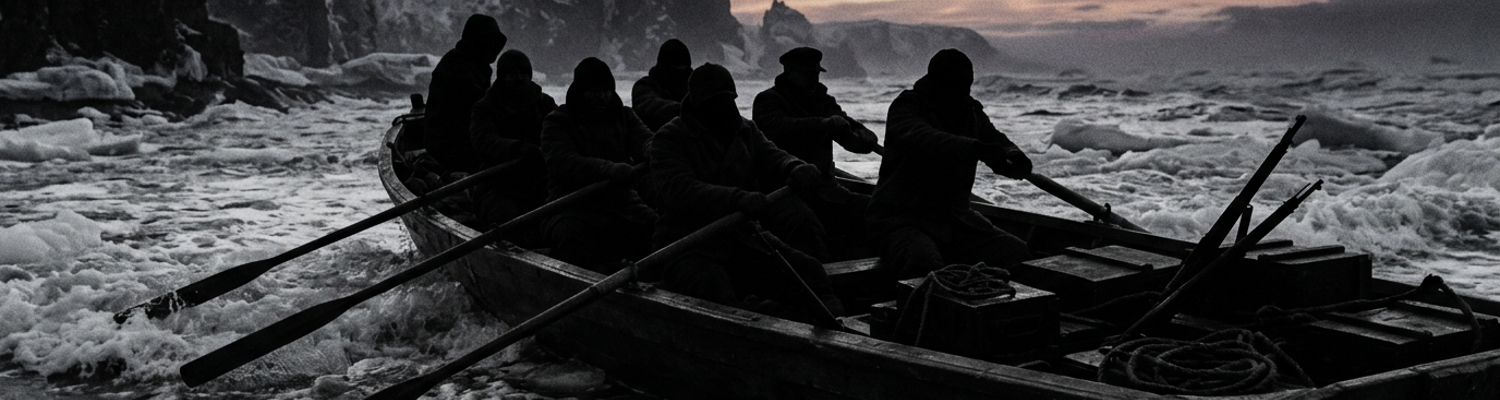
When examining the tactical records kept by Floyd, theater command directives issued by British Major General Charles Maynard strictly prohibited localized amphibious excursions. Standing orders required detached outpost units to maintain fixed defensive positions along established rail depots. Commanders were to consolidate rifle strength behind sandbag revetments and avoid committing scarce naval personnel to uncoordinated surface maneuvers without explicit theater approval. Disregarding this mandated standoff posture, Floyd determined that passive compliance meant death for the isolated sentries. Expeditionary officers moved to the Kandalaksha waterfront. They requisitioned an abandoned, twenty-two-foot flat-bottomed timber lighter previously used for hauling cut birch firewood along the Niva River mouth. The unarmored wooden craft possessed no propulsion machinery. It relied entirely on pine planking, rotted hemp caulking, and four crude spruce sweep oars. Floyd rejected calls to await rear-echelon support. He detailed six volunteer bluejackets, two Lewis gunners for shore-fire suppression, and the naval corpsman to crew the vessel. Floyd loaded two Lewis machine guns, six stretchers, and dry wool blankets into the timber frame. He shoved the heavy craft into the six-knot tidal current at 1800 hours.
Improvised Lighter Operations Across Tidal Shallows
Archival evidence shows that Lieutenant Floyd and Chief Boatswain Mate John Larson located the craft abandoned beside a collapsed timber wharf at the inner commercial basin of Kandalaksha. Local White Sea Pomor shipwrights had built the vessel to haul cordwood and river stone across the Gulf of Kandalaksha. The barge measured twenty-eight feet in length with an eight-foot beam and an empty draft of barely fourteen inches. Its unarmored hull consisted of heavy rough-sawn pine planks fastened to crooked birch ribs with hand-forged iron spikes. Decades of salt brine and summer rot had degraded the vessel hemp caulking. Water pooled over the bottom frames within minutes of displacement testing. Naval bluejackets stripped scrap zinc sheets and pitch from damaged freight cars in the rail yard. They hammered the metal plates over the worst splits in the outer deadwood while smearing hot pine tar into the seam lines. The vessel lacked any rudder assembly or protective decking. Rowers were completely exposed to incoming rifle fire from the western shoreline.
Cold harbor water seeped through the forward planking at forty gallons an hour.
A close review of operational logs indicates that moving this two-ton deadweight across three hundred yards of intertidal mudflats required mechanical leverage salvaged from the rail depot. Petty officers recovered two hand-cranked cargo capstans and two hundred yards of five-eighths-inch steel hoisting cable from a derailed maintenance crane at milepost 311. Bluejackets drove five-foot iron railway track spikes into the frozen permafrost bank at fifteen-yard intervals to anchor the winches against horizontal loads. Eight sailors rigged a double-purchase block tackle between the lighter stempost and the shore capstans. They worked in knee-deep glacial silt mixed with sharp summer ice floes driven south by coastal currents. Mud suction locked the flat bottom into the subsoil. As sailors leaned their chest weight into the capstan bars, the tensioned steel wire snapped three wooden guide rollers and stripped teeth off a cast-iron reduction gear. Men shoved spruce ties under the chines. They levered the hull forward three inches per throw while dodging free-floating ice chunks that threatened to cave in the green pine framing.
Friction frayed the steel cable down to its hemp core.
When examining the tactical records kept by Floyd, the lighter broke clear of the mud bar at 1835 hours into the primary tidal raceway. Estuary current charts documented a seven-knot ebb rip colliding directly with outgoing Niva River runoff. This generated four-foot standing chop across the submerged granite reefs. Six naval bluejackets manned twelve-foot spruce sweep oars. They fought to prevent the unsteered craft from broaching broadside into the thirty-four-degree water. Spray coated the oarlocks in frozen rime. Floyd balanced in the bow with a lead sounding line. He directed the rowers away from boulder fields hidden beneath eighteen inches of brown foaming surf. The craft slammed twice against granite shelves. Two bilge frames cracked and seams widened along the port chine before Floyd cleared the main channel. Reaching the inundated gravel spit where the eight Marines stood immersed past their cartridge belts, the corpsman jumped waist-deep into the rip to hold the bow line. He dragged each semi-conscious man over the gunwales into the sloshing bilge.
Sailors wrapped the hypothermic sentries in wool blankets. They stripped their frozen leggings and turned the craft back toward the rail embankment before the incoming tide drowned the gravel spit entirely. Floyd counted eight surviving pickets, six salvaged M1903 rifles, and zero casualties upon beaching at milepost 314 at 1945 hours.
Subarctic Littoral Lessons for Expeditionary Operations
Subsequent tactical debriefings conducted by the Navy Department examined the Kandalaksha extraction as a primary case study in littoral combat operations. Official reports filed by Captain Bion B. Bierer (NARA Record Group 38) documented the severe limitations of heavy engineer bridging trains in rapidly deteriorating subarctic environments. The reliance on standard gauge railway infrastructure proved highly vulnerable to permafrost degradation. British and American planners had assumed that deep-water naval gunfire could secure coastal railheads. They failed to account for the shallow gradient of the White Sea mudflats. Warships drawing twenty feet of water could not approach within ten miles of the Kandalaksha depot. This geographic constraint forced light infantry detachments to operate entirely outside the protective envelope of naval artillery.
The extraction proved the requirement for organic shallow-draft transport.
Floyd demonstrated that expeditionary forces operating in estuarine environments required immediate access to flat-bottomed utility craft. Standard naval doctrine of 1918 emphasized the deployment of heavy, steam-powered launches and steel-hulled cutters. These vessels required deep channels and constructed piers for loading operations. The twenty-two-foot timber lighter used at Kandalaksha bypassed these requirements. Its fourteen-inch draft allowed the crew to navigate directly over submerged granite reefs and intertidal mud bars. The improvised use of railway cargo capstans and five-eighths-inch steel cable provided the mechanical advantage necessary to launch the heavy wooden hull across the tidal flats. This field modification proved highly effective when standard slipways were unavailable.
Medical reports generated from the incident altered survival timelines for Arctic deployments. The frontline corpsman observations regarding peripheral vasoconstriction and rapid core temperature drop in thirty-four-degree water provided empirical data for future cold-weather operations. The eight rescued Marines required intensive thermal recovery protocols at the Kandalaksha depot. Their survival hinged entirely on the immediate availability of dry wool blankets and the rapid transit time provided by the timber lighter. Awaiting the seventy-two-hour repair timeline for the Royal Engineer bridging train would have resulted in a total loss of the picket force.
Expeditionary doctrine began to reflect these environmental constraints.
Commanders operating in the Russian North recognized that rigid adherence to rear-echelon supply schedules often conflicted with frontline survival. Floyd disregarded standing orders from British Major General Charles Maynard prohibiting uncoordinated surface maneuvers. His decision prioritized immediate tactical extraction over passive defensive posturing. The successful recovery of the eight sentries without a single casualty validated this aggressive approach to localized problem-solving. Naval landing parties deployed to Archangel and Vladivostok later in the year incorporated these lessons. They requisitioned local shallow-draft river craft and stockpiled block-and-tackle rigging for improvised amphibious operations. The Kandalaksha crossing established a clear operational precedent. Frontline commanders required the authority to commandeer local assets and execute independent extractions when environmental conditions severed communication and supply lines. The eight recovered Marines returned to active duty along the Murmansk railway on July 14.