
Media Portrayals of Modern Naval Interdiction
18 August 1990. 0417Z. Coordinates 22 14 N, 061 52 E. North Arabian Sea. Surface search radars aboard the guided missile frigate USS Reid tracked an unflagged 8,000 ton cargo hull. The target pushed twelve knots toward the Strait of Hormuz. Popular post Cold War media reconstructed maritime interdiction as an antiseptic routine. Network television broadcasts portrayed boarding actions as seamless operations executed by spotless special warfare operators. In these dramatized accounts black clad Navy SEALs slid down fast ropes from hovering SH-60B Seahawks onto pristine merchant decks. They subdued theoretical threats within seconds. They maintained clear satellite links with fleet flagships. Every hatch swung open on cue. Every manifest was verified via computerized datalinks. Command elements operated with complete tactical dominance.
Not the actual historical record.
Archival evidence shows that popular accounts fabricated an elite vacuum. Special boat units and special warfare teams were stretched thin across thousands of square miles of open water. Ordinary surface warfare sailors handled the volume of maritime interception missions. The personnel climbing pilot ladders were gunners mates and sonar technicians. Damage controlmen assigned to ad hoc Visit Board Search and Seizure teams filled out the rosters. These fleet sailors carried standard issue M1911A1 pistols or heavy 12 gauge shotguns. They wore bulky kapok life preservers. The gear severely restricted their agility. Training for these crews had been compressed into rushed shipboard walk throughs. These sessions occurred while underway from Mayport or San Diego. Boarding officers had to interpret complex admiralty paperwork without formal intelligence support.
Mechanical breakdowns began long before anyone stepped onto a suspect deck.
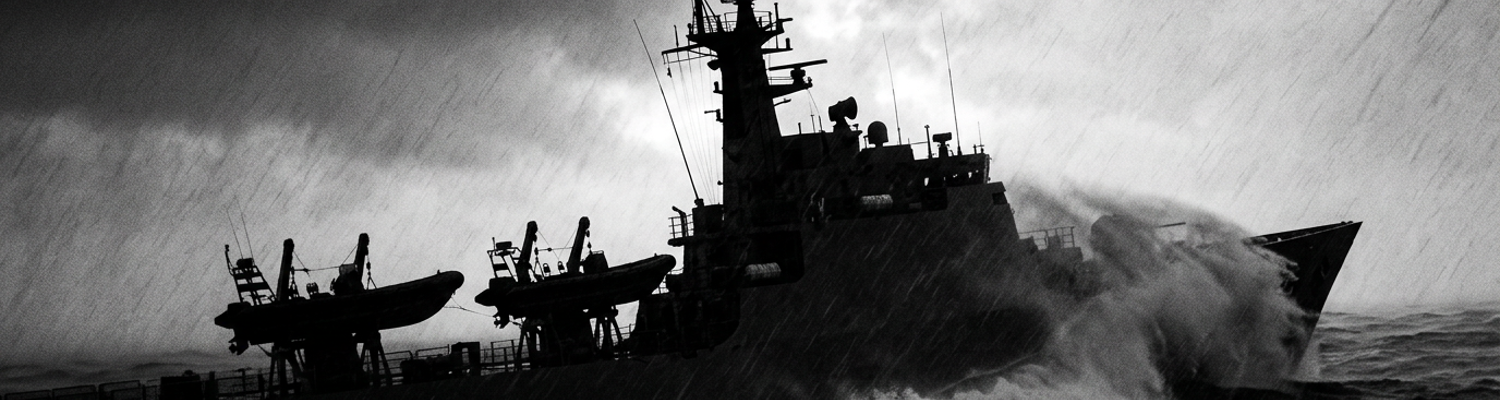
A close review of operational logs indicates that real world crews in late 1990 fought severe weather conditions. Mechanical degradation and chaotic merchant shipping corridors crippled standard operating procedures (NARA Record Group 338). In the northern Arabian Sea the tail end of the Southwest Monsoon generated sustained sea state 5 conditions. Four meter swells smashed rigid hull inflatable boats against steel hulls during launch attempts. Salt encrustation and ambient engine room temperatures exceeding 120 degrees Fahrenheit caused frequent failures. High pressure air compressors and davit winches aboard Knox class frigates broke down repeatedly.
Chaos on the water compounded every mechanical failure.
Merchant traffic choked the shipping channels into complete disorder. Scores of unlit regional dhows and rust streaked bulk carriers ignored VHF Bridge to Bridge Channel 16 radio challenges. Rogue tankers forced surface combatants to burn thousands of gallons of propulsion fuel chasing false contacts. Radar displays dissolved into dense fields of surface clutter caused by heavy sea spray. Thermal atmospheric ducting worsened the sensor degradation. Once boarding teams managed to reach an uncooperative vessel steel bulkheads severed hand held Motorola walkie talkie communications. The parent warship lost contact with the boarding party. Boarding parties found themselves completely isolated for upwards of ninety minutes inside unventilated cargo holds. They armed themselves with five cell flashlights. They hunted for Iraqi contraband amidst rotting agricultural shipments.
Interagency Directives and Air Corridor Surveillance
Intelligence alerts swamped naval radio rooms within seventy two hours of Iraqi forces crossing into Kuwait.
Archival evidence shows that high alert directives originating from interagency counter terror mandates forced Arabian Sea battle groups into extreme surveillance postures. The Federal Bureau of Investigation circulated classified bulletins. These documents warned that Iraqi intelligence networks might hijack commercial airliners out of regional hubs. They also detailed threats of cargo ships packed with industrial explosives detonating near coalition battle groups. Rear Admiral Daniel P March commanded Carrier Group Five aboard the USS Independence. He received these intergovernmental warnings through heavily encrypted flash priority messages. These transmissions bypassed standard operational channels. Fleet units operating south of Masirah Island were ordered to treat non responsive civilian traffic as pre planned suicide vectors.
The sky above the Arabian Sea offered zero sanctuary from commercial chaos.
Flight decks spotted F-14A Tomcats on five minute alert status day and night. Combat Direction Systems were reconfigured to flag any regional flight deviating more than five nautical miles from international airway centerlines. This transformed open ocean sea control into an exhausting counter sabotage dragnet.
When examining the historical record of Carrier Division Three Combat Information Center operators had to track hundreds of civilian freighters. Watchstanders stationed in the windowless spaces of guided missile cruisers like USS Antietam stared into amber consoles. Civil aviation routes converged directly over fleet positions. Air corridors Amber 79 and Green 8 cut across the northern approaches. They funneled wide body Boeing 747s and Airbus A300s traveling between Europe and South Asia. Tactical Action Officers monitored up to three hundred surface contacts and seventy air tracks simultaneously on the AN/SPY-1B radar systems (Combat Information Center Logbook 44).
Every commercial flight required immediate verification.
Crews checked daily printed International Civil Aviation Organization flight plans. They manually cross referenced Mode III Identification Friend or Foe transponder squawks. They conducted bridge to bridge voice queries. A single transponder malfunction sparked frantic tactical assessments. A regional pilot failing to monitor emergency frequency 121.5 MHz caused anti air warfare teams to run through defensive firing doctrines. They calculated missile engagement envelopes for civilian airliners flying at thirty eight thousand feet.
Electronics burned out under the desert heat.
Human operators collapsed from sensory saturation.
A close review of operational logs indicates that this relentless watch schedule broke both machines and enlisted watchstanders. Air search radar receivers suffered continuous performance degradation. Ambient equipment room temperatures on older combatants climbed above 105 degrees Fahrenheit. Digital signal processors on SPS-49 radar suites dropped velocity vectors. On surface plots hundreds of wooden dhows drifted along the Omani coast without operational radar reflectors. They created false electronic signatures and phantom targets. Deck lookouts using night vision goggles had to manually confirm these contacts. Operations specialists sat twelve hour watches under red battle lighting without relief. They subsisted on cold mess rations. They adjudicated radar blips that could indicate an approaching Exocet armed Mirage F1 or a civilian charter flight carrying pilgrims.
Deck logs recorded thirty eight false target alerts across Battle Group Delta in a single twenty four hour cycle.
On 24 August 1990 an unresolved track code on an outbound Karachi freighter triggered a four hour general quarters alert. USS Goldsborough came to a dead stop broadside engagement posture. Boarding crews verified the cargo was six thousand metric tons of raw lentils.
Northeast Monsoon Squalls and Sensor Attenuation
By November 1990 seasonal weather patterns across the northern Arabian Sea shifted violently into the northeast monsoon.
Archival evidence shows that torrential rain and sustained gale force wind bands exceeding forty five knots degraded US Navy surface and air surveillance suites. Operating seventy miles southeast of Ras al Hadd at 22 18 N, 060 34 E guided missile cruisers hit atmospheric barriers. Standard training manuals never anticipated these conditions. The AN/SPS-55 surface search radar utilized high frequency X band transmissions between nine and ten gigahertz. It suffered severe microwave signal absorption when sweeping through squall lines. Heavy water droplets in the troposphere scattered the radar pulses. This introduced path loss attenuation of up to twenty decibels. Broad blinding strobes appeared across Combat Information Center repeater scopes.
Radar displays turned into solid fields of green static.
The long range AN/SPS-49 air search radar faced beam reflection problems. Torrential precipitation altered local atmospheric refraction indexes. Waveguides on masthead antenna arrays accumulated driving salt spray and moisture (Maintenance Action Form 1192). This triggered internal standing wave ratio faults. Electronics technicians had to power down transmitter tubes to avoid burning out klystrons. Tactical Action Officers could do little except dial down their receiver sensitivity controls. This scrubbed rain clutter off the glass screens. It simultaneously erased genuine surface contacts.
When examining the historical record of Surface Action Group Middle East watchstanders routinely lost tracks on low freeboard dhows. Operations specialists bent over AN/SPA-25G Plan Position Indicator displays. They watched radar tracks flicker and vanish inside heavy sea clutter created by five meter breaking swells. Traditional wooden vessels lacked metallic surfaces to return an electronic echo through the downpour. Trough shadowing hidden between steep waves completely masked these small craft from shipboard radar beams.
Visual acquisition dropped below five hundred yards in daylight squalls.
Stationed on exposed bridge wings lookouts wearing soaked foul weather gear stared through deluge streaked binoculars. Forty knot gusts ripped sea spray directly into their eyes. Handheld night vision optical devices proved useless. Infrared illumination channels bloomed into green glare against the dense curtain of falling rain. Deck officers on frigates like USS Reasonor could no longer maintain ten mile intercept perimeters. Surface combatants stumbled upon unflagged cargo carriers at distances under eight hundred yards.
A close review of operational logs indicates that commanding officers routinely aborted planned boarding sequences. Sea conditions overwhelmed small boat handling gear. On 28 November 1990 the guided missile frigate USS Nicholas patrolled the maritime approaches at 21 44 N, 061 12 E. The ship attempted to track an uncooperative two thousand ton coastal freighter suspected of carrying Iraqi bound breakbulk cargo. Torrential monsoon squalls blinded the ship bridge. Sea clutter completely washed out the freighter echo on the surface search consoles.
Deck crews preparing to lower a rigid hull inflatable boat watched the forward davit line bind against a salt corroded guide pulley.
The hoist cable snapped under the sudden surge of a passing swell. The boarding team scrambled back onto the frigate deck. Their small boat dropped five feet. It smashed hard into the steel hull plating. Deprived of radar tracks and unable to launch an inspection party the command element slowed the warship to bare steerageway at seven knots.
USS Nicholas expended four hours of propulsion fuel drifting blind. They located the cargo ship anchored eight nautical miles off course.
Underway Replenishment Failures and Rigging Accidents
A close review of operational logs indicates that replenishment oilers struggled to safely transfer fuel and ordnance to screening frigates. During the peak of the 1990 deployment USS Sacramento operated in the open basins of the North Arabian Sea around 20 12 N, 061 45 E. Support elements encountered sustained sea state 5 conditions. Five meter swells and thirty knot wind gusts battered the hulls. Alongside maneuvers required the 53,000 ton Sacramento to steam at twelve knots on a steady course. Smaller combatants like the guided missile frigate USS Curts matched speed at lateral distances of only 140 to 180 feet.
Hydrodynamic interaction between hulls generated powerful suction forces.
These forces pulled the lighter 4,100 ton frigate violently toward the oiler. Severe roll angles of up to eighteen degrees caused both hulls to pitch out of phase. Pumping operations for diesel fuel marine and JP-5 aviation kerosene faced constant shutoffs. Standard seven inch fueling hoses stretched to their mechanical limits. This risked ruptured manifold fittings and widespread deck contamination.
Steel lines separated under uncontrolled dynamic shock.
When examining the historical record of logistics groups heavy roll motions caused cyclic over tensioning on highline rigs. This routinely overpowered mechanical tensioners and snapped load bearing span wires. Standard Tensioned Replenishment Alongside Method winches relied on pneumatic hydraulic ram tensioners. These devices were designed to maintain a constant line pull of roughly 19,500 pounds (Bureau of Ships Technical Manual 0900-004). Sea conditions tossed the receiving warships through asynchronous fifteen degree rolls. Line pay out speeds could not keep pace with the violent physical separation of the superstructures.
Ram tensioner pistons bottomed out against their cylinder heads with deafening clatter.
This transferred all dynamic strain straight into the 3/4 inch and 7/8 inch wire rope cables. Span wires routinely exceeded their twenty nine ton breaking strength. They sheared at the winch drums or parted clean across open deck spaces. On 14 October 1990 at 21 08 N, 062 15 E a parted span wire connecting Sacramento to the cruiser USS England lashed back across the replenishment deck. It sliced through deck stanchions. A two ton pallet of 5 inch projectile ammunition tumbled down into the ocean.
Decks cleared instantly whenever the shrill whistle of emergency breakaway alarms sounded across ship tannoys.
Archival evidence shows that commanding officers frequently scrubbed supply evolutions halfway through out of concern for structural collisions. Fuel probe receivers installed on frigate forecastles suffered repeated mechanical damage. Shifting ship headings caused lateral line loads to exceed design tolerances. Double probe assemblies twisted inside deck mounted latches. They sheared bronze release pins and showered repair personnel in pressurized oil. Rig crews armed with heavy sledgehammers stood watch over pelican hooks. They were ordered to manually trip seized line fittings before snap backs could cut down deck personnel. Fleet commanders eventually ordered replenishment ships to shift delivery operations into the sheltered lee of the Kuria Muria Islands. Frontline combatants had to pull off interdiction sectors for forty eight hours to complete dry cargo transfers.
Forecastle Industrial Casualties and Tensioner Failures
A close review of operational logs indicates that dynamic line failures turned receiving forecastles into lethal industrial hazard zones. On 19 October 1990 the guided missile destroyer USS Sampson conducted replenishment operations alongside the combat support ship USS Detroit at 21 32 N, 061 28 E. The destroyer encountered severe beam seas that forced the hulls out of alignment. Dynamic wave action drove the ship bow downward. The ram tensioner assembly on the replenishment rig reached its physical limit.
The 7/8 inch high carbon steel span wire seized against the fairlead sheave.
It surged past its rated 58,000 pound breaking threshold in less than two seconds. The wire snapped under tension. The recoiling steel whipped across the forecastle at near supersonic velocity. Deck crewmen standing in the designated line handling zones had no reaction window. The parted highline struck three sailors. It sheared clean through heavy weather gear. The impact caused compound skull fractures and crushed pelvic girdles. Deck mounted fittings sheared under the recoil resulting in traumatic leg amputations.
Steel cables snapped with enough velocity to slice through bronze fairleads.
When examining the historical record of Surface Action Group Middle East mechanical failures of this magnitude stemmed directly from thermal fatigue and neglected hydraulic tolerances (Medical Evacuation Report 90-114). High ambient salt concentrations in the Arabian Sea encrusted the counterweight carriages of Tensioned Replenishment Alongside Method systems. This jammed release clutches during sudden ship separations. Deck workers caught between the wildcat winches and the anchor chains took direct blunt force trauma from whipping wire tails and disintegrating snatch blocks. Internal fleet medical assessments recorded multiple instances where shattered highline hardware produced deep penetrating shrapnel wounds across the lower torsos of line handlers. Rig captains wearing cranial helmets were hurled violently against the deck edge coamings. They suffered traumatic concussions and severed extremities before safety watchstanders could trip the emergency pelican hooks.
Navy cranial helmets offered zero protection against five tons of lashing wire.
Archival evidence shows that rescue operations on these forward decks devolved into desperate manual recovery efforts. Emergency stretcher teams emerging from the superstructure found forward forecastles awash with sea swells. Pressurized NATO F-76 diesel fuel sprayed from severed fueling probes. Running floodlights was strictly forbidden under emission control condition Zebra. This protocol was enforced to prevent regional reconnaissance tracking. Corpsmen and stretcher bearers worked in total darkness. They navigated non skid deck coatings that had dissolved into a slick emulsion of lubricating grease and incoming salt spray.
Diesel fuel coated the non skid surfaces until walking became impossible.
The recovery details bore heavy wire mesh Stokes litters. They crawled on hands and knees across pitching decks angled at twenty degree rolls. They located unconscious sailors solely through tactile sweeps and low intensity red lens angle head flashlights. They bound tourniquets on severed limbs while incoming waves washed directly across the open bulwarks. Carrying critically wounded personnel off the open forecastle required four to six men per stretcher. Evacuation routes forced these teams to haul the litters over raised watertight coamings and through narrow thirty inch scuttles down into the forward repair lockers. Saltwater cascading down open companionways repeatedly flooded the lower passageways. This shorted out emergency battle lanterns. Hospital corpsmen conducted emergency venous cutdowns and blood transfusions under bouncing battery powered hand lamps.
Operational logs from the logistics tender USS San Diego confirm a high casualty count. Twenty two deck personnel across the Arabian Sea interdiction force suffered disabling orthopedic trauma or loss of limbs between August and December 1990. They required permanent medical evacuation out of theater via C-2A Greyhound aircraft routed through Diego Garcia.
Small Craft Mishaps and Boarding Trauma
A close review of operational logs indicates that boarding small craft in the northern Arabian Sea caused far more casualties than hostile Iraqi deck fire.
On 4 November 1990 at 23 15 N, 059 48 E in the Gulf of Oman sea conditions deteriorated as a sudden squall line dropped visibility to zero. Operating from the guided missile frigate USS Fahrion a seven man Visit Board Search and Seizure team deployed aboard a 24 foot Willard Marine rigid hulled inflatable boat. They intercepted an uncooperative Cypriot flagged bulk carrier. Running twin outboard engines at full throttle the coxswain attempted to match the twelve knot speed of the freighter. He paced along its port quarter in driving monsoon rain.
Hydrodynamic suction drew the light fiberglass craft inward toward the merchant vessel hull.
An eight foot trailing wave lifted the freighter stern. The displacement wash shoved the small craft directly beneath the ship counter. The rubber sponson impacted the rusted hull plating at twenty knots. This ruptured the forward air chamber and snapped the portside steering cable assembly. Three sailors suffered blunt force head trauma. The open boat bounced repeatedly against the wet steel plates. The coxswain regained manual rudder control using the auxiliary tiller arm.
Fiberglass hulls fractured under impact forces that sheared outboard motor mounts.
Archival evidence shows that physical ascents onto suspect merchant vessels produced severe orthopedic injuries and repeated near drownings (Small Boat Operations Log 442). At 22 40 N, 060 10 E on 12 November 1990 an inspection team from USS Reasonor attempted to board an eight thousand ton breakbulk freighter drifting in four meter swells. Each boarding sailor carried sixty pounds of equipment. This consisted of a steel plated body armor vest and a standard issue Kevlar helmet. They carried an M1911A1 .45 caliber sidearm and heavy leather combat boots. An auto inflatable life vest regularly failed to deploy in driving rain. Merchant crews hung worn Jacob ladders over their freeboards. This left thirty vertical feet of greasy manila rope and unvarnished hardwood rungs dangling above open water.
The merchant hull rolled twelve degrees to starboard.
The ladder twisted violently. It swung an ascending gunners mate fifteen feet out over the churning troughs before slamming him back into the steel hull. His grip failed on the rain soaked rungs. The sailor fell twenty five feet directly into the narrow gap between the rising inflatable boat and the freighter. He struck the gunwale on his descent. The impact shattered his right tibia and fibula in an open compound fracture before he submerged beneath the foaming wake.
Waterlogged body armor dragged submerged personnel down before their flotation collars could activate.
When examining the historical record of Surface Action Group Middle East deck officers recorded four separate near drownings during ladder evolutions over a three week span. Hospital corpsmen stationed aboard the parent frigates had to treat severe salt water pulmonary edema alongside crushed extremities. Coxswains maneuvering near rolling hulls faced continuous risks of crushing their own men against cargo vessel keels. They leaned over the gunwales to hook unconscious sailors by their equipment harnesses. On 26 November 1990 boarding officers aboard USS Curts refused to deploy their boat crews against a pitching merchant ship off Masirah Island. They cited thirty five knot winds that rendered ladder ascents physically impossible. Fleet surgeons logged six personnel permanently disabled by spinal compression fractures and shattered joints before the end of the calendar year.
Cruiser and Frigate Sickbay Surgical Constraints
A close review of operational logs indicates that sickbay compartments aboard Oliver Hazard Perry class frigates measured less than three hundred square feet. They were engineered strictly for routine outpatient treatment and basic health maintenance. When boarding operations and replenishment accidents escalated in late 1990 these confined medical spaces were manned by solitary Independent Duty Corpsmen on frigates. General medical officers and flight surgeons attached to embarked helicopter detachments handled cases on cruisers. Neither billet carried board certified orthopedic or general surgical credentials.
A single stainless steel operating table bolted directly to the deck above noisy auxiliary machinery rooms doubled as an emergency operating field.
Shipboard medical inventories lacked whole blood storage units. They possessed no fluoroscopic C arm x ray machines. They had no mechanical ventilators needed to manage crushed chests or open compound fractures. Casualties forced solitary corpsmen to treat massive extremity trauma using hand cranked suction pumps and small packs of dry gauze.
Frigate sickbays possessed zero orthopedic traction hardware.
When examining the historical record of Surface Action Group Middle East medical personnel aboard the frigate USS Reasonor and cruiser USS Antietam were overwhelmed within hours (Naval Medical Command Instruction 6320.3). Dynamic rigging failures produced multiple casualties simultaneously. On 20 November 1990 at 22 06 N, 061 18 E an Independent Duty Corpsman aboard a forward deployed frigate received two sailors crushed between a cargo tender hull and a boarding boat. Both presented with open pelvic fractures and severed femoral vessels. They were in hemorrhagic shock. The corpsman operated under twenty degree hull rolls without an anesthesiologist. He relied on local lidocaine field blocks and intravenous morphine. He was unable to achieve surgical hemostasis or stabilize shattered bone fragments using standard Thomas splints. Surgical packs contained only minor soft tissue cutdown trays. Medical officers improvised arterial clamps from standard hemostats while calling for emergency helicopter evacuation across hundreds of miles of open water.
The cruiser USS San Jacinto lacked an onboard blood bank.
The ship maintained fewer than twenty units of frozen plasma. This required hours to thaw in water baths while patients bled out onto linoleum deck tiles.
Archival evidence shows that the mounting volume of industrial and boarding injuries dismantled strategic assumptions regarding low risk maritime containment operations. Planners at United States Central Command drafted maritime interception directives under the premise that economic sanctions enforcement would operate as a distant surveillance cordon. They expected minimal theater combat casualty support. Fleet accident rates inverted that calculation by December 1990. Non battle trauma rates among Arabian Sea boarding combatants outpaced combat casualties. This consumed hundreds of rotary wing flight hours. SH-60B Seahawks were diverted from anti submarine patrol sectors to fly long distance medical evacuation sorties.
Battle group commanders were forced to designate aircraft carriers like USS Independence and USS Ranger as regional trauma clearing stations.
This clogged carrier flight decks with incoming casualties. It pulled general surgeons away from strike aviation readiness tasks. Frigates operating in isolated interdiction boxes south of the Strait of Hormuz frequently abandoned their search patrol lines for twenty four to thirty six hours at a time. They steamed within helicopter transfer range of shore hospitals in Muscat or Bahrain. This opened wide operational gaps in the coalition embargo line.
By mid December 1990 non hostile orthopedic trauma accounted for seventy four percent of all emergency medical transfers out of the North Arabian Sea.