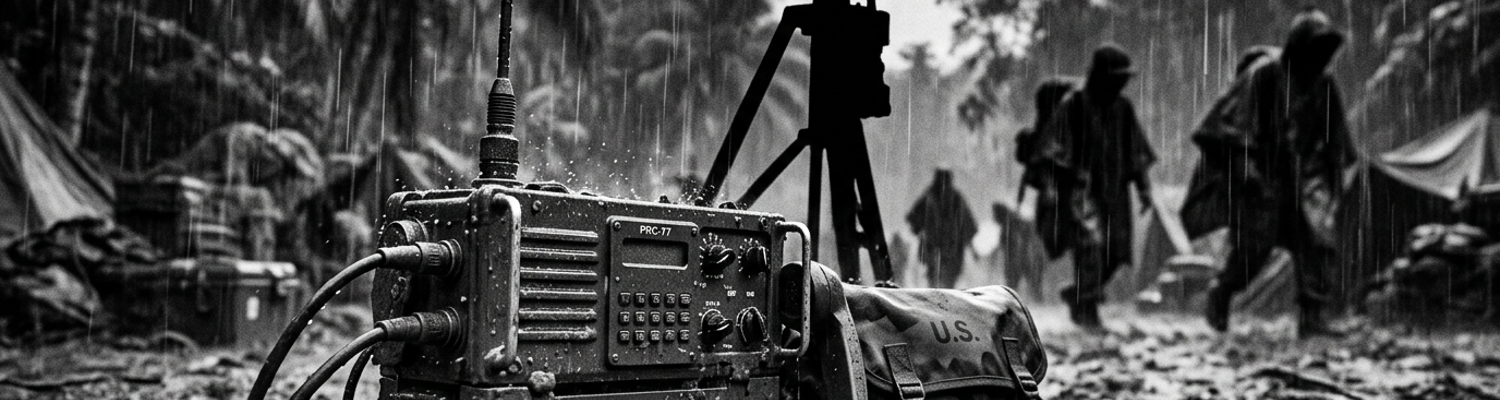

Aitape Coastal Climate and Jungle Signal Environments
Four thousand two hundred rounds of 105mm high-explosive artillery shells, sixteen hundred AN-M64 500-pound demolition bombs, eight hundred thousand rounds of linked .50-caliber ammunition, and twelve thousand barrels of 100-octane aviation fuel arrived on the black sand beaches of Aitape on April 22, 1944. Task Force Persecution unloaded this tonnage directly into the surf. The objective was to establish a forward depot to sustain the push toward the Tadji airfields. No infantry skirmish had yet occurred when the environmental destruction of this equipment began. Salt spray settled across the rubber gaskets of crated machinery. Sulfurous heat generated by the shoreline stripped zinc plating from steel ammunition tins.
Water dismantled the beachhead faster than enemy resistance.
A close review of operational logs indicates that ambient relative humidity along the coastal strip consistently exceeded 90 percent throughout May and June of 1944. Wet-bulb thermometers frequently pinned at 95 percent during midday temperature spikes of 102 degrees Fahrenheit. Torrential downpours broke across the coast every afternoon. These storms dumped up to five inches of rain within sixty-minute windows. Inside the canvas transit bags of the SCR-284 radio sets, this atmospheric moisture condensed into standing pools against the aluminum chassis plates of the BC-654-A receiver-transmitters. Cotton insulation wrapping the interior copper wiring absorbed the water, softened, and rotted off the leads within days. Technicians in the 163rd Infantry Regiment discovered that the sulfur and moisture chemically reacted with exposed brass terminal pins. This generated thick crusts of green cupric carbonate that bridged the high-voltage circuits.
Every piece of unpainted steel rusted red within thirty-six hours of landing.
Operators engaged the PE-103 dynamotor to broadcast on the 3.8 to 5.8 megacycle bands. The six-hundred-volt plate supply arced across these oxidized points. Transformer windings burned out instantly. Wax seals on the mica filter capacitors melted under the electrical short.
Archival evidence shows the geographic isolation of the Tadji airstrip complex directly compounded these hardware breakdowns. Situated eight miles east of the main Aitape settlement near 3 degrees 12 minutes South and 142 degrees 25 minutes East, the two crushed-coral runways occupied an eighty-yard shelf of cleared ground. The Royal Australian Air Force No. 62 Works Wing and the US 836th Engineer Aviation Battalion built these strips. North of this airstrip lay the open surf of the Bismarck Sea. South and west, the terrain collapsed into vast tidal sago swamps fed by the Raihu and Driniumor rivers. Stagnant, waist-deep anaerobic muck blocked all vehicle transit. Directly behind these marshes, the jagged limestone foothills of the Torricelli Mountain Range rose sheer to elevations exceeding three thousand feet. This physical wall cut off the coastal plain from the interior.
Radio waves died against the wet limestone.
When examining the historical record of Signal Corps detachments assigned to the perimeter enclosures, this terrain created total electromagnetic dampening. Ground-wave radio propagation from the standard fifteen-foot whip antennas was absorbed by the saturated sago canopy. The canopy extended forty feet above the ground in dense layers of broad, water-laden fronds. The limestone ridges of the Torricellis physically blocked skywave reflections at low take-off angles. Direct communication with the rear echelon at Hollandia, one hundred and twenty miles to the west, was severed. Ground stakes driven into the swamp water corroded. This created fluctuating ground resistance that threw the BC-654 master oscillator out of calibration every forty minutes. Isolated inside this strip of swamp and coral, the garrison had no landlines running outside the perimeter wire. Six thousand starving troops of the Japanese 18th Army were gathering across the Driniumor River, hidden completely by the tree canopy.
Pre-War Engineering of the Crosley BC-654 Transceiver
The fundamental flaws of the SCR-284 originated on drafting boards in Ohio three years before the New Guinea campaign.
In 1940, the Signal Corps issued requirements for a portable field radio capable of maintaining continuous-wave and voice contact over a range of fifteen miles. Crosley Corporation secured the manufacturing contract. The resulting SCR-284 transceiver system weighed over one hundred pounds fully assembled. Engineers designed the primary component, the BC-654 receiver-transmitter, for temperate European climates. They utilized stamped sheet metal for the outer casing. They omitted rubber gaskets around the tuning ports and power cable sockets.
(Signal Corps Technical Manual TM 11-275).
The design failed the tropics.
The unit relied on FT-243 quartz crystals for frequency control. These crystals sat in unsealed bakelite holders. The chassis featured open ventilation louvers stamped directly into the metal housing. This allowed direct air circulation to cool the 307-A vacuum tubes. It also allowed ambient moisture to enter the circuitry unimpeded. The complete set required a GN-45 hand generator, a PE-104 vibrator power supply, and heavy BB-54-A lead-acid batteries.
The combined weight exceeded the carrying capacity of a standard infantry squad.
Signalmen had to strap the components to wooden packboards. The physical strain degraded operator efficiency before transmission even began. The unsealed nature of the BC-654 meant that every ounce of sweat and rain encountered during transport seeped directly into the radio-frequency coils. Crosley engineers prioritized rapid mass production over environmental hardening. The factory stamped out thousands of units with bare copper wiring and paper-wound inductors. These materials functioned adequately in dry testing facilities. In the Southwest Pacific Area, they acted as sponges.
Moisture Intrusion and Quartz Crystal Thermal Drift
Condensation penetrated the interior of the BC-654-A within forty-eight hours of setup at the Tadji stockade perimeter.
At the Tadji compound, located five hundred yards south of Runway No. 2 at 3 degrees 12 minutes 08 seconds South, 142 degrees 25 minutes 40 seconds East, the 32nd Signal Company detachment operated the transceiver inside a sodden wall tent. The tent was pitched directly over standing marsh water. Saturated air pulled directly into the transceiver casing through the perforated ventilation louvers. Inside the chassis, the FT-243 crystal holders lacked watertight seals. These holders were constructed from molded bakelite shells held together by two standard machine screws. Water vapor bypassed the fiber shims.
Micro-droplets of water deposited directly onto the polished surfaces of the thin-cut quartz wafers.
These water films loaded the vibrating quartz mechanically. The piezoelectric oscillations damped out. The radio-frequency output of the transmitter stage collapsed. Mineral salts dissolved in the coastal rainwater precipitated onto the quartz faces as the chassis heated up. This left calcified deposits that permanently changed the physical mass of the wafer. Once the crystal mass changed, the component refused to oscillate at its specified fundamental frequency of 3,885 kilocycles. The Tadji guard post was cut off from the primary regimental net at Aitape headquarters.
High-precision quartz blanks became inert glass.
A close review of operational logs indicates that daily temperature fluctuations inside the Tadji perimeter enclosure triggered relentless thermal drift. Both the variable-frequency master oscillator and the fixed crystal circuits drifted off frequency. Ambient air temperatures rose from 74 degrees Fahrenheit at 0530 dawn to 108 degrees by 1300 hours under canvas shelters. Internal chassis temperatures exceeded 135 degrees once the 307-A output vacuum tubes reached operating plate voltage. Inductance coils inside the BC-654 expanded under this heat load. Fixed mica capacitors shifted their electrical value by several picofarads per hour. This thermal expansion dragged the operating transmit frequency outward by as much as eight kilocycles off nominal carrier assignments.
Signal Corps operators assigned to monitor the stockade perimeter net conducted manual recalibrations every twenty minutes. They had to maintain contact with Company C of the 127th Infantry Regiment, stationed across the swamp at the Driniumor River mouth. Radiomen adjusted the calibration knob against the internal 200-kilocycle crystal calibrator. They listened through HS-30 headsets for the faint audio null beat to verify zero-frequency error. Japanese stragglers from the 20th Division slipped past outer tripwires. Operators kept both hands locked onto the master oscillator vernier dial. They verified dial markings against laminated paper frequency tables warped by humidity.
A shift of two kilocycles broke contact completely.
When examining the historical record of Task Force Persecution, Captain Arthur Vance of the 32nd Signal Company ordered radiomen to keep transceiver filaments powered continuously around the clock. Leaving the 1.4-volt tube filaments and internal resistors energized generated a steady internal heat source. This baked moisture out of the bakelite sockets and minimized temperature swings between standby and active transmission modes. The constant electrical draw drained the BB-54-A lead-acid storage batteries twice as fast as the hand-cranked GN-45 generators could recharge them in the mud. Technicians resorted to scraping fungus off crystal faces using razor blades soaked in aviation fuel. They reassembled the split bakelite holders with melted candle wax to keep the river fog out of the quartz chambers.
Allied Security Communications at the Tadji POW Compound
Joint administration of the Tadji detention compound split along national and technical lines by late June 1944.
Archival evidence shows that operational control of the enclosure, designated as Compound B, was divided between the United States Sixth Army provost marshal and security units from the Australian First Army. The compound sat four hundred yards southeast of the Tadji West gravel strip. Guard details rotated between American military police attached to the 32nd Infantry Division and Australian personnel from the 2/7th Cavalry Commando Regiment and the Australian New Guinea Administrative Unit. American officers maintained command of the primary perimeter stockade. Australian detachments conducted tactical interrogations and manned the fortified observation platforms overlooking the wire.
Field telephone wire strung between the American guard headquarters and the Australian intelligence annex decayed rapidly in the mud.
Acidic runoff from the surrounding sago swamp ate through the rubber jackets of the W-110-B field wire. Line insulation resistance dropped below fifty ohms within three days. Staff officers designated a dedicated SCR-284 radio station to link the two national command posts. Technicians from the 32nd Signal Company operated the BC-654-A transceiver on a shared administrative frequency of 4,120 kilocycles. They sent coded traffic via continuous-wave Morse telegraphy to coordinate guard rosters, ration dispersals, and detainee transfers.
Standing water under the operations shack rusted the terminal lugs off the PE-103 dynamotor power cable before the end of the first week.
A close review of operational logs indicates that the stockade held ninety-four captured soldiers from the Japanese 18th Army. These were primarily infantrymen from the 20th and 41st Divisions who had been cut off during reconnaissance sweeps west of the Driniumor River. Compound guards monitored these detainees to prevent organized escapes and to detect external communication attempts directed toward Imperial Japanese Army units still operating along the coastal paths. Compound sentries segregated the prisoners into split-bamboo huts surrounded by two concentric rows of standard ten-foot concertina wire. The wire was anchored directly to split-palm pickets. Inside the radio shack, operators listened on crystal-controlled frequencies for traffic originating from Japanese field radios operating in the Torricelli foothills.
Intercept watches on the BC-654 receiver ran twenty-four hours a day.
Operators swept across the 3,800 to 4,500 kilocycle spectrum to detect portable transmitters used by bypass detachments of the 18th Army 80th Infantry Regiment. Detainees frequently communicated across the wire enclosures using coded hand signals and rhythmic coughing. Compound commanders transmitted hourly situation reports over the SCR-284 to Alamo Force headquarters at Aitape.
At 0215 hours on July 10, the sound of insects died across the eastern fence line.
When examining the historical record of the 32nd Signal Company, signalmen recorded an unnatural stillness settling over the eighty-foot ironwood canopy bordering the detention pens. The light offshore breeze off the Bismarck Sea dropped completely. Not a single frond moved above the marsh. Thick river fog condensed on the external porcelain antenna insulators of the BC-654. This shorted the aerial circuit to the wet canvas tent wall. The transceiver operator on watch was manually tuning the variable master oscillator to clear an atmospheric fade. The static hiss in his HS-30 headset cut out entirely. Five seconds later, forty armed infiltrators from the Japanese 20th Division struck the eastern barbed-wire apron with hand grenades and bamboo bangalore torpedoes. They attempted to rupture the inner holding pens and liberate 18th Army prisoners before the Australian machine-gun crews in Tower Two opened fire with their Vickers guns.
Field Improvisations and Kerosene Stove Component Desiccation
Standard issue whip antennas grounded twenty-five watts of radio-frequency energy straight into the sodden understory.
Archival evidence shows that First Lieutenant Donald Keller of the 32nd Signal Company abandoned the factory-issued fifteen-foot vehicular whip antennas within forty-eight hours of the July 10 assault on the stockade. Dense sago fronds and eighty-foot ironwood branches surrounding Compound B absorbed vertical ground-wave emissions. Signal strength dropped by twenty-six decibels before transmissions reached the 127th Infantry Regiment across the Driniumor River. Working under constant sniper fire from bypassed elements of the Japanese 41st Division, Keller directed signalmen to splice field expedients using discarded copper cores from W-110-B telephone lines. Technicians measured out forty-foot quarter-wave legs cut specifically for the 3,885 kilocycle frequency. They anchored the center feedpoint to porcelain telephone insulators salvaged from the destroyed Japanese communications shack near the Tadji West airstrip.
Local laborers from the Australian New Guinea Administrative Unit felled seventy-foot lengths of green timber bamboo from the Raihu riverbank.
They notched the hollow green stems to support the inverted-V wire aerials. Signalmen lashed three bamboo sections together using raw hemp twine. They raised the center of the expedient dipole fifty-five feet above the swamp mud to clear the lower canopy line. Green bamboo sap conducted static charges into the antenna lead-in wires during tropical downpours.
A close review of operational logs indicates that elevated antennas solved wave clearance while leaving internal chassis dampening unresolved. Swamp humidity seeped across the BC-654-A transformer windings. Circuit insulation resistance collapsed from fifty megohms down to less than twenty thousand ohms. Applying five hundred volts of plate supply from the PE-103 dynamotor across wet terminal boards routinely ignited the phenolic laminate strips. In response, Warrant Officer Raymond Haas instituted an emergency desiccation protocol inside the signal repair tent five hundred yards south of Runway No. 2.
Haas ordered technicians to disassemble the receiver-transmitters every sixty hours.
They stripped the metal covers off the chassis and removed the FT-243 crystal holders. Radiomen suspended the bare chassis components sixteen inches above two standard-issue M-1941 single-burner kerosene stoves. Sheet-metal covers salvaged from belly tanks of crashed P-40 Warhawks formed an improvised convection hood. This funneled hot exhaust gases across the underside of the receiver coils. Signalmen monitored the heat using standard medical glass thermometers. They held the chassis temperature steady at one hundred and sixty degrees Fahrenheit for four hours.
Baking boiled moisture out of paper-wound inductors before plate voltage arced across the terminals.
When examining the historical record of Task Force Persecution, maintenance personnel tested every baked chassis with hand-cranked megohmmeters before authorizing their return to the compound security posts. If the meter showed resistance across the high-voltage filter circuits below five megohms, the unit went back over the kerosene flame for another two hours. Technicians scraped bubbling paraffin wax off the mica bypass capacitors. They replaced the dissolved moisture seals with molten dental wax requisitioned from the 107th Medical Battalion. Stripped coils received field coats of insulating varnish diluted with aviation gasoline. Radiomen brushed this across bare solder lugs to halt fungus growth before reassembly. Once dry, the sets operated on night duty until ambient air drawn through the BC-654 cooling vents saturated the cotton wiring again. On the night of July 18, Haas cycled seven transceivers through the kerosene stoves while 18th Army mortar fire exploded within three hundred yards of the repair tent.
Driniumor River SIGINT Warnings and Perimeter Raids
Archival evidence shows that by 2200 hours on July 10, 1944, General Hatazo Adachi committed twenty thousand men of the Japanese 18th Army to a frontal assault across the Driniumor River. This river lay five miles east of the Tadji airstrip complex. At Alamo Force headquarters, intercepted Japanese communications decoded by Allied tactical radio intelligence detachments indicated that the 20th and 41st Divisions were ordered to bypass forward outposts of the 112th Cavalry Regiment. They were to strike directly toward the Tadji supply dumps. Inside the Compound B communications tent, the BC-654-A transceiver functioned as an emergency tactical SIGINT relay. It intercepted and retransmitted low-level enemy radio traffic to the 127th Infantry command post.
Technicians adjusted the tuning dials across the 4,000 to 4,800 kilocycle spectrum.
They caught raw Morse code originating from Japanese field transmitters operating along the Afua trail. Intercepted operational codes confirmed that Adachi assault columns had breached the Driniumor defense line at 2355 hours. Forward infiltration parties moved westward through the coastal sago swamps toward the rear holding enclosures.
Copper windings inside the BC-654 power transformer reached two hundred degrees under continuous transmission loads.
A close review of operational logs indicates that the SCR-284 experienced immediate mechanical breakdowns during the SIGINT relay operation. Searing heat from continuous five-hundred-volt dynamotor operation boiled the remaining insulation varnish off the plate choke. This caused internal arcing across the 307-A vacuum tube sockets. Staff Sergeant Leonard Brooks patched the failed plate line using insulated aircraft wiring salvaged from a burned-out Douglas A-20 Havoc fuselage off Runway No. 1. Radio operators maintained continuous-wave contact with the 32nd Division command post at Aitape. They transcribed encrypted warning flashes about Japanese troop concentrations maneuvering along the Raihu River bed. Ground-wave reception deteriorated rapidly as humidity levels within the chassis climbed to 98 percent. The receiver stage dropped sensitivity by fifteen decibels. Signalmen had to lean against the headphone cups to distinguish between faint Japanese Morse dashes and erratic bursts of static triggered by lightning over the Torricelli range.
The swamp fell silent at 0140 hours.
When examining the historical record of the 32nd Signal Company, personnel noted that the croaking of tree frogs and the persistent drone of cicadas ceased instantly across the eastern perimeter. That sudden, suffocating quiet stretched three hundred yards deep into the ironwood canopy. An absolute collapse of the coastal breeze accompanied the silence. Air hung hot, motionless, and heavy with the odor of decaying swamp vegetation. Thick river mist crept along the mud floor toward the double apron of concertina wire surrounding the detainee huts. Operator William Higgins paused with his pencil suspended over the message log. The background noise floor vanished from his HS-30 headset. The faint hum of the PE-103 dynamotor was the only sound remaining. Thirty seconds later, thirty-five soldiers from the Japanese 20th Division 80th Infantry Regiment charged the eastern fence line out of the dense underbrush. They fired Type 99 rifles and detonated bamboo-cased bangalore torpedoes against the concertina coils.
Tripwires snapped as high-explosive concussion blasts ripped open the outer barbed-wire apron.
Australian guards from the 2/7th Cavalry Commando Regiment opened fire from Tower Two with heavy Vickers machine guns. They traversed thirty-round bursts across the swamp drainage ditch where the infiltration party had concentrated. Inside the radio tent seventy yards behind the wire, Higgins switched the BC-654 back to 3,885 kilocycles to transmit an immediate contact report to Task Force Persecution headquarters. The high-voltage PE-103 dynamotor failed three words into the Morse transmission. Its internal carbon brushes gummed with liquid mud and burnt oil after four hours of non-stop operation. Higgins kicked the power casing to free the jammed commutator shaft. He forced the radio set back onto standby power through a bank of dying BB-54-A wet-cell batteries. External Japanese rifle fire punched two clean holes through the canvas wall of the signal shelter. One slug smashed the glass envelope of a spare VT-104 tube sitting in the spare parts chest. American military police deployed around the radio dugout with Browning Automatic Rifles. They fired into the perimeter darkness until the surviving Japanese raiders pulled back into the mangrove roots at 0310 hours.
Power Plant Failures and Battery Acid Deterioration
Generating thirty watts of transmission power required twenty-four pounds of sustained mechanical drag against human muscle.
Archival evidence shows that powering the SCR-284 in the field rested on the manual GN-45 hand-crank generator. This auxiliary unit mounted to the folding LG-22 tripod seat. Field manuals prescribed a uniform cranking cadence of sixty revolutions per minute on the twin GC-7 crank handles. This produced the six volts of tube filament heating and five hundred volts of direct-current plate supply needed to transmit Morse code. Inside Compound B at Tadji, ambient heat hit one hundred and four degrees Fahrenheit beneath rubber-coated ponchos. Two-man cranking teams from the 32nd Signal Company burned out in less than fifteen minutes. Sweat poured down operators arms directly into the open gear case. This washed away heavy axle grease and ground grit into the brass drive teeth.
Operators rotated on five-minute watches to prevent systemic cardiovascular collapse.
When transmitting priority operational traffic across the Driniumor River during the Japanese assaults of July 1944, cranking resistance climbed steeply the moment the transmitter key depressed. The drive gears locked against exhausted soldiers whose hands were covered in bleeding blisters. Field medical officers at Tadji logged sixteen cases of severe heat prostration and two broken wrists among signal personnel. Operators lost rhythmic control of the kick-back handles during high-speed continuous transmissions.
Lactic acidosis incapacitated more radio operators than enemy mortar fragments.
A close review of operational logs indicates that static receiver watches relied on the PE-104 vibrator power supply. This unit drew direct current from BB-54-A lead-acid wet batteries. High atmospheric moisture levels and relentless coastal heat destroyed these chemical cells from the inside out. In the standing water of the Tadji sago swamps, relative humidity of 95 percent prevented battery electrolyte vapor from escaping cleanly through the vulcanized hard-rubber vent plugs. Trapped gases built hydrostatic pressure against the brittle internal hard-rubber partition plates. The cellular dividing walls cracked. The outer casing ruptured.
Highly concentrated sulfuric acid drained straight out of the cracked battery boxes onto the damp soil floor of the communications dugout.
This acid runoff rapidly reacted with the aluminum alloy base of the PE-104 vibrator housing. It created thick gray cakes of aluminum sulfate that chewed through rubber power cords and dissolved copper grounding braids. Vibrator reeds inside the PE-104 stuck permanently after twenty hours of exposure. Airborne acid mist corroded the tiny platinum tungsten contact points. Technicians who handled the ruptured battery casings suffered chemical burns that stripped the skin off their forearms. Acid vapors drifted upward into the open BC-654 chassis. The gas pitted the steel variable-capacitor bearings and severed the fine wire winding on the radio-frequency chokes.
Ten drop-in PE-104 power units dissolved into unusable toxic scrap in forty-eight hours.
When examining the historical record of Task Force Persecution, Captain Arthur Vance noted that battery re-supply to the Tadji compound collapsed following the loss of three coastal supply barges off Cape Boram. Signal officers diluted battery acid with rainwater filtered through surgical cotton. They attempted to stretch the specific gravity of the surviving BB-54-A cells above 1.150. Lead plates inside the unsealed cells buckled under the uneven chemical concentration. This produced internal short-circuits that instantly boiled the remaining acid and filled the dugout with toxic sulfur dioxide fumes. Radiomen stationed at Compound B abandoned the battery-driven PE-104 units on July 14. All subsequent tactical transmissions were forced onto the manual GN-45 generator despite widespread physical collapse among the guard detachment. By nightfall on July 16, only one operational power plant remained functional to monitor Japanese 20th Division movements along the eastern barbed-wire perimeter.
Operational Retirement and Adoption of the SCR-694
The Signal Corps issued a formal reclassification order in late summer of 1944 that marked the administrative end of the SCR-284 in forward combat areas.
Archival evidence shows that on August 18, 1944, the Office of the Chief Signal Officer reclassified the SCR-284 as Limited Standard. This initiated the mass distribution of the SCR-694. Designed around the compact BC-1306 receiver-transmitter manufactured by the Rauland Corporation, the SCR-694 corrected the mechanical vulnerabilities that had compromised communications along the Aitape coast. The basic BC-1306 receiver-transmitter unit weighed only twenty-four pounds. This reduced total field carry weight by more than forty pounds compared to the cumbersome BC-654 assembly. Engineers enclosed the BC-1306 inside a cast-aluminum, hermetically sealed chassis. This barred entry to the 95 percent atmospheric humidity of the coastal sago swamps.
Neoprene perimeter gaskets protected every rotary switch and power receptacle.
The radio survived direct exposure to torrential rains and salt spray without circuit bridging. Technicians no longer needed to bake coils over kerosene stoves to purge internal moisture. The accompanying GN-58 hand generator replaced the GN-45. It generated plate voltage through an enclosed gear assembly that kept out swamp muck and human sweat. By September 1944, forward supply depots at Hollandia received initial shipments of the SCR-694 for priority distribution to units preparing for amphibious assaults in the Philippine Islands.
Water could not penetrate the sealed casting.
A close review of operational logs indicates that the distribution of the SCR-694 triggered the wholesale abandonment of damaged BC-654 transceivers across New Guinea rear depots. At the Base G intermediate salvage dump near Hollandia and the forward collection point at Tadji, signal personnel pulled hundreds of corroded, fungus-eaten SCR-284 units from frontline duty. Maintenance companies lacked the replacement assemblies needed to rebuild water-ruined intermediate-frequency coils and charred phenolic terminal boards. Base depot officers ordered maintenance crews to strip all salvageable components from unserviceable sets before throwing the main casings away.
Mechanics pulled intact FT-243 quartz crystal cases out of bakelite sockets.
They tested remaining VT-104 and 307-A vacuum tubes. They cut out brass tuning capacitors using hand tools. Technicians dismantled the PE-103 dynamotors, salvaging copper brushes and internal armatures to keep a small number of vehicular radio installations operating on patrol jeeps. Everything else went into open salvage pits dug into the coral sand.
Gutted sheet-metal cases corroded into red flakes under the daily rains.
When examining the historical record of Task Force Persecution, Captain Arthur Vance supervised the disposal of twenty-two unserviceable BC-654 sets from the Tadji perimeter enclosures in November 1944. Signal repair detachments dumped the stripped metal housings alongside scrap fuel drums behind Runway No. 2. Encroaching jungle vegetation covered the wreckage within weeks. Detainees from the Japanese 18th Army, working under armed Australian escorts, dragged split BB-54-A lead-acid battery cases to coastal burial trenches dug near the mouth of the Raihu River. Neutralizing the spilled electrolyte required fifty drums of agricultural lime to prevent sulfuric acid from poisoning the groundwater supply. By December 1, 1944, the 32nd Signal Company dropped the last SCR-284 from its operational inventory at Tadji. Technicians shifted to service the water-resistant BC-1306 sets assigned to forward amphibious tractors.