
Field Manuals promised a predictable enemy. They promised clear lines of engagement and discernible objectives. The operational environment of 1981 delivered a suffocating global jungle, both literal and figurative, where the primary adversary was ambiguity. The line between ally and enemy was a constantly shifting calculation written in dozens of languages and paid for with Soviet rubles. This strategic backdrop demanded a profound evolution in intelligence gathering, moving beyond static, continental-scale threats into the granular, chaotic world of proxy warfare. The core of this demand was a recognition that the Cold War would not be won by counting tanks in East Germany alone. Victory required tracking small arms shipments into Central American villages and deciphering the political allegiances of rebel factions in distant mountains.
Declassified assessments from the period, specifically National Intelligence Estimate 11-14-81, provide the analytical foundation for this operational shift. The document was not a simple ledger of Soviet military hardware. Its deeper strategic value was in its assessment of the Warsaw Pact as a mechanism for projecting global power far beyond Europe. The estimate articulated how the Soviet Union leveraged its satellite states to assure domination, maintain numerical superiority against NATO, and simultaneously project force to deter American assets in the Far East. The analysis delved into Soviet doctrine for the potential use of chemical weapons and the conditions for preempting a NATO nuclear response. This created an urgent requirement for intelligence that could discern Soviet intentions from the subtler, widespread evidence of its global activities. A coup in a developing nation, fueled by Soviet advisors and weapons, was as much a part of the strategic contest as a tank division poised on the Fulda Gap.
This high-level assessment drove a frantic effort to analyze and counter global proxy activities. Intelligence analysts in Washington D.C. were tasked with building a coherent picture from a blizzard of fragmented, often contradictory, information. They had to track the flow of Soviet-bloc weaponry, from AK-74 rifles and RPG-7 launchers to T-55 tanks and Mi-24 Hind helicopters, disappearing into the arsenals of dozens of insurgent groups. This involved monitoring the complex web of Soviet active measures, which included disinformation campaigns, the use of front groups, and political influence operations. Analysts had to differentiate between authentically indigenous uprisings and those instigated and sustained by Moscow. The intelligence picture from theaters like Angola, Ethiopia, Nicaragua, and Cambodia was a mosaic of questionable human source reports, ambiguous signals intercepts, and the occasional revealing satellite photograph. The sheer scale and dispersion of these proxy conflicts stretched analytical resources to their breaking point.
The view from space was a lie. While the KH-11 KENNEN satellites, first launched in 1976, provided unprecedented real-time electro-optical imaging, their utility diminished sharply when pointed at the triple-canopy jungles that served as the battlegrounds for many proxy wars. A KH-11, with a primary mirror estimated at over two meters and a theoretical ground resolution as fine as 15 centimeters, could identify a truck on a road with stunning clarity. It could transmit this digital image via a Satellite Data System (SDS) relay to a ground station in moments. But the satellite could not see beneath the dense foliage where troops and supplies moved. It could not determine the allegiance of the truck’s driver or the nature of its cargo. Archival evidence shows these limitations created a severe intelligence gap. The strategic imperative defined by NIE 11-14-81 could not be met from orbit; it required boots on the ground, operating deep within hostile territory, to provide the ground-truth intelligence that satellites were physically incapable of acquiring.
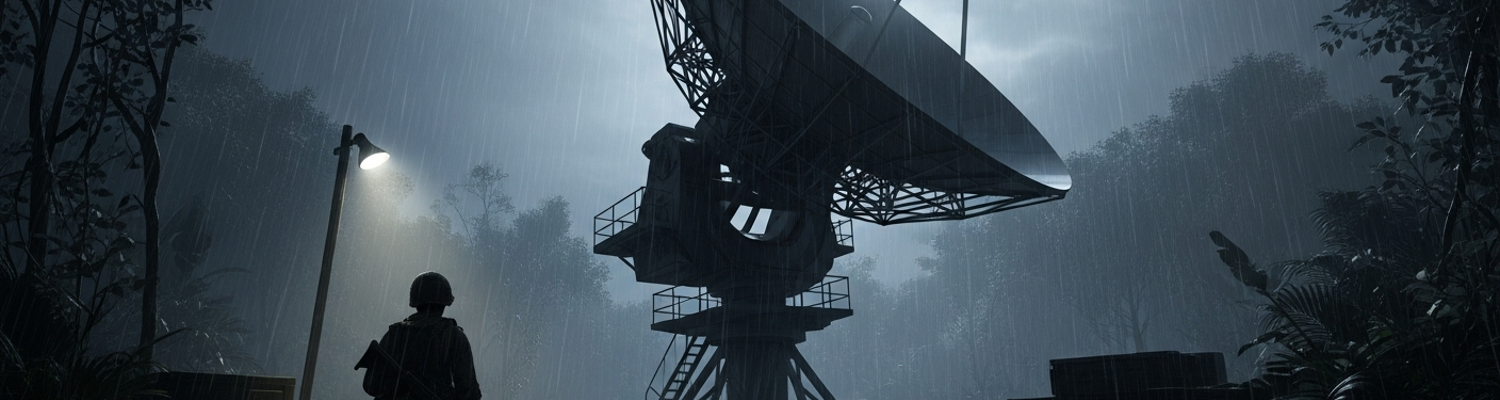
Operational logs from Army units like the 513th Military Intelligence Brigade indicate the extreme difficulty of establishing covert satellite nodes in tropical environments during 1981. Site selection was a complex calculus of competing technical and tactical requirements. The primary technical need was an unobstructed line-of-sight to the geosynchronous Defense Satellite Communications System (DSCS) satellites orbiting 22,500 miles above the equator. This demanded high ground. Such prominent locations were also the most exposed, both to visual observation and to enemy signals intelligence seeking the radio frequency signature of an active uplink. Planners therefore sought locations in natural depressions or valleys that could contain RF emissions. The lateritic soils common to jungles provided poor stability for the foundations of heavy SHF terminals like the AN/TSC-85B, which required unwavering alignment to maintain connection. The site also needed dense, triple-canopy jungle for concealment, yet this very foliage had to be selectively cleared for the antenna’s field of view, a process that could easily betray the position.
The jungle itself was the most effective counter-intelligence agent.
Security protocols for inserting a signal team and its equipment were layered and severe. A typical deployment involved a signals intelligence support team attached to a U.S. Army Special Forces ODA. Insertion was always clandestine, conducted under the cover of darkness, often via high-altitude, low-opening (HALO) parachute jumps or long-range patrols. Every piece of equipment, from the CAR-15 carbines to the individual components of the satellite terminal, was sterilized, with all U.S. military markings removed. Noise and light discipline was absolute. No open fires were permitted. All communication was conducted via hand signals or whispers. Once on site, the team established a three-ring security perimeter: a small, tightly controlled area for the technicians, an inner perimeter patrolled by the main security force, and a series of covert, far-flung observation posts for early warning.
Initial deployment challenges stemmed from the collision of 1980s-era electronics with the tropical environment. The ninety-five percent humidity common in regions like Honduras, where the U.S. conducted numerous exercises like Falcon's Eye in 1981, was catastrophic for the sensitive circuit boards and power amplifiers of the AN/TSC-85 system. After-action reports frequently cite failures due to corrosion and fungal growth that bloomed across connectors. Powering the energy-hungry terminals was a persistent nightmare. The portable generators required were loud, their acoustic signature capable of traveling for miles. Teams were forced to dig deep pits to baffle the sound, but these pits would invariably flood during torrential downpours, shorting out the generators and halting all transmissions. Army signal teams from units like the 67th Signal Battalion, reactivated in October 1981, discovered that the jungle’s fauna was as hostile as its climate. There are documented cases of fire ants and termites chewing through the insulation of coaxial cables, rendering the multi-million dollar satellite terminals useless until a technician could crawl through mud and insects to find and repair the break.
Records from units like the 11th Signal Brigade, which supported operations in Honduras, reveal that the transportation of specialized satellite equipment into the jungle was a point of near-catastrophic failure. The workhorse AN/TSC-85B tactical satellite terminal was a modular system, with its heaviest components weighing thousands of pounds. These components were designed for mobility in a European theater, movable by truck or heavy-lift helicopter. In the triple-canopy jungles of Central America, there were no roads. Insertion required CH-47 Chinook helicopters operating at the edge of their lift capacity, lowering equipment via sling loads into tiny, hand-cleared landing zones. The violent rotor wash, combined with the instability of a sling load, often resulted in equipment being damaged upon arrival. Archival evidence shows that shock-absorbing transit cases frequently failed, transferring the full force of a hard landing directly to the delicate microwave components and solid-state amplifiers within.
Every gram had to be carried.
The problem of building stable foundations was an engineering nightmare. The primary technical requirement for an AN/TSC-85B terminal was an absolutely unwavering platform; its 8-foot parabolic dish had to maintain a precise lock on a DSCS satellite. A shift of a fraction of a degree would sever the link. The very ground the teams stood on was a semi-liquid enemy. The common soil type, laterite, is rich in iron and aluminum and becomes exceptionally soft when saturated. Standard engineering solutions were impossible. Teams from the 67th Signal Battalion found that digging foundations was often an exercise in futility. The pits would immediately fill with water. Technicians reported having to constantly re-level and re-align their antennas, a process that could take hours and required breaking the communications blackout each time. After-action reports detail desperate, ad-hoc solutions, such as attempting to build timber-cribbing platforms from felled trees, only to have them rot and collapse within weeks.
This led directly to a crippling resource scarcity. The ideal material for a stable antenna pad was reinforced concrete, a resource as unobtainable in the deep jungle as a paved road. The logistical chain to bring in even a small amount was prohibitive; it would require dozens of helicopter sorties, each one a potential security breach. Command repeatedly denied requests for such high-signature operations. This forced teams to attempt to source materials locally, a direct violation of security protocols. The sound of a chainsaw to fell a hardwood tree could travel for miles. Procuring sand or gravel from a local village created an unacceptable counter-intelligence risk. Any local contact could be a potential informant. The final command decision was to forbid local procurement entirely, forcing the signal and engineering teams to make do with what they could carry on their backs. The result was predictably poor construction that often failed during the first torrential downpour, jeopardizing the mission and the lives of the team.
After-action reports from signals intelligence units in Central America during 1981 reveal a consistent, mission-degrading battle against the environment. The extreme humidity was a direct antagonist to the sensitive electronics of the era. Inside the shelter of an AN/TSC-85B terminal, the interplay of heat-generating vacuum tubes and early solid-state circuit boards created a constant cycle of condensation. Fungal growth was a primary culprit in equipment failure. This was not a slow decay; archival logs document how aggressive fungal strains could bloom across a high-voltage power supply in a matter of days. The fungus would etch into copper traces, creating micro-shorts, or grow over connectors, causing intermittent signal loss. This degradation was particularly catastrophic for radio frequency components, where minor changes in resistance or capacitance could detune the entire system.
The human element was under a separate, more personal siege from vector-borne diseases. Malaria, particularly the life-threatening Plasmodium falciparum strain, was a constant menace. While standard-issue anti-malarial prophylaxis like chloroquine was administered, its effectiveness was already being compromised by the emergence of drug-resistant parasite strains, a trend that concerned military medical planners. A single soldier incapacitated by the cyclical, high-grade fevers of a malaria attack was a severe liability for a small, isolated team. It compromised the unit’s security and diverted manpower from the primary mission to patient care. Operational logs detail the psychological strain this placed on teams, where every mosquito bite was a potential countdown to mission failure.
Beyond microscopic threats, teams waged a physical war against the jungle's vitality and chemical corrosion. The same moisture that shorted out circuit boards also attacked every piece of metal. The combination of high humidity and ambient heat created a perfect electrolyte bath, accelerating electrochemical corrosion on any exposed metal surface. Steel fasteners on aluminum antenna frames would create galvanic cells, rapidly corroding the surrounding metal. Personal weapons like the CAR-15 required obsessive levels of cleaning; reports describe a light film of rust appearing on barrels and receivers overnight if not kept meticulously oiled. This constant fight against decay extended to the site itself. Paths cleared for antenna line-of-sight would be reclaimed by jungle overgrowth with visible speed, requiring hours of manual labor with machetes each day just to maintain the status quo. This physically draining, repetitive work added significantly to troop fatigue, grinding down morale in a slow, attritional process.
Operational logs from 1981 reveal the profound logistical fragility of isolated intelligence and special operations detachments. The lifeline of these small units depended entirely on resupply. In a theater like Honduras, where U.S. forces conducted extensive operations, ground resupply was often a non-starter. The few existing roads were primitive tracks, impassable during the long rainy seasons and easily interdicted. This placed a premium on air mobility, primarily through C-130 Hercules aircraft for high-altitude drops or CH-47 Chinook helicopters for low-level delivery.
Container Delivery System (CDS) bundles, while effective for delivering essentials, were notoriously imprecise. In triple-canopy jungle, a drop zone was a fleeting concept; bundles could become entangled high in the trees or scatter across impenetrable terrain, forcing the ground team to conduct risky and exhausting recovery operations. A misplaced pallet of supplies could dictate the success or failure of a mission. Helicopter insertion offered more precision but at a much higher risk. A helicopter hovering over a landing zone presented a loud, stationary target. The decision to call for a helicopter was a calculated risk, weighed against the desperation of the unit’s supply situation. This tension between the need for supplies and the risk of exposing their position placed immense pressure on detachment commanders.
The communications infrastructure connecting these forward-deployed teams to their command elements was tenuous. While 1981 saw the deployment of tactical satellite (TACSAT) terminals like the AN/TSC-85B, these systems were bulky and power-hungry, requiring a large antenna and a clear line-of-sight to a satellite. More common for small teams were High Frequency (HF) radios like the AN/PRC-74, which relied on bouncing signals off the ionosphere. Jungle environments severely hampered HF communications; dense, wet foliage absorbed radio waves. A review of logs from the 11th Signal Brigade, which maintained a company in Honduras to support Joint Task Force Bravo, shows a constant struggle to maintain connectivity. Sending a simple burst transmission could be an hours-long ordeal of finding the right location, erecting a suitable antenna, and waiting for a window of clear propagation, all while maintaining absolute silence and light discipline.
Perhaps the most attritional struggle was the fight to maintain operational readiness against constant equipment decay and a scarcity of spare parts. The high-humidity, high-temperature environment was an aggressive adversary. Reports from signal and intelligence units are replete with accounts of corrosion on circuit boards, fungus on optical lenses, and insects chewing through cables. For sophisticated electronics, the jungle was a uniquely destructive environment. The problem was compounded by a logistical system not configured for supplying specialized components to deep-field units. A single failed power amplifier in an AN/TSC-85B terminal could render the entire system useless. A request for a replacement part would have to be transmitted over the same unreliable comms channels, and its delivery would be subject to the same hazardous resupply process. Technicians became masters of improvisation, cannibalizing less essential equipment and attempting field-expedient repairs, but this only served to delay the inevitable entropy that threatened to isolate them completely.
Post-mission debriefings and medical officer logs from Central American operations during 1981 highlight a pervasive and corrosive psychological stressor: the absolute inability to distinguish friend from foe. In the contested territories of countries like Honduras, teams from U.S. Army Special Forces were immersed in a population that was ethnically and linguistically uniform. There were no clear front lines or uniforms. A local farmer tending his field by day could be a government informant, a sympathizer with Soviet-backed insurgents, or simply a farmer. This ambiguity was a weapon used against the American teams. Intelligence reports document how insurgent groups, supported by Cuban and Soviet intelligence officers, actively blended with local populations. A patrol could encounter a group of men on a jungle trail; their silence or their friendliness were equally meaningless and equally threatening. The decision to engage or let them pass was a gamble that weighed constantly on junior officers and NCOs.
The enemy was a ghost.
This constant uncertainty was magnified by a palpable fear of undetected enemy surveillance. The jungle, which provided concealment for the U.S. teams, offered the same advantage to their opponents. The faint hum of a generator buried in a sound-baffling pit or the brief, directional squawk of a burst transmission from an AN/PRC-74 radio could, in theory, be detected by sophisticated Soviet-supplied direction-finding equipment, such as the R-375M 'PIRAMIDA'. Declassified CIA reports from 1981 confirm the extensive presence of Cuban DGI and Soviet KGB advisors throughout the region, tasked with organizing local intelligence efforts. This created a deep-seated paranoia within the teams. Every rustle of leaves, every unfamiliar bird call, was interpreted as potential enemy reconnaissance. After-action reports detail instances of teams finding signs of recent, covert observation of their positions. The psychological effect was to transform the jungle from a neutral environment into an actively hostile entity.
The cumulative effect of this sustained, high-pressure environment was a steady erosion of the unit’s mental state. Constant vigilance is a physiological impossibility to maintain over weeks and months. Medical logs speak of a condition that maps closely to combat fatigue. Soldiers exhibited increased irritability, shortened tempers, and a marked decline in function, including memory and the ability to prioritize tasks. Sleep deprivation was rampant, exacerbated by the need for a 100% security posture. The very skills that kept a soldier alive, a heightened state of awareness and a readiness to react violently, also ground down his mental and emotional resilience, pushing teams closer to a breaking point that was as dangerous as any enemy patrol.
Operational summaries from 1981 indicate that the single greatest factor driving personnel to the breaking point was the relentless operational tempo combined with an absence of personnel rotation. For the small, specialized teams operating covert satellite uplinks, deployment was open-ended. Command decisions, driven by the strategic urgency, consistently prioritized mission continuity over the welfare of the operators. A detachment from a unit like the 11th Signal Brigade was considered irreplaceable. There was no 'next team up' waiting to be slotted in. This created a psychological state where there was no light at the end of the tunnel. The mission only ended with catastrophic equipment failure, political termination, or personal collapse.
This was not sustainable.
The symptoms of this sustained stress are documented in stark detail within post-deployment medical debriefings. Soldiers exhibited significant weight loss, persistent gastrointestinal problems, and uncontrollable tremors. The psychological decline was more alarming. A state of hypervigilance metastasized into crippling paranoia. Irritability and aggression became the baseline emotional state, leading to breakdowns in unit cohesion. Cognitive functions decayed. Operators reported memory lapses, an inability to concentrate on complex technical tasks, and a dangerous apathy. An after-action report from one signals team noted that a highly skilled technician, after three months in the field, began making basic procedural errors that jeopardized the security of their transmissions, a direct result of sheer mental exhaustion.
Compounding this breakdown was an almost complete lack of psychological support infrastructure. The concept of combat stress as a treatable injury, rather than a personal failing, was still in its infancy; the term Post-Traumatic Stress Disorder had only been formally recognized by the American Psychiatric Association in 1980. For an operator in a forward-deployed team, there were no mental health professionals to consult. The unit medic or the chaplain were the only outlets, and neither was equipped to handle the severe operational fatigue these soldiers were experiencing. The prevailing command culture viewed any admission of psychological strain as a sign of weakness. The official response for a soldier who had reached his breaking point was administrative removal from the field, a solution that carried deep personal and professional stigma. This absence of a safety net ensured that soldiers remained on mission until they were rendered completely ineffective, their psychological resilience eroded to nothing.