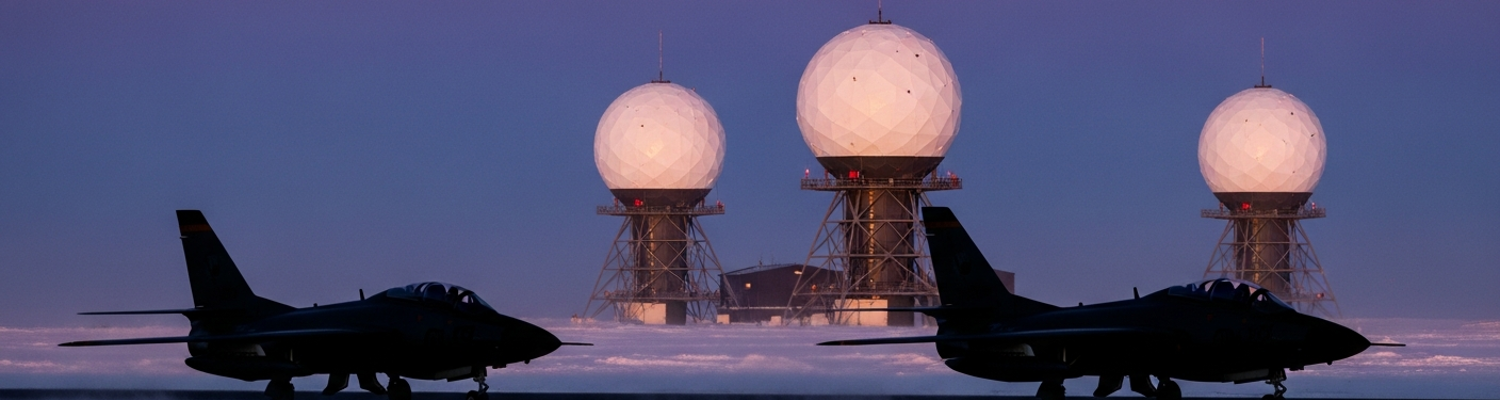

The Soviet Union’s successful atomic bomb test in August 1949 obliterated America’s nuclear monopoly and strategic complacency. This event, followed by the 1947 appearance of the Tupolev Tu-4, a precise Soviet reverse-engineered copy of the B-29 Superfortress, presented a direct and tangible threat to the continental United States. For the first time, a foreign power possessed the material capability to deliver a nuclear strike against American cities. In response, the U.S. Air Force’s Air Defense Command (ADC) initiated a massive, technologically ambitious effort to construct a continental shield. This defense was not built on static fortifications, but on a dynamic, integrated system of advanced interceptor aircraft, sprawling electronic sensor networks, and a revolutionary architecture for command and control.
The All-Weather Rocket Sleds
The immediate problem was the interceptor itself. World War II piston-engine fighters were wholly obsolete against the prospect of high-altitude jet bombers. The ADC required a new breed of aircraft, an all-weather, jet-powered interceptor capable of locating, closing with, and destroying a target in darkness or storm. The aircraft would be guided not by the pilot’s eye but by the electronic pulses of its own radar. This urgent requirement produced two foundational aircraft that defined the first generation of American air defense. The North American F-86D Sabre Dog was a radical departure from its daylight fighter sibling, the F-86 Sabre. Though sharing a basic airframe, the F-86D, initially designated the F-95A, was a different machine for a different war. Its most distinctive feature was the large radome in the nose that housed its Hughes E-4 fire control system. This radome displaced the air intake to a ventral position, giving the aircraft its signature bulldog-like appearance. The E-4 system represented a leap in automation for a single-seat fighter. It could compute a target’s position, guide the aircraft onto an intercept course, and automatically fire its weapons without the pilot manually aiming. This high degree of automation was necessary, as the pilot's workload was immense. Armament consisted solely of a retractable ventral tray holding twenty-four 'Mighty Mouse' 2.75-inch Folding-Fin Aerial Rockets (FFARs). The doctrine was simple and brutal. The pilot would execute a single, overwhelming pass, firing a salvo of unguided rockets with the collective explosive power of multiple artillery shells into a bomber formation.
While the F-86D was a modification of an existing design, the Northrop F-89 Scorpion was a purpose-built, all-weather interceptor from its inception. Its design was conservative but robust, featuring a straight wing for stability at high altitude and two Allison J35 turbojet engines. Unlike the single-seat F-86D, the F-89 carried a two-man crew. A pilot flew the aircraft while a dedicated radar operator in the rear cockpit managed the complex interception equipment. This division of labor allowed for more effective management of the increasingly complex task of finding and tracking targets in adverse conditions. Early F-89 models were armed with six 20mm cannons in the nose. The definitive F-89D variant, introduced in 1954, removed the guns entirely. It replaced them with a Hughes E-6 fire control system, an AN/APG-40 radar, and an AN/APA-84 computer. Its primary weapons were 104 Mighty Mouse rockets housed in enormous pods fixed to the wingtips. The Scorpion’s stable flight characteristics and powerful radar made it an effective weapons platform, serving as the ADC’s heavy hitter through the 1950s, guarding the northern approaches to America.
An Arctic Tripwire and the Vacuum Tube Brain
These advanced interceptors were potent, but they were also blind without a guiding hand. Defending a continent required a nervous system, an electronic network that could peer over the horizon, process vast amounts of data, and direct the shield’s armored fist. This led to the construction of the most complex and expensive defense network the world had ever seen. The first line of defense was the Distant Early Warning (DEW) Line. Approved in the mid-1950s, this was a chain of more than sixty radar stations stretching 3,000 miles across the high Arctic, from Alaska, through Canada, to Greenland. Its AN/FPS-19 search radars created an electronic tripwire across the most likely Soviet bomber approach route over the North Pole. The DEW Line’s purpose was to provide time, turning a surprise attack into a detected raid and giving NORAD hours, not minutes, of advance warning. Its construction by Western Electric was a massive undertaking, executed in one of the world’s most inhospitable environments. It became operational on July 31, 1957, a testament to engineering resolve. Raw data from the DEW Line and other radar networks like the Pinetree Line and Mid-Canada Line was useless without a way to process it. This was the purpose of the Semi-Automatic Ground Environment, or SAGE. At the heart of SAGE were twenty-four Direction Centers, each housing a massive AN/FSQ-7 computer. Manufactured by IBM and developed from MIT’s Whirlwind II project, the AN/FSQ-7 was the largest computer ever built. Each duplex system weighed 275 tons, contained 49,000 vacuum tubes, consumed three megawatts of power, and occupied 22,000 square feet of floor space. SAGE took in real-time data from hundreds of radars, processing it to form a single, unified picture of the airspace. In windowless, concrete blockhouses, Air Force controllers sat at display consoles, using light guns to select targets. SAGE automatically calculated intercept vectors and, in a revolutionary step, could transmit steering commands directly to the autopilots of interceptor aircraft via data link, guiding them to their targets. This was the birth of networked warfare, a fusion of computing, communications, and weaponry on a continental scale.
From Guided Darts to a Nuclear Tipped Spear
The final piece of the shield was the evolution of the weapons themselves. The massed salvos of Mighty Mouse rockets were a crude area-effect weapon, effective against a large, non-maneuvering bomber but lacking precision. The next logical step was the guided missile, a weapon that could correct its own course to the target. The Hughes AIM-4 Falcon, which entered service in 1956, was the USAF’s first operational guided air-to-air missile. Developed in both semi-active radar homing (AIM-4A) and infrared-guided (AIM-4B) versions, the Falcon fundamentally changed interceptor tactics. Pilots were no longer just aiming their aircraft. They were now managing a weapon system, acquiring a lock, and launching the missile within its specific engagement envelope. Early Falcons were plagued by limitations. They had small six-pound warheads and, critically, lacked a proximity fuze. This meant they had to score a direct hit to detonate. The liquid coolant for the infrared seeker also had a very short life once activated, giving pilots a brief window to fire. Despite these issues, the Falcon represented a doctrinal shift away from ballistic gunnery and toward the age of guided munitions.
The ultimate expression of the bomber-killing philosophy was the Douglas AIR-2 Genie. This was not a precision weapon but an area denial munition of extreme power. The Genie was an unguided air-to-air rocket armed with a 1.5-kiloton W25 nuclear warhead. Its purpose was simple: to destroy an entire formation of bombers with a single shot, guaranteeing a kill against a hardened target. On July 19, 1957, during Operation Plumbbob, an F-89J Scorpion, piloted by Captain Eric W. Hutchison with Captain Alfred C. Barbee as his radar operator, fired a live Genie over the Nevada Test Site. The rocket detonated successfully, marking the first and only live-fire test of a U.S. nuclear air-to-air rocket. The Genie, carried by F-89J, F-101B, and F-106A interceptors, introduced nuclear weapons to tactical air combat and represented the apex of the doctrine to stop incoming bombers at any cost. The firing aircraft had to perform a sharp, pre-planned escape maneuver to outrun the blast of its own weapon.
A Fleeting Supremacy and Enduring Concepts
The integration of supersonic interceptors, continental sensor networks, and guided nuclear weapons created a defense system unlike any in history. The days of visual-range dogfighting as the primary mode of air combat were replaced by all-weather, radar-guided, data-linked interceptions managed from hardened computer centers hundreds of miles away. Pilot training shifted from marksmanship to systems management. The entire architecture, from the arctic DEW Line stations to the SAGE blockhouses and the alert hangars of ADC squadrons, was a machine built for a single purpose: to counter the Soviet atomic bomber.
This supersonic shield was a product of its time, a massive national investment driven by the singular fear of nuclear annihilation from the air. The dawn of the Intercontinental Ballistic Missile (ICBM) era in the late 1950s would soon shift the primary threat from the skies to the blackness of space, rendering the great electronic fortress partially obsolete against the newest danger. Yet, the legacy of this system endures. The SAGE network was the direct ancestor of modern military command and control systems and the entire global civilian air traffic control network. The technological race between offense and defense, the reliance on complex networked systems, and the doctrine of guided, beyond-visual-range engagement that were pioneered in the stark, high-stakes environment of early Cold War air defense continue to define the contours of military power today.