
Operation Sea Signal and Ground Force Restructuring
Two hundred and twenty-one American military personnel sustained blunt-force trauma during the compound clashes of late 1994. Thirty-six transport vehicles burned down to the axles across the naval reservation. Over twenty thousand linear feet of chain-link perimeter wire lay trampled into the dirt. When examining the historical record of Operation Sea Signal, the systemic failure on the ground becomes clear long before the first riot erupted. By September 1994, the detained population at Guantanamo Bay climbed past forty-five thousand people. These individuals were confined within temporary compounds erected on bare dirt and asphalt. Naval forces interdicted hundreds of wooden rafts weekly in the Windward Passage. This funneled waves of Cuban and Haitian migrants straight into an installation designed to support only a fraction of that population.
Control broke down under the mathematical limits of the mission.
A close review of operational logs indicates that Joint Task Force 160 had to restructure its ground forces as the crisis peaked. Brigadier General Raymond P. Ayres assumed command in October 1994. He confronted an administrative mandate requiring combat-trained troops to act as static detention guards without formal detention training. The Pentagon deployed the 519th Military Police Battalion and elements of the 716th Military Police Battalion. Independent units like the 401st and 571st Military Police companies reinforced the inner perimeter cordons. Regular infantrymen from the 1st Battalion, 12th Infantry Regiment were pulled from mechanized doctrine. They were reassigned to static riot-control posts along the wire.
Soldiers carried wooden batons and plastic riot shields.
They also carried non-lethal shotguns loaded with beanbag rounds. Their standard AN/PRC-68 and AN/VRC-series tactical FM radios constantly dropped connection in the limestone ridges. Squad leaders routinely had to communicate across separate compound sectors using handheld commercial walkie-talkies. These devices ran out of rechargeable nickel-cadmium batteries within four hours of continuous monitoring. Operational planners made a basic tactical choice to consolidate battalion security nets into single-channel tactical VHF bands. This was done to economize limited frequency space. This basic radio programming decision prevented commander awareness across adjacent sectors.
Internment infrastructure was improvised out of open flat ground across the naval reservation.
Archival evidence shows that engineers from the 22nd Naval Construction Regiment and the 299th Engineer Battalion were ordered to construct two primary detention zones. Camp Bulkeley sat on the scrub-covered hills of the eastern sector. Camp McCalla occupied a decommissioned World War II airfield along the coastline. Camp Bulkeley rested on baked limestone ridges. Trenching for waste lines was impossible without heavy rock-drilling equipment. This resulted in above-ground plumbing and wooden latrine towers that frequently overflowed into walking paths.
Down on the coast, planners cleared McCalla Airfield.
This expanse of black asphalt measured over 5,000 feet in length. Heavy machinery could not drive metal stakes into the eight-inch runway tarmac. Engineers had to lash general-purpose medium tents to water-filled barrels and heavy concrete ballast blocks. The dark asphalt absorbed direct solar radiation. Daytime surface temperatures exceeded 120 degrees Fahrenheit inside the canvas shelters. Compounds McCalla I through IV were separated only by rolls of concertina wire strung on temporary star pickets. Thousands of military-aged single males were packed together within direct line of sight of adjacent migrant factions. Field command posts were positioned in wooden sheds on the margins of the runway. They relied on field telephone wire taped directly across active vehicle avenues.
A single vehicle tire crushed the primary external telephone line at McCalla just as afternoon temperatures peaked.
McCalla Airfield Infrastructure and Structural Constraints
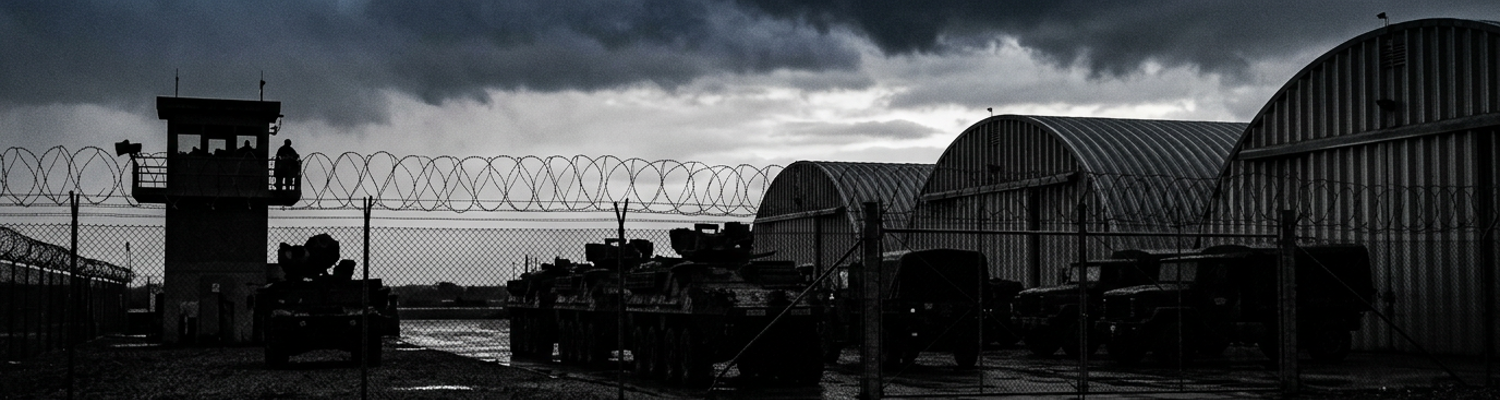
A close review of operational logs indicates that Joint Task Force 160 engineers selected the McCalla flight line out of immediate physical need. Built in 1941 to service carrier-based Grumman F4F Wildcats, McCalla Airfield retained two structural-steel hangars. These buildings were clad entirely in heavy-gauge galvanized corrugated iron sheeting. Marine and Navy construction teams from the 22nd Naval Construction Regiment gutted these World War II aircraft maintenance sheds. They were designated Hangar 750 and Hangar 751. Teams stripped out machine-shop partitions to convert the cavernous bays into centralized holding facilities.
Hundreds of aluminum-frame army cots were crammed beneath the arched steel ceiling trusses.
This positioned more than twelve hundred male transferees inside a single uninsulated metal shell directly adjacent to the primary taxiways. On the exterior tarmac, Seabees erected perimeter pens directly over the eight-inch concrete aircraft parking aprons. Heavy steel runway tie-down eyes were spaced every ten feet along the deck. These were repurposed to anchor guide wires for multi-tiered razor wire barriers.
The heat trapped within the corrugated iron walls reached 134 degrees by midday.
Archival evidence shows that this concentration of heavy structural metal destroyed the radio frequency propagation paths required by base security forces. The thick galvanized steel walls acted as unintended Faraday shields. They severely attenuated radio frequency signals crossing into or out of the hangar bays. VHF radio waves operating along military frequencies between 30 and 88 megahertz suffered signal loss in excess of twenty-five decibels whenever a transmission path intersected the hangar envelope. As signals struck the massive corrugated surfaces, the ridges scattered the electromagnetic waves into multiple out-of-phase wave fronts. This generated severe multipath interference across the entire tarmac.
Receiving transceivers registered these reflected waves as destructive phase cancellations.
This caused rapid signal flutter and complete squelch lockup. Even on open asphalt outside the hangars, thousands of linear feet of chain-link security fencing acted as a chaotic scattering array. This fencing was reinforced by structural steel catwalks and rows of metal drum barriers. It scrambled line-of-sight VHF signals before they could travel four hundred yards across the compound.
When examining the historical record of the 519th Military Police Battalion, the mechanical consequences of this interference become apparent in daily sector logs. Military Police patrols assigned to secure Camp McCalla carried standard AN/PRC-68 small-unit transceivers. These were equipped with flexible 14-inch whip antennas. These low-power handheld units generated only one watt of radio frequency output. This emission level was utterly incapable of penetrating the corrugated iron hangars. It could not overcome the multipath phase cancellation echoing off the tarmac structures.
Sentry teams operating inside Hangar 750 discovered a severe dead zone.
Taking three steps behind an interior steel support column completely severed their connection to the sector command post stationed at the eastern taxiway. Outside on the perimeter, vehicle-mounted AN/VRC-46 tactical FM transceivers suffered from constant receiver desensitization. This occurred whenever their antennas swung within twenty feet of the metal hangar roofs. Signal operators could hear static-filled carrier signals keyed by panicked perimeter guards. The phase distortion stripped away all intelligible voice modulation.
Static replaced voice traffic across the entire internal perimeter net.
Field radio operators attempted to circumvent the structural dead zones. They ran field wire from AN/GRA-39 remote control units out to external OE-254 omnidirectional broadband antennas erected on magnesium masts. These masts had to be lashed directly to external hangar framework braces. The concrete tarmac prevented ground anchoring. Thunderstorms and coastal squalls off the Caribbean repeatedly whipped the antenna masts against the corrugated roof overhangs. This stripped the coaxial transmission cables down to bare copper wire.
Within two weeks of initial operations, six of the ten OE-254 antenna arrays deployed across McCalla Airfield suffered direct mechanical grounding against the hangar walls.
This shunted radio frequency energy straight into the structural steel of the airfield instead of the upper atmosphere.
Tactical Communications Architecture and Spectrum Crowding
A close review of operational logs indicates that the 519th Military Police Battalion entered the Camp McCalla sector carrying a split inventory of tactical combat net radios. Frontline MP detachments received aging Vietnam-era AN/PRC-77 transceivers alongside newly fielded single-channel ground and airborne radio system units. These new units were designated AN/PRC-119 SINCGARS. These two systems operated on fundamentally incompatible architectural baselines.
The older RT-841 receiver-transmitters of the AN/PRC-77 relied on 50-kilohertz channel spacing across a 30.00 to 75.95 megahertz spectrum.
The microprocessor-driven RT-1439 SINCGARS used 25-kilohertz channel intervals up to 87.975 megahertz. Joint Task Force 160 communications planners forced both platforms into common clear-text operational channels. This allowed perimeter foot patrols to communicate directly with vehicle quick-reaction teams. This mandate disabled the frequency-hopping electronic counter-countermeasure capabilities of the SINCGARS units. It bound modern transceivers to fixed unencrypted frequencies.
Handheld AN/PRC-77 sets generated less than two watts of RF output.
They drew power from BA-4386/U carbon-zinc batteries that corroded under tropical humidity. The 25-kilohertz spacing mismatch caused adjacent-channel spillover. This generated continuous background hiss that masked weak transmissions whenever an AN/PRC-119 keyed within eighty yards of a legacy set.
Technicians recorded forty-seven separate transceiver component burnouts during the first week of October alone.
When examining the historical record of Joint Task Force 160, the spectrum management across the naval reservation reveals severe structural crowding. Naval base telecommunications officers assigned only twelve discrete tactical VHF-FM frequencies to cover all military police and internal security operating around the airfield. Base administration clerks broadcast routine personnel movements and daily supply requisitions over the same narrow frequency block assigned to medical triage teams. These medical teams were managing acute dehydration and dysentery cases inside McCalla Compounds II and III.
Joint Logistics Command supply convoys operated heavy tactical trucks to deliver potable water and transport waste.
They continuously keyed high-power AN/VRC-90 vehicle-mounted sets rated at fifty watts. These vehicular transmitters overpowered the one-to-two-watt manpack radios carried by foot patrols along the wire. Transmitters stationed inside a two-mile perimeter generated immediate cosite interference and receiver desensitization. Spurious emissions bounced across the metal hangars. This created intermodulation products that produced phantom signals on compound security nets.
Emergency calls for medical evacuations vanished beneath administrative chatter.
Archival evidence shows that on October 24, 1994, this spectral saturation paralyzed crowd control operations during an escalating disturbance along the western gate of McCalla IV. Detachment sentries attempting to report broken perimeter ties on the 571st Military Police Company net found their transceivers blocked. They were blocked by a continuous automated retransmission loop established by a Joint Logistics Command water delivery convoy.
Guard personnel repeatedly depressed push-to-talk switches.
They encountered total squelch capture caused by the higher-wattage logistic transmitters operating out of the central port staging area. Sentry posts attempted to shift to secondary channels. Triage medics at the Camp McCalla dispensary were concurrently occupying those alternate frequencies to coordinate ambulance dispatches for thirty heat-stroke casualties. Operating on overlapping 40-megahertz bands without radio frequency bandpass filters induced broad spectrum clipping across adjacent receiver front-ends. Sentries could not alert the standby quick-reaction force stationed five hundred yards away at Hangar 751. This left twelve military policemen isolated against a crowd of eight hundred transferees armed with tent poles and asphalt chunks.
Frequency Reallocation and Perimeter Net Degradation
A close review of operational logs indicates that Joint Task Force 160 communications staff faced a crippling administrative overload by early November 1994. This was driven by sixty daily supply flights and thousand-gallon water deliveries. Civilian relief agencies and processing stations run by the Immigration and Naturalization Service required uninterrupted radio coordination across the flight line.
Signal planners executed an immediate internal frequency reallocation.
They did this rather than requisitioning additional spectrum blocks from Atlantic Command or running physical copper wire through the heat-baked runway tarmac. Communications officers reassigned three discrete tactical VHF-FM channels previously reserved for the internal compound security nets of the 519th Military Police Battalion. Dedicated military bands at 34.50 MHz, 38.25 MHz, and 42.10 MHz were transferred to camp sanitation and trash clearance details. These bands were originally allocated to sentry teams monitoring eight thousand male migrants inside Compounds McCalla I and II.
Sentry detachments were forced to migrate onto two shared administrative nets.
This bureaucratic shuffle eliminated the frequency isolation that separated routine base housekeeping from perimeter distress traffic. Archival evidence shows that this shift degraded response capabilities throughout the 571st Military Police Company sector. Signal bulletins reveal that security personnel suddenly shared bandwidth with more than four hundred administrative and logistical transmissions every twenty-four hours. Logistics dispatchers keyed fifty-watt AN/VRC-90 vehicular transmitters to organize diesel refuelings and latrine servicing.
This overpowered the one-watt AN/PRC-68 handheld transceivers carried by foot patrols pacing the razor wire.
When perimeter guards keyed push-to-talk switches to report organized unrest, high-wattage carrier waves from vacuum pump trucks drowned out their modulation entirely. Radio operators at the sector command station logged twelve dropped call signs in a single four-hour morning window. Communications planners treated these lost signals as routine equipment flutter. This left unlogged transmission gaps across eight guard logs during the shift change.
When examining the historical record of the 716th Military Police Battalion, the most damaging tactical consequence of this frequency swap hit the static perimeter watchtowers. Eight elevated timber guard platforms stood twelve feet above the concrete apron along the western and northern fence lines of McCalla. They were designated Observation Posts 1 through 8. Two sentries manned each platform. They were equipped with 12-gauge shotguns, plastic crowd shields, and an AN/PRC-77 field set.
Under the original perimeter plan, every tower maintained a direct unshared alert frequency wired straight into the quick reaction force stationed inside Hangar 751.
Depressing the handset push-to-talk switch instantly mobilized the standby riot squads. During the mid-November frequency reallocation, communications planners stripped this direct channel to clear spectrum for convoy routing and medical triage lines. Watchtower sentries were told to direct all emergency alerts through the central battalion switchboard on the shared administrative net. This added a manual telephone relay step to every defensive alert.
Static posts lost their direct line to armed backup.
Paralysis struck the western edge of McCalla Compound III during the late afternoon shift on November 26. Sentries on Observation Post 4 spotted thirty transferees using wooden tent stakes to pry open the heavy turnbuckles anchoring the perimeter fence to the concrete tarmac. Stripped of their direct quick reaction force link, the watchtower guards switched their AN/PRC-77 to the battalion administrative frequency. They found it jammed by a three-minute status report from an empty food delivery truck.
The tower sentries shouted across the wire.
Engine noise from nearby generator sets masked their voices. By the time the sentries finally accessed an open window on the net and the switchboard clerk telephoned Hangar 751, fifteen minutes had elapsed. The reaction force arrived to find thirty-five linear feet of chain-link fence flattened onto the taxiway. Sixty-two detainees were already out on the active runway tarmac.
December 1994 Camp McCalla Riot Outbreak
A close review of operational logs indicates that the initial flare-up began at 1130 hours on the morning of December 7, 1994. This occurred across McCalla Compounds II and III. Washington officials had publicly reaffirmed that no Cuban transferees would receive direct entry into the United States. This confined more than twenty-eight thousand individuals to open-ended internment on the naval reservation without legal hearings or release dates.
Inside McCalla, camp leaders organized rapid assembly signals using coordinated whistle blasts and rhythmic banging on metal cot frames.
This bypassed military police patrols. Detainees inside Camp McCalla I gathered en masse along the western wire. They presented military police sentries with unified demands for immediate repatriation or transit to third-party states. Agitation spread across the asphalt tarmac within forty minutes as transferees in McCalla II ignited piles of canvas tent liners. This produced dense black plumes of smoke that completely obscured the visual observation fields of watchtowers along the taxiways.
Joint Task Force 160 headquarters received initial distress calls from the 519th Military Police Battalion at 1152 hours.
They reported that unarmed administrative staff and contract sanitation workers were trapped behind rapidly barricaded gate corridors near Hangar 750. The wire gave way under the weight of three thousand men. Archival evidence shows that coordinated kinetic breaches struck perimeter fencing and internal supply stations simultaneously across four separate compound quadrants. Migrants wielded sharpened aluminum cot legs and heavy galvanized guy-wire turnbuckles. They used fractured runway concrete to shatter locking mechanisms on intermediate gates.
Detainees dismantled the external concertina wire barriers by throwing discarded wool blankets and wooden plywood flooring across the coils.
This created direct footpaths over the obstacles. North of the runway, hundreds of transferees converged on the primary water distribution point and the McCalla field galley. They overturned two 3,000-gallon water bladders and set three M923 five-ton cargo trucks on fire. Rioters encircled Observation Posts 2 and 3 with coordinated volleys of broken asphalt and iron star pickets. This fractured the reinforced safety glass of the watch cabins and forced the two-man sentry teams down onto the floorboards.
Sentries on Observation Post 2 fired twelve warning rounds of non-lethal 12-gauge beanbag shot into the advancing crowds.
The kinetic impact rounds failed to halt individuals protected by thick foam cot mattresses tied across their torsos. Every distribution shed across the northern taxiway burned to the asphalt. When examining the historical record of the 716th Military Police Battalion, the operational collapse of the internal sector escalated between 1400 and 1630 hours on December 8. Crowds overwhelmed the main security cordon around Hangar 751.
Transferees systematically attacked the reinforced perimeter fence surrounding the battalion maintenance yard.
They cut secondary ground-anchor cables with stolen bolt cutters and toppled three hundred linear feet of chain-link barrier onto the service road. Soldiers from the 1st Battalion, 12th Infantry Regiment formed a static skirmish line across the airfield centerline. They deployed CS gas canisters from handheld launchers into twenty-knot headwinds. This blew the chemical irritant straight back into American defensive positions.
Riot squads lacked functioning VHF hand transceivers after administrative channels locked up under fifty-watt carrier wave interference from base fire dispatchers.
This left squad leaders to deliver defensive commands using arm-and-hand signals amid the smoke. By 1700 hours, rioting transferees overran the Camp McCalla security processing center. They destroyed eighty thousand physical personnel record folders. They took control of two perimeter generator stations at coordinates 19 54 12 N, 75 09 38 W.
Perimeter Breaches and Manual Command Relays
Structural tension along the western boundary failed completely under the physical mass of twelve hundred men surging against the fence. Archival evidence shows that at 1422 hours on December 8, the ten-gauge galvanized chain-link fencing separating Compound McCalla II from the runway taxiways sheared clean off its horizontal tension wires. Sentry teams stationed along ground patrol post Oscar-4 watched the steel fence fabric fold downward. Waves of transferees used cot frames as levers against the base rail.
Standing less than twenty yards from the break, two military police sentries from the 571st Military Police Company were cut off from all immediate support.
Sector operational guidelines prohibited foot sentries from tuning directly to the dedicated tactical net of the Quick Reaction Force stationed inside Hangar 751. Planners had deliberately locked the AN/PRC-68 transceivers of the sentries onto the shared administrative channel to prevent net congestion. When the guards keyed their push-to-talk buttons to sound an open alarm, continuous administrative chatter from base supply runs blocked their low-wattage transmissions.
Visual emergency signals proved equally useless.
Black smoke billowing from burning canvas tents masked the hand-and-arm signals of the sentries from the watchtowers. The roar of runway diesel generators completely drowned out whistle blasts. Frontline sentries watched the primary security wire flatten into the dirt without any direct means of calling the reaction squads five hundred yards away. A close review of operational logs indicates that JTF-160 command doctrine mandated a cumbersome multi-echelon communications relay before any riot-control element could move.
Sentries who managed to break through static on the shared radio frequency were routed to an administrative radio-telephone operator at the 519th Military Police Battalion Tactical Operations Center.
This operator had to transcribe the verbal incident report by hand onto a standard DA Form 1594 journal sheet. Standard operating procedures then required the duty sergeant to verify the transmission before placing a landline telephone call to the Joint Task Force 160 central switchboard. From that switchboard, an operator manually patched the line through aging SB-22/PT switchboards to an AN/VRC-46 vehicular base station parked outside Hangar 751. Only after receiving this relayed telephone message could the watch officer at Hangar 751 sound the physical siren to scramble the standby infantry platoon from Company C, 1st Battalion, 12th Infantry Regiment.
Fourteen minutes elapsed between the initial fence buckle and the first physical movement of armored Humvees out of the hangar doors.
When examining the historical record of the 716th Military Police Battalion, this relay lag allowed the breach to expand from a single gap into an uncontrollable multi-directional rout. Transferees poured through the flattened fence at coordinate 19 54 08 N, 75 09 44 W. They spread across the service access road and seized picks, shovels, and scaffolding poles left by contractor work crews.
By the time the thirty-man Quick Reaction Force platoon reached the western taxiway in full riot gear, four hundred detainees held the high ground along an elevated asphalt fuel berm.
Two M1025 Humvees attempting to block the intersection suffered cracked ballistic windscreens under concentrated volleys of fist-sized runway gravel and steel turnbuckles. This forced the lead vehicles to reverse toward Hangar 750. Wire barriers along Compounds McCalla III and IV collapsed from behind as the escaped crowd hit the rear support stays with angle irons. This widened the gap across eight hundred linear feet of the airfield corridor.
Emergency Containment at the Cuban Border Minefields
Twelve hundred migrants were moving straight toward the live minefields of the Cuban frontier. Archival evidence shows that after smashing through the secondary perimeter fences of Camp McCalla IV, the mass of transferees pushed eastward across the arid limestone ridges toward the base boundary. They cut through dry scrub brush and dense patches of organ-pipe cactus at coordinate 19 54 45 N, 75 08 12 W. The crowd outpaced the disorganized security patrols.
Behind them lay burning tents.
Ahead lay the defensive belt of the Cuban Frontier Brigade. This border strip contained one of the densest operational minefields in the Western Hemisphere. It was packed with Soviet-supplied PMN-2 pressure-activated blast mines and POMZ-2M fragmentation stakes. TM-46 anti-tank ordnance lay buried in the dry topsoil. Decades of erosion and tropical washouts had shifted many of these explosive devices outside their original survey stakes.
Along this specific northeastern stretch, the base perimeter lacked continuous galvanized chain-link fencing.
It was marked only by weathered wooden signposts and sporadic cattle wire strung between fence pickets. Disoriented individuals ran along dry creek beds in the darkness. They were unaware that three hundred yards past the low ridgeline sat the tripwires of the Cuban perimeter strip. The PMN-2 required only five kilograms of pressure to detonate its main charge.
A close review of operational logs indicates that Joint Task Force 160 scrambled every available motorized element to interdict the fleeing crowd before it breached the frontier wire.
Watch officers inside the base operations center bypassed standard radio protocols to scramble Company C, 1st Battalion, 12th Infantry Regiment. This unit was paired with mobile patrols from the 519th Military Police Battalion. Fourteen M1025 armament carriers and troop-transport trucks roared along unpaved ridge roads. They cut off access corridors leading to the border sector. Soldiers leaped from vehicle flatbeds into the thorn brush.
They formed an improvised shoulder-to-shoulder skirmish line six hundred yards shy of the Cuban blast zone.
Troops raised high-density polycarbonate riot shields and loaded 12-gauge shotguns with rubber fin-stabilized projectiles and M1012 non-lethal beanbag rounds. Gun crews on elevated vehicles illuminated the arroyos with handheld 250,000-candlepower spotlight beams. As crowds rushed the American line, infantrymen fired volleys of CS gas canisters into the scrub. This was followed by direct kinetic impact rounds aimed at lower extremities.
The physical cordon held eighty yards from the warning wire.
When examining the historical record of the 716th Military Police Battalion, combat engineers from the 299th Engineer Battalion raced behind the infantry line. They unspooled hundreds of meters of rapid-deployment concertina wire directly across the gully mouths. Armored Humvees idled their diesel engines bumper-to-bumper across the dry washes. This created a metal barricade that redirected scattered migrant groups back toward the coastal lowlands.
Squad leaders used battery-operated megaphones to broadcast Spanish-language audio warnings.
These warnings detailed the exact location of the buried antipersonnel devices ahead. Hand-to-hand skirmishes erupted along the outer flanks of the cordon. Soldiers used side-handle wooden batons to subdue small groups attempting to scramble past the vehicles. Detainees were pinned to the earth, bound with plastic flex-cuffs, and loaded into canvas-topped five-ton cargo trucks. They were transported under armed guard to the Leeward side of the base. American patrols completed the final head count at 0315 hours on December 9 at checkpoint Alpha-Three.
Doctrinal Aftermath and Inter-Service Communications Revisions
A close review of operational logs indicates that the United States Atlantic Command after-action inquiry focused immediately on the J-6 signal annex drafted during the initial staging of Joint Task Force 160. Major General John Sheehan directed an investigative board to dissect the decision tree that led base communications officers to subordinate compound perimeter defense nets to routine administrative channels. Military investigators established that civilian contractors and base support elements had consumed sixty-five percent of all available VHF-FM discrete frequencies across the lower 30.00 to 50.00 megahertz band.
This pushed the 519th Military Police Battalion off their assigned tactical bands.
By treating basic camp sanitation and water delivery dispatching as high-priority radio traffic, the joint communications staff left internal guard posts with zero frequency isolation. When the wire collapsed on December 8, perimeter distress signals registered as unintelligible background hash against the fifty-watt carrier waves of five-ton logistics trucks operating out of the central port depot. Board findings formally classified this spectrum configuration as a catastrophic failure mode.
Assigning primary compound defense to shared clear-text housekeeping nets directly compromised tactical situational awareness across the entire base.
Archival evidence shows that subsequent Army Inspector General technical reports singled out the mechanical consequences of running 1-watt AN/PRC-68 small-unit radios alongside high-wattage vehicle sets on shared spectrum. Signal specialists proved that cosite receiver desensitization stripped forty-two guard posts along the McCalla taxiway of any capability to break squelch during active convoy operations. Handheld sets lacked the power to punch through the broad intermodulation products created by corrugated metal hangars and unshielded diesel generator plants.
The investigative panel discovered that communications personnel never calculated radio frequency path loss across the open asphalt runway.
They wrongly assumed that line-of-sight propagation guaranteed signal delivery regardless of concurrent vehicular transmissions. The administrative routing doctrine had placed an armed quick reaction force behind an unmonitored standard manual telephone patch rather than a dedicated continuous hot loop. Investigators concluded that this administrative chain added an unrecoverable twelve-to-fifteen-minute delay to physical reaction forces attempting to deploy during kinetic breaches.
When examining the historical record of United States Army doctrine, the Guantanamo breakdowns triggered an immediate rewrite of internment and non-combatant evacuation standards.
Training and Doctrine Command extracted the lessons of Camp McCalla to overhaul Field Manual 19-40. They replaced outdated military police interned-personnel guidelines with the revised FM 3-19.40 for Internment and Resettlement Operations. The new field manual established an absolute doctrinal prohibition against combining security combat net radio frequencies with camp administration or supply circuits. Planners mandated that all future facility perimeters operate on fail-safe dedicated tactical nets isolated from base sustainment operations.
Joint Pub 3-07.6 incorporated binding communications annexes.
These annexes required physical red-line landline wire networks using hard-drawn WD-1/TT field wire and TA-312/PT telephone sets to parallel every tactical wireless net on a detention perimeter. Under these rewritten non-combatant internment standards, every static guard tower and perimeter patrol element had to retain a direct hardwired link. They also required a dedicated clear-channel FM radio frequency tied exclusively to the on-duty quick reaction force operations console.
Doctrinal directives published at Fort McClellan in 1996 instituted mandatory RF spectrum surveys before setting up wire enclosures on decommissioned airfields or industrial sites.
These directives specifically cited the multipath phase cancellation documented inside Hangars 750 and 751. Reception units deploying to future contingency camps were required to stock dual-feed OE-254 antenna arrays and elevated mast systems placed at minimum standoff distances of one hundred and fifty meters from structural metal walls. The Army enforced these fail-safe communication nets across subsequent humanitarian and migrant processing deployments. This began with Operation Pacific Haven on Andersen Air Force Base in Guam during the late months of 1996.