
### Desert Storm Operational Perceptions
The perception, cultivated for a global audience, was one of technological perfection. In the hours before the Coalition air campaign began on January 17, 1991, a multi-national military machine waited for the signal to initiate a new form of conflict. This was presented as the first war of the information age, defined by surgical precision rather than bloody attrition.
Live, 24-hour news coverage brought the fighting into civilian homes with unprecedented immediacy. The term “CNN effect” was born from grainy, green-hued video feeds of laser-guided bombs seemingly gliding down air shafts of Iraqi command centers. The F-117 Nighthawk, a stealth platform whose existence was only recently acknowledged, became the icon of this new warfare. It struck targets in heavily defended downtown Baghdad with apparent impunity. These images created a powerful narrative of a clean conflict where technology had supposedly tamed the chaotic nature of battle. The public saw a war of pinpoint strikes. Military spokespersons reinforced this image, speaking of precision and the careful selection of targets to minimize collateral damage. This media portrayal suggested a conflict where every asset was tracked and every target precisely engaged.
U.S. Central Command leadership entered the conflict with a deep-seated belief in the supremacy of its new generation of weapon systems. This was the force built during the massive defense spending of the 1980s, designed to overwhelm the Soviet Union. Planners held immense faith in platforms like the E-3 Sentry (AWACS) and the new E-8 Joint STARS (JSTARS) to provide a complete view of the battlefield, tracking enemy aircraft and ground formations in real-time. The daily Air Tasking Order (ATO), a massive, 600-page computer printout, was the intricate blueprint for the air campaign. It was designed to deconflict and synchronize thousands of daily sorties. The F-15E Strike Eagle, with its advanced LANTIRN navigation and targeting pods, was expected to hunt mobile Scud missile launchers at night with unparalleled efficiency. The widespread introduction of the Global Positioning System (GPS) promised to give ground forces an unprecedented ability to navigate the featureless desert.
The gap between these confident perceptions and the ground truth was immediate. The “smart” bombs that defined the public face of the war constituted less than 9% of the total tonnage of munitions dropped by the coalition. The vast majority were unguided, conventional bombs with a much lower probability of hitting their targets from the medium-to-high altitudes mandated to protect aircraft. The heralded F-117, while effective, was not invisible; British naval radar reportedly tracked the stealth aircraft from up to 40 miles away. The complex Air Tasking Order could not be transmitted electronically to Navy aircraft carriers in the Persian Gulf and Red Sea due to incompatible systems. Physical copies of the massive document had to be flown out to the carriers daily via S-3 Viking aircraft, a low-tech workaround in a supposedly high-tech war. On the ground, the M1 Abrams tank’s turbine engine air filters clogged with fine desert sand, causing maintenance issues. A glaring software flaw in the Patriot missile defense system demonstrated the hidden dangers of complex technology. At Dhahran, Saudi Arabia, a Patriot battery had been running continuously for over 100 hours. Its internal clock drifted by one-third of a second. On February 25, this minute inaccuracy caused the system's tracking gate to shift, failing to intercept an incoming Iraqi Scud missile. The missile struck a U.S. Army barracks, killing 28 soldiers and injuring around 100 more. The software patch to correct this fatal rounding error arrived the following day.
Haboob Effects on Air Coordination
A close review of operational logs from the 1991 Gulf War reveals a persistent antagonist to the air campaign that had nothing to do with Iraqi air defenses. It was the weather. Specifically, the fine-particle sandstorms known as haboobs.
The first and most immediate breakdown occurred in the link between ground observers and airborne assets: radio communications. Forward Air Controllers (FACs), the human nodes responsible for guiding attack aircraft, found their equipment rendered nearly useless. Billions of microscopic sand and dust particles colliding in the turbulent air generated a massive field of static electricity. This atmospheric static overwhelmed the VHF and HF frequencies used by standard-issue man-portable radios like the AN/PRC-77. Instead of a FAC providing a 9-line attack brief, pilots often heard only a roar of white noise. This severed the connection at the most important moment of a close air support mission, forcing a reversion to less effective, pre-planned missions.
The machines were blind.
Precision-guided munitions were acutely vulnerable to atmospheric dust. The Low-Altitude Navigation and Targeting Infrared for Night (LANTIRN) pods, which gave aircraft like the F-15E their night-fighting capability, depended on detecting the heat signature of targets. A haboob negated this advantage. Suspended dust particles, heated by the sun, created a uniform thermal curtain, masking the infrared signature of an Iraqi tank or artillery piece. The heat difference between a vehicle’s engine and the sand around it would vanish. The target became invisible to the infrared sensor. Laser designation systems used to guide Paveway-series bombs were also heavily degraded. A laser beam fired from a targeting pod or a ground designator would be scattered and absorbed by the dense cloud of airborne particulates, a phenomenon known as atmospheric attenuation. The laser spot on the target would become too diffuse for the bomb’s seeker head to lock onto. The “smart” bomb became a simple unguided projectile. Archival reviews show that PGM sortie effectiveness plummeted during these weather events.
For pilots, flying into a haboob was an experience of complete sensory deprivation. The transition was often sharp, from a clear sky to a near-zero visibility wall of brown dust that eliminated the horizon and all ground references. This immediate loss of visual contact with the ground was the most dangerous factor in coordinating air support for fast-moving ground forces. The primary method for preventing fratricide, visual confirmation of friendly positions marked by orange vehicle identification panels, became impossible. A pilot could not distinguish a column of Abrams tanks from a column of T-72s when the ground itself was an indistinct blur. A review of after-action reports indicates a sharp spike in aborted close air support missions during periods of low visibility. Airspace deconfliction measures, such as the “kill box” grid system, became the only tool to prevent friendly fire. Their effectiveness was limited when pilots, flying solely on instruments, struggled to confirm their own position over a featureless desert now obscured by a featureless sky.
Improvised Targeting and Fratricide Potential
With advanced sensors inert and radio channels dissolving into static, Coalition pilots and ground forces reverted to primitive methods for target identification. Archival evidence shows that Forward Air Controllers, unable to transmit coordinates, instructed pilots to look for crude visual signals. These included marking friendly positions with the multi-spectrum “beanbag” light, a low-powered strobe visible only under night vision, or even shining flashlights and vehicle headlights into the sky. For attack runs, FACs would attempt to mark enemy locations by firing bursts of tracer ammunition or launching colored smoke grenades.
This entire system was a gamble.
The effective range of these visual markers was dramatically reduced by dust and smoke, forcing pilots to fly lower and faster into harm’s way to acquire the signal. The smoke itself was unreliable; a sudden wind shift could obscure the target or drift over friendly units, creating a false target for an inbound aircraft. Pilots of aircraft like the A-10 Thunderbolt II, designed for low-level visual attacks, were placed under immense pressure. They had to interpret these fleeting, ambiguous signals while flying at several hundred miles per hour. After-action reports reveal numerous instances of pilots struggling to differentiate between friendly and enemy tracer colors or being unable to spot a marker grenade through the haze. The responsibility for preventing fratricide shifted from the command-and-control system to the individual pilot’s eyes. This contradicted the doctrine of technologically-assured combat identification. The failure of Identification Friend-or-Foe (IFF) systems, a long-known issue, became acutely apparent. Makeshift solutions like taping inverted 'V' shapes onto vehicles were unreliable at long engagement ranges and completely invisible at night, in sandstorms, or through thermal sights. Thermal imaging systems, designed to give Coalition forces an edge, also stripped away the visual cues that distinguished friend from foe, rendering all vehicles as indistinct hot silhouettes.
The conditions were ripe for catastrophe.
The most severe case occurred on February 26, 1991. Following a brief sandstorm, visibility had improved, but the battlespace remained confused. Two USAF A-10s were tasked to attack Iraqi armor. The pilots were informed that no friendly forces were within 10 kilometers of the target grid. After making two high-altitude passes to observe with binoculars, the pilots identified vehicles they believed to be Iraqi T-55 tanks and support vehicles. They were, in fact, the British Warrior armored fighting vehicles of the 3rd Battalion, The Royal Regiment of Fusiliers. The A-10s engaged with Maverick missiles. The first missile struck a Warrior, callsign 22, causing it to explode. As the crew of another Warrior, callsign 23, maneuvered to assist, it too was struck by a missile from the second A-10. The attack resulted in the deaths of nine British soldiers and injuries to eleven more. A similar incident during the Battle of Khafji on January 29 saw a US Air Force jet fire a Maverick missile that hit a Marine Corps light armored vehicle, killing seven Marines inside. These events were the direct consequence of systems and procedures that failed to account for a fast-moving, low-visibility desert battlefield.
Underway Replenishment Systemic Flaws
The naval logistics system that supported Desert Storm was built for a different war. A close review of operational logs and after-action reports reveals that the U.S. Navy’s Combat Logistics Force (CLF) was unprepared for the tempo and specific environmental demands of the Persian Gulf. The core assumption of Cold War naval planning was a series of high-intensity engagements in the open North Atlantic, not the sustained, high-volume, and geographically constrained supply chain required to support carrier battle groups in the Red Sea and the Persian Gulf. This geographic split, combined with the sheer consumption rate of munitions and stores, placed an unprecedented demand on the underway replenishment (UNREP) system. Reports from the General Accounting Office published after the conflict detailed long-standing problems in the supply distribution system that impeded timely support.
The system was not designed for this fight.
A significant point of failure emerged in the material handling of munitions aboard supply vessels. Analysis of naval records indicates that ammunition and dry cargo ships arriving in the theater were often improperly loaded, a direct consequence of the rapid deployment timeline. Pallets of bombs, missiles, and other ordnance were frequently not secured correctly within the ships' holds. This forced crews of vessels like the fast combat support ship USS Sacramento (AOE-1) and ammunition ship USS Suribachi (AE-21) to conduct dangerous and time-consuming re-stowage operations while at sea. Improper ballasting of these supply ships, a procedure for maintaining stability during the transfer of heavy loads, made a perilous situation worse. As tons of ordnance were shifted from one side of the ship to the other during UNREP, an improperly ballasted vessel could develop a severe list. This threatened to send unsecured pallets of high explosives sliding across decks or to snap the high-tension transfer lines connecting the supply ship to the combatant. Each UNREP evolution involving ordnance became a calculated risk.
These specific mechanical and procedural failures were symptoms of a deeper problem: inadequate training for Persian Gulf operations. The majority of UNREP training for both Navy crews and the civilian mariners of the Military Sealift Command was conducted in the open, temperate waters of the Atlantic and Pacific. These exercises could not replicate the operational conditions of the Gulf: extreme heat that stressed machinery and personnel, confined waterways that limited maneuverability, and a constant state of high alert. Reports compiled after the war noted significant shortcomings in pre-deployment training across the services. The crews tasked with executing these resupply missions often lacked the specific experience needed. This deficiency was compounded by the activation of thousands of naval reservists to man the surge in logistics vessels. The result was a logistics force that operated with a thin margin of safety, overcoming systemic flaws through the effort and improvisation of its sailors.
Hazardous Munition Transfers and Delays
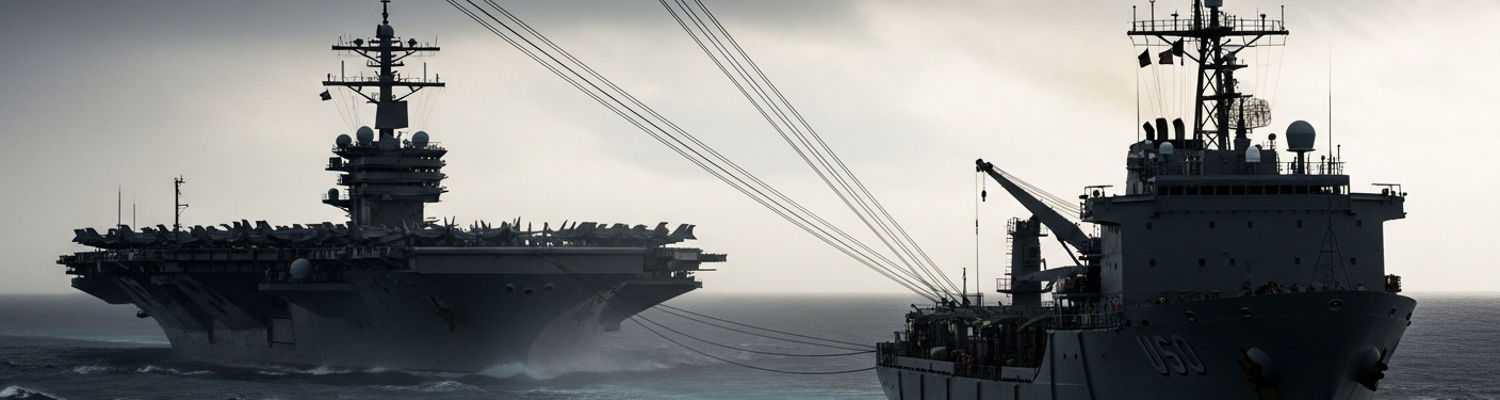
Archival analysis of Combat Logistics Force after-action reports reveals that the process of arming warships at sea was frequently a high-risk operation. The Standard Tensioned Replenishment Alongside Method, or STREAM, was the mechanical system for transferring ordnance, but it had an extremely low tolerance for error. It involved two or three ships steaming in precise formation, often only 60 to 100 feet apart, connected by high-tension steel cables. Any deviation in course or speed could create a powerful hydrodynamic suction effect, pulling the multi-thousand-ton vessels toward each other. Into this environment, pallets of bombs, missiles, and artillery shells, each weighing up to two tons, were sent sliding down the highline. A close review of operational logs shows that CLF ships like the USS Sacramento (AOE-1) and USS Suribachi (AE-21) were often forced to conduct these transfers under immense pressure.
Delays were a common and dangerous consequence. A GAO report published after the conflict noted that serious logistical problems plagued the operation, in part because munitions ships arrived in theater improperly loaded. This forced crews to perform hazardous re-stowing of ordnance pallets at sea before a transfer could even begin. An aborted UNREP was a frequent result. A sudden increase in sea state, a mechanical failure in the ram-tensioner device designed to keep the highline taut, or a steering casualty on either ship could force an emergency breakaway. In such an event, crews had to sever the transfer lines, often sacrificing the pallet of ordnance currently suspended over the ocean. Records from the USS Ranger (CV-61) battle group indicate that such events were a constant concern. Each aborted attempt meant a combat vessel remained on station with a depleted magazine, forcing another high-risk replenishment attempt later.
The physical consequences of these flaws were clear. While major accidents were narrowly avoided, material damage was a persistent problem. A well-documented incident occurred when the fast combat support ship USS Sacramento suffered a split rudder during a replenishment operation with the USS Abraham Lincoln (CVN-72). The steering casualty caused the Sacramento to slam into the aircraft carrier, punching a large hole in the Lincoln’s superstructure. While this collision did not involve ordnance, it highlights the kinetic forces at play. A similar steering error during a munitions transfer could have been catastrophic. Less dramatic but more frequent were instances of ordnance pallets shifting violently during transfer. Pallets of 500-pound and 2,000-pound bombs, not always properly secured, would swing uncontrollably or slam against the ship’s hull. Any impact strong enough to damage the bomb’s casing or fusing mechanism could render the munition unstable and unsafe to handle, load, or store.
Logistical Planning vs. Ground Truth
A close review of Government Accountability Office reports and naval after-action assessments reveals a significant disconnect between the Navy’s logistical doctrine and the conditions encountered in the Persian Gulf and Red Sea. The Combat Logistics Force was conceptually and structurally configured for a high-latitude, open-ocean conflict against the Soviet Union, not the sustained, high-volume support demanded by two carrier battle groups operating in confined, high-threat waterways. The entire system was predicated on a model of intermittent, short-duration combat, followed by withdrawal to safe rear areas for resupply.
This model was immediately invalidated.
The operational tempo required a continuous forward presence, which in turn demanded a nearly unbroken chain of underway replenishment (UNREP) operations. A December 1991 GAO report highlighted that U.S. forces overcame these logistical shortfalls primarily because Iraq’s defensive posture granted the coalition several months to build up forces and supplies without hostile interference. This luxury of time allowed logistics crews to compensate for a system that was not designed for the mission.
A specific and dangerous failure point emerged in the handling of hazardous cargo. Within the holds of Military Sealift Command vessels, the systems designed to provide warning for shifting or unstable ordnance pallets were effectively nonexistent or ignored. Coast Guard inspection teams, activated to oversee the loading of explosives and hazardous materials onto these ships, were faced with an unprecedented scale and speed of operations. Archival evidence points to supply ships arriving in the theater of operations with improperly stowed and secured munitions. This forced combat logistics ships to conduct dangerous, at-sea re-stowage of multi-ton pallets of bombs and missiles before UNREP operations could even commence. This was a procedure for which there were no formal warning alarms or automated safety systems beyond the eyes and ears of the crew.
Finally, the architecture for providing reliable, advance warning to the fleet of an approaching replenishment vessel was fraught with deficiencies. In the high-threat environment of the Persian Gulf, any unidentified vessel approaching a carrier battle group was treated as a potential threat. The command-and-control systems in place were optimized for identifying and tracking hostile contacts, not for managing the administrative and logistical traffic necessary to sustain the force. There was no dedicated, foolproof system for a supply ship to signal its identity and intentions to a carrier group from over the horizon. This forced reliance on standard bridge-to-bridge radio communications, which were often unreliable and unencrypted, or on visual signals at close range. By that point, a combat vessel’s own defensive posture was already heightened. The approach of a friendly oiler or ammunition ship could trigger preliminary defensive alerts within the very battle group it was sent to resupply.
Crew Strain and Preventable Equipment Losses
Naval operational logs and post-conflict analyses from Desert Storm expose the human and material cost of the logistics campaign. The relentless operational tempo, driven by the need to support two carrier battle groups, shattered the Navy’s standard crew rest and work cycles. For sailors aboard both combatants and CLF ships, the cycle of UNREP was a constant, grueling interruption. Normal watch schedules became theoretical as nearly every available body was required on deck for the multi-hour evolution of transferring fuel, ordnance, and stores. The work was physically demanding, performed in extreme heat and often in full chemical protective gear. Government Accountability Office reports published after the war pointed to systemic shortcomings in pre-deployment training, meaning many crews, including a large number of activated reservists, were unprepared for the specific environmental and operational stresses they would face. The result was a fleet-wide state of cumulative fatigue, a condition that erodes judgment and slows reaction times.
This pervasive exhaustion directly contributed to preventable equipment losses and damage.
The most dramatic example occurred during a replenishment operation when the fast combat support ship USS Sacramento (AOE-1) suffered a split rudder, causing it to lose steering control and slam into the aircraft carrier USS Abraham Lincoln (CVN-72). The collision punched a large hole in the Lincoln’s superstructure and severely damaged the Sacramento’s port side, crushing a berthing area and disabling replenishment equipment. A close reading of hazard reports indicates that less dramatic but more frequent damage was a constant problem. Pallets of bombs, improperly secured due to the rushed deployment schedule, would swing into ships' hulls during transfer in even moderate seas. Any impact sufficient to damage a bomb’s casing or fusing mechanism rendered the munition a hazard, creating an additional risk for the ordnance handlers and flight deck crews who had to deal with the unstable weapon.
These were not random accidents. They were the predictable outcomes of a system operating beyond its designed limits, where ignored safety protocols and maintenance shortfalls became the accepted norm. The USS Sacramento was forced to dock for several weeks for repairs at Jebel Ali, removing a key logistics vessel from the operational cycle. Every aborted UNREP due to weather or mechanical failure, and every combat ship forced to wait for resupply, represented a tangible degradation of combat capability.