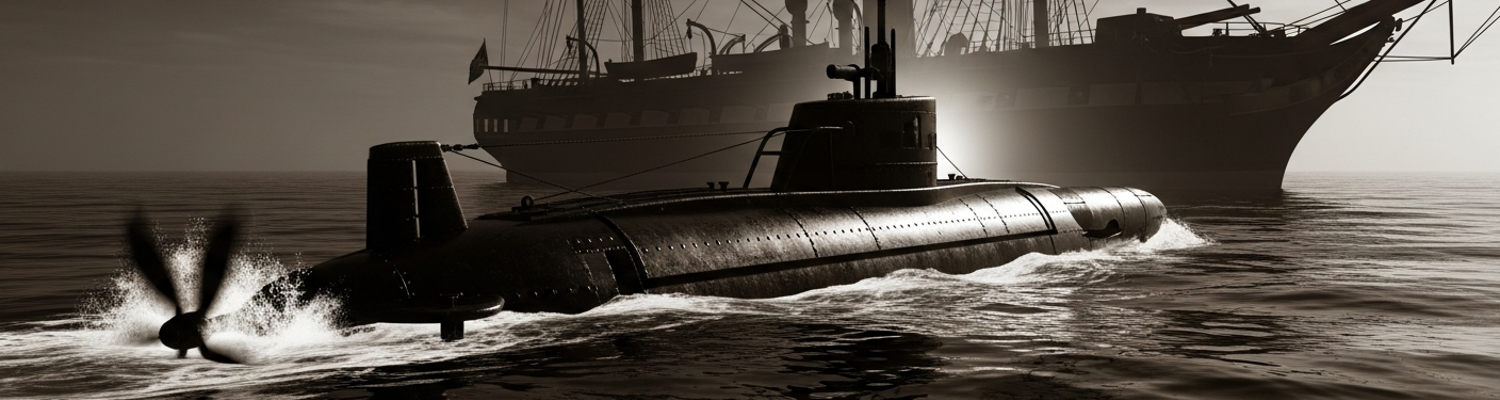

Twenty-one Confederate sailors died inside the H.L. Hunley. They died across three separate sinkings before the submarine ever reached its intended target. The vessel was a deathtrap. Its existence was a function of strategic desperation, a Confederate attempt to counter the Union's overwhelming naval superiority with an underwater weapon.
The road to the Hunley was marked by failure. A review of Confederate naval development records shows a high-stakes process of trial and error, driven by the absolute need to break the Union's suffocating blockade. The first major attempt, the Pioneer, was built in New Orleans in 1862 by a team that included Horace Lawson Hunley. The submarine had to be scuttled to prevent its capture when Union forces advanced on the city. The development team then moved to Mobile, Alabama, and constructed their second vessel, the American Diver. This machine was a significant engineering setback. Attempts to power it with electric motors and then a steam engine failed, forcing a reversion to a hand-cranked propulsion system. In February 1863, while trying to attack the Union blockade outside Mobile Bay, the underpowered craft foundered in choppy seas and sank. All hardware was lost, though the crew managed to escape. These early disasters highlighted the deep technological challenges of propulsion, buoyancy, and basic seaworthiness that defined the entire program.
The machine was powered by men.
Inside the modified 40-foot iron steam boiler, a long iron crankshaft ran the length of the crew compartment. Seven men sat on a narrow wooden bench, shoulder to shoulder in the dark, turning handles connected to the central shaft. Their combined physical labor turned the propeller. A top speed of a few knots was possible, but only in calm water with a rested crew. The effort rapidly poisoned their own air supply with carbon dioxide. At the front, an eighth crewman, the commander, peered through a small viewport, manipulating the rudder and diving planes to steer.
The submarine’s only weapon was a primitive and dangerous device. The Hunley’s offensive power was its spar torpedo, a copper cylinder packed with 135 pounds of black powder. This was mounted on a 22-foot-long iron pole fixed to the submarine’s bow. The initial plan, which involved towing a floating mine and diving under a target, was deemed too unpredictable. The spar torpedo demanded a direct, aggressive approach. The commander had to physically ram the submarine into an enemy ship with enough force to embed a barbed point on the torpedo’s tip into the wooden hull. After impalement, the submarine was meant to reverse, paying out a lanyard connected to the torpedo's trigger. Once at a supposedly safe distance, the crew would pull the cord to detonate the charge. This operational plan was borderline suicidal. Archaeological evidence from the recovered wreck confirms the torpedo casing was still attached to the spar, suggesting the charge detonated while fixed to the submarine, less than 20 feet from the target. The crew was well within the lethal concussion zone of their own weapon, a detail that likely explains their deaths from the blast wave’s internal trauma.
On the night of February 17, 1864, the USS Housatonic was on station. It was part of the Union’s South Atlantic Blockading Squadron, anchored in about 27 feet of water four miles off the coast of Sullivan’s Island, guarding the entrance to Charleston Harbor. Naval court of inquiry records (NARA Record Group 45) confirm its position was roughly five and a half miles from Fort Sumter. The time was approaching 9:00 p.m. For the men aboard, it was another night of tedious blockade duty. The sea was calm and the night clear. The moon had not yet risen. This routine defined blockade service. Long periods of quiet punctuated by sudden action.
The target was a formidable part of the blockading fleet. Naval records identify the USS Housatonic as a 1,240-ton, steam-and-sail-powered screw sloop-of-war, launched from the Boston Navy Yard in 1861. Its crew of approximately 155 officers and men, under Captain Charles W. Pickering, operated a heavy armament. This included a 100-pounder Parrott rifle, three 30-pounder Parrott rifles, and an 11-inch Dahlgren smoothbore. The ship had a proven record, participating in the capture of several blockade runners like the Princess Royal and the Georgiana. Its boats and crew were also active in shelling shore defenses, making the Housatonic a known and active threat to Charleston.
The attack came with shocking speed. Around 8:45 p.m., a lookout, Landsman Robert F. Flemming Jr., spotted an object moving through the water about 100 yards away. An officer on deck dismissed it as a log. As it drew closer, its deliberate movement against the tide made its hostile intent clear. The alarm was sounded. Orders were given to slip the anchor chain and reverse the engines. It was too late. Within two minutes of the sighting, the Hunley rammed its spar torpedo into the Housatonic’s starboard side, just forward of the mizzenmast and near the ship’s powder magazine. The underwater explosion from the 135 pounds of black powder was a crushing force that tore a massive hole in the wooden hull.
The warship sank in less than five minutes.
The blast and rapid sinking resulted in the deaths of five Union crewmen. Naval casualty records identify two officers and three enlisted men: Ensign Edward C. Hazeltine, Captain’s Clerk Charles O. Muzzey, Quartermaster John Williams, Second-Class Fireman John Walsh, and Landsman Theodore Parker. The ship went down stern-first, settling upright on the shallow seabed. This allowed most of the crew, including a bruised Captain Pickering, to save themselves by climbing into the ship’s rigging, which remained above the water. Others escaped in two hastily lowered lifeboats. Survivors clung to the masts in the cold darkness for nearly an hour before boats from the USS Canandaigua arrived for the rescue.
News of the Housatonic’s destruction arrived in Washington as a fragmented, confusing report. The tactical loss had strategic and psychological implications. A 1,240-ton warship had been sunk in calm seas, on station, in under five minutes. The method was more disturbing than the loss. There was no evidence of a conventional surface attack. Survivor reports described an object moving low in the water just before a catastrophic underwater explosion. This was an attack by an unseen weapon, a method of warfare that defied established naval doctrines. The event introduced a paralyzing new variable into naval planning. The enemy could approach and strike from beneath the surface, rendering lookouts and cannon functionally useless. The psychological shock in the War Department and the Navy Department was immediate. Command and control were predicated on observable threats. The Hunley presented a threat that was invisible until the moment of impact.
This weapon could kill a warship.
The event posed a direct threat to the Union’s entire war strategy. The Anaconda Plan, the grand design to economically suffocate the Confederacy, was built on the naval blockade. Hundreds of wooden-hulled Union warships were stationed for months at a time off key Confederate ports. A review of operational records shows this duty was defined by static, predictable anchorage in shallow coastal waters. These were the exact conditions that made the ships perfect targets for a submersible. The Hunley’s single success demonstrated that every one of these anchored vessels was now vulnerable. The sinking of one ship suggested that a small fleet of such machines could potentially dismantle the blockade, reopening the Confederacy to European trade.
Rear Admiral John A. Dahlgren, commander of the South Atlantic Blockading Squadron, had received intelligence from deserters about a “diving machine” even before the attack. His initial orders from January 1864, a month before the sinking, reveal a command already grappling with this new threat. He instructed his captains to anchor in shallower water, deploy extra picket boats, and hang chains and netting over the sides of their ships. The goal was to foul the propellers of any approaching submersible or detonate a spar torpedo prematurely. After the Housatonic went down, these measures were intensified. Anxiety spread through the blockading fleet. The attack confirmed a technological leap had occurred, one for which the Union Navy had no purpose-built countermeasure.
Secretary of the Navy Gideon Welles faced an immediate crisis of confidence. The loss of the Housatonic was a challenge to the technological superiority of the Union Navy, a force Welles had built from a few dozen active vessels into a 650-ship behemoth. His writings and official communications from the period show deep concern with the “infernal machine” and the morale of his sailors. He was under pressure to provide an answer to a weapon that operated outside the known rules of war. Welles supported Dahlgren’s defensive measures and put a high priority on gathering intelligence, offering substantial rewards for the new weapon's capture or destruction. The Navy Department had to confront the reality that its massive fleet of conventional warships was now threatened by a small, inexpensive, and nearly undetectable underwater craft.
The destruction of the USS Housatonic forced an immediate evolution in Union naval doctrine. A close review of Dahlgren's operational orders (General Order No. 13, January 7, 1864) shows he acted swiftly on prior intelligence. The order described a vessel that was “nearly submerged and can be entirely so,” designed to operate underneath a ship’s hull. His initial instructions were for ironclads to rig out their fenders and deploy picket boats for close-in security. He specifically advised anchoring in shallower water to limit the space a submersible could operate in beneath the keel. After the Housatonic was lost, these precautions were expanded across the entire wooden-hulled blockading fleet. The squadron shifted from passive watchfulness to active, high-alert defense. Every captain now treated the dark water around his ship as a potential vector of attack.
Fear of another invisible strike prompted physical and tactical modifications.
Captains were ordered to keep steam pressure high, allowing them to get underway instantly. They changed their anchorage frequently, denying the enemy a predictable target. The most visible countermeasures were elaborate net and boom defenses. Following Dahlgren's directive, crews began hanging heavy nets and chains over the sides of their vessels. The intention was to prematurely detonate a spar torpedo or to foul the propeller of an approaching submersible. These nets were often weighted with cannon shot. Some ships deployed floating booms made from large timber blocks, chained together to create a standoff barrier. Patrols were also drastically altered. Small picket boats, which had previously served as outer sentries, were now pulled in to circle their mother ships constantly, their crews looking for the barely visible profile of a submersible.
This was the birth of anti-submarine warfare.
The Union Navy also began to develop crude offensive strategies. A purely defensive posture was insufficient. Archival evidence shows Dahlgren proposed a significant financial incentive to Navy Secretary Gideon Welles for the capture or destruction of one of the Confederate machines, suggesting a reward of $20,000 to $30,000. This high-value bounty was intended to spur aggressive action. Tactics were devised on the fly. Small boats were dispatched to drag grappling hooks and chains through suspected operational areas. Other concepts involved dropping explosive charges, early precursors to the depth charge, from longboats in the vicinity of a suspected submarine. Howitzers aboard the warships were kept loaded with canister shot, ready to fire at anything suspicious that broke the surface. The Union Navy, a force built around the power of surface combatants, was forced to invent a new form of warfare in real-time.
The destruction of the USS Housatonic sent a shock through the naval establishments of Europe. In an era dominated by the fleets of Great Britain and France, the idea that a crude underwater machine could destroy a modern warship was a radical development. Naval attachés and foreign ministries reviewed the sparse details from Charleston with a mixture of professional skepticism and alarm. A review of press reports from the period shows that while some dismissed the event as a fluke, the dominant reaction was concern. The Hunley had proven a concept that threatened the foundation of sea power, which was built on large, expensive surface combatants. Some considered it dishonorable warfare, but such sentiments were secondary to the practical threat. The event also influenced writers like Jules Verne, whose fictional Nautilus drew inspiration from the anxieties surrounding vessels like the Hunley and the French Plongeur.
This was the beginning of asymmetrical naval combat.
The H.L. Hunley became a symbol of how a technologically inferior power could challenge a vastly superior navy. The Confederacy, with its limited shipbuilding capacity, could never hope to match the Union ship-for-ship. Instead, it pursued asymmetrical solutions. A review of the resources involved demonstrates the strategic imbalance: a 40-foot vessel, built from a modified steam boiler by a small team and powered by eight men, destroyed a 1,240-ton, steam-powered Union sloop-of-war. The Hunley represented a cost-effective way to project force and negate an enemy’s conventional strength. It demonstrated that a small, determined nation could inflict disproportionate damage on a global power, a lesson that would define naval strategy for smaller nations and insurgent forces for the next century. The submarine offered a path to relevance for any nation that could not afford a fleet of battleships.
The long-term influence on naval doctrine was transformative. Before 1864, maritime warfare was a two-dimensional affair fought on the ocean’s surface. The Hunley’s success introduced a third dimension to naval strategy: the subsurface. It was a proof-of-concept for the attack submarine, forcing a fundamental rethink of fleet defense. The technology was primitive, but the idea was powerful. Inventors like John Philip Holland and Simon Lake, who would later build the first commissioned submarines for the U.S. Navy, were directly inspired by the tales of Civil War-era submersibles. While the U.S. Navy was slow to officially adopt submarines, the seed was planted. Other world powers, recognizing the potential, began their own development programs. The Hunley's attack and disappearance also created the first laboratory for anti-submarine warfare. Admiral Dahlgren’s orders to deploy nets, booms, and additional picket boats were the first tactical responses to an underwater threat, the direct ancestors of the complex ASW doctrines of the World Wars. Naval warfare would never again be confined to the surface.