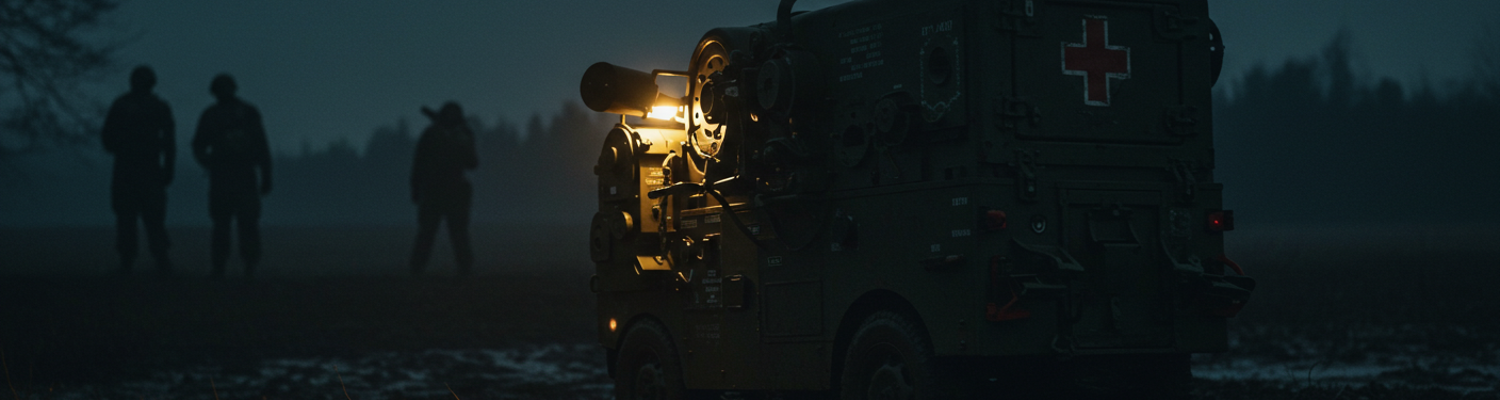

Development Imperatives
The Korean peninsula, 1950. A medic at a battalion aid station saw his world reduced to mud and bacteria. Ammunition was scarce, plasma was low. The single pot of boiling water for sterilizing surgical tools was hopelessly outmatched by the tide of mangled bodies arriving from the front. A dropped hemostat, coated in the filth of the battlefield, represented a potential death sentence from infection days later, long after a soldier was evacuated. This scene, repeated across countless aid stations, formed a central failure of World War II-era field medicine. Simple boiling and chemical washes could not keep pace with the demands of mobile warfare or provide a sufficient level of sanitation.
The solution had to be technological.
A review of after-action reports and medical planning documents from the mid-1950s reveals a military grappling with two distinct but converging threats. The first was the fresh, bloody lesson of Korea, where high rates of dysentery, hepatitis, and wound infections were a constant drain on manpower. The mobility of the conflict meant that fixed, sterile hospital environments were a distant luxury. Medical planners, looking ahead to a potential conflict with the Soviet Union, extrapolated these problems onto a much larger scale. Their planning assumed a future battlefield that could be contaminated with nuclear, biological, and chemical (NBC) agents. Mass casualties would be the norm and the existing medical chain would be completely overwhelmed. The imperative was to develop a new class of rugged, portable equipment that could bring a higher standard of medical care directly to the point of injury.
From this directive, the concept of the M-1958 Field Sterilizer was born. It promised nothing less than hospital-grade sterile readiness at the forward edge of the battle area (FEBA). In the tactical doctrine of the day, the FEBA was the fluid, violent line of contact with the enemy, often miles ahead of established field hospitals. The vision was to place a device at the battalion aid station, the first point of substantive medical care, that could produce sterile water for wound irrigation and perfectly sterilized sets of surgical instruments on demand. This capability aimed to allow for more advanced damage control surgery to be performed much closer to the point of injury, drastically cutting down the time between wounding and treatment. The goal was to reduce reliance on a long, tenuous evacuation chain and decrease mortality from secondary infections that festered during transport.
At its core, the M-1958 was designed around a single, focused capability: the sterilization of medical instruments through high-pressure steam. It was conceived as a portable, gasoline-fired autoclave, a significant leap from the simple boiling pans it was meant to replace. While boiling water could kill many bacteria, it was not effective against hardy, heat-resistant bacterial spores. An autoclave, by using steam under pressure, could achieve temperatures well above boiling, typically 121°C or higher, ensuring the destruction of all microbial life. This would bring a level of sterility to the battlefield previously only achievable in rear-area hospitals. The specifications called for a device that could take a full set of surgical tools, scalpels, forceps, retractors, and clamps, and render them safe for use in an open wound within a single, rapid cycle, powered by the same fuel that powered the Army’s jeeps and trucks.
An Unforgiving Logistical Footprint
The M-1958’s design documents promised battlefield sterility. Its operational manual delivered logistical chaos.
A close review of operational logs from medical companies attached to armored and infantry divisions in the 1960s highlights a persistent and debilitating flaw in the sterilizer’s core design: its multi-fuel burner unit. While advertised as capable of running on standard military gasoline (MOGAS), the M2 burner assembly with its delicate, precision-machined atomizer nozzle required a far cleaner, higher-grade fuel to function reliably. Standard MOGAS, drawn from the same supply chain as jeeps and trucks, was often contaminated with sediment and contained additives that would rapidly foul the M2’s internal passages. This fouling caused inconsistent flame patterns, temperature drops, and frequent, sudden flameouts during the pressurization phase of the sterilization cycle. Field units quickly discovered that only by sourcing white gas, a pure, additive-free gasoline typically used for lanterns and cook stoves, could they guarantee consistent operation. This introduced a venomous new requirement into an already strained medical supply chain. A battalion aid station, already burdened with managing blood, plasma, and bandages, now had to secure, transport, and quarantine a separate, specialized fuel supply just to make its sterilizer function as designed. An after-action report from a REFORGER exercise in West Germany noted that a forward aid station supporting an armored cavalry troop was rendered medically ineffective for six hours, not by enemy action, but by a predictable lack of the correct gasoline.
This dependency was compounded by the M-1958’s thirst for a specific and stable electrical current. The unit’s automated timers and safety interlocks could not run on the variable power from a vehicle’s electrical system. Operation demanded a dedicated power source: the MEP-026A 3.0 kW gasoline generator. This was not a small, portable inverter. The MEP-026A was a heavy, skid-mounted unit with its own four-cycle gasoline engine, weighing over 200 pounds. For a medical detachment already tasked with transporting tents, cots, medical chests, and the 300-pound sterilizer itself, the addition of another large, heavy, and maintenance-intensive piece of equipment was a significant burden.
The generator itself became a new point of failure. Its engine required its own supply of oil, spare spark plugs, and air filters, items not typically stocked in a medical supply channel. Operational records from the 47th MEDSOM are filled with frantic requests for generator parts, a task that fell outside their primary mission. The noise of the generator, audible from a considerable distance, compromised tactical positioning, a dangerous liability for a battalion aid station that needed to operate close to the front lines yet remain concealed.
Weight and fuel were one dimension of the problem. Complexity was another. The entire system was a direct impediment to the rapid movement demanded by mechanized warfare doctrine. Setting up the M-1958 was an unforgiving, multi-step process that a trained two-man team needed at least 30 minutes to complete, and that was in daylight and calm conditions. First, the 300-pound sterilizer had to be uncrated and placed on perfectly level ground. Any significant incline could cause the boiler to heat unevenly or prevent proper drainage, risking equipment failure. Medics then had to connect a web of color-coded but frustratingly similar hoses for water, fuel, power, and drainage before proceeding through a delicate, sequential pre-operation checklist detailed in a laminated instruction booklet, often read by a red-lensed flashlight. This involved manually priming the fuel pump, bleeding air from water lines, and carefully inspecting the finicky burner nozzle for carbon deposits. Only then could the nerve-wracking ignition sequence begin, a process that could easily result in a dangerous fuel flare-up that could give away the unit’s position or cause severe burns. For a medical unit supporting a fast-moving armored column, a 30-minute, stationary setup time was an operational eternity. Failure at any point in this sequence would force the operators to shut everything down and start again from the beginning.
Impairment of Medical Support
The failure of the M-1958 directly compromised the established chain of medical evacuation during large-scale formation maneuvers. A core tenet of Cold War-era doctrine was the rapid stabilization of casualties at the Battalion Aid Station (BAS), the first echelon of physician-directed care, before movement to rear-area hospitals. This entire model depended on speed.
The M-1958’s operational demands destroyed that speed.
A review of after-action reports from REFORGER exercises shows that the 30-minute minimum setup time for the sterilizer created an impossible delay for medical platoons supporting fast-moving armored or mechanized infantry units. A BAS could not halt for half an hour to make its primary tool functional while the combat elements it supported continued to advance. This forced a ruinous choice upon the battalion surgeon: either fall behind the advance and become irrelevant, or keep pace with the unit without the ability to generate sterile surgical instruments. The result was a breakdown in forward medical support. Wounded soldiers who required even minor surgical intervention for stabilization could not be treated at the BAS. Instead, they were simply packaged for transport, increasing the burden on MEDEVAC assets and lengthening the time between injury and definitive surgical care.
In the absence of a functioning autoclave, combat medics and surgeons were forced to revert to far more primitive and less effective methods of sanitization. This was a significant regression from the technological leap the M-1958 had promised. Operational logs detail medical teams falling back on two primary techniques: boiling instruments in a pot over a standard-issue gasoline camp stove, or soaking them in chemical disinfectants. Neither method provided true sterilization. While boiling water can kill most active bacteria, it is ineffective against the hardy, heat-resistant spores of bacteria like Clostridium perfringens and Clostridium tetani, the causative agents of gas gangrene and tetanus, respectively. Achieving sterility against these threats requires the higher temperatures that can only be reached by using steam under pressure, the very function of an autoclave. Chemical soaks were even less reliable, requiring long contact times that were impractical in a mass casualty situation, and their effectiveness was degraded by the presence of blood and tissue debris on the instruments.
This forced reliance on substandard sanitation methods led directly to an increased risk of severe infections for wounded soldiers. A contaminated hemostat or scalpel used in a debridement procedure at a forward aid station could introduce anaerobic bacteria deep into a wound. These bacteria thrive in the oxygen-poor environment of damaged muscle tissue, producing toxins that cause rapid tissue death, or necrosis. The result was gas gangrene, a condition that could turn a survivable wound into a fatal one within 24 hours. Historical analysis of battlefield casualties shows a direct correlation between delayed or inadequate wound care and spikes in such infections. The failure of the M-1958 meant that soldiers who survived the initial trauma of their injuries were placed at a much higher risk of dying days later from preventable infections contracted at the point of first-line care. The inability to ensure sterile instruments at the BAS transformed a device meant to save lives into a potential vector for disease.
A Quiet Withdrawal
By the early 1970s, the M-1958 Field Sterilizer was less a piece of functioning medical equipment and more of an immovable monument to logistical overreach. Its quiet withdrawal from active service was not a matter of a single directive but a slow, creeping obsolescence driven by user rejection from the ground up. Archival records of medical units participating in annual REFORGER exercises in West Germany show a clear pattern. The sterilizer, listed on unit property books and therefore required to be transported, was frequently the last item loaded and the first to be “lost” during simulated divisional movements. After-action reports from medical companies attached to fast-moving armored cavalry regiments are littered with instances of M-1958s being left behind at staging depots or suffering convenient, unrepairable breakdowns en route to the forward line of troops. Medics and their supporting maintenance teams, already stretched thin, simply refused to expend the effort required to transport, fuel, power, and set up a 300-pound machine whose core function could be crudely replicated with a pot and a gasoline stove.
It was a ghost in the supply system.
The M-1958 was a product of a procurement philosophy that prioritized theoretical technical specifications over the lived experience of the end-user. It was a technological solution in search of a narrowly defined problem, the destruction of bacterial spores, that willfully ignored the wider operational context. The focus on achieving 121°C under pressure was so absolute that it blinded designers and logisticians to the cascading second- and third-order effects of their creation. Instead of freeing the medic, the sterilizer burdened him with a new supply chain for white gas, the maintenance schedule of a heavy generator, and a 30-minute setup sequence that was a tactical impossibility for a unit trying to keep pace with an armored advance. The true revolution in battlefield medicine during this period was not found in complex hardware. It was found in systemic improvements: the widespread use of MEDEVAC helicopters, the establishment of robust blood supply programs, and the development of new topical antimicrobial agents. The M-1958, with its large physical and logistical footprint, represented a doctrinal dead-end.
The final disappearance of the M-1958 from inventory was as quiet as its operational failure was loud. By the late 1980s and the lead-up to the Gulf War, the doctrine of forward medical care had decisively shifted. The focus moved toward stabilization and rapid evacuation, coupled with the widespread use of pre-packaged, disposable sterile instrument kits and a new generation of broad-spectrum antibiotics. The problem of field sterilization was not solved by a better machine, but by designing a system that largely eliminated the need for it at the forward edge of the battle area. The remaining M-1958s were gradually withdrawn, their line items deleted from supply catalogs. Newer, smaller, and more efficient automated steam sterilizers, like the P2131, were eventually fielded for use in combat support hospitals, but these devices were designed with the lessons of the M-1958’s failure in mind, emphasizing water efficiency and simplified operation. The hulking, gasoline-fired machines of the 1950s were consigned to Defense Reutilization and Marketing Office (DRMO) yards, to be sold for scrap.