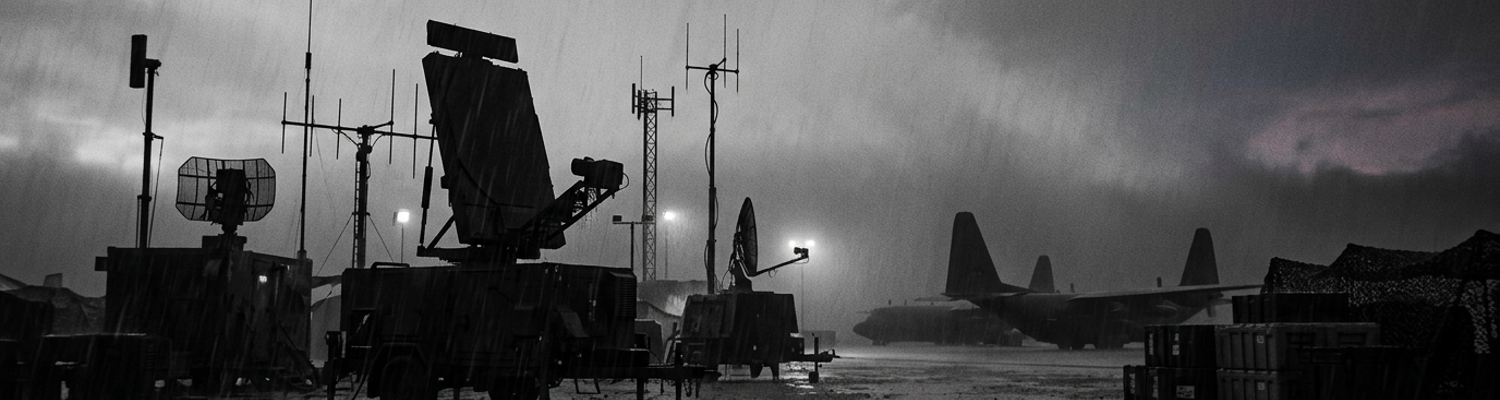

Austere Deployments at Johnston Atoll Airstrip
Freezing rain lashed the crushed coral surface of the runway. The precipitation instantly turned the accumulated topsoil and construction dust into a thick abrasive mud. Unbearable heat followed minutes later as the squall line broke. The sudden temperature spike baked the moisture into a dense vapor hovering just above the tarmac. The environmental cycle at 16 degrees 45 minutes North 169 degrees 31 minutes West consisted entirely of this violent oscillation between sudden hypothermic atmospheric deluges and blinding equatorial thermal radiation.
The climate actively dismantled heavy machinery.
Archival evidence shows that in mid-1989, Pacific Air Forces command ordered a rapid buildup of surveillance assets on this isolated speck of land. Elements of the 961st Airborne Warning and Control Squadron deployed multiple E-3 Sentry AWACS detachments to Johnston Atoll for Central Pacific air surveillance. Soviet Naval Aviation Tu-95 bomber sorties had increased along the Hawaiian transit corridors during the mounting geopolitical tension. Pacific Command required an immediate forward-deployed radar picket to track these long-range incursions before they breached the outer air defense identification zones. The E-3 airframes landed on the 9,000-foot primary runway carrying minimal ground support equipment. These were modified Boeing 707s carrying the heavy AN/APY-1 passive electronically scanned array radar.
Logistics officers at Hickam Air Force Base allocated only three C-141 Starlifter cargo flights. These flights transported the diagnostic computers, spare auxiliary power units, and flightline tool kits. Ground crews slept in un-air-conditioned canvas tents pitched directly on the rough coral aggregate alongside the taxiway. Base infrastructure lacked hardened hangars or covered maintenance bays. The expensive surveillance aircraft parked directly in the open elements. They were completely exposed to the prevailing trade winds.
Parts availability dictated mission generation.
A close review of operational logs indicates a rapid degradation of hardware across the detachment within the first three weeks of arrival. High marine salinity and high humidity rapidly eroded airframe components. Exposed electrical systems failed throughout the E-3 fleet. The ambient air contained microscopic salt crystals. These crystals bypassed the standard environmental seals on the radar rotodome hydraulic struts. The contamination scored the polished metal cylinders during every rotation of the thirty-foot radar dome.
Hydraulic fluid bled directly onto the hot exhaust manifolds of the inboard TF33 turbofan engines. This created a constant fire hazard during taxi operations.
Wiring harnesses running through the unpressurized wheel wells absorbed the saturated air during low-altitude holding patterns. The moisture caused hard electrical shorts in the multiplex data buses linking the mission crew consoles to the central computer complex. Copper grounding straps oxidized into brittle green flakes. These flakes snapped under normal flight vibrations.
Technicians worked eighteen-hour shifts replacing corroded terminal blocks.
Supply officers submitted daily high-priority requisition forms via secure teletype to the Defense Logistics Agency depot in Hawaii. The requested anti-corrosion compounds were backordered across the entire Pacific theater due to competing demands in South Korea. Mechanics resorted to scrubbing the radar waveguides with unauthorized commercial solvents shipped via civilian mail. The supply chain bottleneck worsened when a salt-induced short circuit fried the primary ground-based air conditioning cart. This specific cart was required to cool the AWACS internal mainframe during pre-flight alignment procedures. The aircraft sat idle on the apron while ambient cabin temperatures exceeded 130 degrees Fahrenheit. The heat warped the plastic casings of the tactical display screens and melted the insulation on the communications relay wiring.
The lack of standard replacement parts forced maintenance personnel to cannibalize one grounded E-3 just to keep a single aircraft flying. Flight engineers documented fifty-two distinct system failures on a single airframe over a four-day period.
Salt Salinity and Radar Cooling Degradation
When examining the historical record of the 961st Airborne Warning and Control Squadron during the late summer of 1989, the primary cause of grounded sorties traces directly to the aft fuselage of the E-3 Sentry. The aircraft relied on a gas turbine Auxiliary Power Unit to generate electrical current and pneumatic pressure before the main TF33 engines spooled up. Ground crews parked these modified Boeing 707s directly on the crushed coral apron at Johnston Atoll. Prevailing trade winds whipped off the Pacific Ocean at twenty knots. This constant breeze carried high concentrations of atomized marine salinity directly into the APU intake vents positioned near the tail.
The ambient salt spray baked onto the internal compressor blades during the combustion cycle.
Hardened sodium deposits disrupted the precise aerodynamic balance of the titanium turbine wheels. Mechanics operating on the flightline noted severe pitting along the leading edges of the stators after just forty hours of operation in the tropical environment. Extended rotations on the atoll subjected these unprotected intake tracts to continuous corrosive exposure.
The resulting internal friction snapped the main generator drive shafts.
A close review of maintenance logs from early September reveals a secondary compounding failure point within the APU fuel delivery system. Extreme temperature fluctuations on the tarmac caused heavy condensation to form inside the partially empty wing tanks overnight. Water pooled at the lowest points of the internal plumbing. Microscopic fungi thrived at the boundary layer between the heavy liquid water and the lighter JP-8 aviation fuel.
This biological sludge combined with heavy particulate contamination from the construction dust. The mixture bypassed the primary strainers.
The viscous material packed tightly into the micron-level paper filters of the APU fuel control units. Fuel pressure dropped below the minimum threshold required for ignition. Technicians from the 961st spent hours under the wings with safety wire and drain pans. They manually bled gallons of contaminated water from the sump valves. Base commanders ordered strict rationing of APU run times to preserve the few surviving generators. Crews had to execute rapid pre-flight checks in complete darkness to save electrical power.
Supply depots in Hawaii denied emergency requisition requests for replacement fuel control units due to a theater-wide shortage.
Above the fuselage, environmental degradation dismantled the primary surveillance sensor. The thirty-foot AN/APY-1 radar housing required a continuous flow of synthetic polyalphaolefin coolant. This fluid prevented the high-power passive electronically scanned array from self-destructing. Archival evidence shows that persistent environmental corrosion compromised the sensitive liquid cooling loops inside the unpressurized fiberglass rotodome.
The hardware relied on a complex network of aluminum tubing and steel connective fittings. This network circulated the chilled fluid across the densely packed transmitter modules.
Saline moisture penetrated the worn neoprene weather seals at the base of the rotating strut. Trapped ocean water acted as an electrolyte between the dissimilar metals of the coolant manifold. Galvanic corrosion rapidly ate through the aluminum pipe walls. Micro-fractures formed along the welded seams of the primary heat exchangers. Pressurized polyalphaolefin fluid leaked out into the internal cavity of the dome. It pooled around the high-voltage phase shifters.
Coolant reservoir levels dropped to zero mid-flight.
Radar operators inside the fuselage watched their tactical screens go blank as the automated thermal limiters engaged. The AN/APY-1 transmitters generated massive thermal loads during standard sector scans. Without the liquid cooling loops actively transferring that energy to the ram-air scoops, the internal hardware reached failure temperatures almost instantly.
A detachment engineering report dated September 12 details frantic attempts to patch the corroded manifolds using industrial epoxy and silicone tape. Field repairs failed under the 3,000 pounds per square inch of operating pressure.
Flight engineers cannibalized intact cooling lines from an aircraft grounded with a shattered landing gear strut. They spent consecutive night shifts suspended in safety harnesses thirty feet above the tarmac. They attempted to splice the stolen aluminum tubes into a functional radar dome using handheld flaring tools. Repair teams lacked the specialized vacuum pumps required to purge air bubbles from the newly sealed cooling loops. Cavitation inside the lines destroyed the primary circulation pump bearings on the very next engine start.
Supply Bottlenecks for Radar Power Units
A close review of operational logs from the 961st Airborne Warning and Control Squadron indicates a complete breakdown in routine airframe decontamination by early September. Standard Air Force technical orders required ground crews to perform a full-scale fresh water rinse of the E-3 Sentry exterior every seventy-two hours. The high-salinity marine environment demanded it.
This procedure relied entirely on specialized desalting wash kits. The A/M32A-86 portable reverse osmosis units were specifically required.
These trailer-mounted systems filtered the calcified local groundwater on Johnston Atoll into deionized spray. Purified water was necessary to safely dissolve the thick layers of crystallized sodium chloride accumulating on the composite materials of the thirty-foot radar rotodome. Base commanders submitted daily requisition forms to the Defense Logistics Agency depot at Pearl Harbor. They requested replacement resin filter cartridges and MIL-C-85570 Type II alkaline cleaning compounds.
Supply officers in Hawaii repeatedly marked these requests as backordered.
The inventory tracking system routed all available aviation cleaning supplies to tactical fighter wings operating out of Kadena Air Base in Japan. Maintenance chiefs at the atoll canceled the mandatory wash cycles entirely on September 14.
Without the specialized desalting kits, the corrosive Pacific air rapidly compromised the external mounting hardware of the passive electronically scanned array. High-velocity winds drove aerosolized ocean spray directly into the unsealed gaps between the aluminum fuselage and the steel support struts of the radar dome. The accumulated salt baked into a hard white crust under the equatorial sun.
This deposit functioned as a mechanical abrasive against the protective polyurethane paint during flight operations. Bare metal was exposed to the humid atmosphere within days.
Galvanic corrosion began eating away at the cadmium-plated grounding studs connecting the external wiring harnesses to the airframe. The resulting impedance mismatch in the electrical grounds caused intermittent static interference on the tactical display screens inside the cabin. Flightline mechanics attempted to manually scrub the strut assemblies using unauthorized buckets of untreated tap water and stiff nylon brushes. The highly chlorinated local water only accelerated the oxidation process on the exposed aluminum panels.
By the third week of the deployment, severe corrosion forced the grounding of three separate surveillance aircraft.
Archival evidence shows that replacing the damaged AN/APY-1 radar power supplies presented an entirely different supply failure across the Pacific theater. The surveillance radar required specialized High Voltage Power Supply units to convert the raw alternating current from the engine-driven generators into the precise direct current needed by the transmitter modules.
Each power supply weighed four hundred pounds.
The heavy metal casings contained delicate high-capacity capacitors packed inside pressurized dielectric fluid. Severe voltage fluctuations caused by the corroded grounding studs forced these internal capacitors to overheat and rupture. Thick acrid smoke filled the aft equipment racks when a unit failed. Replacing a blown power supply required an exact hardware match shipped directly from the manufacturer on the mainland.
Logistics planners at Travis Air Force Base in California loaded the replacement crates onto pallets. The Pacific airlift schedule was already saturated. C-141 Starlifter cargo flights heading westbound prioritized anti-submarine warfare buoys and replacement jet engines for the carrier strike groups assembling near the Philippine Sea.
Loadmasters routinely bumped the heavy AWACS power units from the manifests to save weight.
The resulting bottleneck stranded eleven AN/APY-1 power supply units in a holding warehouse at Hickam Air Force Base for eighteen days. Detachment commanders at Johnston Atoll sent urgent encrypted messages requesting a dedicated C-130 Hercules transport flight to retrieve the stranded hardware. Theater command denied the request to preserve flight hours for tactical transport operations.
On the ground at the 16 degrees 45 minutes North 169 degrees 31 minutes West coordinates, the 961st AWACS maintenance crews ran out of functional spares by September 22. Technicians resorted to cannibalizing power units from aircraft already grounded for engine maintenance. Moving the heavy metal boxes required K-loader vehicles. These heavy machines constantly sank into the muddy crushed coral surface of the apron.
Mechanics laid down interlocking steel Marston Matting to create a stable path between the parked aircraft. A heavy forklift sheared a hydraulic line while attempting to lift a salvaged power unit into the cargo door of a waiting E-3. The accident dumped twenty gallons of hydraulic fluid onto the tarmac and permanently damaged the connecting pins on the only working power supply.
Degraded Tracking and Interrogator Channel Failures
When examining the historical record of the 961st Airborne Warning and Control Squadron, a pattern of electronic degradation emerges within the primary Identification Friend or Foe systems. The E-3 Sentry relied on the AN/APX-103 interrogator set to ping transponders on approaching aircraft across a three-hundred-mile radius. This hardware sat in the unpressurized lower equipment bays directly above the main landing gear.
High ambient temperatures on the Johnston Atoll tarmac caused rapid thermal expansion across the solid-state circuit boards of the receiver modules.
Cooling fans ingested construction dust from the runway expansion project directly into the aluminum chassis. The abrasive silica coated the copper heat sinks. Transistors overheated during standard twelve-hour combat air patrols over the Pacific transit corridors. Solder joints connecting the cryptographic key loaders to the main processing units cracked under the constant vibration of the four TF33 turbofan engines.
Aircrews flew blind in highly congested airspace.
Radar operators sitting at the mission consoles inside the pressurized fuselage logged continuous interrogator channel failures starting in late September. The AN/APX-103 system failed to decode the encrypted Mode 4 return signals from friendly F-15C fighter escorts launching out of Hickam Air Force Base. Display screens showed raw unidentified target tracks instead of the designated blue friendly symbology.
Mission commanders ordered their airborne controllers to manually verify every radar contact using voice communications over unencrypted ultra-high frequency radio nets.
This manual verification process consumed valuable minutes during high-speed intercept operations. Soviet Naval Aviation Tu-95 bombers routinely approached the outer air defense identification zones at over four hundred knots. The bombers dropped active radar decoys along the flight path. Controllers lacked the automated tracking data needed to calculate precise intercept geometries through the electronic clutter. They vectored the F-15s using raw primary radar returns and estimated altitudes derived from delayed pilot reports.
Voice channels jammed as multiple controllers attempted to coordinate intercepts simultaneously.
A close review of operational logs indicates that ground maintenance crews exhausted their supply of replacement AN/APX-103 Line Replaceable Units by early October. Technicians established a makeshift avionics repair station inside a canvas tent at the edge of the crushed coral taxiway. They worked under battery-powered lanterns during the night shift to avoid the punishing daytime heat. Mechanics used standard multimeters to test thousands of individual pin connectors on the fried circuit boards.
Base supply officers transmitted urgent requisitions for replacement receiver-transmitter modules to the Defense Logistics Agency via secure teletype. Theater command prioritized these specific electronic components for tactical units operating near the Sea of Okhotsk. Cargo manifests from the bi-weekly C-141 Starlifter supply flights showed zero incoming IFF parts for three consecutive weeks.
Maintenance chiefs ordered flightline crews to cannibalize the interrogator units from an E-3 already grounded for heavy engine repair.
Mechanics stripped the grounded airframe of every functional circuit card.
Archival evidence shows the cannibalization process introduced secondary mechanical failures deep within the airframe infrastructure. Removing the receiver-transmitter modules required technicians to disconnect rigid coaxial cables connecting the IFF chassis to the belly-mounted antenna arrays. Repeatedly unscrewing these heavy brass connectors stripped the delicate aluminum threads on the receiver ports.
High-humidity marine air infiltrated the exposed cable housings overnight while the aircraft sat open on the apron. The trapped moisture altered the electrical impedance of the primary transmission lines.
When flight engineers powered up the scavenged interrogator units the next morning, the mismatched impedance reflected high-wattage radio frequency energy directly back into the transmitter. This feedback loop instantly burned out the final stage amplifier tubes inside the borrowed hardware. Supply personnel documented the destruction of the detachment's last functional amplifier on a requisition form dated October 14.
The logistics depot listed the estimated delivery time for a replacement tube as ninety days.
Data Relay Corruption and Target Misidentification
A close review of operational logs indicates that the PACEX 89 naval and air exercise pushed the Johnston Atoll forward-operating site completely beyond its physical tolerances. Elements of the 615th Tactical Control Squadron deployed to the island in early October to establish a ground-based command center. Technicians positioned their AN/TYQ-23 modular control equipment directly on the exposed crushed coral aggregate near the primary taxiway.
Base engineers lacked the materials to construct climate-controlled server rooms or hardened communications bunkers.
Ground controllers operated inside uninsulated canvas tents powered by external MEP-806 diesel generators. The exhaust from these generators blew directly across the unsealed junction boxes connecting the high-frequency radio antennas to the main cryptographic relay modules. Salt-laden moisture from the Pacific trade winds combined with the diesel soot to form a highly conductive sludge across the exposed copper wiring. This accumulation caused continuous micro-shorts within the tactical data link processors.
The entire regional air picture degraded into intermittent bursts of electronic static.
Archival evidence shows that these localized hardware failures directly compromised the TADIL-A data relays transmitting between the airborne E-3 Sentry AWACS and the ground controllers. High atmospheric pressure systems moving across the Hawaiian archipelago generated fifteen-foot swells across the interception corridors. The cresting ocean waves produced heavy radar surface clutter on the AWACS passive electronically scanned array.
Normal operational parameters required the E-3 onboard IBM 4PI CC-1 central computer to filter out this sea state interference using Doppler shift algorithms.
Degraded cooling systems inside the AWACS radar dome forced flight engineers to manually bypass the primary thermal limiters to keep the processors running. The overheated computers failed to process the Doppler filters correctly and began generating hundreds of false radar returns across the tactical display screens. Airborne controllers attempted to transmit this heavily cluttered radar picture down to the Johnston Atoll ground station via the ultra-high frequency data link.
Oxidized ground antennas dropped thousands of data packets during the transmission.
The resulting data corruption caused a fatal target misidentification on the night of October 24. Two F-15C fighters from the 18th Tactical Fighter Wing launched from Hickam Air Force Base to intercept a suspected Soviet Naval Aviation Tu-142 Bear operating two hundred miles north of the atoll. The F-15C pilots flew under strict emission control protocols. They kept their own AN/APG-63 onboard radars powered down to avoid alerting the Soviet aircraft.
They relied entirely on the data link coordinates relayed from the Johnston Atoll tactical control center.
Ground controllers watched their warped display screens as the corrupted data feed merged the track of the lead F-15C with a false radar return generated by a localized rain squall. The dropped data bits shifted the digital altitude readout of the phantom target from 18,000 feet down to 500 feet above the water. A ground controller issued a rapid descent vector to the wingman, callsign Chevy Two-Two. The controller directed him to intercept the low-altitude contact.
Corrupted telemetry fed directly into the intercept geometry.
Chevy Two-Two executed a steep diving turn through the heavy cloud cover in complete darkness. The pilot trusted the ground relay completely. He armed his AIM-7 Sparrow missiles and descended past the 1,000-foot hard deck while attempting to acquire a visual identification on the target.
The assigned radar track did not exist.
The F-15C impacted the Pacific Ocean at four hundred and fifty knots. The airframe instantly disintegrated upon contact with the heavy swells. Search and rescue helicopters from the 33rd Rescue Squadron launched from Hickam at 0200 hours. They navigated the search grid using infrared sensors and dropped illumination flares over the estimated crash coordinates.
The helicopters found only an oil slick and shredded aluminum floating on the surface.