
A Coastline of Wrecks
The American coastline during the Reconstruction and Gilded Age presented a stark duality. It was a landscape of immense economic promise and simultaneous, profound peril. A nation rebuilding itself and flexing its industrial might depended on a constant flow of maritime commerce carried by thousands of sail and early steam vessels. These arteries of trade were exceptionally vulnerable. The Atlantic seaboard, in particular, was a known ship graveyard. Storms appeared with little warning and turned profitable voyages into desperate fights for survival against the rocks and shoals lining the coast. In the decades following the Civil War, the existing system for maritime rescue, a loose confederation of volunteer stations, proved utterly inadequate. It was a system plagued by neglect, political cronyism, and decaying equipment. The human cost mounted with each storm season, a grim tally reported in the nation’s newspapers, until public outcry demanded a professional, reliable force to stand watch.
This demand led to the formal establishment of the United States Life-Saving Service. Its story is not one of battle flags and foreign campaigns but of a relentless, grinding war against the ocean itself. The soldiers in this war were the surfmen, men who pitted their skill, endurance, and specialized equipment against the most destructive forces of nature. Their work was defined by a stark, unforgiving reality. This reality was captured in their unofficial motto, a phrase passed down from keeper to surfman: "The Blue Book says you have to go out, but it doesn’t say you have to come back." It was a plain acknowledgment of the terms of their service, a commitment to action in the face of mortal danger.
The Kimball Reforms and the Iron Surfman
The transformation from a haphazard collection of shacks to a disciplined federal service began with one man: Sumner Increase Kimball. A lawyer and administrator from Maine, Kimball was appointed chief of the Treasury Department’s Revenue Marine Division in 1871. He was not a mariner, but he was an exceptional bureaucrat with a deep intolerance for inefficiency and corruption. One of his first actions was to dispatch Captain John Faunce of the Revenue Cutter Service on a comprehensive inspection of the existing lifesaving stations along the coasts of New Jersey and Long Island. Faunce’s report was a scathing indictment. He found stations in disrepair, their roofs leaking and their walls crumbling. Rescue equipment, where it existed, was rusted and unusable. Keepers were often appointed for their political loyalty rather than their seamanship. Many were not even residents of the coastal communities they were supposed to protect, living miles inland and showing up only to collect their meager pay.
Armed with this damning evidence, Kimball convinced a reluctant Congress to appropriate $200,000 for a complete overhaul. He systematically purged the politically appointed keepers and began building a new service from the ground up. In 1878, the U.S. Life-Saving Service was formally established as a separate agency within the Treasury Department, with Kimball as its General Superintendent. He instituted a strict, merit-based system. To become a surfman, a man had to be an expert boatman and swimmer, typically recruited from the local fishing and shipping communities. He had to be physically robust, between 18 and 45 years of age, and able to read and write. Each station was staffed by a keeper and a crew of six to eight surfmen who lived at the station during the active season, typically from late fall to early spring when the weather was most treacherous.
Life at the station was governed by a quasi-military routine designed to build teamwork and muscle memory. The week was a relentless cycle of drills detailed in the service's regulations, the "Blue Book." Monday was for practicing with the beach apparatus, deploying the Lyle gun and breeches buoy. Tuesday was dedicated to boat drills, launching the heavy surfboat through the breakers and rowing for hours to build endurance. Wednesday focused on signaling, using flags, lanterns, and pyrotechnic Coston flares. Thursday repeated the beach apparatus drill, reinforcing every step of the complex procedure. Friday was for practicing resuscitation techniques for the "apparently drowned," grim work using primitive methods of manual manipulation. Saturday was for cleaning and maintaining the station and its equipment to impeccable standards. This rigid schedule ensured that when a real wreck occurred, the crew could perform their duties with speed and precision, even in the chaos of a storm. At night and in foul weather, the surfmen walked patrol. Each man would walk miles of desolate beach in his assigned shift, carrying a lantern and a patrol check, punching a time clock at a key post halfway to the next station to prove his vigilance. This combination of intense training, constant watchfulness, and unwavering discipline forged the unique ethos of the Service and was directly responsible for its operational success.
Apparatus for a War Against the Sea
The effectiveness of the surfmen depended on their specialized equipment, tools designed to function in the worst possible conditions. For wrecks that occurred close to shore, where launching a boat was impossible, the primary means of rescue was the beach apparatus. This collection of gear, transported on a heavy, purpose-built cart pulled by the men themselves, centered on the Lyle gun. Developed in the 1870s by U.S. Army Captain David A. Lyle, this was a small, 184-pound bronze cannon with a 2.5-inch bore. It fired a 17-pound iron projectile attached to a thin, strong shot line of braided linen. The gunner’s task was to fire this line over the mast and rigging of the stranded vessel, often from a distance of several hundred yards in a gale-force crosswind, a feat requiring immense skill in judging wind and trajectory.
Once the ship’s crew caught the shot line, they used it to haul a heavier whip line aboard. Attached to the whip line was a tally board with instructions printed in English and French, directing them to secure a pulley block to the mast. Through this block ran the whip line, creating a loop controlled from the shore. The surfmen then sent out a thick, 3-inch manila hawser, which the sailors would secure high up on the mast. Back on the beach, the surfmen anchored the hawser to a buried sand anchor and made it taut using a tackle system. Finally, the breeches buoy, a simple life ring with a pair of canvas breeches attached, was suspended from the hawser and pulled out to the ship. One by one, survivors would climb into the buoy and be hauled to safety by the surfmen on the beach. The entire operation was a complex sequence performed with disciplined haste in the midst of pandemonium.
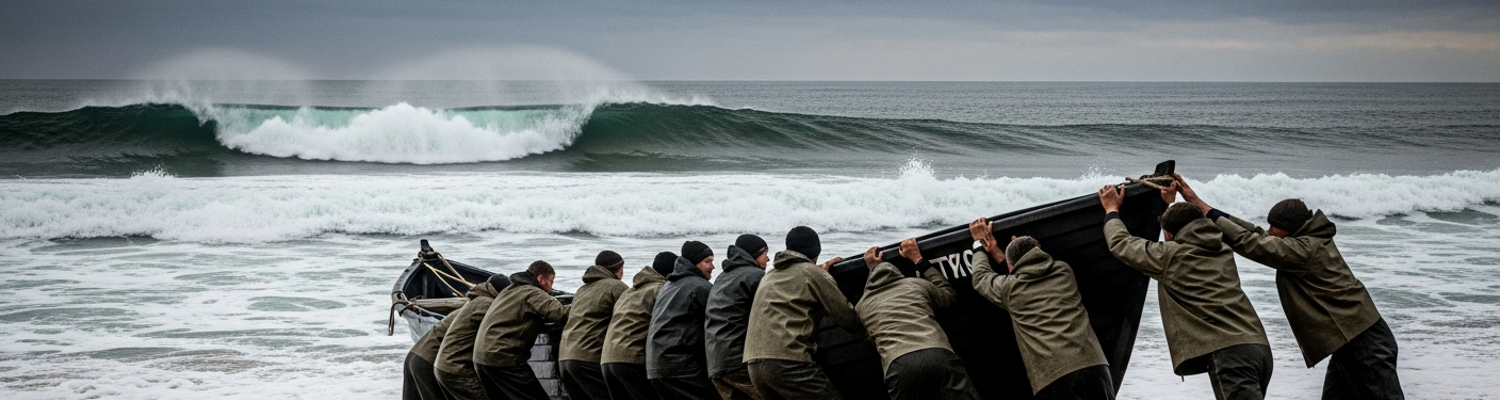
When a boat launch was possible, the surfmen relied on remarkable vessels. The most common was the Beebe-McLellan self-bailing surfboat. Typically 25 to 27 feet long and constructed of cedar planks on oak frames, these boats were open to the elements but designed with freeing ports in the hull that allowed any water washing aboard to drain away quickly. While exceptionally seaworthy, they were not self-righting; if they capsized, the crew had to right the boat themselves. For the most exposed stations on the Great Lakes and the Atlantic, the Service deployed larger, heavier lifeboats. These were often self-righting, an engineering feat accomplished through high, watertight buoyancy chambers at the bow and stern and a heavy iron keel weighing nearly 1,000 pounds. If the boat was overturned by a wave, the combination of the buoyant ends and the weighted keel would cause it to roll back upright. Launching these boats from the beach was an act of controlled violence. The crew would wheel the boat to the water’s edge on its carriage, waiting for a lull between the massive breakers. On the keeper’s command, they would run the boat into the surf, leap aboard, and pull with all their might on the long oars to break through the violent surf zone before the next wave could drive them back or flip them.
The Ledger of Lives Saved and Lost
The official records of the Life-Saving Service document 178,741 lives imperiled and 177,286 saved during its 44-year history from 1871 to 1915. These statistics, however, fail to convey the immense human cost of such a record. The work was brutal, and death was a constant companion. On November 24, 1889, the six-man crew of the Marthas Vineyard station launched into a blizzard to aid the shipwrecked schooner H.P. Kirkham. They successfully rescued the schooner’s crew but became lost in the blinding snow on their return. Their frozen bodies, along with those they had rescued, were found days later after their boat washed ashore.
A particularly telling story is that of the all-Black crew of the Pea Island station in North Carolina. In 1880, after the previous white crew was dismissed for incompetence, the station was placed under the command of Richard Etheridge, a former Union Army sergeant who had served in the Civil War. Etheridge, a consummate waterman, ran his station with iron discipline and trained his crew to an elite standard. On October 11, 1896, during a hurricane of exceptional violence, the schooner E.S. Newman was driven ashore. The vessel was breaking apart so quickly in the churning surf that using the beach apparatus was impossible. Etheridge ordered a different approach. He had two of his strongest surfmen tie a line around their waists and, holding another rescue line, wade into the maelstrom. While the rest of the crew anchored the line on the beach, the two men fought their way through the undertow to the wreck. They reached the vessel, tied the line to a stranded sailor, and the crew on shore hauled all three back through the waves. They repeated this perilous trip ten times, saving every person aboard the Newman, including the captain’s wife and young child. For this act, the crew received no official recognition at the time. It was not until 1996, a century later, that the Coast Guard posthumously awarded the Gold Lifesaving Medal to the Pea Island crew.
These events were not exceptions; they were emblematic of the service itself. The surfmen endured isolation, low pay, and the constant physical and psychological strain of their duties. They operated at the raw edge of human endurance, relying on their training, their equipment, and their profound sense of duty to one another and to the strangers whose lives depended on them. They were the sentinels of the Gilded Age, the guardians who stood watch on the nation’s most dangerous frontiers, bought at a price measured in their own exhaustion and blood.