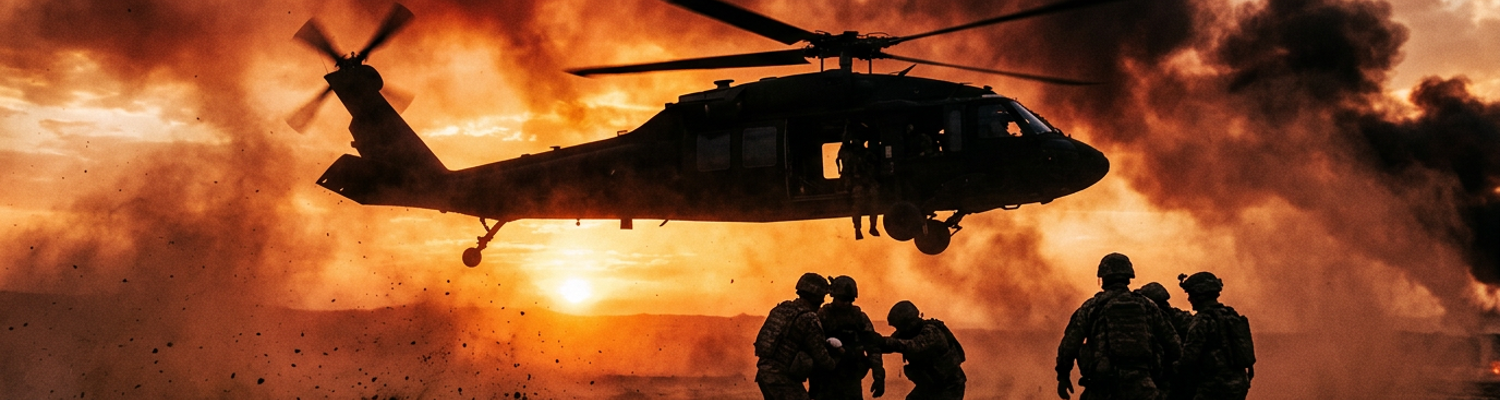

VII Corps Staging and Forward Aeromedical Basing
Limestone dust churned across the northern Saudi Arabian borderlands in February 1991, scouring aircraft skins and clogging intake vents. Violent winter storms drove freezing rain into the open desert, transforming dry wadi networks into deep mud channels and plunging nighttime temperatures below freezing. Relentless surface winds lifted the powder-fine silt into blinding clouds, eliminating visual horizon lines and scratching the polycarbonate windshields of incoming helicopters until clear glass turned opaque and milky. Powerful turbine engines inhaled the abrasive mineral grit with every turn of the rotor blades, which wore down protective compressor coatings, pitted high-pressure turbine components, and clogged intake filtration systems within minutes of initial startup. Ground crews wiped down rotor heads and canopy glass by hand with damp rags every hour to keep the helicopters operational in the driving sand.
Mechanics of the 24th Medical Company tackled that relentless mechanical wear immediately after the unit received orders assigning it to the 56th Medical Battalion to provide dedicated rotary-wing aeromedical support for VII Corps. Army commanders directed the company to fly its fifteen UH-60A Black Hawk medical evacuation helicopters out of established rear bases and push them into primitive tactical assembly areas positioned far out on the western desert shelf. Flight personnel slept on canvas cots inside drafty tents pitched on sharp rock, while crew chiefs tied down their aircraft behind earthen berms thrown up by bulldozers to break the wind. Standard Army aeromedical doctrine had led crews to expect paved dispersal pads, covered maintenance hangars, and solid logistical supply lines, but these forward assembly sites offered only fabric fuel bladders and hand-pumped drums of motor oil. Enlisted flight medics organized their onboard treatment bays in freezing drafty cabins, discovering that the bitter desert nights dropped cabin temperatures so low that intravenous fluid bags began freezing solid in their storage brackets before patients even arrived.
Medics solved that physical hurdle by stuffing cold intravenous fluid bags inside their own chemical suits and flight uniforms for body heat while company leaders integrated their aircraft directly into the armored maneuver axis of advance alongside heavy mechanized cavalry units. Pilots sat beside staff officers from the 2nd Armored Cavalry Regiment and heavy armored divisions, studying grease-pencil attack corridors across maps that showed almost no recognizable terrain features or roads. Peacetime aeromedical manuals dictated that air ambulance helicopters should remain several miles behind armored spearheads and land only after ground troops had cleared and marked sterile casualty collection points, but the high operational speed of M1A1 Abrams tanks made that separation distance completely impractical. Flight crews understood that following cautious peacetime doctrine would isolate wounded soldiers in the desert for hours, so Black Hawk pilots agreed to fly directly behind the advancing armored cavalry columns through track-churned dust clouds. Aviators tuned their cockpit avionics to cavalry radio networks and focused their green night vision goggles on the northern horizon, preparing to launch their aircraft into the pitch-black desert night the moment armored bulldozers breached the border berm.
Field Manual 8-10-6 Doctrinal Assumptions
Radio headsets buzzed with static inside the idling Black Hawk cabins as flight crews realized the theoretical guidelines in Field Manual 8-10-6 offered no realistic answers for the tactical chaos unfolding beyond the border berm. Field Manual 8-10-6, the official doctrine governing aeromedical evacuation in a theater of operations, was written for a slow-moving, defensive war in central Europe against conventional Warsaw Pact armies. The manual assumed aeromedical companies would operate along predictable, stabilized frontlines with well-defined forward lines of own troops and established divisional boundaries. It also assumed that ground combat units would maintain clean line-of-sight communication relays and deliver their wounded to secure, well-fortified casualty collection points positioned safely behind the forward edge of the battle area. Army doctrine designed these casualty collection points to function as stationary medical hubs where ground ambulances gathered casualties for orderly triage before calling in rear-echelon air support. Extreme operational distances and the lack of high ground immediately blocked tactical frequency-modulation radio waves, cutting helicopter crews off from forward medical stations and invalidating the manual assumptions about neat, stationary battle lines.
VII Corps armored columns broke the remaining doctrinal evacuation models the moment heavy tank divisions breached the border berm and accelerated across southern Iraq. Field Manual 8-10-6 based its casualty transfer time estimates on a controlled, linear battlefield where wounded soldiers reached forward aid stations within minutes and entered definitive surgical care within a strict one-hour window. The rapid, uninterrupted pace of the VII Corps armored offensive destroyed those peacetime time calculations as M1A1 Abrams tanks and M2 Bradley fighting vehicles pushed across the desert floor at speeds exceeding twenty miles per hour. Advancing spearheads left logistics units far behind, expanding the distance between forward triage points and rear field hospitals from twenty miles to well over one hundred miles within the first two days of ground operations. Black Hawk pilots faced round-trip flights lasting three to four hours over hostile territory, which forced medical evacuation crews to make emergency fuel stops at remote desert fuel points while critically injured patients waited onboard. Air ambulance crews burned up their reserve fuel searching for scattered combat units in the dark because the doctrinal navigation systems described in military manuals did not exist in the open desert.
Flight manuals and doctrinal provisions in FM 8-10-6 failed to provide procedures for operating air ambulances over featureless desert terrain lacking tactical radio repeaters or fixed navigation beacons. Peacetime aeromedical doctrine assumed pilots could navigate using prominent physical landmarks such as rivers, paved highway networks, and ridgelines, supported by ground-based non-directional beacons and tactical air navigation stations. The western desert contained no elevation markers, transmission towers, or electronic navigation stations to broadcast orientation signals to incoming helicopters. Pilots wearing night vision goggles encountered severe spatial disorientation as blowing dust and overcast night skies created absolute darkness, while the lack of mountaintop radio repeaters severed voice communications with division medical operations centers. Flight medics and pilots abandoned standard manual protocols and coordinated casualty pickups by tuning directly into short-range cavalry combat radios while manually tracking coordinates on knee-board maps. Pilots strapped small commercial Global Positioning System receivers to their cockpit glare shields with velcro, bypassed standard manual guidelines, and entered raw coordinate data to steer their aircraft toward moving armored columns in the dark.
Night Vision Degradation from Weather and Smoke
Aviators followed those digital coordinate readings straight into sweeping winter squalls that wiped out all visual contact with the ground. Violent shamal sandstorms blew across the southern Iraqi border, lifting dense clouds of pulverized limestone that struck driving rain and coated the helicopter windshields in gritty paste. Crew members looking through AN/AVS-6 night vision goggles experienced severe image distortion and optical scintillation as high-velocity sand grains and torrential rain droplets scattered ambient light across the objective lenses. Scintillation generated violent, sparkling static across the green phosphor screens, producing dense electronic noise that blurred horizon lines and made close-range obstacles impossible to identify. Air ambulance pilots struggled to hold steady flight attitudes because the optical distortion tricked their eyes into perceiving false movement in the pitch-black airspace.
Soot from hundreds of burning Kuwaiti wellheads drifted into these storm fronts, compounding the swirling sand with dense layers of oily industrial smog. Retreating Iraqi forces had detonated explosive charges across oil field manifolds, releasing massive plumes of heavy atmospheric soot that rose thousands of feet into the sky and drifted westward over VII Corps operational corridors. Aviation night vision systems suffered a complete loss of contrast as the thick hydrocarbon cloud absorbed infrared energy and eradicated the temperature and visual differences between terrain features. Pilots stared into their intensified displays and saw only an unbroken, featureless green smear where dunes, deep wadis, and armored vehicles blended into a single flat plane. Flight crews descended toward ground level to find surface visual references, but the dense, suspended particles wiped out all depth perception and obscured every physical checkpoint.
Clouds of heavy soot and winter storm fronts completely eliminated ambient starlight and celestial illumination across these low-altitude flight paths. Total darkness left the night vision tubes without incoming photons, causing the intensified green images to dissolve into pure electrical noise. This loss of ambient starlight and celestial illumination forced flight crews to transition abruptly between night vision devices and instrument scanning while flying mere feet above unmapped obstacles. Aviators pushed their goggles up on their helmets or looked underneath the optical tubes every few seconds to cross-check their airspeed indicators, turn-and-slip needles, and barometric altimeters. Rapid eye movements between bright green night vision screens and dim red cockpit instrument lighting induced severe spatial disorientation and acute eye fatigue among the pilots.
Radar altimeters chirped intermittent audio warnings into the crew headsets as Black Hawks drifted perilously close to rolling desert dunes during these disorienting low-altitude casualty searches. Copilots kept their heads locked inside the cockpit, calling out radar altitudes and descent rates in steady voices while the flying pilot held the controls and scanned the black airspace outside. Flight crews maintained hover attitudes twenty feet above the sand by watching rotor wash stir up limestone powder, using the swirling dust rings illuminated by landing searchlights as their sole visual reference. Crew chiefs slid back the side cargo doors, leaned into the freezing slipstream, and shouted altitude corrections over the intercom until the Black Hawk wheels touched down in the desert mud beside waiting armored vehicles.
Instrument Landings on Unmarked Desert Coordinates
Flight medics dragged stretchers across the churned mud, secured wounded cavalry troopers onto the cabin floor stations, and plugged plasma bottles into overhead brackets before clearing the pilots to lift off into the black sky toward the next emergency evacuation request. Every new tasking required navigators to steer across vast, hostile territory toward isolated eight-digit grid references in deep desert sectors where no mapped roads, distinctive terrain relief, or friendly outposts existed. Cockpit crews could not rely on standard military Doppler navigation radars because system drift over featureless sand dunes accumulated several miles of positioning error within thirty minutes of continuous flight. Aviators overcame this technological failure through cockpit reliance on early commercial Small Lightweight GPS Receivers, commonly called SLGR units, which maintenance personnel secured directly to the cockpit glare shields with heavy strips of velcro. Pilots plugged the portable receivers into auxiliary aircraft power cords, dialed in the raw eight-digit coordinates radioed from scattered armored columns, and tracked digital steering cues across small liquid-crystal screens that pulled satellite signals through the stormy desert skies.
Turbine exhaust beat violently against the saturated desert floor as pilots pulled back on the cyclic flight controls to bleed off forward airspeed over those calculated GPS coordinates. Main rotor blades tilted backward to arrest forward momentum, instantly throwing thousands of pounds of pulverized limestone dust and cold rainwater upward into an expanding cloud of blinding grit. These dangerous brownout and rainout conditions during final descent obscured the horizon, erased the ground plane, and stripped away every visual attitude reference outside the canopy glass. Optical illusions triggered acute spatial disorientation inside the cockpit, causing aviators to feel violent physical sensations of falling, pitching up, or banking steeply while the helicopter actually drifted level. Flying pilots fought the involuntary urge to jerk the flight controls, locked their eyes onto the illuminated artificial horizon on the instrument panel, and relied entirely on their copilots to read out altitude changes and drift rates over the intercom.
Instrument flight techniques governed every physical movement as the crew executed a zero-visibility hover descent onto unprepared, unlit desert terrain. Forward ground units locked in active combat could not set up infrared strobe beacons, chemical light sticks, or orange fabric landing zone panel markers because any visible light source risked drawing immediate Iraqi artillery fire and tank rounds onto friendly foxholes. Black Hawk crews had to complete these precarious landings without forward landing zone panel markers or ground guidance of any kind to mark landing hazards. Copilots watched the radar altimeter needles drop steadily through forty feet, thirty feet, and ten feet, calling out vertical descent rates of less than fifty feet per minute while crew chiefs leaned out the open cargo doorways to spot the approaching surface. Heavy landing gear tires struck unseen limestone boulders and deep mud, compressing the oleo shock struts as pilots lowered the collective lever to settle the fifteen-thousand-pound airframes firmly into the desert soil.
Cabin Hypothermia and Intravenous Fluid Failure
Crew chiefs shoved the sliding doors open against the wet mud, hauled litter cases aboard, and locked each stretcher onto the internal rack tiers before the pilots pulled collective to climb back into the sky. Uninsulated UH-60A cargo bays allowed desert winter night temperatures to plunge into near-freezing conditions during high-speed transit across the open border. Aluminum airframe skins and unsealed doorway gaps provided no thermal protection against the exterior winter gales, turning the patient area into a drafty chamber at one hundred and twenty knots. Wounded cavalry troopers had already lost heavy amounts of blood on the battlefield, and ground medical personnel had cut away their wet combat jackets during emergency trauma evaluations. Frigid slipstreams entering through window vents stripped remaining warmth from exposed skin, driving patient body temperatures downward within minutes of clearing the border berms and mud flats. Severe cabin cold pushed these injured soldiers into violent shivering and vascular collapse, accelerating the onset of acute hemorrhagic shock.
Plastic bags of standard intravenous saline hanging from ceiling hooks offered the only immediate treatment for this hemorrhagic shock, but the severe ambient cabin cold began to freeze the crystalloid solutions. Crystallization and reduced flow rates of standard intravenous saline bags followed rapidly as subfreezing air chilled the unheated cargo compartment. Thin plastic tubing filled with cloudy slush, causing gravity-fed drip chambers to plug completely or slow to a near stop. Flight medics could not infuse the heavy volumes of fluid required to support falling arterial blood pressures and counter vascular collapse. Standard UH-60A medical evacuation kits contained no onboard blood warmers or powered fluid heaters because peacetime training doctrine assumed evacuation flights would take place in moderate European climates over short distances. Unheated saline delivered through cold lines lowered patient core temperatures even further, creating a dangerous clinical conflict between restoring blood volume and preserving basic body heat.
Blood inside the casualties lost the ability to form stable clots as this falling core temperature triggered acute coagulopathy. Chemical clotting enzymes in the liver ceased functioning below ninety-five degrees Fahrenheit, turning survivable shrapnel punctures and soft-tissue tears into lethal, uncontrollable hemorrhage. Standard pressure dressings and tourniquets soaked through with thin, uncoagulated blood as hypothermia stripped the body of its natural biological defenses. Flight medics recognized that pumping cold crystalloid solution into these troopers was accelerating the clotting breakdown, but leaving hemorrhagic shock untreated meant imminent cardiac arrest. Theoretical medical manuals offered no emergency protocols for managing severe hypothermia alongside explosive trauma inside unheated rotary-wing aircraft during long desert flights.
Medics unhooked stiff saline containers and tucked the icy pouches beneath their own chemical suits and wool undershirts. Flight medics used body heat to warm crystalloid fluids while attempting to stem acute coagulopathy and hemorrhagic shock without onboard blood warmers. Crew chiefs assisted by holding extra plastic bags against their bare chests and armpits, kneading the slush through the vinyl to liquefy crystalline blockages before passing the fluids back to the attendants. Attendants then knelt beside the litter stacks on the vibrating cabin floor, squeezed the softened bags with both hands to overcome constricted veins, and covered the patients with wool blankets and chemical heating pads. Pilots pushed engine throttles forward to maximize cruising airspeed, trading fuel reserves for precious minutes to reach forward surgical teams before internal temperatures collapsed entirely. Crew chiefs slid the cabin doors open as the landing gear touched the forward hospital pad, signaling triage teams to take over the hypothermic casualties before the turbine engines began to spool down.
Surge Triage and Mass Enemy Evacuations
Litter bearers wheeled the freezing cavalrymen toward heated surgical tents while company operations dispatchers rushed out to the pad with emergency coordinates directing the helicopters back to frontline positions. Heavy armored spearheads had overrun Iraqi defensive lines faster than military planners anticipated, producing massive waves of wounded Iraqi Enemy Prisoners of War who quickly overwhelmed forward casualty collection points. Battalion aid stations built to handle a dozen injured soldiers found themselves swamped by scores of surrendered Iraqi troops suffering from severe shrapnel wounds, blast trauma, and untreated burns. Doctrinal aeromedical plans had assumed rotary-wing units would transport primarily friendly casualties, but the unexpected collapse of enemy resistance forced flight crews to commit nearly all their operational flight hours to enemy evacuations. Incoming Black Hawk crews discovered that every forward collection point held dozens of critical enemy patients, instantly exhausting the four-tier rotary-wing litter capacity of the aircraft. Flight medics had to make rapid triage assessments in the mud, leaving ambulatory or stabilized prisoners behind while cramming the internal cabin floor with the most critical litter cases.
Flight medics sorted through these crowded patient groups by applying strict medical priority triage, treating the most critical trauma cases first regardless of whether the soldier wore an American or Iraqi uniform. Field regulations and international conventions dictated equal medical care based purely on the severity of wounds, but transporting hostile enemy prisoners inside pitch-black helicopter cabins introduced serious security hazards for the four-person aircrews. Medics and crew chiefs had to conduct rapid physical searches of groaning prisoners in the blowing sand to check for concealed knives, sidearms, or fragmentation grenades before hauling them aboard. Uninsulated cargo bays offered no physical partition between the patient area and the cockpit controls, meaning unrestrained enemy prisoners were positioned only inches away from the flight controls and medical attendants. Crew chiefs kept their sidearms unholstered while assisting with heavy litters, watching the hands of conscious prisoners who cried out in fear or confusion during the climb into the dark sky. Cockpit crews could not turn on white cabin lights without blinding the pilots on night vision goggles, forcing the single flight medic to control agitated, hostile patients in near-total darkness while managing airway lines and chest dressings.
Aluminum oxygen cylinders emptied at alarming rates as medics ran high-flow breathing masks on multiple prisoners suffering from severe blast lung and traumatic chest wounds. Non-stop casualty shuttle runs between forward collection areas and field hospitals left crews with zero turnaround time to divert to rear-echelon medical depots for resupply. Standard cabin inventories of disposable trauma supplies, including sterile gauze rolls, burn dressings, chest seals, and intravenous infusion sets, were completely exhausted after the first few evacuation runs. Flight medics adapted by salvaging medical supplies from captured Iraqi first-aid kits, tearing clean fabric to wrap secondary bleeding sites, and dialing oxygen flow valves down to absolute minimum survival settings to preserve their remaining tanks. Ground refuelers pumped jet fuel into running aircraft at forward refueling points while the rotor blades kept turning, avoiding engine shutdown procedures that would waste critical evacuation minutes. Crew chiefs restacked the empty oxygen tanks against the rear cabin bulkhead, pulled the sliding cargo doors shut over another load of critical prisoners, and tapped the pilot on the flight helmet to signal immediate liftoff back into the desert night.
Logistics Failures and Refueling Point Depletion
General Electric T700 turboshaft engines operated at maximum power settings as pilots pulled collective to lift the heavy airframes into the freezing night sky with their cargo of wounded prisoners. High fuel burn rates of twin General Electric T700 turboshaft engines operating in high-demand tactical flight profiles quickly eroded the safe flight endurance of the medical helicopters. Flying fifty feet above the ground through heavy winter gales with full cabin loads forced the turbine powerplants to draw continuous maximum torque, burning aviation fuel at rates exceeding one thousand pounds per hour. Peacetime aeromedical manuals assumed standard cruise speeds along direct routes in stable air, but combat maneuvers in southern Iraq required constant altitude adjustments, evasive turns, and prolonged hover descents through blowing sand. Copilots monitored cockpit fuel indicators as digital readouts dropped rapidly toward zero, recalculating their flight radius on kneeboard charts with every passing minute. Amber caution lights on the master warning panels illuminated inside darkened cockpits, signaling that internal tanks held less than twenty minutes of usable aviation kerosene before the fuel pumps ran dry.
Supply convoys tasked with establishing Forward Area Refueling Points failed to keep pace with the swift forward maneuver of armored spearheads across the Iraqi border. Armored divisions advanced dozens of miles ahead of their scheduled timetables, leaving ground support elements struggling behind in deep mud and broken wadi networks. Stranded or delayed Forward Area Refueling Points, known as FARPs, remained stuck in sand drifts or lost in logistical gridlock along congested desert trails far to the south. Ground refuelers driving heavy expanded-mobility fuel trucks could not push forward to designated refueling sectors before air ambulance fuel reserves reached critical stages. Aviators reached the preplanned map coordinates only to find dark expanses of empty desert without fuel tankers, portable pumps, or grounding rods. Radios produced only receiver static when pilots broadcast emergency fuel requests on tactical frequencies, because long distances and heavy atmospheric interference blocked transmissions to missing logistical units.
Flight crews had to calculate fuel reserves to engine flameout thresholds while searching for elusive mobile fuel bladders in zero-visibility conditions. Pilots recognized that each minute spent circling in blowing dust consumed precious pounds of fuel, bringing both turbines closer to complete flameout and a sudden dead-stick landing in enemy territory. Aviators could not land in the unmapped desert to wait for dawn because hypothermic trauma casualties inside the uninsulated cargo bays required immediate surgical intervention to survive. Cockpit crews adjusted their night vision goggles to scan the ground for isolated logistics teams that had set up temporary fuel positions without radio beacons. Copilots watched fuel totalizer numbers drop below two hundred pounds, calling out remaining minutes of engine run time while flying pilots followed faint vehicle ruts in the wet silt. Rotor wash kicked up blinding rings of sand as pilots finally detected the outline of an isolated five-hundred-gallon fuel bladder, set down their landing wheels in the mud, and kept the turbines running at idle while ground refuelers dragged heavy fuel nozzles toward the open tank ports.
Army Reforms and Postwar Modernization
Fuel nozzles locked into the open tank ports as ground crews pumped kerosene into the idling helicopters, concluding the emergency evacuation runs of a campaign that thoroughly discredited peacetime manuals. Flight commanders returning from the desert compiled extensive after-action logs documenting how the rapid armored advance had severed radio lines, outrun logistics, and left theoretical casualty collection points completely empty. These urgent operational reports triggered formal revisions to United States Army aeromedical manuals, including updated operational mandates later codified in revised editions of FM 8-10-6. Doctrine writers at the Army Medical Center discarded the old central European models of stationary frontlines, establishing mandatory guidelines for deep, non-linear battlefields where air ambulances had to operate without fixed radio repeaters, secure boundary lines, or prepared landing zones. Revised text formally directed flight crews to integrate directly into tactical combat networks and plan independent navigation corridors, while warning commanders that ground-force night vision devices had repeatedly blinded aviators in smoke and blowing sand.
Army aviation officials tackled these nighttime blindness hazards by accelerating the military development and fielding of the AN/AVS-7 Aviator's Night Vision Imaging System Heads-Up Display, commonly called ANVIS HUD. Engineers designed the AN/AVS-7 specifically for helicopter cockpits, overlaying vital flight symbology directly onto the night vision display so pilots could monitor altitude, airspeed, and attitude without looking away from the outside scene. Specialized filter coatings on the ANVIS lenses allowed pilots to read green cockpit instruments without degrading outside night vision, while high-gain intensifiers pulled usable images from faint starlight that would have produced complete darkness on older gear. Aviation modernization programs paired these upgraded goggles with forward-looking infrared sensors mounted on the nose of rotary-wing aircraft, providing flight crews with real-time thermal video displays on their instrument panels. Flight crews used these forward-looking infrared sensors to spot terrain obstacles, enemy vehicle hulls, and blowing dust rings through dense oil-fire smoke and shamal storms, eliminating the hazardous guesswork of unguided hover descents. Advanced cockpit optics solved the blind navigation crisis outside the aircraft, but flight surgeons still had to confront the lethal hypothermia that had chilled wounded soldiers and frozen intravenous bags inside the drafty cargo cabins.
Flight surgeons and medical engineers answered that cabin crisis through the creation of specialized en-route critical care gear and ruggedized thermal fluid warmers for subsequent rotary-wing ambulance platforms. Technicians engineered compact fluid warmers that drew power directly from the helicopter electrical bus, passing cold saline and blood products through heating channels to deliver fluids at normal body temperature within seconds of needle insertion. New en-route critical care packages replaced loose trauma rolls and chemical hand-warmers with crash-tested litter stations, mechanical ventilators, compact suction units, and multi-channel cardiac monitors that clamped securely onto cabin bulkheads. Aviation maintenance depots installed these integrated medical mission systems directly into dedicated HH-60 airframes, enclosing the drafty cargo bays with insulated wall liners and high-output cabin heaters to protect shock casualties during high-speed transit. Mechanics secured the final mounting brackets, verified the electrical connections for the new thermal warmers, and cleared the upgraded air ambulances for operational testing with frontline air cavalry squadrons.