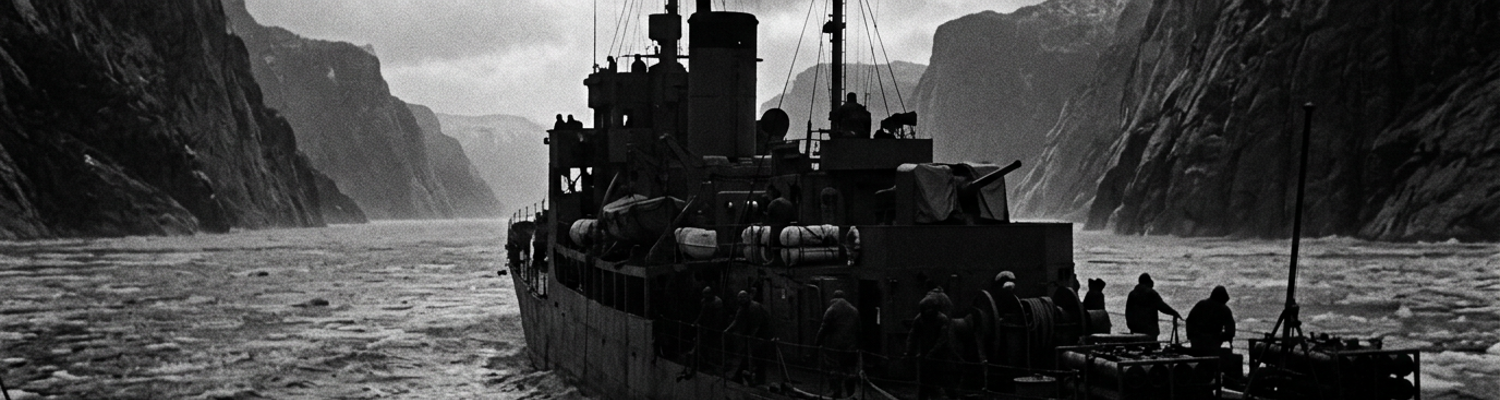

Task Force 24 and the Ivittuut Defense Mandate
Fireman First Class Robert Vance hammered a cold chisel against the frozen release latch of the starboard depth-charge rack aboard the cutter Northland. Sea spray had locked the drop-mechanism in a shell of gray ice. The release pins froze solid in twenty-degree weather. Every blow of his mallet echoed off the sheer rock faces of Arsuk Fjord. The ship swung at anchor in the shadows of the Ivittuut bluffs at 61 degrees 12 minutes North, 48 degrees 10 minutes West.
The Allied air war hinged on the stability of this single open-pit hole in the sub-Arctic permafrost.
Archival evidence shows that Task Force 24 operated under an explicit tactical priority. Rear Admiral Edward H. Smith commanded the unit. Hold the Ivittuut cryolite mine at all costs. Cryolite was a rare sodium aluminum fluoride compound found in commercial quantities only on this southwest Greenland coast. It was the single most efficient fluxing agent used to dissolve aluminum oxide during the Hall-Heroult electrolytic smelting process. Aluminum reduction plants operated by Alcoa in Tennessee and Alcan in Quebec depended directly on this site. They needed it to produce the lightweight alloys required for airframes. A disruption to the Ivittuut output meant airframe production across the United States would face immediate deficits. This directly hit output quotas for B-17 Flying Fortress bombers and carrier-based fighters. Task Force 24 placed the armed cutters of the Greenland Patrol directly into the fjords. Ships included Northland, Modoc, and Tampa. They were ordered to deter German surface raiders, interdict covert landing parties, and protect the harbor infrastructure from naval shelling.
Extracting the mineral through the ice-choked waterways posed an immediate tactical danger.
When examining the historical record of local merchant movements, the geography of the southwestern fjords favored the offensive tactics of the Kriegsmarine. Ore carriers had to negotiate Arsuk Fjord. This drowned glacial valley featured vertical rock walls climbing thousands of feet directly out of water reaching depths over six hundred feet. Ships could not execute defensive zigzag maneuvers through the narrow channels. Type VII and Type IX U-boats of wolfpacks operating around Cape Farewell tracked these choke points. They waited for laden mineral transports that emerged at eight knots into open water. A single merchant ship sunk in the narrowest throat of the channel would plug the shipping lane entirely. Extraction facilities would be stranded behind a blocked fjord. Merchant helmsmen struggled with submerged glacial moraines and drifting growlers. A helm deviation of three degrees meant gutting a steel hull on submerged granite. Coast Guard escorts could not establish wide protective screens in waterways less than a mile across. The slow freighters were exposed to torpedo shots fired into the fjord entrances.
A close review of operational logs indicates that the standard peacetime antisubmarine doctrine issued to Task Force 24 failed in this environment.
Tactical doctrine had been developed in the deep open ocean of the mid-Atlantic and Caribbean. It relied on active QC sonar systems operating against submerged hulls in predictable water columns. In the fjords around Ivittuut, glacial meltwater poured across the sea surface. This generated a dense cold-water halocline within the first thirty feet of the surface. This acoustic boundary bent sonar sound beams downward toward the sea floor. It created dead zones. A German U-boat could sit silently at shallow depths without reflecting a return ping. Acoustic pulses bounced off underwater granite cliffs. This produced hundreds of false contacts that overwhelmed sound operators. Cutters lacked ahead-throwing antisubmarine weapons like the Hedgehog. They depended entirely on stern-mounted gravity tracks and K-gun projectors. Rolling Mark VII depth charges in cramped rock channels threatened to rip the rudder and screws off the escort cutter. Shockwaves rebounded off underwater rock walls and slammed back into the ship's own hull.
Greenland Patrol deck logs recorded forty-two false submarine contacts during one three-week stretch in the summer of 1942.
Fjord Bathymetry and Acoustic Propagation Failures
A close review of operational logs indicates that the standard QC-series magnetostriction sonar sets installed aboard Greenland Patrol cutters proved technically useless inside the steep topography of southern Greenland. These 24-kilohertz active pingers were manufactured for open-ocean tracking. They emitted directional acoustic energy designed to travel through uniform water masses and reflect off submarine pressure hulls. Cutters entered Arsuk Fjord and the narrow reaches of Tunulliarfik at 60 degrees 55 minutes North, 45 degrees 50 minutes West. Those acoustic transmissions slammed directly into submerged granite cliffs that dropped sheer into depths exceeding eight hundred feet. Acoustic pulses rebounded off underwater rock faces. They sent multiple scattered returns back to the ship from dozens of opposing angles within milliseconds. Sound operators wearing Western Electric headsets had their ears overwhelmed by continuous ringing static. They were unable to distinguish a true metallic target return from the deafening multi-path acoustic reverberation of the shoreline. The magnetostriction nickel-tube transducers saturated with false echoes. Sending out an active ping in these narrow glacial troughs blinded the cutter for several minutes at a time.
Standard acoustic gear had been calibrated for the open Atlantic.
Archival evidence shows that environmental dynamics below the waterline scrambled acoustic physics even further during the summer of 1942. Heavy volumes of low-density meltwater rushed down from the Sermilik glacier. This discharged millions of gallons of near-zero-degree fresh water directly over the high-salinity seawater of the fjord channels. This sudden influx generated extreme halocline and thermocline stratifications within the upper forty feet of the water column. Density differentials between the cold freshwater surface layer and the warmer saline Atlantic water beneath caused severe downward refraction of active sonar pulses. Snell's law governed every transmission. The 24-kilohertz sound wave struck the sharp thermal boundary. The beam bent sharply toward the seabed rather than projecting forward in an elongated horizontal cone. A distinct acoustic shadow zone opened up directly underneath this refractive boundary. The sound beam plunged into the bottom silt at steep angles. This left a massive volume of dead water between forty and two hundred feet where active sonar pulses could not penetrate.
An escort ship could pass directly over a submarine without registering a single return signal.
When examining the historical record of Task Force 24, patrol escorts attempted to resolve this tactical vacuum using standard naval search patterns drawn straight from Navy doctrine publications. Command directives ordered cutters like Comanche and Modoc to execute expanding square searches and creeping line sweeps across waterways where German U-boats were suspected of tracking merchant convoys. These maneuvers collapsed immediately. Arsuk Fjord averaged less than two thousand yards in width. This completely prevented cutters from establishing the standard four-mile search legs and wide turning radii prescribed by tactical manuals. Escort commanders maneuvering within these cramped corridors had no room to conduct coordinated multiship sonar sweeps. German submarine commanders were aware of the acoustic distortion created by sub-Arctic estuaries. They could submerge beneath the freshwater halocline, settle into neutral buoyancy at sixty meters, and cut their electric drive motors completely. Cutters executed mechanical back-and-forth grid searches directly above these silent targets. They dropped Mark VII depth charges set to standard hydrostatic depths of one hundred feet based purely on erratic compass bearings.
Post-patrol evaluations from August 1942 recorded sixteen separate anti-submarine attacks across Arsuk Fjord where cutters dropped their entire deck loads of ordnance into acoustic shadow zones.
Shallow-Water Depth Charge Blast Dynamics
Naval ordnance manuals written for the open Atlantic became self-destructive liabilities inside Greenland coastal corridors.
Archival evidence shows that United States Navy tactical publications dictated hydrostatic pistol settings calibrated for open-ocean combat against deep-diving fleet submarines. Fleet doctrine issued to Task Force 24 escorts in early 1942 mandated depth-charge drops bracketed at settings between one hundred and three hundred feet to counter evasive deep dives by German U-boats. In the shallow approaches and glacial sills of southwestern Greenland, soundings frequently registered less than twenty-five fathoms over submerged terminal moraines. Setting an explosive canister to detonate at two hundred feet meant the ordnance reached the hard non-porous bedrock before triggering. It often detonated while resting directly upon the granite bottom. Explosive energy did not disperse radially outward through an unconfined ocean water column. It compressed violently against the unyielding stone shelf. The solid bedrock acted as an acoustic and hydrodynamic reflector. It redirected peak overpressure waves upward toward the surface in a concentrated vertical cone of kinetic energy.
Granite sea beds do not absorb shock.
When examining the historical record of anti-submarine actions off Cape Desolation, reflected underwater shockwaves delivered catastrophic mechanical punishment to the attacking Coast Guard cutters themselves. Detonations generated by 300-pound TNT charges released blast fronts traveling through cold high-density sub-Arctic seawater at nearly five thousand feet per second. These compression waves rebounded off sheer submerged rock walls. They slammed back into the unarmored steel plates of escort cutters like Modoc and Tampa before the ships could clear the blast radius at their standard attack speeds of twelve knots. Hull plates buckled inward between frames. Hundreds of structural rivets popped across the bilge keels and forward machinery flats. The sudden violent vertical acceleration lifted the vessels by their transoms. This bent the main propulsion shafts and threw the shaft-alley split bearings out of mechanical alignment. Operational logs from July 1942 note that attacks carried out in shallow channels routinely tripped main electrical switchboards. They snapped low-pressure steam piping in the engine spaces and shattered cast-iron pump casings. This effectively disabled the escort ships in the middle of active submarine hunts.
Every dropped charge risked crippling the hunter.
A close review of operational logs indicates that the physical design of the standard Mark 6 depth charge made accurate shallow-water engagements nearly impossible. Loaded with 300 pounds of cast TNT inside a drum-shaped casing, the Mark 6 exhibited a fixed slow terminal sink rate of only eight to nine feet per second. This sluggish descent left a massive temporal gap between the moment of release from a stern roll-track and the final hydrostatic detonation. Currents ran fast in confined waterways. Sonar targets were rapidly lost in reverberation clutter. An escort commander possessed zero certainty regarding a submarine's true operating depth. The commander might adjust the Mark 6 Mod 1 hydrostatic bellows mechanism to its shallowest sixty-foot threshold to protect the ship's running gear from bottom bounce. A target running at ninety feet escaped undamaged. If set deeper, the charge detonated on the rock floor. This shredded the cutter's own rudder assembly while the pressure hull of a submerged German boat remained shielded behind underwater granite ledges.
Deck logs from the cutter Escanaba recorded four separate Mark 6 depth charges exploding prematurely against submerged rock shelves during a three-day sweep off Arsuk Island.
Collateral Damage Along the Greenland Littoral
Sub-surface shockwaves do not distinguish between hostile pressure hulls and civilian workboats.
Archival evidence shows that uncontained acoustic concussion waves tore through the shallow anchorages flanking the Ivittuut settlement with destructive mechanical force. Cutters like the Modoc and Tampa rolled three-hundred-pound Mark 6 depth charges into the confined waters of Arsuk Fjord. The unyielding granite walls prevented explosive overpressure from dispersing into deep water. Peak hydrodynamic blast fronts traveled along the narrow shelf at nearly five thousand feet per second. They entered shallow coves where civilian wooden sealing boats lay moored. Clinker-built pine and oak hulls sustained immediate structural trauma. The instantaneous pressure differential blew horsehair caulking straight out of ship seams. It sheared through copper fasteners and buckled framing ribs inward along the keelson. In the sheltered bight south of the mining station at 61 degrees 11 minutes North, 48 degrees 13 minutes West, local hunters found five motorized skiffs and seven wooden dories flooded to the gunwales within twenty minutes of an unannounced depth-charge drop. Their planking split apart by reflected water hammer.
Compression waves transformed the solid shoreline into a dynamic hazard.
A close review of operational logs indicates that repeated sub-surface detonations catastrophically compromised the shore-fast ice shelves anchoring the regional transport network. Across southwestern Greenland, fast ice reaching thicknesses between four and seven feet served as coastal road infrastructure. It supported heavy sledge traffic and provided structural reinforcement against wave wash for timber crib wharves. Underwater concussion waves produced violent vertical water displacement. This sent shear fractures racing through these rigid ice shelves along the rock face. Hundreds of thousands of square yards of shore ice detached instantaneously from cliff bases. The ice collapsed into the shipping channels in violent tsunamis of broken pack ice. This ice displacement shattered the wooden crib pylons supporting the secondary supply docks at Ivittuut. It blocked traditional dog-sled routes connecting the mining enclave with seasonal seal-hunting grounds at the head of the fjord. Sledges loaded with meat and equipment fell through hidden stress cracks that formed miles from the initial detonation coordinates.
Ordnance fell without advance warning.
When examining the historical record of civilian administration under South Greenland Governor Aksel Svane, patrol cutters dropped anti-submarine munitions adjacent to Greenlandic hamlets without prior coordination with local town councils. Settlements like Arsuk village absorbed the full psychological and material brunt of these tactical engagements. The village was situated less than six miles from the mine defenses. Concussion reverberations traveling through hard bedrock rattled the foundations of stone and sod houses. They shattered window glass and triggered scree slides down steep coastal bluffs that buried coastal drying racks. Severe economic damage to their seasonal food supply compounded the terror among local Inuit families. Sub-surface detonations ruptured the swim bladders of Arctic cod and white whale pods throughout the littoral zone. Thousands of dead fish rotted on mudflats. Seal herds were driven out of the inner fjord channels. Hunting tallies in the Arsuk district dropped sixty-eight percent during the autumn of 1942. Several hamlets became dependent on emergency flour rations issued by Danish administrators to prevent starvation through the Arctic winter.
Acoustic Phantoms and Winter Command Dilemmas
Archival evidence shows that active sonar sweeps conducted across the approaches to Cape Farewell and Nanortalik at 60 degrees 08 minutes North, 45 degrees 14 minutes West during the winter of 1942 registered dozens of false-positive target contacts. Submerged ice keels extending fifty to eighty feet beneath heavy pack ice presented dense irregular barriers. These reflected active 24-kilohertz sound pulses straight back to cutter receiver arrays. Force 9 gale winds whipped the sea into an aerated froth. They churned surface water down into sharp thermal fronts that refracted acoustic sound beams erratically across the upper fifty fathoms. Pods of harp seals and migrating minke whales generated distinct Doppler shifts against the nickel-tube transducers of standard QC sonar sets. Sound operators seated in cold sonar shacks aboard cutters like Modoc and Tampa struggled to distinguish between the metallic reverberation of a Type VIIC pressure hull and the dense acoustic return of an inverted iceberg tongue. These natural phenomena consistently mimicked the acoustic signature of twin electric motors running at low revolutions. They triggered combat alerts over empty water.
Active sound gear routinely tracked drifting ice instead of German hulls.
A close review of operational logs indicates that commanding officers faced immediate ordnance starvation with every dropped attack pattern. Greenland Patrol cutters carried a standard loadout of only thirty to forty-eight Mark 6 depth charges on their stern racks and K-gun projectors. Naval supply routes from Boston or Argentia halted entirely by heavy winter pack ice between November and April. Expending a five-charge pattern against an unverified contact depleted more than ten percent of a cutter's total anti-submarine inventory in under two minutes. Escort commanders like Lieutenant Commander Frank M. Meals aboard Modoc calculated whether a faint hydrophone sound justified expending munitions they could not replace until the spring thaw. Holding fire preserved the ship's magazines for verified contacts. It risked allowing an authentic German boat to slip through to the merchant shipping lanes off Cape Farewell. Cutters that exhausted their ordnance on phantom contacts lost their defensive capability entirely. They were forced to complete month-long patrol cycles with empty racks while German weather vessels and combat U-boats operated in nearby fjords.
Supply ships did not break through southern Greenland pack ice to restock depleted depth-charge racks during winter storms.
When examining the historical record of merchant movements along the southwest coast, blind depth-charge drops executed in poor weather directly threatened the civilian freighters the escorts were assigned to protect. Heavily laden cryolite freighters like the Danish cargo ship Julius Thomsen steered through outer coastal leads and Arsuk Fjord amid sixty-knot blizzards that reduced visibility to twenty yards. Escort cutters responding to ambiguous acoustic contacts launched full-speed depth charge runs through whiteouts without establishing the radar or visual bearings of nearby merchant vessels. Sub-surface detonations of three-hundred-pound TNT charges within eight hundred yards of a merchantman transmitted violent hydrodynamic shockwaves through the frigid water. These compression waves struck cargo hulls already rendered brittle by sub-zero temperatures. They sheared structural rivets, knocked out reciprocating feed pumps, and cracked cast-iron sea valves below the waterline. A civilian freighter disabled by friendly depth charges lost steerageway instantly. It drifted sideways into grinding pack ice that crushed unreinforced hull plates before rescue tugs could pass a hawser. Damaged holds flooded with freezing seawater. This endangered cargo manifests of three thousand tons of refined cryolite bound for Allied airframe factories.
Coast Guard action reports from December 1942 confirmed near-miss depth charge concussions caused steering gear failure aboard two separate civilian ore ships operating off Arsuk Island.
Tactical Improvisations and Littoral Realignment
Archival evidence shows that by late summer of 1942, escort commanders across Task Force 24 turned off their active QC sonar sets while navigating inner coastal channels. Transducers that saturated sound rooms with multi-path reverberations off submerged rock faces were secured. They were replaced by continuous visual observation networks. Captain Edward H. Smith directed cutters Northland and Modoc to double their topside watch complements. He stationed lookouts equipped with handheld 7x50 binoculars and pedestal-mounted 20x120 naval spyglasses along the flying bridges and masthead crow's nests. Watchstanders scanned for telltale visual signatures that acoustic gear missed. They looked for periscope feather wakes, oil slicks, exhaust scum, and disturbances in the brash ice. Task Force 24 engineers built elevated timber observation shacks on rocky promontories overlooking channel bottlenecks. These included the entrance at Simiutaq Island and the bluffs near Cape Thorvaldsen at 60 degrees 40 minutes North, 47 degrees 23 minutes West. Coast Guardsmen stationed at these shore outposts manned radio transmitters and signal lamps around the clock. They tracked surface traffic and telephoned bearings directly to cutter bridges whenever suspicious wakes emerged near the outer skerries.
Visual bearings replaced sound gear.
A close review of operational logs indicates that coastal defense expanded directly onto the pack ice and tundra through combined amphibious boarding parties and dog-sled reconnaissance. German naval command sought meteorological dominance in the North Atlantic by deploying clandestine automated and manned weather outposts. These included the Wetter-Funkgerat Land units and shore parties hidden along east Greenland's uncharted fjords. To counter this, cutter Northland landed armed landing teams equipped with M1903 Springfield rifles, Thompson submachine guns, and cold-weather field equipment. Commander Carl C. von Paulsen led the operation. They swept deserted seal-hunting camps and abandoned meteorological shelters. The Coast Guard integrated its shore operations with the North-East Greenland Sledge Patrol. Provincial governor Eske Brun organized this authority and veteran Danish hunter Ib Poulsen led it. These patrols operated two-man sledges drawn by teams of Greenland huskies. They covered hundreds of miles of frozen coastline between Scoresby Sound and Shannon Island at 75 degrees 10 minutes North, 17 degrees 30 minutes West. Sledge drivers located hidden German gear caches. They reported unauthorized ship tracks in the coastal fast ice and guided armed cutter parties directly into concealed anchorages where German trawlers attempted to set up radio masts.
Sledge teams tracked footprints through areas ship keels could never reach.
When examining the historical record of convoy movements into southern Greenland, coastal geography forced escorts to dismantle textbook tactical formations. Naval doctrine for open-ocean anti-submarine warfare mandated that escort screens deploy three to five thousand yards ahead and abeam of a convoy. They executed zigzag sweeps to bracket incoming torpedo tracks. Inside Tunulliarfik and Arsuk fjords, navigable sea room narrowed to less than twelve hundred yards. Shallow moraine banks and towering granitic cliffs hemmed in the channels. Escort commanders discarded these wide protective umbrellas entirely. Cutters Escanaba and Comanche squeezed their tactical stations down to tight column intervals of six hundred to eight hundred yards directly ahead of and behind merchant ore transports like Julius Thomsen. The cutters moved in rigid single file through blind dogleg bends. They operated as physical channel buffers. Escorts maintained low speeds of six to eight knots to avoid cavitation. They kept main battery guns unlimbered and depth-charge crews standing by at the stern release tracks. They were ready to lay visual barrages against any surfaced U-boat attempting an ambush from the flanking coves.
The narrow throat of Arsuk Fjord left an escort cutter barely four hundred yards of maneuvering room.
Post-1942 Doctrinal Evolution in Polar Waters
Archival evidence shows that in January 1943, the United States Navy Anti-Submarine Warfare Assessment Committee convened in Washington. They evaluated after-action reports submitted by Task Force 24 commander Rear Admiral Edward H. Smith. These files contained raw hydrographic charts, broken gear logs, and sound operator records compiled across eight months of operations in southern Greenland. Peacetime naval acoustics had assumed that active sonar beams traveled along predictable paths through open ocean basins of uniform temperature and salinity. Reports gathered from cutters Northland, Modoc, and Tampa proved that active QC-series 24-kilohertz pingers completely failed when directed against the submarine approaches to Ivittuut and Cape Farewell. Engineers at the Naval Sound Laboratory in New London, Connecticut, analyzed bathythermograph data recovered from Arsuk Fjord. They discovered that freshwater glacial discharge generated sharp horizontal sound channels that refracted high-frequency acoustic pulses straight into bottom silt. Standard sound manuals had treated Arctic fjords as uniform deep-water anchorages. Naval hydrographers conceded that acoustic reverberation against underwater granite shelves overwhelmed receiver arrays. This rendered active echo-ranging useless inside enclosed littoral corridors.
Peacetime acoustic models had treated every ocean basin as uniform water.
When examining the historical record of naval tactical publications, the Tenth Fleet initiated sweeping rewrites of fleet antisubmarine doctrine throughout the spring of 1943. Revisions to the Fleet Anti-Submarine Bulletin and tactical instruction manual FTP-223 replaced open-ocean search procedures with specific sub-polar operating rules. Manual writers codified strict guidelines governing sub-Arctic thermoclines. They required escort watch officers to deploy bathythermographs and draw mechanical bathythermograms before dropping a single explosive pattern. Temperature graphs might reveal a sharp meltwater layer within fifty feet of the surface. Escorts were forbidden from conducting standard expanding square searches under those conditions. Command directives instructed cutter captains operating inside fjords like Tunulliarfik to power down active sonar transmitters entirely. This prevented self-saturating acoustic echoes. Escorts formed stationary hydrophone picket lines instead. They drifted with shut-down auxiliary machinery to listen for cavitation signatures on passive listening gear while shore lookouts swept the water surface for physical periscope wakes.
Standard naval doctrine had driven destroyers and cutters to hunt blind.
A close review of operational logs indicates that the Bureau of Ordnance overhauled shallow-water weapons loads to eliminate the self-destructive concussions documented throughout 1942. The drum-shaped Mark 6 depth charge sank at a sluggish rate of eight feet per second and detonated violently against hard bedrock shelves. It was phased out of inner fjord operations. Naval ordnance facilities in Newport, Rhode Island, accelerated distribution of the teardrop-shaped Mark 9 depth charge. They fitted the casing with directional guide vanes that doubled terminal descent speeds to sixteen feet per second. Hydrostatic pistols received modifications allowing reliable detonations at shallow depths of thirty to fifty feet. This prevented explosive overpressures from slamming into submerged granite moraines and bending cutter propeller shafts. Naval shipyards in Boston began cutting away forward main battery mounts on Treasury-class and 165-foot cutters. They welded on twenty-four-spigot Mark 10 Hedgehog projectors. These ahead-throwing mounts fired contact-fused thirty-pound Torpex projectiles four hundred feet over the bows. The missiles exploded only upon direct impact with a steel hull. Escorts could attack submerged targets in shallow fjord channels without triggering bottom-bounce shockwaves that ripped open their own sea chests.
Specialized detection gear followed the ordnance updates directly into Arctic deployment. Coast Guard repair bases at Argentia and Bluewest One began mounting trailing hydrophone arrays and experimental variable-depth sound heads aboard patrol cutters. Sound crews lowered these streamlined listening pods on steel-armored cables through the freshwater surface haloclines. They positioned receivers seventy feet deep into the undisturbed saline layer below. Dropping listening sensors beneath the thermal boundary allowed sound operators to bypass the downward acoustic refraction that had masked submerged U-boats during the previous summer. The Bureau of Ships issued calibrated echo-sounders designed specifically to profile underwater rock pinnacles. This allowed cutters to plot safe lanes through shallow glacial sills without alerting submerged targets through active transducer pings. Every Greenland Patrol cutter operating north of the 60th parallel carried revised Arctic acoustic manuals, Hedgehog spigot mounts, and hydrodynamic Mark 9 charges loaded in their deck lockers by November 1943.