
North Korean Propaganda Onslaught 1950
Korea in 1950 was an environment of extremes. Summer monsoons turned the ground to glutinous mud. Winter brought Siberian winds that froze the ridges into razor-sharp edges. For United Nations forces, particularly American infantrymen accustomed to different climates, the physical cost was high. Summer heat buckled metal and exhausted soldiers. The autumns brought freezing rain that turned foxholes into water-logged pits. The environment was a constant enemy, wearing down equipment and human morale. A close review of operational logs from the U.S. 1st Cavalry Division during the defense of the Naktong River line shows a spike in non-combat casualties directly attributable to heat exhaustion and waterborne diseases. The physical misery was a powerful, ever-present reality that predated any contact with the enemy.
Into this context, North Korean and later Chinese psychological warfare units introduced an auditory assault. This was a blunt instrument designed to exploit the exhaustion and isolation of the UN troops. The primary weapon was radio. Broadcasting from powerful transmitters, some of them mobile and difficult to pinpoint, Radio Pyongyang and other clandestine stations began a daily barrage aimed at the frontline soldier. The content was a mix of demoralization and intimidation. One of the most infamous voices belonged to a woman GIs came to call Seoul City Sue. She was an American-born missionary named Anna Wallis Suh who had remained in Seoul after the invasion. Her broadcasts, delivered in a monotone American accent, were a staple of the evening airwaves.
Her words were a direct application of psychological pressure.
She would read the names of captured or killed American soldiers, taken from their dog tags, often with soft music in the background. The message was clear: this could be your name next. She taunted soldiers about their conditions, suggesting they would be better off back home and that their girlfriends and wives would not wait. For African American soldiers, the broadcasts specifically pointed to racial injustices back in the United States, questioning why they were fighting for a country that denied them basic civil rights. The broadcasts also demonstrated a disturbing level of intelligence, welcoming new UN units by name as they arrived in-country or identifying warships on station, creating a sense of enemy omniscience. For an exhausted infantryman in a freezing foxhole, these disembodied voices were a constant, unnerving presence.
The tactical impact of this propaganda offensive was magnified by its ability to dominate the radio spectrum. Archival evidence shows that North Korean and Chinese broadcast capabilities often overwhelmed the weak, vehicle-mounted and man-portable radio sets used by UN forces in 1950. The standard U.S. Army radios of the period, like the SCR-508 series in tanks or the new AN/PRC-6 handheld radio, were designed for short-range, tactical line-of-sight communication. The PRC-6, a vacuum-tube handheld set, had a rated power output of only about 250 milliwatts. Its effective range was roughly one mile, a distance that shrank considerably in the dense, mountainous terrain of Korea. North Korean transmitters, by contrast, were far more powerful. From fixed stations like the one in Seoul, which was only temporarily knocked off the air by a B-26 bomber strike on August 13, 1950, they could blanket entire sectors of the front. Their signals would bleed over, or intentionally jam, the low-band VHF frequencies (typically 20 to 55 MHz) used by UN armor and infantry for command and control. A platoon leader attempting to coordinate with his company command post would find his frequency hijacked by a Sousa march followed by the monotone delivery of Anna Wallis Suh. This technical dominance created confusion, severed communication links during battle, and deepened the psychological isolation of units under fire.
Allied Forces Psychological Dread
The combination of propaganda and environmental hardship created a distinct form of psychological dread within the United Nations Command. It was not simple combat fear. A close review of operational logs from the U.S. 8th Army (Record Group 407, NARA) during the defense of the Pusan Perimeter reveals a spike in non-combat psychiatric casualties. Soldiers in forward positions, already physically broken by the heat and terrain, were subjected to an auditory siege. The enemy broadcasts, particularly those naming specific units or captured soldiers, fostered a paralyzing sense of being constantly watched. The fear of capture became an obsession, fed by propaganda leaflets showing gruesome images of executed prisoners and supported by genuine intelligence reports on the North Korean People's Army's (NKPA) treatment of POWs. This anxiety was not confined to the foxhole. It seeped into the rear echelons, creating a corrosive suspicion that undermined unit cohesion. Soldiers became wary of local nationals employed on bases. The constant threat of guerrilla attacks behind the lines, often heralded by propaganda, meant that no location felt secure. The psychological breaking point for many was the feeling of isolation, a sensation engineered by the enemy’s technical ability to dominate radio frequencies.
The psychological war also engulfed the South Korean civilian population. The rapid advance and retreat of battle lines transformed the peninsula into a landscape of fear and displacement. North Korean propaganda, disseminated by leaflets and local agents, promised liberation but delivered systematic violence against landlords, intellectuals, and government officials. This created a terror that drove millions of civilians south in massive refugee columns that choked strategic roads. These columns presented an unsolvable tactical dilemma for UN forces. Archival evidence shows that NKPA and Chinese People’s Volunteer Army (PVA) units deliberately used these refugee flows as cover for their own troop movements. An infantry platoon from the 25th Infantry Division holding a roadblock near Chinju, for example, had to make impossible decisions, searching thousands of fleeing civilians for hidden weapons or soldiers in disguise. This necessity bred suspicion and hostility, straining the relationship between Allied soldiers and the people they were there to protect. Civilian panic was a weaponized element of the conflict.
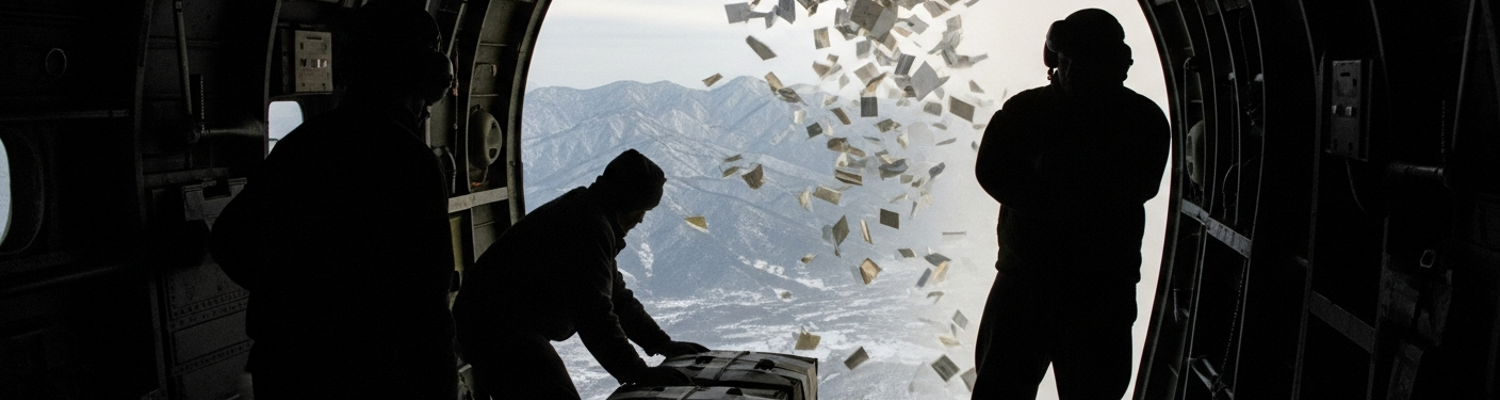
General Douglas MacArthur’s Far East Command authorized the formal establishment of a dedicated Psychological Warfare Section (PWS) in the summer of 1950. This small staff section quickly grew. Its first major tactical unit, the 1st Loudspeaker and Leaflet Company, was activated on August 4, 1950, in Fort Riley, Kansas, and rushed to the Korean theater. Their mission was direct: seize the psychological initiative. The company deployed with specialized equipment, including vehicle-mounted loudspeaker systems designed to broadcast messages directly to enemy frontline trenches. Their primary weapon was the paper leaflet, delivered by the millions via C-47 transport aircraft and artillery shells. These were not crude instruments. Leaflets were designed to achieve specific objectives. Safe-conduct passes, promising humane treatment under the Geneva Convention to any enemy soldier who surrendered, became one of the most effective tools. Other leaflets carried news from the outside world, showed photos of well-fed prisoners of war, or carried direct messages from General Douglas MacArthur to the North Korean command. A radio station, the Voice of the UN Command, was established, broadcasting in Korean, Chinese, and English from a transmitter in Japan. By September 1950, the PWS was dropping over 2.5 million leaflets a week over enemy-held territory.
Initial UN Leaflet Counter-Propaganda
Early UN counter-propaganda was an improvised affair. Far East Command records show that the first leaflet drop occurred on June 28, 1950, three days after the initial invasion. A C-46 Commando transport plane from the 374th Troop Carrier Wing departed Ashiya Airbase in Japan and scattered over 12 million hastily printed leaflets over captured South Korean cities. These initial leaflets were crude, carrying simple messages assuring the population that UN assistance was imminent. The strategic bombing force was quickly co-opted. Heavy B-29 Superfortress bombers of the 98th Bomb Group were loaded not with explosives, but with paper. A single B-29 could carry up to 32 M16A1 cluster adapters. Each cylindrical bomb casing was packed with around 22,500 leaflets, enabling the dissemination of over 700,000 leaflets on a single sortie. Accuracy was a significant problem. Wind, altitude, and primitive release mechanisms meant that leaflet bundles often drifted miles off target.
This was a layered approach.
While B-29s and C-47s conducted deep-penetration drops, the Eighth Army pushed for methods to deliver leaflets directly to enemy soldiers on the front line. This tactical requirement was met by modifying artillery shells. Operational reports from artillery battalions show that 105mm smoke shells, such as the M84, were hollowed out by ordnance crews, who then hand-stuffed them with tightly rolled leaflets. An artillery battery could fire these shells over enemy trenches just before an attack. The payload was small, but the effect could be immediate. The 1st Loudspeaker and Leaflet Company, activated in September 1950, became the primary tactical asset for this ground-level psychological war. This unit, attached to the Eighth Army, utilized leaflet shells and patrols that would physically place packets of leaflets on trails and in villages within enemy territory.
The core of the early UN effort was a direct attempt to counter specific North Korean and Chinese propaganda. The single most effective tool developed was the safe-conduct pass. These leaflets, printed in Korean and Chinese and often bearing the signature of General Douglas MacArthur, promised any surrendering soldier humane treatment under the Geneva Convention. This was a direct rebuttal to enemy propaganda that claimed UN forces summarily executed prisoners. To reinforce this message, other leaflets featured photographs of smiling, well-fed North Korean and Chinese POWs playing sports or receiving medical attention. Another prominent theme aimed to break the enemy’s information control. The PWS G-2 Section of the Eighth Army produced a regular leaflet series titled Parachute News, which provided summaries of world events and factual reports on UN military victories. Other leaflets were designed to sow discord, highlighting the frigid winter conditions and blaming communist leaders for prolonging the suffering. By December 1950, the Far East Command’s Psychological Warfare Branch had prepared and disseminated over 142 million leaflets, with over 14 million specifically targeting the new threat of Chinese forces.
Intelligence Synthesis Challenges WASH-DIR-OFF-OP-266
Operational directive WASH-DIR-OFF-OP-266 was assigned to a small analytical cell in the Far East Command’s G-2 intelligence section. Its objective was to provide intelligence to psychological warfare units for targeted leaflet drops and loudspeaker broadcasts against Chinese People’s Volunteer Army (PVA) units. The specific focus was a desolate piece of high ground designated Hill 266, a position that would later earn the name Old Baldy after artillery fire stripped its crest of vegetation. The analysts assigned to OP-266, a mix of Army Security Agency (ASA) personnel and G-2 staffers, were located in a secure facility in Tokyo. Their task was to weave a coherent picture of enemy morale, supply status, and unit identification from a chaotic storm of incoming data. A review of operational logs from this period shows the disconnect between the directive's mandate and the disorganized information the analysts had to work with.
Their primary source was a torrent of fragmented radio intercepts.
Forward listening posts, often mobile teams in vehicles or dug-in positions close to the front, would capture short, encoded enemy transmissions. The Army Security Agency, after neglecting Korean targets prior to the invasion, had scrambled to increase its intercept positions. Yet the raw material forwarded to the OP-266 desk was fragmented. Chinese units, having learned from the initial North Korean lack of communications security, employed stronger encryption and frequently changing field ciphers as the war settled into a static fight in 1951. An analyst would receive a transcript of a five-second burst of coded traffic, the signal degraded by mountainous terrain. The lack of trained Korean and Chinese linguists was a systemic failure. Analysts were therefore heavily reliant on traffic analysis, a painstaking process of mapping who was transmitting, from where, and to whom. A sudden spike in radio traffic from a specific sector near Hill 266 might suggest a pending assault, but it could just as easily be a feint.
This electronic data was then laid beside conflicting human-source and photographic reports. A PVA deserter, interrogated by a Counter Intelligence Corps agent, might provide a detailed order of battle and pinpoint a planned attack, as one did before the fight for Hill 395. Days later, a different prisoner from the same division might offer a contradictory report, either from ignorance or as part of a deliberate deception campaign. Archival evidence shows that high-ranking North Korean and Chinese political operatives would sometimes allow themselves to be captured specifically to sow disinformation. To this, the OP-266 analyst had to add aerial reconnaissance photos from L-19 spotter planes. A photograph might show newly dug trenches, but it could not reveal the morale of the soldiers digging them. The analysis required by WASH-DIR-OFF-OP-266 was a constant battle against ambiguity. An analyst had to decide whether the radio silence from a PVA regiment on Old Baldy’s flank indicated it had withdrawn, as a POW claimed, or if it was merely practicing strict communications discipline before an attack, as a recent increase in captured medical supply shipments might suggest.
Delayed PSYOPs Effectiveness Assessment
Gauging the effectiveness of any psychological warfare campaign was an exercise in delayed inference. For the aircrews of the C-47 Skytrains and B-29 Superfortresses tasked with leaflet dissemination, the mission concluded the moment the paper bundles were pushed out of the fuselage. A review of operational logs from the 374th Troop Carrier Wing reveals the absence of any mechanism for real-time observation. Once released from altitudes of several thousand feet, the leaflets were subject to the whims of wind shear and mountain updrafts. A planned drop intended for PVA positions along the Imjin River could easily drift miles off target. The physical mechanics of the paper bombs themselves presented another variable; bundles could fail to break apart, plummeting to earth as a useless block of paper. Even on the tactical level, success was a matter of faith. An artillery crew firing a modified 105mm smoke shell packed with safe-conduct passes had no way of confirming if the leaflets were seen.
The leaflets vanished into an information vacuum.
The primary obstacle was the enemy’s own counter-intelligence discipline. North Korean and Chinese political officers attached to every unit enforced strict orders for the immediate collection and destruction of all UN propaganda. Soldiers were instructed that possession of a leaflet, particularly a safe-conduct pass, was an act of treason punishable by execution. This actively suppressed the intended effect, turning the simple act of picking up a piece of paper into a life-or-death decision.
The only conduit for assessing the impact of these paper weapons was the slow process of intelligence gathering from enemy sources. Reports on leaflet effectiveness were almost entirely dependent on the interrogation of prisoners of war and deserters. Archival evidence from Eighth Army G-2 interrogation summaries shows a fundamental, systemic delay built into this feedback loop. An enemy soldier, perhaps motivated by a leaflet, would have to surrender. He would then be processed through a multi-echeloned system, moving from the front-line infantry platoon to a regimental holding area, and finally to a divisional or corps-level POW enclosure where trained intelligence officers could conduct a detailed debriefing. This process alone could take days.
The resulting interrogation report, which might contain a single sentence confirming that the soldier had seen a specific leaflet, was then physically transported to the rear. It traveled by courier pouch on a jeep or helicopter back to Eighth Army headquarters. There, it was collated with other reports and analyzed for the Psychological Warfare Section. A review of this workflow indicates that the time from a leaflet drop to the moment a planner received a consolidated report on its potential effects was seldom less than three weeks and often extended to over a month. Information gleaned from captured diaries was even slower, bottlenecked by a persistent shortage of qualified translators.
This information lag rendered agile psychological operations an impossibility. The feedback loop was too slow to allow planners to react to fluid tactical developments. A leaflet could be designed to exploit a reported ammunition shortage in a particular Chinese division. The leaflet would be written, translated, printed in Japan, and then shipped to an airbase for dissemination. By the time it was dropped over the target area, two weeks might have passed. By the time the first piece of feedback filtered back through the POW interrogation pipeline another three weeks later, the tactical situation had completely changed. The targeted division may have been resupplied, withdrawn from the line, or destroyed in an assault. This forced a reliance on broad, evergreen themes: humane treatment, the misery of winter, and attempts to sow discord between Chinese soldiers and their North Korean allies. These messages were effective but lacked the precision that PSYOP doctrine called for.
Propaganda Dissemination Logistical Barriers
The physical delivery of over 2.5 billion leaflets during the Korean War was an undertaking crippled by three fundamental barriers: the Korean climate, a shortage of available aircraft, and a centralized, slow production pipeline. The ambition to overwhelm the enemy with paper was frequently defeated by mud, competing military priorities, and distance.
The paper war was fought for scraps of flight time.
The Korean peninsula’s weather was a primary obstacle. During the summer monsoon season, high humidity could turn leaflet bundles into useless blocks of paper pulp. Aircrews from the 374th Troop Carrier Wing, flying C-46 and C-47 transports out of bases in Japan, reported instances where moisture-saturated bundles failed to break apart upon release. Conversely, the powerful Siberian winds that swept down the peninsula in winter made accuracy impossible. Leaflets released from B-29s at high altitude were scattered unpredictably. This environmental hostility meant that a significant portion of the leaflet campaign was wasted.
Aircraft availability was a constant source of friction. The U.S. Air Force in 1950 was struggling to meet overwhelming demands with a limited number of planes. Strategic bombing, close air support, medical evacuation, and supply runs were always given precedence over psychological operations. The workhorse of the leaflet campaign, the C-47 Skytrain, was the same aircraft desperately needed to transport supplies and evacuate the wounded. A review of Fifth Air Force operational directives shows that PSYOP missions were often the first to be canceled due to weather, maintenance, or the sudden need to divert aircraft for higher-priority tasks. This competition for airframes meant that planners could not guarantee when or if their leaflets would be delivered, making it impossible to synchronize paper propaganda with ground operations.
The entire production process was geographically displaced and inherently slow. The nerve center of the strategic leaflet campaign was in Tokyo. There, the 1st Radio Broadcasting & Leaflet Group (1st RB&L) designed and wrote the propaganda. Once a design was approved, it was sent to the Far East Command Printing and Publications Center, located in a former Japanese aircraft instrument factory in a suburb of Kawasaki. This facility, operating around the clock, would print the leaflets by the million. The printed and bundled leaflets then had to be trucked to a Japanese airbase like Ashiya, loaded onto transport aircraft, and flown to a forward airbase in Korea like Kimpo. Only then were they available to be loaded onto the C-47s or B-29s that would drop them. This multi-stage journey built in a delay of days or even weeks, making the system unresponsive to the fast-moving battles of 1950 and 1951.
Operational Cycle Futility Perception
For the psychological warfare specialists of the Far East Command (FECOM), the operational cycle became an exercise in frustration. A review of archival records from the 1st Radio Broadcasting & Leaflet Group (1st RB&L) and the Eighth Army’s G-2 and G-3 sections reveals a process crippled by dislocation and delay. The intelligence analysis was conducted hundreds of miles from the front in Tokyo. Analysts there worked with fragmented and contradictory information to build a picture of enemy morale. This synthesis was a near-impossible task. By the time a recommendation for a leaflet drop targeting a specific unit’s low morale was approved, the intelligence was often stale.
This analytical lag was compounded by a disjointed dissemination pipeline. The strategic leaflet production process was logistically inefficient. After a leaflet was designed in Tokyo by the 1st RB&L, the artwork and text were sent to the large printing plant in Motosumiyoshi, outside Yokohama. Once printed, cut, and bundled, the leaflets were trucked to an airbase, flown to Korea, and only then loaded onto the B-29s or C-47s for the final drop. This journey guaranteed a delay. Competition for aircraft was another severe constraint; combat support and supply missions always took priority, meaning PSYOP missions were frequently postponed.
While UN propaganda struggled to reach its audience, frontline soldiers were subjected to a constant barrage of enemy broadcasts. The powerful transmitters of stations like Radio Pyongyang, the official name for the Voice of Korea until 2002, easily overpowered the weak, line-of-sight tactical radios used by UN forces. A platoon leader attempting to use his AN/PRC-6 would find his frequency hijacked. These broadcasts were a direct assault on morale, featuring American-accented announcers who would read the names of captured or killed soldiers and taunt troops about the miserable conditions. For the isolated soldier in a foxhole, the enemy seemed omniscient.
This combination of a failed offensive capability and a porous defensive one created a deep-seated perception of futility among PSYOP personnel. The primary method for gauging leaflet effectiveness, the interrogation of prisoners of war, had a systemic delay that rendered it almost useless for timely adjustments. A report confirming a leaflet’s impact might take weeks to filter back to planners in Tokyo. This forced a reliance on broad, non-time-sensitive themes. Many combat commanders, skeptical of paper-based warfare, saw PSYOP as a marginal effort and often prioritized firepower over leaflets. For the analysts, aircrews, and staff officers involved, the relentless cycle of analysis, production, and failed dissemination fostered a belief that their work was an exercise in futility.
PSYOPs Personnel Psychological Combat Fatigue
The psychological toll on the intelligence analysts responsible for supporting psychological operations was a unique form of combat fatigue, born of dislocation and intellectual frustration. A close review of records from the Eighth Army’s G-2 and G-3 PSYWAR divisions shows analysts in Tokyo were tasked with identifying enemy vulnerabilities from a chaotic inflow of data. They worked in sterile environments, hundreds of miles from the violence, attempting to model the morale of Chinese and North Korean divisions from fragmented radio intercepts and contradictory prisoner of war interrogations. The pressure to produce actionable intelligence was constant. An analyst might spend days trying to determine if a specific PVA division was suffering from low ammunition, only to have the intelligence become obsolete by the time a leaflet could be designed, printed, and dropped. This perpetual disconnect created a profound sense of futility. They were fighting a war of abstraction, where victory was measured in data points that rarely translated into confirmed results.
This was a war against an enemy they could not see.
For the forward-deployed PSYOPs teams of the 1st Loudspeaker and Leaflet Company, the psychological stress was immediate and visceral. These teams were the tactical edge of the paper war, and their work placed them in extreme danger for results they could not measure. A standard mission involved driving a truck or jeep equipped with a large bank of loudspeakers into exposed, forward positions to broadcast surrender appeals directly at enemy trenches. Archival evidence shows these vehicles were frequently the priority target for enemy mortar and machine-gun fire. A team would broadcast messages into the darkness, their only response often being the muzzle flashes of incoming rounds. The work was a test of nerve, performing a highly visible action with no immediate feedback on its effectiveness. One member of the 1st L&L participated in 253 such combat missions, a relentless cycle of risk built on the combination of tangible danger and intangible results.
The result was a deep and pervasive professional cynicism that permeated every level of the PSYOP effort. The analysts in Tokyo understood that the intelligence they provided was often stale, while the loudspeaker teams on the ground knew that dissemination was a shot in the dark. This created a shared understanding that the operational cycle was fundamentally broken. This perception was reinforced by the attitudes of many combat arms commanders, who viewed PSYOPs as a sideshow and were reluctant to divert precious assets for leaflet delivery. Personnel within the 1st Radio Broadcasting and Leaflet Group and the 1st Loudspeaker and Leaflet Company became acutely aware of the disparity between the doctrinal promise of psychological warfare and its messy, ineffective application. This fostered not just disillusionment with the mission, but a corrosive skepticism toward the entire command structure that demanded they continue performing these seemingly futile tasks.