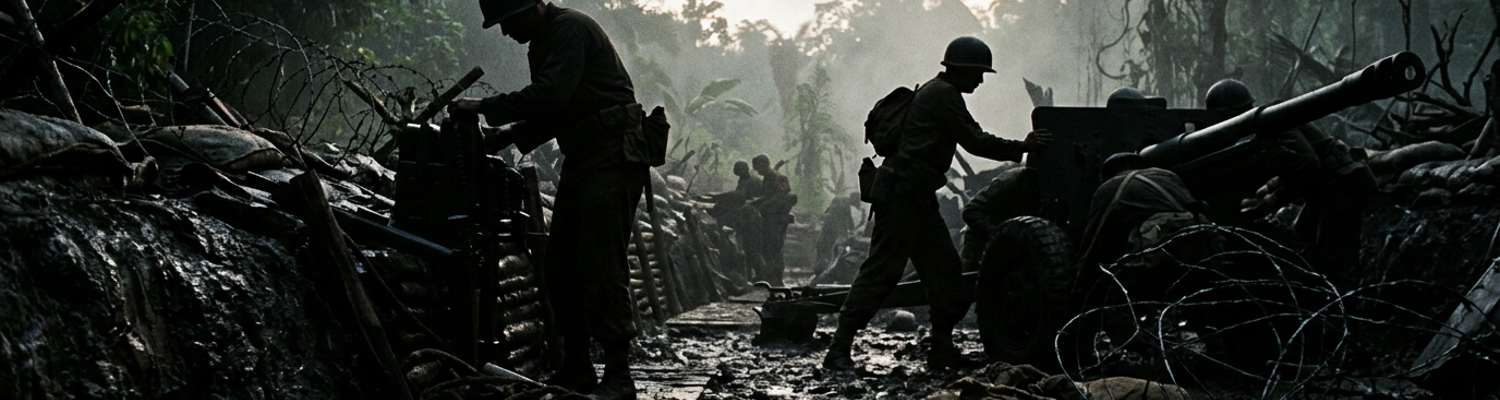

Defensive Crisis Along the Abucay-Mauban Line
At 0315 hours on January 11, 1942, an emergency radio transmission from the Balantok sector reported dead battery circuits. Wire teams were wiped out along the trail. Incoming Japanese 75mm fire fell directly along the main communications trench.
Archival evidence shows that General Douglas MacArthur implemented War Plan Orange-3 on December 24, 1941. This order concentrated surviving forces into the Bataan peninsula. The eastern sector of the defensive front anchored directly on the Abucay-Mauban line. During the first week of January 1942, the Philippine Division moved into position. They placed the Philippine Scouts of the 57th Infantry Regiment along the sodden, cane-choked banks of the Balantok River just north of Abucay. Commanded by Colonel George S. Clarke, the regiment secured the extreme right flank of II Corps. This flank extended from Manila Bay westward across open rice paddies and swampy irrigation cuts toward Mount Natib. These men dug into thick volcanic mud without heavy entrenching machinery. They drove bamboo stakes into riverbanks to construct revetments while Japanese reconnaissance aircraft circled unchecked overhead. Major General George M. Parker Jr. tasked the regiment with holding a sector roughly three thousand yards wide. The Balantok formed a shallow, fordable ditch rather than an effective anti-tank obstacle. Patrols from the forward battalions immediately collided with forward elements of the Japanese 65th Brigade under Lieutenant General Akira Nara. Dry agricultural dikes turned into continuous point-blank combat positions.
The defensive works along the Balantok were held together by hand tools, wet mud, and thin wire.
A close review of operational logs indicates supply depots at Cabanatuan and Guinto had been abandoned in haste. This stripped field artillery units of their baseline reserves before the first defensive perimeter even stabilized. The 57th Infantry and supporting artillery elements of the 24th Field Artillery Regiment faced immediate shortages of 75mm high-explosive shells, mechanical fuzes, and standard recoil-cylinder oil. Gun crews operating British-pattern 75mm Model 1897 field guns scavenged replacement parts from shattered carriages abandoned along the road to San Fernando. In several forward firing positions, ordnance mechanics cannibalized leather gaskets from civilian water pumps. This stopped pneumatic fluid leaks in the recuperator mechanisms. Artillery spotters received strict orders rationing high-explosive rounds to no more than six per battery per day. Japanese troop concentrations moving through open sugar fields across the river could not be broken up by prolonged indirect fire. Weapons crews lacked spare firing pins, extractor springs, and even grease for their Springfield 1903 rifles. They relied on vegetable oil skimmed from food rations to keep bolt assemblies from seizing in the humid jungle dirt.
Every gun battery along the Abucay line operated on scavenged parts.
Telephone wire constituted the single most fragile point in the entire Abucay defense. Forward observers directing 75mm guns relied almost entirely on standard field wire lines run through thick brush and shallow ditches between the riverbank and the command post in Abucay hacienda. Japanese artillery batteries, supported by light bombers flying out of captured airfields in Pampanga, subjected the Balantok positions to round-the-clock bombardment. This routinely shredded the surface-laid cables. Signal corps technicians crawled along exposed roads under mortar fire to splice mangled copper strands with pocketknives. They wrapped the exposed copper with medical adhesive tape or friction strips peeled from truck supplies. Spare insulated wire spools ran out entirely. Signal officers salvaged barbed fence wire and iron clotheslines from abandoned farming shacks. They ran uninsulated makeshift connections that grounded out instantly during tropical downpours. By January 12, radio sets like the SCR-195 had burned out their dry cell batteries. Clarke's regimental headquarters went completely blind to tactical developments on the left flank near Mount Natib for hours at a time. Runners dispatched across the rice fields to deliver hand-scrawled firing coordinates were repeatedly cut down by sniper fire before reaching the battery pits.
Improvised Demolition Saps at the Balantok River
The Japanese 7th Tank Regiment deployed Type 89 Chi-Ro medium tanks and Type 95 Ha-Go light tanks along the coastal approaches north of Abucay. The 57th Infantry Regiment possessed zero standard ordnance to stop them. Supply manifests from the Philippine Department ordnance depot at Bataan show that modern M1 anti-tank mines never reached the forward positions along the Balantok River. Colonel Clarke's infantrymen watched light armor maneuver along the raised earthen causeways running through the sugarcane fields. They were unable to block the culverts or fordable points with factory-built blast weapons. II Corps ordnance staff had requisitioned steel antitank obstacles and pressure plates during the withdrawal from San Fernando. Rear supply elements abandoned these bulky iron stocks along the rail siding in Pampanga. Soldiers confronted twelve-ton armored fighting vehicles mounting 57mm guns using only obsolete 37mm anti-tank guns with cracked trails and scarce armor-piercing ammunition. Tank treads crushed listening posts established in the marshy cane fields. Forward observation squads were left vulnerable to rapid flanking moves.
Ordnance manifests across the entire peninsula listed zero factory-manufactured anti-tank mines.
Faced with this complete absence of defensive hardware, combat engineers from the 14th Engineer Regiment and the 57th Infantry Pioneer Section located several dozen unexploded American 100-pound general-purpose aerial demolition bombs. Airmen had abandoned these AN-M30 munitions at auxiliary landing strips near Pilar and Orion after surviving P-40 pursuits dispersed to southern airstrips. Philippine Scout engineers dragged the heavy steel casings down into the Balantok riverbed on civilian carabao carts. They worked during darkness to avoid strafing runs by Japanese Mitsubishi reconnaissance planes. Digging teams excavated deep subterranean saps. These narrow, vertical trench cuts sank into the water-saturated clay of the river's northern bank to receive the heavy bomb casings. Men scraped out the volcanic mud with mess-kit spoons and short shovels when standard entrenching spades broke against buried bamboo root systems. Positioning the bombs nose-up at thirty-degree angles, the engineers packed gravel and wet sand over the tail assemblies. This forced the high-explosive concussion outward across the expected vehicle ford.
Scout pioneers turned discarded aviation ordnance into buried static river saps.
Detonate-on-command mechanisms had to be constructed entirely from non-military scrap. Standard M34 blasting machines and military electric squibs were completely missing from battalion property books (NARA Record Group 338, Box 412). Demolition squads unscrewed the mechanical nose plugs of the aerial bombs to pack commercial non-electric blasting caps directly into the cast TNT booster charges. Signal crews salvaged insulated strands of W-110-B field telephone cable. They stripped the frayed insulation with trench knives and spliced long firing loops between the riverbed saps and concealed firing positions two hundred yards back in the tree line. Regular exploder boxes did not exist. Engineers took common 1.5-volt BA-30 carbon-zinc dry-cell batteries from infantry flashlights and field switchboards. Technicians soldered four to six of these dry cells in series inside bamboo canes to supply the twelve volts necessary to overcome circuit resistance along the sodden wire runs. Moisture constantly leaked through friction-tape splices. This grounded circuits into the acidic mud. Scouts verified line conductivity by touching exposed copper strands directly to their tongues under mortar fire.
On the morning of January 12, forward armor tracks pressed through the river brush near the trail junction. The firing crews manually closed the copper circuit across the raw battery terminals.
Field Maintenance of Obsolete 37mm Gun Optics
A single shell fragment rendered a modern anti-tank gun inoperable.
The 37mm Gun M3 units deployed along the Balantok River were crippled within forty-eight hours of General Akira Nara's initial artillery preparation. Carriage M4 mountings carried delicate M6 telescopic sights. These optical instruments were engineered for temperate proving grounds rather than tropical counter-battery fire. Blast overpressure from Type 38 75mm field gun shells detonating in the cane fields regularly shattered the internally cemented achromat lenses and cracked the thin aluminum-alloy housings. Shrapnel shearing past the gun shields sliced through external deflection screws. This stripped the fine brass worm gears that adjusted elevation angles. Moisture then seeped into fractured prism tubes. Fungal blooming and internal condensation completely obscured the etched range reticles. Operational logs from January 13 indicate that seven of the nine 37mm guns attached to the 57th Infantry had suffered destroyed or unusable sighting optics. Forward crews were unable to acquire incoming Japanese armor past fifty yards.
Glass lenses could not be requisitioned anywhere on Bataan.
Ordnance mechanics from the Philippine Division set up an improvised field repair station under secondary jungle canopy six hundred yards behind the regimental line. Supply depots in Mariveles held no spare optical housings or replacement reticles. Technicians salvaged discarded agricultural steel from abandoned sugar-cane processing sheds on the Abucay plantation. They gathered rusted plow points, cultivator disks, and broken truck leaf springs. Open fires could not be lit to heat the metal. Rising smoke instantly drew mortar fire from forward Japanese observers perched in nearby banyan trees. Mechanics used heavy cold chisels and twelve-pound sledgehammers to manually pound the hardened plow steel against segments of discarded railroad track. They sheared the plate into flat triangular leaves and coarse V-notch battle sights. Filipino armorers filed rough rear apertures by hand with worn triangular bastard files. They drilled mounting holes through baseplates with manual hand braces. Ordnance personnel strapped these makeshift iron brackets directly across the 37mm gun tubes with bailing wire. They also secured them using recycled manifold studs pulled from burned-out civilian sedans.
Fighting in the dark required zeroing by hand.
Aligning these crude open battle sights required gunners to conduct manual bore-sighting adjustments while under constant Japanese harassment fire. Men dropped the heavy vertical sliding breechblocks onto canvas sacks in the bottom of the mud trenches to peer straight down the rifled barrels. Gun captains taped two crossed strands of unraveled field telephone copper wire across the muzzle crown. They looked through the firing pin hole in the open breech to center the improvised crosshairs on fixed terrain markers. Teams conducted these sight-alignment tasks at dusk. They zeroed the guns onto distinct silhouette points such as burned carabao carts, shattered irrigation sluices, and marked bamboo clusters two hundred yards out across the Balantok mud flats. Japanese sniper rounds and knee-mortar bursts periodically drove the crews flat into the trench water. This knocked the unhardened metal brackets out of true and forced soldiers to repeat the alignment drill. Bore axis and iron sights converged on the expected approach paths of the Japanese 65th Brigade. Gunners locked the mounting wire with pliers and smeared petroleum grease over the rough metal edges to prevent overnight corrosion.
Clark Field Aviation Machine Gun Modifications
Wrecked bombers on the Clark Field tarmac held the only rapid-fire automatic weapons left on central Luzon.
Following the December 8 airstrikes by the Japanese 11th Air Fleet, ground crews from the 19th Bombardment Group and the 24th Pursuit Group picked through shattered hangars and burning dispersal bays to strip heavy firepower before the base fell. Mechanics pulled sixty-eight caliber .30 AN/M2 Brownings and thirty-four heavy caliber .50 AN/M2 weapons out of twisted Boeing B-17 Flying Fortress fuselages and Curtiss P-40 Warhawk wings. These aviation weapons differed fundamentally from infantry-issue M1919A4 and M2 ground guns. Designed strictly for aerial gunnery, the weapons lacked spade grips, charging handles, mechanical trigger groups, and heavy ground-cooling sleeves. Firing cycles were initiated remotely by 24-volt direct-current electrical solenoids bolted directly to the receiver backplates. These were wired to cockpit switches. Ordnance teams under Lieutenant Colonel Harold C. Vance loaded these stripped, bare receivers into quarter-ton trucks and civilian haulers. They trucked them south along Route 3 into the Bataan peninsula while Japanese reconnaissance units pressed into Angeles.
A solenoid-fired aircraft gun could not fire a single round without an active electrical grid.
Ordnance mechanics stationed at the Provisional Ordnance Depot in Limay and repair shops behind the Abucay line found zero factory parts kits to make the guns man-portable. Technicians had to fabricate manual mechanical trigger linkages by hand to bypass the missing 24-volt aircraft batteries. Armorers used bench vises and hacksaws to cut small L-shaped rocker arms out of salvaged truck leaf springs and mild scrap steel. Filing the metal down to match the internal receiver tolerances, they pinned these hand-shaped trip levers directly through the solenoid bracket holes. This allowed the lever to strike the weapon's internal sear bar when depressed by a soldier's thumb. Firing high-recoil .30 and .50 caliber automatic weapons without stabilizing surfaces caused dangerous muzzle climb. Carpenters cut shoulder stocks from native narra wood and salvaged packing crates. Filipino machinists drilled cross-bolt channels through the receiver backplates. They secured the contoured wooden stocks with threaded iron studs scavenged from wrecked civilian Dodge sedans.
The converted aviation weapons cycled ammunition twice as fast as standard infantry guns.
The rapid cyclic rates of these aircraft weapons reached twelve hundred rounds per minute for the caliber .30 guns. This caused catastrophic thermal failures within seconds of ground combat. Aerial guns relied on three-hundred-mile-per-hour prop wash to dissipate heat through their lightweight, thin-walled barrels. Operating in the humid, stagnant trenches along the Balantok River, barrels warped and rifling stripped away after three continuous belts. Ordnance technicians tackled the heat problem by cutting sheet-metal jackets from gasoline drums and galvanized water piping. They slipped the metal sleeves over the perforated aircraft barrels and packed the internal gaps with asbestos string, wet burlap, and mud. Ground stability presented a secondary challenge. The guns lacked ground tripods. Philippine Scout mechanics welded scrap structural angle iron and tubular aircraft wing struts into folding two-leg bipods. They pinned them with cotter pins directly under the front barrel jacket. Crews from the 57th Infantry mounted these converted weapons directly into mud parapets facing the Balantok cane fields on January 14, 1942.
Rear-Guard Engineering Actions Along Trail 12
Retreat was the only tactical choice once the mountain gaps gave way.
On the evening of January 22, 1942, Major General Jonathan M. Wainwright received formal orders from General Douglas MacArthur's headquarters to initiate a general withdrawal from the Abucay-Mauban line. Japanese elements from the 16th Division had penetrated the trackless rain forest of Mount Natib. This severed contact between I Corps in the west and Major General George M. Parker Jr.'s II Corps in the east. Wainwright directed all combat elements to abandon their entrenchments under cover of darkness. They fell back south toward the newly surveyed Orion-Bagac line along the Pilar-Bagac road. Eastern divisions pulled back down the coastal highway. Thousands of exhausted troops from the 21st Division, 31st Division, and Philippine Scout units funneled directly into Trail 12. This unmapped path through dense secondary jungle and volcanic ravines formed the sole interior escape route capable of bypassing coastal air attacks. Steep basalt ridges framed the trail on both sides. These dropped sharply into dry riverbeds and thick bamboo corridors. A single stalled truck or overturned ammunition cart could bottleneck entire regiments for hours under the sights of advancing Japanese patrols.
Trail 12 had become an open bottleneck.
Rear-guard security fell to isolated detachments from the Philippine Scouts and the 31st Infantry Regiment. They positioned converted aircraft machine guns at the narrowest ravines along Trail 12. These weapons were the caliber .30 AN/M2 Brownings scavenged from Clark Field. They fired at twelve hundred rounds per minute. Armorers had fitted them with hand-whittled narra stocks and crude leaf-spring sears, but the guns lacked quick-change barrels. Gunners set these weapons behind fallen banyan trees and sharp bends in the trail. They aimed down interlocking kill zones where the path squeezed between sheer basalt banks. Forward scouts from the Japanese 65th Brigade entered the trail bends at 0800 hours on January 23. They walked directly into point-blank bursts. Concentrated bursts of automatic fire cut down lead infantry squads and sheared through thick bamboo stalks. The pursuit halted in its tracks. Heat buildup warped the thin aircraft barrels within ninety seconds of continuous firing. Scout crews doused the sheet-metal cooling jackets with canteen water and river silt between enemy charges. They cleared stovepipe jams with bayonet tips.
A single jam meant abandoning the weapon.
Behind these machine gun ambushes, combat engineers from the 14th Engineer Regiment executed a timed series of delayed command demolitions to seal the corridor permanently. Working under Captain Albert P. Cruz, engineer squads lacked standard military blasting machines. They relied instead on commercial safety fuses, non-electric blasting caps, and salvaged sixty percent gelatin dynamite sticks wrapped in oiled canvas. Sappers drilled horizontal shot holes into the soft volcanic tuff cliffs flanking Trail 12 using hand augers and steel mining bars. They packed forty-pound charges behind rock ledges and wrapped lengths of civilian blasting cord around ancient lauan trees that measured five feet in diameter across their root bases. At the trail crossing over the dry tributary of the Tiawir River, engineers undermined the timber stringers. They loaded bridge bents with unexploded aerial bombs rigged to friction pull-igniters. Demolition teams waited in ditch hideouts until the final rear-guard elements scrambled across the wooden spans. When pursuing Japanese riflemen reached the gorge rim, engineers touched safety matchheads directly to the exposed powder trains. The detonating charges brought entire cliff faces down into the defile and dropped forty tons of timber into the river approach.