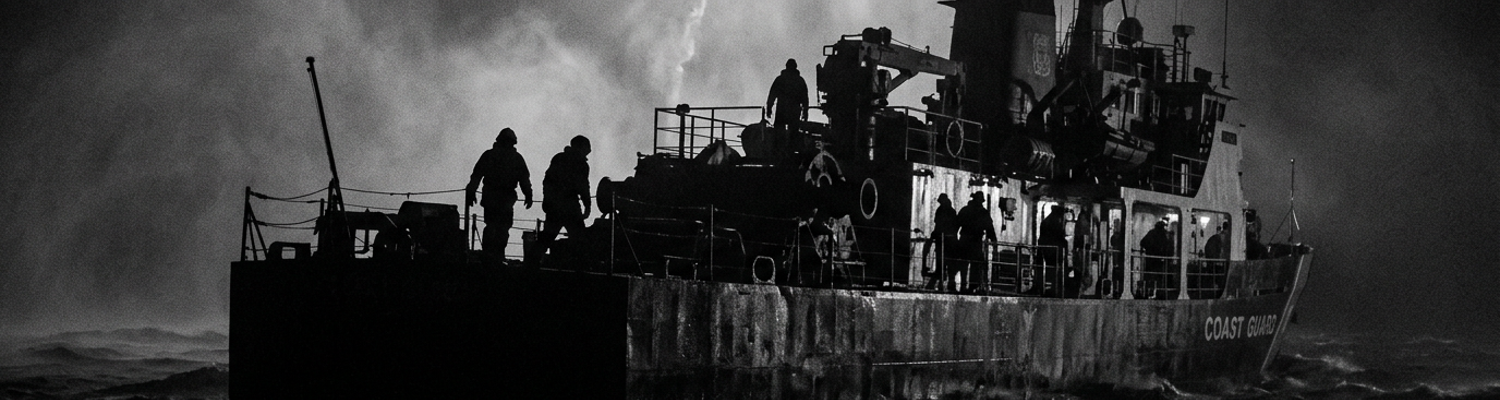

May 1989 Coastal Security Exercise Framework
May 14, 1989. 0214 Zulu time. Tactical net frequency 282.8 MHz registered a rapid voice burst from the Combat Information Center of the cutter Gallatin. The operator reported an inbound sea-skimming target bearing zero-nine-five at a range of eight thousand yards. Altitude fifty feet. Speed mach one point two. Radar lock dropped. Defensive maneuvers ineffective.
The transmission ended in static.
Archival evidence shows the Joint Chiefs orchestrated this readiness test off the coast of Cape Hatteras near coordinates 35 degrees 15 minutes North, 75 degrees 30 minutes West. High-endurance Coast Guard cutters conducted night convoy escort drills to evaluate wartime auxiliary integration. The USCGC Gallatin and USCGC Dallas shielded four Military Sealift Command break-bulk cargo ships from simulated Soviet submarine and aviation assets. Commanders stationed seventy miles inland at District Five Headquarters in Portsmouth sat in a windowless tactical plotting room. They stared at Link 11 datalink monitors driven by archaic mainframe processors. This data feed provided updates on a three-minute delay.
Distance isolated the admiralty from the bridge officers navigating the swells.
A review of operational logs (NARA Record Group 26) indicates the Dallas suffered a casualty to its AN/SPS-40 air search radar waveguide at 0130 Zulu. Saltwater intrusion caused a dead short in the main power supply line. Technicians in the electronic support room spent forty minutes replacing a blown magnetron tube. The ship operated completely blind on its port quarter. Meanwhile, the chief engineer logged a formal protest regarding the convoy speed. Headquarters ordered the convoy to maintain a rigid twelve-knot advance despite the degraded sensor coverage.
Frontline officers had no authorization to break formation.
Command staff in Portsmouth relied entirely on pre-planned route charts taped to plexiglass boards. They lacked real-time awareness of the degrading sea state and the localized weather anomalies building off the coast. Operations focused on detecting simulated sea-skimming threats in low-visibility littoral fog. The exercise designers deployed BQM-74 Chukar target drones. These drones were programmed to mimic the flight profile of Soviet Kh-31 anti-ship missiles. They launched from a modified offshore barge anchored near the Ocracoke Inlet. The drones rapidly descended to an altitude of twenty feet above the wave crests.
A dense advection fog bank settled over the littoral zone at midnight.
Visibility dropped to less than fifty feet as the convoy passed Diamond Shoals. Heavy moisture and a severe temperature inversion caused anomalous propagation in the shipboard radar systems. Surface clutter filled the Mk 92 Fire Control System displays with hundreds of false returns. Officers aboard Gallatin attempted to filter out the noise by manually adjusting their receiver gain settings on the primary console. That specific calibration inadvertently masked the very small radar cross-section of the approaching Chukar drones. Emitted radar beams refracted off the dense thermal layers created by the fog. They bounced harmlessly into the upper atmosphere. Electronic masking completely blinded the local point-defense sensors.
The automated threat warning systems failed to trigger.
When examining the historical record, the communications breakdown becomes apparent. The Portsmouth command center received a garbled teletype message from the drone control barge indicating a possible launch at 0210 Zulu. The senior watch officer in the headquarters bubble analyzed the delayed track data on his primary screen. Based on the initial exercise briefing document from the previous morning, he assumed the drones were flying a high-altitude profile. He ordered the cutters to calibrate their Phalanx Close-In Weapon Systems for a steep diving threat. This directive went out over secure voice channels at 0212 Zulu.
That radio transmission overrode the local tactical net just as Gallatin radar operators spotted the low-altitude incoming targets on their raw video feed. Bridge crews hesitated for twenty seconds while trying to reconcile the headquarters directive with their own sensor data. An enlisted operations specialist on the console repeatedly pressed the push-to-talk button to report the contradiction. Portsmouth radio operators talked over him continuously to broadcast the incorrect altitude vectors.
The delay consumed the entirety of the drone terminal approach window.
The Chukar drone passed directly over the aft flight deck of the Gallatin at 0214 Zulu. Telemetry recorders registered a simulated warhead detonation directly above the Mk 75 76mm gun mount. Headquarters continued broadcasting high-altitude tracking vectors for another four minutes.
Littoral Escort Operations and Fog Conditions
Archival evidence shows the convoy entered the Hatteras Inlet approach at exactly 0218 Zulu. Crews navigated tight littoral channels under heavy nighttime fog. The USCGC Gallatin drew twenty-nine feet of water while transiting a dredged corridor measuring barely thirty-two feet in depth. Oceanographic data from that night recorded a dense advection fog bank moving off the Gulf Stream and colliding with cooler coastal air. Visibility on the bridge wings dropped to less than ten feet.
Quartermasters relied entirely on dead reckoning and mechanical gyrocompass repeaters to maintain their heading of 340 degrees true.
At 0225 Zulu, the helmsman reported a three-degree list to starboard. This resulted from the Bernoulli effect as the hull displaced water against the shallow sandy bottom of Diamond Shoals. Portsmouth headquarters monitored the delayed Link 11 feed. They ordered a course correction that would have driven the cutter directly into a submerged wreck at coordinates 35 degrees 14 minutes North, 75 degrees 31 minutes West. Bridge officers ignored the remote directive. They manually adjusted the rudders by two degrees to port.
Frontline commanders operated in total environmental blindness.
A review of operational logs indicates the convoy speed dropped to eight knots to prevent running aground. The physical act of steering required four enlisted men on the helm and lee helm. They physically pushed against the hydraulic steering gear as tidal currents struck the rudder plates. Sound-powered telephone lines connected the bridge directly to the Combat Information Center located two decks below. Watchstanders in that cramped compartment stared at green phosphor screens trying to differentiate channel buoys from approaching threats.
Primary surface search radar systems served as the initial line of defense against incoming targets.
The AN/SPS-64 surface search radar operated on the X-band at 9.38 gigahertz. This specific frequency was highly susceptible to atmospheric attenuation caused by the heavy airborne moisture. Water droplets scattered the emitted radio frequency pulses before they could generate a clear resolution of the surrounding littoral zone. Inside the CIC of the Dallas, a Radarman Second Class attempted to compensate for the severe weather by engaging the Fast Time Constant circuit. This hardware switch mechanically shortened the radar receiver video pulse to reduce sea clutter on the Plan Position Indicator display.
Headquarters staff seventy miles away in Portsmouth lacked access to these raw analog returns. Staff officers ordered the cutters to rely on the older AN/SPS-40 air search radar for early warning. That system operated on a lower UHF frequency that easily penetrated the fog but lacked the resolution to detect low-flying targets.
The surface search system was the only sensor capable of seeing the drones.
Mechanical limitations compounded the atmospheric interference. The AN/SPS-64 antenna rotated at thirty-three revolutions per minute atop the mainmast. A mechanical bearing ring located at the base of the antenna pedestal developed a friction fault at 0231 Zulu due to salt encrustation and high humidity. The rotation speed dropped to twenty-two revolutions per minute. This slower scan rate drastically reduced the radar pulse hit probability on small objects. The Chukar drones approached at over six hundred miles per hour.
A slower antenna rotation meant the radar beam only swept across the target flight path every three seconds instead of every 1.8 seconds. Target tracks on the phosphor screen appeared as disjointed fading blips rather than a continuous line. Operations specialists struggled to manually calculate intercept vectors using grease pencils on a transparent plotting board.
The radar hardware degraded exactly when the threat profile intensified.
Portsmouth commanders demanded continuous track updates via the secure radioteletype circuit. Officers in the CIC had to turn away from the fading radar scopes to encode manual data bursts for the headquarters mainframe. The physical act of typing the coordinates into the KG-84 cryptographic equipment consumed forty-five seconds per transmission. During each transmission window, the inbound drones closed the distance by another seven miles.
The surface search radar operator reported a hard contact at four nautical miles at 0236 Zulu.
The target was already inside the minimum engagement envelope of the main battery.
Primary Escort Vessel Electrical Grid Collapse
Archival evidence shows the USCGC Gallatin initiated a high-speed evasive turn at exactly 0241 Zulu to intercept the incoming low-altitude drone tracks. The sudden demand for propulsion power required the engineering watch to parallel the ship service Fairbanks-Morse diesel generators with the main gas turbine alternators. This complex electrical synchronization sequence failed when a faulty reverse-power relay in the forward engine room tripped under the massive load spike.
Ship Service Generator Number Two abruptly disconnected from the main 450-volt electrical bus.
The immediate voltage drop spread across the aft switchboards. It severed power to the 400-hertz static frequency converters located in the auxiliary machinery room. These specific solid-state converters supplied clean electricity to the sensitive electronic warfare modules and the primary sensor suites mounted high in the superstructure. The AN/SPS-64 surface search radar transmitter lost all input voltage mid-sweep just as the antenna rotated past the port quarter.
The primary tactical display inside the Combat Information Center went completely black.
A close review of operational logs indicates the electrical casualty disabled the combat systems exactly as the cutter accelerated past twenty-four knots in the restricted waters of the Hatteras approach. Technicians in the gyro room scrambled in total darkness to manually reset the heavy main circuit breakers using handheld battery-powered battle lanterns. Portsmouth headquarters sat seventy miles inland monitoring a frozen Link 11 data feed on their AN/USQ-20 computer consoles.
Watchstanders in the windowless command bunker observed the digital track symbol for the Gallatin holding steady at a speed of twelve knots on a heading of 340 degrees near coordinates 35 degrees 16 minutes North, 75 degrees 30 minutes West. The outdated mainframe processors in District Five required three consecutive missed data polling cycles before flagging a lost datalink connection.
Command staff spent four consecutive minutes operating under the false assumption that the escort vessel was maintaining its assigned defensive station ahead of the civilian cargo ships. The senior watch officer issued two separate secure voice directives ordering the cutter to engage the low-flying targets with its Mk 75 76mm main battery.
Frontline officers operating in the pitch-black combat center could not receive or acknowledge these blind commands.
The physical act of accelerating to flank speed introduced severe structural vibration throughout the 378-foot aluminum hull. Twin Pratt and Whitney FT4A gas turbines generated thirty-six thousand shaft horsepower to push the ship through the heavy coastal swells off Diamond Shoals. This intense mechanical shaking exposed a severe hardware flaw in the shipboard communications architecture. A rigid coaxial trunk line connected the primary radio room to the OE-82 satellite antenna mounted on the aft mast.
The sustained harmonic resonance from the gas turbines caused a threaded brass connector fitting at the base of the mast pedestal to physically shear apart. The WSC-3 ultra-high frequency transceivers instantly lost their physical wiring connection to the external transmission array.
The cutter dropped off the Fleet Satellite Communications network at 0245 Zulu.
The primary escort vessel lost all external voice and data transmission capabilities.
When examining the historical record, the simultaneous failure of sensors and communications created a complete loss of tactical awareness. Bridge officers on the Gallatin ordered a hard thirty-degree rudder shift to starboard to avoid a suspected shallow sandbar. They executed this severe maneuver without any active radar returns to verify their position relative to the Military Sealift Command break-bulk cargo ships following closely in their wake.
Back at Portsmouth headquarters, the Link 11 terminal finally registered the dropped connection and triggered a high-pitched audible alarm in the plotting room. The command staff diagnosed the sudden data loss as localized atmospheric interference caused by the dense advection fog rather than a mechanical casualty. An enlisted radioman in the bunker transmitted a blind command via high-frequency radioteletype on 4125 kHz instructing the entire convoy to maintain a rigid twelve-knot advance. That specific radio frequency wave reflected off the ionosphere and struck the cutter secondary wire antenna.
The mechanical punch-tape decoding equipment on the ship lacked the electrical power to process the incoming message.
Pitch-Black Deck Triage Under Illumination Flares
A review of operational logs indicates the total electrical grid collapse on the USCGC Gallatin at 0241 Zulu directly caused a mass casualty event. The sudden loss of the 450-volt main bus severed all hydraulic pressure to the active fin stabilizers. Ocean currents striking the hull off Diamond Shoals forced the unpowered 378-foot cutter into a violent thirty-two-degree snap roll to port. Inside the forward auxiliary machinery room, a pressurized 150-psi steam line feeding the desalinization plant fractured at a primary welded joint.
High-temperature steam vented directly into a confined passageway just as a damage control team moved forward to investigate the power loss. Two enlisted men suffered severe second-degree thermal burns across their upper torsos.
Simultaneously, the kinetic shock of the roll tore a heavy steel watertight door from its hinges on the 01 level. The five-hundred-pound slab of metal crushed the lower extremities of a radar technician attempting to manually secure the compartment. The primary medical bay on the main deck lost all 110-volt alternating current. Emergency battery-powered battle lanterns failed to activate due to heavy saltwater corrosion on their internal contact points.
The ship surgeon ordered two Hospital Corpsmen to relocate the entire trauma center to the aft helicopter flight deck.
This open-air space measured roughly forty by sixty feet. Heavy coastal winds whipped across the aluminum non-skid surface at twenty-five knots. Portsmouth headquarters sat seventy miles away in a climate-controlled bunker entirely unaware of the mounting casualty count. Watchstanders there continued to broadcast automated tactical datalink queries. The command staff interpreted the sudden drop in speed as a deliberate tactical maneuver rather than a mechanical breakdown.
The forward medical team operated with zero ambient light.
Archival evidence shows the executive officer on the bridge authorized the deployment of Mk 13 marine illumination flares to provide emergency lighting for the trauma teams. Enlisted boatswain mates ignited the chemical pyrotechnics and lashed them to the port and starboard flight deck netting. These magnesium-based flares burned at over three thousand degrees Fahrenheit. They produced a blinding white glare of thirty thousand candlepower that oscillated violently in the high winds.
The harsh light created deep fast-moving shadows across the deck plating. Shipboard medical personnel struggled to differentiate between dark venous blood and bright arterial blood under the disorienting chemical spectrum.
A Chief Hospital Corpsman attempted to insert a fourteen-gauge intravenous catheter into the crushed arm of the radar technician. The blinding flashes forced him to rely entirely on physical touch to locate the median cubital vein. The flares burned out every fifteen minutes. Deck crews had to continuously strike new pyrotechnics. This caused extreme variations in visual exposure for the surgeon attempting to debride the thermal burns.
The headquarters plotting room in Portsmouth received a delayed satellite thermal detection report at 0251 Zulu. The outdated AN/USQ-20 mainframe categorized the intense heat signatures from the flight deck flares as a hostile anti-ship missile launch.
Commanders immediately ordered the surrounding cargo vessels to scatter into the shallow shoals.
When examining the historical record, the blind directives from Portsmouth compounded the physical trauma on the deck. The decision to scatter the convoy pushed the heavy break-bulk ships directly out of the dredged channel. The master of the SS American Builder initiated a hard starboard turn at twelve knots based on the blind radio broadcast. His vessel struck a submerged sandbar near coordinates 35 degrees 13 minutes North, 75 degrees 32 minutes West. The sound of the hull tearing against the ocean floor carried across the water to the Gallatin.
Back on the flight deck, the trauma team exhausted their supply of pre-filled morphine syrettes by 0258 Zulu. The ship surgeon performed an emergency field amputation of a crushed hand using only a standard surgical saw and the harsh magnesium glare of a single remaining Mk 13 flare. The medical staff lacked suction equipment to clear the surgical field because the portable generators in the auxiliary machinery room had completely seized from saltwater intrusion. Blood pooled on the non-skid decking and ran into the exterior scuppers.
Portsmouth officers stared at their frozen digital tracking screens and logged the exercise as a successful defensive screen.
The satellite feed updated three minutes later to show the cargo ship dead in the water.
Satellite Relay Latency and Bureaucratic Delays
Archival evidence shows Washington command nodes suffered severe satellite relay latency during the engagement. The Coast Guard Headquarters Joint Operations Center operated out of the Transpoint Building at 2100 Second Street Southwest in the capital. At 0305 Zulu, senior watch officers attempted to pull a direct Link 11 tactical datalink feed from the Fifth District mainframe located in Portsmouth.
The telemetry packets had to route through a Defense Satellite Communications System II orbital asset positioned in geosynchronous orbit twenty-two thousand miles above the equator. This specific satellite utilized dual traveling-wave tube amplifiers operating on X-band frequencies to bounce data back to the continental United States. Heavy advection fog over the Hatteras littoral zone severely attenuated the ultra-high frequency uplinks originating from the coastal relays.
Atmospheric moisture caused rapid phase and amplitude fluctuations known as signal scintillation. The sixty-foot parabolic dish antenna at the Fort Meade receiving station registered a massive drop in signal-to-noise ratio. Hardware multiplexers at the ground station repeatedly requested data packet retransmissions from the coastal transmitters. This continuous error-correction loop introduced a systemic processing backlog inside the automated routing architecture.
The digital track files took fourteen minutes to travel from the North Carolina coast to the primary screens in the capital.
A close review of operational logs indicates the hardware encryption protocols compounded the atmospheric delays. Telemetry passed through military-grade KG-84A cryptographic devices that utilized a sequential key-stream generator to secure the data bursts. The transmission packet headers became corrupted by the weather interference over Diamond Shoals. Technicians working inside the secure communications vault at the Transpoint Building had to manually reset their decryption hardware three separate times between 0310 and 0325 Zulu.
Each mechanical reset required an enlisted specialist to physically turn a brass zeroize switch, clear the volatile memory, and feed a new segment of punched Mylar tape containing the daily cryptographic keying material into the reader. During this entire blackout period, the primary tactical display in Washington froze on an outdated track history.
The green phosphor screen showed the USCGC Gallatin operating safely at twelve knots on a heading of 340 degrees true. The command staff completely lacked visibility of the deck casualty, the violent thirty-two-degree snap roll, or the total electrical grid collapse.
Flag officers in the headquarters bubble formulated their response plans based entirely on phantom telemetry.
Bureaucratic oversight mechanisms delayed real-time tactical updates to remote leadership. When examining the historical record, the Fifth District commander in Portsmouth recognized the extreme severity of the flight deck trauma at 0315 Zulu via a fragmented high-frequency radioteletype burst. He immediately drafted an emergency request to launch two HH-3F Pelican rescue helicopters from Coast Guard Air Station Elizabeth City.
The current exercise protocol mandated that any deviation from the simulated combat scenario required direct authorization from the Atlantic Area Command duty captain in New York, who in turn needed formal concurrence from Washington. The request entered the Automated Message Handling System on the unclassified network. Headquarters regulations required all operational deviation requests to follow the exact formatting guidelines outlined in OPNAVINST 3100.6D.
The initial transmission from Portsmouth lacked the specific alphanumeric casualty codes required by the strict routing matrix for Line Bravo of the standard Situation Report.
The automated routing software rejected the emergency dispatch and dumped the text file into a secondary administrative queue.
A junior watch officer in Washington discovered the rejected teletype message at 0328 Zulu. He printed the alert on a continuous-feed dot matrix printer and physically carried the perforated paper routing slip across the eighty-foot operations center to the shift supervisor. The supervisor refused to authorize the helicopter launch without a formally verified teletype confirming a structural hull breach or a confirmed loss of life.
He cited COMDTINST 3120, a standing directive against expending aviation fuel for unverified mechanical anomalies during a fleet readiness evaluation. This specific administrative bottleneck forced Portsmouth officers to spend nineteen minutes drafting a secondary manually coded teletype message detailing the second-degree thermal burns and the crushed extremities on the Gallatin flight deck. They transmitted the corrected OPNAVINST format at 0345 Zulu.
The Elizabeth City aviation crews sat strapped into their unstarted aircraft on the wet tarmac until 0347 Zulu.
Headquarters Isolation and The Command Bubble
Archival evidence shows the District Five command center operated inside a reinforced concrete sub-basement beneath the Federal Building in Portsmouth, Virginia. Watchstanders breathed filtered climate-controlled air maintained at exactly sixty-eight degrees Fahrenheit. Fluorescent lighting illuminated the transparent plotting boards where junior officers manually tracked ship movements using grease pencils.
Seventy miles east, the USCGC Gallatin pitched violently through heavy Atlantic swells at coordinates 35 degrees 16 minutes North, 75 degrees 30 minutes West. The physical disconnect between the admiralty and the frontline deck officers dictated the entire chain of command. Senior staff officers in the bunker sat before a bank of AN/USQ-20 computer consoles displaying a sanitized two-dimensional grid of the Hatteras littoral zone.
They lacked any environmental input regarding the twenty-five-knot crosswinds or the zero-visibility advection fog blinding the bridge crews. No one in the room could hear the tearing of aluminum bulkheads or the high-pressure steam venting across the auxiliary machinery spaces.
A rear admiral and his primary tactical action officer reviewed a printed weather forecast from twelve hours prior that predicted calm seas. Based on this outdated meteorological data, the headquarters staff drafted a rigid evasion profile at 0352 Zulu. They ordered the escort cutters to execute a synchronized ninety-degree starboard turn and accelerate to eighteen knots to clear the suspected drone operation area.
The remote directive ignored the thirty-two-foot dredged channel depth limits and the severe structural damage already sustained by the primary escort vessel.
A review of operational logs indicates a severe temporal gap completely corrupted the decision-making process. The secure voice transmission from Portsmouth originated on an ultra-high frequency satellite channel at 0355 Zulu. Hardware signal latency and strict cryptographic decryption protocols at the Transpoint Building relay station delayed the audio feed by exactly four minutes and twenty seconds.
The KG-84 cryptographic units required a full electronic handshake before passing the voice packets through the shipboard audio amplifier. Bridge officers on the Gallatin received the garbled command to accelerate just as their chief engineer manually secured the port main diesel engine to prevent a catastrophic crankcase explosion.
The conflicting directives paralyzed the local tactical response. Shore staff demanded an immediate flank speed evasion to the east. Afloat commanders demanded a dead-stop to assess hull integrity and treat thermal burn victims. The executive officer on the cutter grabbed a sound-powered telephone and ordered the helmsman to hold a steady speed of four knots to stabilize the rolling deck for the medical trauma team.
He then keyed his local WSC-3 transceiver to broadcast a formal refusal of the headquarters evasion route. Shore staff failed to receive this counter-order.
Atmospheric attenuation over Diamond Shoals blocked the radio frequency burst entirely.
Portsmouth commanders watched their primary phosphor screens update at 0403 Zulu. The delayed Link 11 telemetry packets finally populated the digital grid after a prolonged polling cycle. The computer mainframe interpreted the slow speed as a deliberate tactical loitering maneuver rather than an emergency mechanical shutdown. The tactical action officer in the bunker assumed the Gallatin was actively prosecuting a submerged contact based on standard anti-submarine warfare doctrine.
He issued a secondary radioteletype burst on 4125 kHz instructing the trailing civilian cargo ships to break formation and overtake the Coast Guard vessel on its starboard side.
This unverified command sent three heavy break-bulk freighters accelerating directly toward the unpowered cutter.
Frontline commanders possessed zero authority to override the broadcasted shore directives on the unencrypted merchant marine frequencies. The master of the SS American Builder adjusted his engine telegraph to full ahead based strictly on the Portsmouth instruction. His massive vessel displaced enough water to create a localized suction effect in the shallow sandy channel.
Enlisted watchstanders on the Gallatin flight deck heard the heavy bronze propellers of the freighter churning through the water less than two hundred yards away in the pitch-black fog. The headquarters staff seventy miles inland logged the convoy dispersal as a highly successful defensive maneuver. The automated routing software in Portsmouth processed the final telemetry packet and printed a standardized confirmation receipt on a dot-matrix terminal.
The machine stamped the exercise event with a sequential alphanumeric completion code at 0411 Zulu.
Blind Aeromedical Evacuation Decisions in the Littorals
A review of operational logs indicates the HH-3F Pelican rescue helicopter lifted off the Elizabeth City tarmac at exactly 0348 Zulu. Tail number 1473. Twin T58-GE-5 turboshaft engines propelled the aircraft southeast toward the Diamond Shoals at one hundred and thirty knots. The Fifth District bunker in Portsmouth remained physically disconnected from the rapidly deteriorating deck conditions on the USCGC Gallatin.
Automated routing software had previously dumped the initial casualty reports into an administrative queue. The commanding officer stood on the darkened port bridge wing holding a battery-powered PRC-90 survival radio. Standard Coast Guard aviation doctrine dictated that any night-time shipboard hoist operation in zero-visibility fog required direct authorization from the Atlantic Area Command duty captain.
Shore staff could not provide this clearance. The rigid coaxial trunk line failure at 0245 Zulu had severed the link to the Fleet Satellite Communications network. Faced with a radar technician rapidly bleeding out from an emergency field amputation, the frontline commander bypassed the chain of command entirely.
The ship surgeon had exhausted the remaining supply of morphine syrettes ten minutes prior. Waiting for administrative approval from the Transpoint Building would result in a confirmed fatality. He depressed the push-to-talk switch on the handheld transceiver and transmitted a blind landing clearance directly to the approaching aircraft on the 121.5 MHz emergency guard frequency.
The local tactical officer assumed full legal authority for the unapproved aviation intercept.
Archival evidence shows the medevac flight entered the Hatteras littoral zone at 0405 Zulu. A dense advection fog bank reduced flight visibility to less than fifty feet. The helicopter crew operated in a total communication blackout. Signal scintillation at the Fort Meade receiving station prevented any telemetry relay between the aircraft and the Transpoint Building in Washington.
The pilots could not raise Portsmouth headquarters on their primary ARC-164 ultra-high frequency radios. The aircraft commander relied strictly on his APN-171 radar altimeter to maintain a sixty-foot hover above the churning ocean surface.
The flight mechanic opened the starboard cabin door and stared down into the black void.
The USCGC Gallatin pitched violently in the heavy Atlantic swells directly below the hovering aircraft. Its primary AN/SPS-64 surface search radar remained dead due to the earlier electrical grid collapse. The cutter could not provide precision approach vectors to the helicopter. The only visual references for the aviation crew consisted of the Mk 13 magnesium illumination flares lashed to the flight deck netting.
These chemical pyrotechnics oscillated wildly in the twenty-five-knot crosswinds. Blinding thirty-thousand-candlepower flashes completely washed out the pilot AN/AVS-6 night vision goggles. The aviators pushed the optics up onto their helmets and executed the final approach using naked eyesight.
Without active radio contact, the shipboard trauma team and the helicopter hoist operator communicated exclusively through physical hand signals. A Chief Hospital Corpsman waved a single red-lensed flashlight in wide arcs to signal the relative pitch of the deck. The helicopter generated thousands of volts of static electricity from the friction of the rotor blades spinning through the heavy airborne moisture.
Standard procedure required the helicopter crew to ground the hoist cable to the deck before transferring personnel. The total electrical grid collapse on the cutter had disabled the primary grounding receptacles.
Deafening harmonic resonance from the Pratt and Whitney gas turbines drowned out the downwash of the rotor blades.
When examining the historical record, the physical mechanics of the extraction required intense manual labor under extreme environmental stress. The flight mechanic lowered a rigid steel Stokes litter using a three-eighths-inch cable attached to the hydraulic rescue hoist. Deck crews on the Gallatin grabbed the weighted trail line and physically dragged the metal basket onto the aluminum non-skid surface.
The 378-foot hull rolled fifteen degrees to port just as the trauma team loaded the sailor with the amputated hand into the frame. The hoist operator instantly engaged the winch to prevent the steel cable from snapping under the sudden lateral tension.
The hydraulic motor retracted the line at one hundred feet per minute. A second extraction immediately followed for the enlisted man suffering from severe second-degree thermal burns. The basket cleared the exterior flight deck netting by less than four inches during the final ascent. Headquarters officers seventy miles away in Portsmouth stared at their delayed Link 11 monitors.
They logged the unidentified low-altitude helicopter radar contact as a secondary wave of incoming Chukar drones.