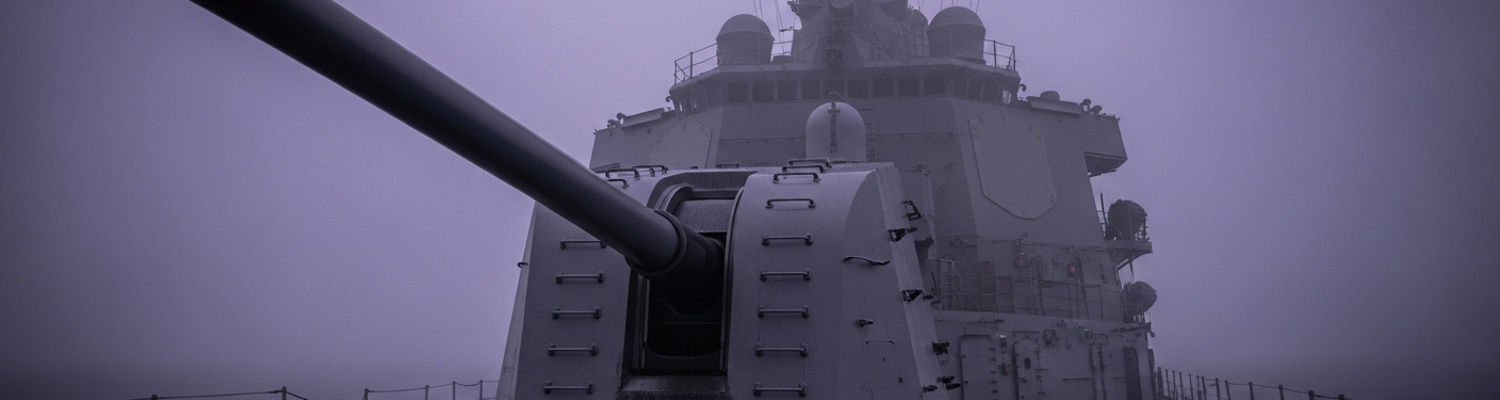

### Mark 45 Post-Soviet Operational Realignment
The Mark 45 naval gun system was a direct product of Cold War fleet defense doctrine. Its development was driven by the requirement to defend carrier battle groups from massed Soviet anti-ship missile and bomber attacks on the open ocean. The weapon's core control element, the Mark 86 Gun Fire Control System (GFCS), was introduced in the 1970s and built around a specific set of sensors to solve this problem. Its primary inputs were the AN/SPQ-9 surface search radar and the AN/SPG-60 air tracking radar, a prominent parabolic reflector. These sensors fed targeting data to a central computer, which calculated ballistic solutions for high-speed aerial threats.
The system was designed for speed and automated precision against predictable targets.
Archival analysis of the weapon's development shows a clear prioritization of the anti-air warfare (AAW) mission. The Mark 45 gun mount itself was lighter and required less manning than its Mark 42 predecessor, but its key performance parameter was a high rate of fire, between 16 and 20 rounds per minute. This capability was intended to create a dense wall of flak to intercept incoming saturation attacks. The standard ammunition developed and stockpiled reflected this mission, consisting primarily of high-explosive rounds with proximity fuzes optimized for aircraft. Naval surface fire support (NSFS), the mission of bombarding land targets, was considered a secondary function during this period. There was little institutional drive to develop a wide range of specialized land-attack munitions.
With the dissolution of the Soviet Union in 1991, the U.S. Navy's strategic focus shifted almost overnight. The threat of a large-scale naval air war in the North Atlantic evaporated. The new operational environment was the world's littorals, the crowded coastal waters where political instability demanded power projection. Destroyers and cruisers were now expected to operate close to shore, providing direct fire support for ground forces. This was a mission profile for which the Mark 45 and its Mk 86 fire control system were not prepared. The GFCS, optimized for tracking fast-moving targets against a clean sea and sky background, had difficulty targeting fixed points on land without GPS integration, a feature that was not yet standard. The gun's high-velocity, flat-trajectory characteristics were also poorly suited for the high-angle, plunging fire needed to engage targets in complex terrain. The 1992 decommissioning of the last Iowa-class battleships removed the fleet's only dedicated NSFS platforms, leaving the Mark 45 to fill a capability gap for which it was not designed.
Littoral Sensor Integration Deficiencies
A close review of operational logs from Ticonderoga-class cruisers on maritime interdiction patrols in the Persian Gulf following Operation Desert Storm reveals a system struggling with its environment. The Mark 86 GFCS, designed for the clear air of the open ocean, was now operating in the perpetual haze, sandstorms, and smoke from oil well fires characteristic of the region. The primary surface-search radar, the AN/SPQ-9A, experienced significant performance degradation. Its X-band frequency, while excellent for detecting low-flying missiles over water, suffered from severe attenuation in the dusty and humid air. The radar display would become saturated with false returns, rendering its data feed to the Mk 86 computer unreliable for targeting small surface contacts. Fire control teams were often forced to rely on verbal reports from helicopters, introducing communication delays that defeated the purpose of an automated system.
The system could not reliably see.
The challenge of radar ambiguity was amplified during operations in the Adriatic Sea as part of the blockade against the former Yugoslavia. The operational area was defined by the complex, island-dotted Dalmatian coast. The AN/SPQ-9A was a two-dimensional, surface-search radar whose beam, when directed toward the shore, produced a chaotic picture. Radar energy reflected from hills, buildings, and civilian infrastructure, creating a high level of ground clutter that masked legitimate surface targets. Analysis of archived radar scope recordings from this period shows large sections of the display saturated with returns. A small patrol boat operating near the coast would be indistinguishable from the landmass behind it. The Mk 86 computer, lacking the sophisticated digital filtering and moving target indication (MTI) of later systems, could not resolve these ambiguities. It would either generate a firing solution on a piece of terrain or fail to establish a target lock. This forced operators to manually interpret raw radar video, a skill that had atrophied during the Cold War's emphasis on automation.
This reliance on human operators exposed the system's third failure point: its optical hardware. The AN/SPG-60 tracking radar director was fitted with a simple television camera for visual identification of airborne targets. This was 1970s-era technology, a low-resolution, black-and-white camera with no low-light or thermal imaging capability. When a radar operator identified a potential contact hidden in coastal clutter, the fire control officer would slew the SPG-60 director to investigate. The resulting image on the console was often a grainy, washed-out picture, made useless by haze, rain, or low-light conditions. It was impossible to distinguish a hostile vehicle from a civilian bus at tactically relevant ranges. Post-Cold War rules of engagement demanded positive visual identification to prevent collateral damage. This optical weakness frequently prevented the use of the Mark 45 gun, even when it was locked on a valid radar track.
The 1995 Adriatic Surface Interdiction Incident
After-action reports from Operation Sharp Guard in the winter of 1995 document a near-catastrophic failure of target identification in the Adriatic Sea. The USS Normandy (CG-60), a Ticonderoga-class cruiser, was enforcing the UN arms embargo against the former Yugoslavia. The tactical environment was compromised by a thick fog that reduced visibility to under one nautical mile, blinding the crew's optical sensors and forcing total reliance on electronics.
The ship was tracking an ambiguous contact in the fog.
Inside the Combat Information Center (CIC), operators tracked a vessel on a course consistent with a smuggling route toward the Montenegrin coast. The ship's AN/SPY-1 radar, the core of the Aegis Combat System, held a firm track on the contact. However, the system's dedicated surface-search and fire-control radar, the AN/SPQ-9A, was struggling. The combination of dense fog and high sea state created significant sea return, where the radar's energy reflected off waves, cluttering the display. The AN/SPQ-9A model in use at the time could not effectively filter this noise, resulting in a corrupted and erratic track. The Tactical Action Officer faced a decision based on this flawed data: allow a potential arms shipment to pass or act on uncertain information.
Intelligence reports indicated a contraband shipment was imminent. The rules of engagement permitted disabling fire after a series of warnings. The decision was made to escalate. The Normandy's fire control system generated a firing solution based on the corrupted data from the AN/SPQ-9A. The Mark 45 gun trained on the target's predicted location, and a single high-explosive warning shot was fired into the fog. Moments later, a lookout on the bridge reported a sudden, brief break in the fog. The target was revealed not as a lone blockade runner, but as an Italian-flagged civilian passenger ferry, off its normal course due to the weather.
An urgent "check fire" command was issued through the CIC's communication system. The firing sequence was aborted, but the first round was already airborne. The shell landed and detonated in the water less than 100 yards from the ferry's port bow. A world-class fire control system, fed fatally ambiguous data, had narrowly missed causing a major international incident. The incident report was circulated at the highest levels of the Sixth Fleet, serving as a stark warning about a critical vulnerability in the Navy's most advanced surface combatants.
Post-Incident Vulnerability Analysis
The near-miss in the Adriatic triggered a fleet-wide review. Analysis of the USS Normandy incident exposed deep vulnerabilities in the Aegis combat system's software architecture. The system's software baseline was a product of the 1980s, designed to identify and track distinct, high-speed Soviet missiles against a clean, open-ocean background. Its filtering algorithms were not written to handle the high-clutter environment of dense fog and choppy seas. The AN/SPQ-9A radar feed was overwhelmed with sea return, but the system's architecture lacked the Doppler processing to differentiate this noise from a slow-moving surface contact. Instead of rejecting the corrupted data, the Command and Decision (C&D) computer interpreted the erratic returns as valid plot points and proceeded to build a firing solution. This was a fundamental flaw in the system's conceptual design.
This over-reliance on automation was reinforced by operator training protocols. Cold War doctrine had conditioned fire control teams to monitor a system expected to perform the difficult tasks. Training scenarios focused on high-intensity, open-ocean combat against supersonic threats, rewarding speed and adherence to the system's automated recommendations. The skillset for manually interpreting raw data had degraded. The protocols for low-visibility engagements were insufficient, offering little guidance for a scenario where the ship's primary non-visual sensor was being defeated by weather. The crew of the Normandy was confronted with a problem their training had not prepared them to solve.
Another point of failure was a breakdown in internal communication between the Aegis system's primary sensor and its terminal fire control loop. On the main tactical displays, the target appeared as a single, coherent track, held primarily by the ship's long-range AN/SPY-1 radar. When the engagement was handed off to the Mark 45 gun, the system switched to the AN/SPQ-9A radar for the precise targeting data required. The data fusion process failed to properly weigh the quality of the information from the different sensors. The interface between the Aegis C&D suite and the gun control system did not effectively communicate the low confidence of the AN/SPQ-9A's data. To the weapon system, the targeting command was valid. To the operators, the symbol on their screen appeared solid. There was no automated warning that the final link in the kill chain was relying on noise.
Expedited Mark 45 Mod 4 Upgrades
The Adriatic incident served as a catalyst for change. At the Naval Sea Systems Command, the event triggered an immediate acceleration of plans to overhaul the Mark 45 system. The result was the Mark 45 Mod 4, an upgrade so comprehensive it was nearly a new weapon. Engineering directives show the primary physical change was the replacement of the original 54-caliber barrel with a longer 62-caliber barrel. This modification, along with a strengthened gun mount, was designed to handle the higher chamber pressures of a new generation of advanced munitions. The centerpiece of this effort was the EX-171 Extended Range Guided Munition (ERGM). Development records show the ERGM program, initiated in the mid-1990s, was intended to create a rocket-assisted, GPS/INS-guided projectile capable of striking targets with high precision at ranges over 60 nautical miles. The Mod 4 mount included a new digital control system and an Ammunition Recognition System to handle and program these complex rounds. The USS Winston S. Churchill (DDG-81) was the first destroyer fitted with the new Mod 4 gun.
This hardware overhaul was matched by a doctrinal shift. A review of joint fire support publications from the late 1990s, specifically the 1998 update to JP 3-09, reveals a new philosophy for Naval Surface Fire Support. The Cold War model of the ship as an autonomous sensor and shooter was declared obsolete. The new doctrine was built on network-centric warfare, where a ship's fire control team acted as a node in a wider sensor network. Training regimens were rewritten to focus on complex, multi-layered confirmation procedures for land-attack missions. New protocols mandated that a shore target's position had to be confirmed through multiple, independent sources before a firing solution could be generated.
The human operator was placed back in control of the kill chain.
To support this new doctrine, the technology had to be upgraded. The core failure aboard the Normandy was a system that trusted a single, corrupted sensor. The solution was a mandated emphasis on multi-sensor redundancy. This led to the expedited introduction of the AN/SPQ-9B radar, a pulse-Doppler system specifically designed to operate in the high-clutter littoral environments that had defeated its predecessor. The '9B' model could distinguish a small, moving boat from background noise. This new radar was integrated into a new architecture called the Naval Fires Control System (NFCS), which served as a central clearinghouse for targeting data from Army, Marine Corps, and other assets. A target designated by a Marine on a handheld device would appear on the Aegis display with its GPS coordinates, allowing the gun system to generate a highly accurate firing solution for a guided munition. This process of fusing off-board targeting data directly into the ship's fire control loop was the technical solution to the problem identified in 1995.
The Enduring Legacy of the Mark 45 System
The most significant long-term impact of the 1995 incident was philosophical. The near-disaster in the Adriatic demonstrated that a single advanced warship could be defeated by its own flawed perceptions. The solution was the institutionalization of network-centric targeting. Systems like the Naval Fires Control System (NFCS) were developed to ensure a ship's gun would not rely solely on its own organic sensors for a land-attack mission. The NFCS integrated targeting information from Army units, Marine forward observers, and unmanned aerial vehicles directly into the ship's fire control loop. This created a system of systems where a call for fire was a data package containing precise GPS coordinates that required cross-validation before the gun could be cleared to fire.
The gun became one node in a distributed kill web.
The Mod 4 upgrade was intended to be the physical embodiment of this new era, but its key munition, the Extended Range Guided Munition (ERGM), failed. Development records show the ERGM program, started in 1996, was plagued by technical problems. The projectile's complex electronics often failed to survive the violent forces of being fired from a cannon. After twelve years and over $600 million, the program was canceled in 2008 without fielding a reliable projectile. This left the Mod 4 gun, with its expensive new barrel, unable to perform its primary mission of long-range fire support. The search for a replacement led to the adaptation of the Hypervelocity Projectile (HVP), originally designed for the cancelled electromagnetic railgun program. The HVP turned the Mark 45 into a launch platform for a maneuverable, guided round, a concept that has found new relevance in countering drones.
The weapon's role as the fleet's primary long-range strike asset was never truly realized. That mission is now owned by cruise missiles launched from the Mk 41 Vertical Launching System. The failure of the Advanced Gun System (AGS) on the DDG-1000 Zumwalt-class destroyers serves as a final punctuation mark on the era of large-caliber naval guns. The AGS's specialized Long Range Land Attack Projectile (LRLAP) was canceled in 2016 after its per-round cost approached $1 million, leaving the advanced guns with no ammunition. The Navy has since decided to physically remove the AGS mounts from the three Zumwalt destroyers and replace them with launch tubes for hypersonic missiles. This decision signals the end of the line for large-caliber naval guns as primary surface fire assets. The Mark 45 Mod 4 remains a useful secondary weapon on Arleigh Burke-class destroyers, but its days as a central component of naval warfare are numbered.