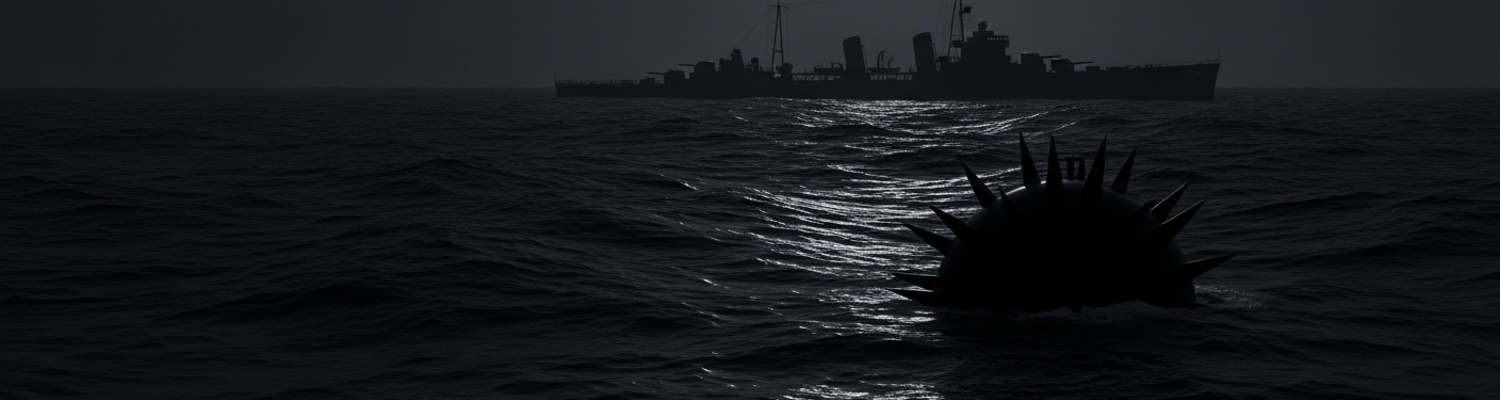

The U.S. Navy’s yearly Fleet Problems were not scripted pageants. They were vast, free-play strategic laboratories designed to push every component of the fleet to its breaking point. February 1931’s Fleet Problem XII was no exception. The scenario was a direct assault on the Panama Canal by an aggressive Asiatic power, the “Black” fleet. The defending “Blue” fleet, representing the United States, was tasked with the canal's protection. The operational theater was the vast expanse of ocean west of Central America and Panama. Blue force’s defense hinged on its two large carriers, USS Saratoga and USS Lexington, intended to strike the invading Black fleet far from its objective.
Defense of the Panama Canal, however, did not rely on ships alone. A less glamorous, but essential, layer of this defense was the planned deployment of naval minefields. Interwar U.S. Navy doctrine, informed by the lessons of the Russo-Japanese War and World War I, viewed mine warfare as a powerful defensive multiplier. The goal was sea denial. Mines were meant to channel enemy forces into kill zones, protect friendly ports, and disrupt an attacker's operational tempo.
The technology for this strategy was the Mark VI naval mine. It was a holdover from the Great War, a 34-inch sphere packed with 300 pounds of TNT. When deployed, an anchor would take it to a preset depth, where it would wait for a ship's hull to strike one of its chemical “Hertz” horns, completing a circuit and detonating the charge. The doctrine was simple: lay dense fields in strategic channels. The fields were not primarily for sinking ships; their purpose was to force an enemy commander to slow down for painstaking minesweeping or reroute entirely, exposing his fleet to attack.
Responsibility for this task fell to a specialized corner of the fleet. The Navy had few purpose-built minelayers. The job was largely assigned to converted flush-deck destroyers from the World War I building program. Vessels like USS Breese and USS Montgomery were reclassified as light minelayers (DM), their torpedo tubes replaced with mine tracks holding around 80 Mark VI mines. For Fleet Problem XII, the plan called for these DMs to sow defensive fields across the Pacific approaches to the Gulf of Panama, creating a barrier for the attacking Black fleet.
Mine Squadron One (MinRon One) received an unforgiving operational order. The squadron had 36 hours to lay a dense, defensive minefield. This was a hard limit dictated by the projected speed of the attacking Black fleet. The countdown initiated a frantic period of activity for the converted destroyers. They had to achieve full steam, rendezvous from patrol stations, and proceed at high speed to designated coordinates. The compressed window placed enormous strain on aging engineering plants and on crews facing sustained, high-intensity work with no rest.
The logistical chain was fragile. Ordnance logs from the Balboa Naval Ammunition Depot show the first signs of trouble. The Mark VI mines, surplus from the Great War, were stored in magazines ill-suited to Panama’s corrosive humidity. Initial inspections revealed significant surface rust on the thin steel casings, prompting time-consuming wire-brushing and repainting that created a bottleneck. Transferring the 700-pound mine-and-anchor assemblies from the depot to the destroyers at Rodman Naval Station was also problematic. A steam crane's boiler tube failed, forcing sailors to use the ships’ own cargo booms, a slower and more dangerous method. On the deck of USS Breese (DM-18), a dropped mine casing dented the mine tracks, requiring two hours of frantic repairs with sledgehammers.
At sea, the challenges became intensely mechanical. Final mine assembly had to be performed at night, under blackout conditions, on the rolling fantails of the destroyers. Action reports describe a scene of controlled chaos. Teams of sailors worked by the dim red glow of battle lanterns. Each Mark VI required its anchor attached and its depth-setting adjusted. This mechanical procedure involved a specialized wrench to turn a mechanism inside the anchor, setting how much cable would pay out. Reports from USS Montgomery (DM-17) document that hasty refurbishment had failed to address corrosion on these internal mechanisms. Crews found roughly one in five depth-setters was frozen with rust or so stiff that the wrench's brass safety pins would shear off. This forced minemen to perform field repairs, prying open anchor casings to manually lubricate gears, a procedure never intended to be done on a moving ship in darkness.
The final deployment under simulated combat conditions was the breaking point. Exercise umpires created diversions to mimic an enemy trying to disrupt the operation. Blue force destroyers made sharp, evasive maneuvers to avoid simulated torpedo wakes. Keeping the squadron in the precise formation for a uniformly patterned minefield became nearly impossible. Aboard USS Tracy (DM-19), a near-collision forced the ship to break formation, leaving a gap in the defensive line. On deck, the situation was perilous. A pitching deck and fatigued sailors led to multiple jams on the mine tracks. A 700-pound mine would get stuck, and the next one would roll down and slam into it, creating a pile-up of armed ordnance on the fantail. Clearing these jams involved pry bars and raw muscle, with the constant threat of a dislodged mine rolling free.
A fundamental flaw was at work, rooted in the cold Pacific water. A review of the Mark VI mine’s technical schematics (BuOrd Dwg. 195442) reveals an environmental vulnerability. The depth-setting mechanism relied on a hydrostatic diaphragm filled with a calibrated glycerin-and-water solution. As the mine sank, increasing water pressure was meant to compress this diaphragm, tripping a lever that locked the anchor’s cable drum at a preset depth. Planners had not accounted for the unseasonably strong Humboldt Current that February. Oceanographic data from the period shows surface water temperatures off Panama plunged to nearly 55 degrees Fahrenheit. In the cold, the glycerin solution thickened. Its viscosity increased to a point where ambient water pressure was insufficient to compress the diaphragm. The locking lever never tripped.
The cable drums never received the signal to lock. They paid out their entire length of cable, sending the mines and their anchors plummeting uselessly to the seabed hundreds of feet below. They were not creating a defensive field. They were depositing TNT on the ocean floor.
This depth-setting malfunction was compounded by a second design issue in the mine’s firing mechanism. The Mark VI’s explosive charge was detonated by a current from a dry-cell battery. The circuit was inert until the mine was immersed in saltwater, which acted as an electrolyte to activate the battery. Post-exercise analysis of recovered training mines showed this activation process was dangerously sluggish in the cold water. The chemical reaction intended to bring the battery to full power in seconds instead took several minutes. In some cases, it never reached full potential. The squadron was deploying a field of duds. The first indication came from an officer aboard USS Tracy (DM-19), who noted through binoculars that the marker buoys attached to the training mines, designed to pop to the surface for recovery, were not appearing.
The cascade of failures produced a new danger. Post-exercise analysis revealed a third, distinct malfunction. On a number of units, the high-torque work by minemen to un-jam corroded gears caused hairline fractures in the anchor’s release housing. The shock of hitting the water was enough to shatter this weakened component. The anchor separated from the mine’s mooring cable prematurely. The heavy anchor plummeted, but the buoyant mine, no longer tethered, popped back to the surface. It floated freely, its Hertz horns exposed and its battery activated by the saltwater. Umpire reports confirm the result. Approximately 15 percent of the mines laid, nearly 75 armed, free-floating contact explosives, were now bobbing on the surface, an unmapped menace in the operational area of the friendly Blue fleet.
This unplanned surface field immediately began to claim victims. As Mine Squadron One completed its deployment and turned back, the ships sailed into the path of the first mines they had sown. On the bridge of USS Breese (DM-18), a lookout spotted the spherical shape of a Mark VI mine 50 yards off the port bow. The captain’s order for “hard right rudder” was too late. An exercise umpire on the bridge informed him of the ruling. For the purposes of Fleet Problem XII, the Breese had struck one of its own mines. A large red flag was hoisted, signaling the ship was out of action. The umpire’s verdict was specific: a simulated detonation against the forward engine room, catastrophic flooding, and a complete loss of power. A report then came from USS Montgomery (DM-17), which, in a maneuver to avoid a floating mine, was judged to have collided with the screening destroyer USS Perry (DD-340). The defensive minefield had functionally sunk two light minelayers and heavily damaged a fleet destroyer from its own side.
Each declaration of damage was accompanied by an assessment of simulated crew casualties. For the USS Breese, the umpire ruled 35 crewmen killed and 50 wounded, wiping out its engineering department. These sailors were not physically harmed, but for the rest of the exercise, they were forbidden from carrying out their duties. The true logistical problem, however, was the dawning realization of what the Blue fleet now faced. It had created a 75-mine hostile field in its own rear area. The mission of Mine Squadron One was instantly changed. Its surviving ships were tasked with cleanup, an operation for which no doctrine existed. It involved destroyers creeping at low speed toward the bobbing mines and attempting to destroy them with machine-gun fire or 4-inch deck guns. This was a dangerous and time-consuming task, exposing ships and crews to potential detonations at close range, all while the Black fleet advanced.
The findings of the post-exercise engineering assessment, submitted by the Bureau of Ordnance in April 1931 (BuOrd Report 31-4), were damning. Ordnance officers dissected recovered training mines and depot stocks. The analysis confirmed the dual-system failure. Laboratory tests duplicating the 55-degree water temperatures demonstrated the glycerin solution in the hydrostatic diaphragm thickened to the point that it resisted compression. This explained why most mines plummeted to the seafloor. The second finding addressed the electrical firing circuit. BuOrd’s analysis showed the dry-cell battery’s chemical activation was severely retarded by the cold saltwater. The report concluded that even a perfectly laid mine would have been a dud.
A review of shipyard maintenance logs for the USS Breese and USS Montgomery reveals a pattern of neglect. As converted flush-deck destroyers, their specialized mine warfare equipment had suffered uniquely. The mine tracks were documented in multiple 1930 maintenance requests as being warped from sun and salt spray, a condition never rectified. This warping was a direct cause of the mine jams. Records show that the complex mechanical release catches on the tracks were supposed to be disassembled and lubricated quarterly. Shipyard records indicate this service was deferred for over a year on at least two ships in the squadron due to budget limitations. The crews were sent to perform a high-stakes mission with equipment known to be faulty.
This institutional disregard extended to the sailors. Personnel records from the Bureau of Navigation paint a picture of a shortage of trained mine warfare technicians. Mine warfare received little serious attention or funding during the interwar period. The specialized “Mineman” rating would not be formally established for another decade. The men handling the mines were often general-duty sailors with rudimentary training, led by a handful of over-stretched gunner’s mates. An analysis of MinRon One’s muster rolls for February 1931 shows that fewer than 20 percent of the enlisted men assigned to mine deployment duties had ever participated in a live-fire mining exercise. This lack of experience was a direct factor in the cascade of human errors. The few experienced leaders were unable to supervise every task at once in the darkness.
The systemic failures during Fleet Problem XII had a lasting impact. The exercise starkly revealed that the Navy’s primary defensive mining system was non-functional under realistic conditions. This revelation, combined with the on-deck operational chaos, confirmed the prejudices of a fleet leadership already focused on the offensive power of carriers and battleships. Mine warfare was relegated to an even lower priority, receiving scant attention and funding. This neglect had direct consequences. The U.S. entered World War II with a severely underdeveloped mine and counter-mine capability, a deficiency that would prove costly in the early years of the Pacific campaign.