
Shamal Sandstorms and Forward Surgical Team Operations
Tactical radio logs at the Karbala Gap captured the broadcast verbatim. Dustoff inbound zero visibility. Generator phase balance lost. Pressure sterilizer exhaust frozen. Priority surgical backlog mounting.
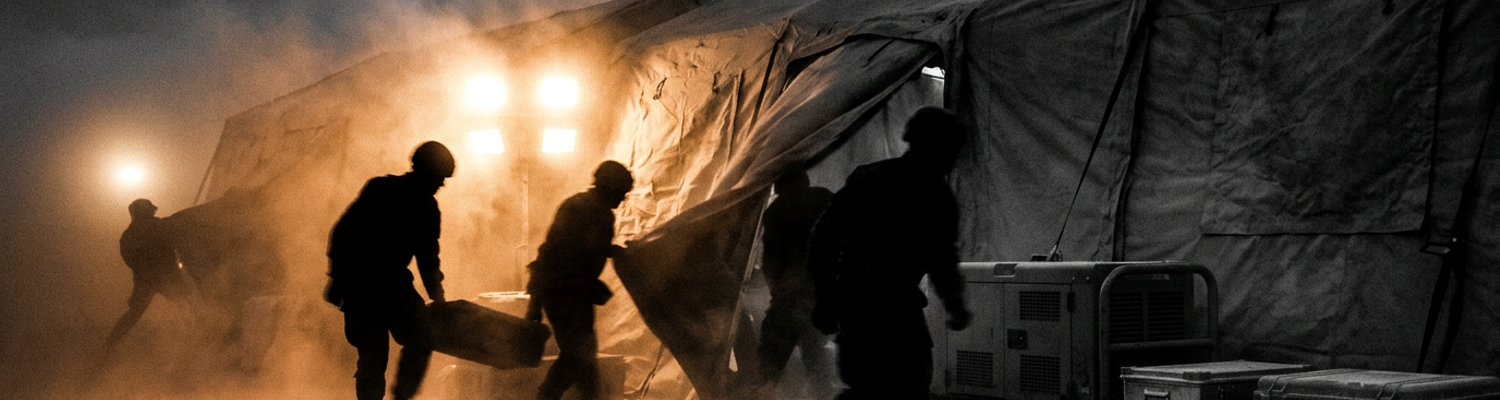
A close review of operational logs indicates that on March 25, 2003, the 3rd Infantry Division drive toward Baghdad collided with a severe southern shamal along Highway 9 near Objective Rams. Sustained 50-knot winds drove dense sheets of abrasive sand across the desert floor. Ambient visibility dropped to zero within twenty minutes. Inside the mobile surgical tents of the Forward Surgical Teams attached to the division support element, canvas seams split under sustained wind loads. Fine particulate matter rushed into sterile treatment bays. Specialist E-4 radio operators logged grid coordinates on acetate boards. They attempted to route emergency medevac flights through blinding orange grit. Surgical teams received blast trauma and shrapnel injuries from running battles along the Euphrates river corridor.
Power died first.
Archival evidence shows standard MEP-806B tactical diesel generator sets choked within hours (National Archives Record Group 338). These units were designed to deliver sixty kilowatts of continuous electricity to the field surgical suites. Desert silt overwhelmed external air intakes. Ground crews watched heavy dust penetrate paper filter elements. This starved the combustion chambers and triggered sudden thermal shutdowns across the primary distribution grid. Voltage plummeted erratically across the mobile electrical bus bars. Command elements faced an immediate breakdown of tactical support infrastructure. Backup twenty-kilowatt generator sets overheated from clogged cooling fins. Circuit breakers tripped. Active surgical operating tables plunged into darkness.
Vehicle-mounted auxiliary power units attempted to bridge the gap.
The abrasive dust ground down internal cooling fan bearings and fouled alternator brushes across the tactical perimeter. Surge currents damaged sensitive solid-state control boards in peripheral diagnostic units. Surgical teams were forced to work under battery-powered task lamps. Mechanical technicians traded spare filters from dead transport trucks in an attempt to restart the primary hospital grid.
Air filtration failed completely.
When examining the historical record of field hospital equipment failures during the advance, the primary point of failure centered directly on the mechanical field pressure steam autoclaves. Airborne silica silt bypassed outer tent skirts. This micro-fine sub-twenty-micron quartz infiltrated the unsealed metal housings of the sterilizer units. Silt settled directly into the mechanical assembly of the spring-loaded pressure relief needle valves and exhaust ports. Operating crews running continuous flash-sterilization cycles discovered the needle seats packed with grit. The safety valves locked in a fixed shut position. Chamber steam could not vent through clogged mechanical exhaust lines. Automated timing cycles aborted. Chambers failed to reach the required 270 degrees Fahrenheit sterilization threshold.
Technicians confronted jammed valve stems and frozen exhaust solenoid actuators.
Incoming casualties with open abdominal trauma lay waiting on external field litters. Instrument trays from initial laparotomy procedures accumulated in washbasins coated with red grit. Surgical techs stripped needle valve fittings with pliers and utility knives. They attempted to flush packed silt using chlorinated water and high-pressure syringe blasts. The buildup of casualties from fighting at the bridge crossings near Al Kifl continued through the storm front. Eight surgical trauma admissions arrived within two hours. Only one field sterilizer chamber held partial steam pressure. Operating personnel placed unsterilized retractor sets into buckets of diluted povidone-iodine solution. Chamber pressure readings dropped to fourteen pounds per square inch.
M59 and Pelton Sterilizer Mechanical Vulnerabilities
Field hospital architecture depended on hardware built for a different war.
When examining the historical record of surgical logistics during the 2003 push through central Iraq, the mechanical vulnerability of forward sterilization units traces directly to mid-twentieth-century design standards. The legacy M59 field steam sterilizer and the Pelton and Crane tactical autoclaves operated by forward surgical elements had been conceived for static combat support hospitals. They were not built for rapid armored assaults across unpaved desert tracks. Both platforms depended on precision-machined brass pressure relief petcocks and hair-thin copper capillary tubes. In fixed brick-and-mortar facilities or reinforced base clinics, these components routed saturated steam and actuated mechanical bellows with steady reliability.
Sustained transport over washboard desert terrain along Highway 9 fractured the brazed solder joints securing the capillary lines.
Continuous fifty-hertz vibration from heavy cargo beds loosened the brass petcock valve stems within their housings. Micro-fractures formed along the threaded fittings. Wind-driven silica entered the valve seats whenever pressure dropped during decompression phases. Grit locked inside the petcock mechanisms. The internal brass needles jammed against their seats. Manual bleed valves seized completely. High-pressure steam vented prematurely before surgical cycles achieved required lethality temperatures.
Metal fatigued under the road march.
Archival evidence shows thermal degradation combined with environmental friction destroyed the non-metallic sealing components required to hold steam under pressure. Tactical M59 units utilized multi-fuel burners running on standard kerosene or DF-2 diesel to heat external water reservoirs. A series of nitrile and Buna-N elastomeric gaskets sealed fuel lines, pre-heat cups, and vaporizing chambers. Outside ambient air temperatures at the Karbala Gap frequently exceeded 105 degrees Fahrenheit during operational hours. These rubberized fittings baked before burners were even ignited. Repeated thermal cycling between intense burner combustion and desert dust exposure caused the burner gaskets to harden. They shrank and cracked within forty-eight hours of field deployment. Fuel seeped across burner manifolds. Yellow, incomplete combustion coated sterilizer retorts in thick carbon soot. The boiler chambers starved of consistent thermal transfer.
Simultaneously, the main chamber elastomeric lid seals faced identical mechanical destruction.
A close review of operational logs indicates the circular silicone and neoprene door gaskets on the Pelton autoclaves lost their elasticity under constant exposure to airborne quartz grit and cycling chamber temperatures of 270 degrees Fahrenheit. Fine sand settled into the circumferential gasket grooves along the perimeter of the sterilizer doors each time technicians opened the autoclaves to cycle surgical instrument packs. When clamping bars were tightened down with manual handwheels, the sharp quartz crystals scored the softened elastomer. Deep channels cut across the sealing face. Steam escaped through these micro-fissures at twenty pounds per square inch. Chamber moisture vented directly into the surgical preparation spaces. Internal pressure dropped below the critical sterilization floor of fifteen pounds per square inch gauge.
Medical maintenance personnel attempted to reseat scored gaskets using military-standard petroleum jelly or silicone grease.
The lubricants acted as an adhesive trap for more particulate matter. By March 26, forward surgical elements supporting the mechanized infantry columns had depleted their entire allocation of replacement lid seals. Biomedical equipment specialists cut improvised circular shims from scrap rubber vehicle mudflaps and inner tubes to seal chamber doors against escaping steam.
Mechanical Failures During Mass Casualty Triage
Triage stopped at the door.
A close review of operational logs indicates by 1400 hours on March 25, the triage pad outside the 3rd Forward Surgical Team at grid coordinate MC 284071 received twelve urgent surgical casualties from ambushes near the bridge approaches of Al Kifl. Fine quartz dust swept under the vinyl vestibule flaps. The heavy steel locking mechanisms of the operational autoclaves became coated in grit. Ground silica particles settled into the Acme-threaded swing-bolt closures clamping the heavy cast-bronze doors to the pressure vessels. Internal chamber pressure climbed toward twenty pounds per square inch. The thermal expansion of the vessels forced the quartz grains deep into the machined threading of the clamping yokes.
Technicians attempted to loosen the swing-bolts following an aborted pre-vacuum cycle.
The abrasive grit cut into the brass threads and bound the metal solid. Four complete laparotomy instrument sets and five major vascular clamp packs became locked inside the pressurized sterilizers. Pressure gauges on the units indicated an internal residual pressure of seven pounds per square inch. Technicians could not strike the swing-bolt lugs with mallets without risking explosive decompression and chamber rupture across the sterile corridor.
The trays stayed trapped.
Archival evidence shows tactical VHF radio traffic from Dustoff callsigns Eagle Claw and Witchdoctor surged across the 3rd Infantry Division medical net. The radio operators logged twenty-two additional penetrating abdominal wounds inbound from Republican Guard artillery strikes along Highway 9. Surgical technicians improvised emergency mechanical interventions right on the treatment bay floor. Two specialists unbolted the brass condensation petcocks and manual exhaust bypass valves from the rear manifolds using commercial multi-tool locking pliers. They worked under blackout red headlamps. Fine silt had packed into the internal ball assemblies. The petcocks could not bleed residual chamber steam or regulate internal pressure.
Lacking clean solvent or ultrasonic baths, the crew poured raw DF-2 diesel fuel siphoned from an adjacent utility truck into thirty-milliliter plastic syringes.
They forced high-pressure hydrocarbon streams directly through the petcock orifices. This dissolved accumulated sludge and flushed out embedded quartz crystals. Technicians reamed the micro-apertures with straightened safety pins and heavy utility wire. They wrenched the petcocks back onto their threaded brass ports. The needle stems were manually seated against the metal housings while exhaust vapor sprayed hot diesel fumes across the surgical workspace.
Operating rooms ran dry of sterile steel.
When examining the historical record of surgical logs during the mass casualty surge, chief surgeons altered operative plans for casualties suffering from mesenteric lacerations and femoral artery disruptions. Two surgical tables operated concurrently. Biomedical maintenance soldiers worked on a third disassembled sterilizer with vice-grip pliers behind a hanging plastic drape. The seized swing-bolts could not be loosened without cold water to contract the vessel rims. Five-gallon jerrycans were pulled from emergency drinking rations. The water was poured directly over the exterior autoclave jackets. The thermal shock cracked one cast-iron hinge boss at 1615 hours. Scalding steam vented across the supply duckboards. The remaining autoclave inventory of the forward detachment dropped to a single operational vessel.
Austere Sterilization Workarounds and Doctrine Compromises
A close review of operational logs indicates by the night of March 25, the total mechanical collapse of pressure steam units along Highway 9 forced forward surgical teams to abandon standard autoclave protocols. They shifted to improvised chemical cold-soaks. Medical doctrine dictated twenty minutes of saturated steam exposure at 270 degrees Fahrenheit inside a pressurized chamber to eliminate bacterial endospores from deep-tissue instruments. Pressure vessels were disabled by clogged exhaust needles and cracked cast-iron flanges. Surgical technicians stripped field-issue chemical cold-sterilant kits from transport crates.
Operating bays utilized two-percent glutaraldehyde solutions poured into deep plastic washbasins and rectangular mess trays.
Manufacturer specifications demanded a continuous ten-hour submersion window to achieve full surgical sterilization against resilient spores. Inbound casualties with massive retroperitoneal hemorrhages left teams with zero margin for ten-hour holding cycles. Chief medical officers ordered technicians to compress immersion intervals down to twenty minutes. Technicians pulled stainless-steel hemostats, DeBakey tissue forceps, and Balfour retractors from chemical baths after short soaks. Surgical fields were exposed to high-level disinfection rather than verified sterility. Chemical residue carried severe risks of chemical peritonitis and tissue necrosis. Personnel flushed every soaked instrument pack with three full liters of intravenous normal saline solution before handing tools to the operative scrub nurse.
Standard doctrine ended in plastic washbasins.
Archival evidence shows supply lines running rearward to the 3rd Infantry Division support area could not keep pace with the sudden surge in chemical fluid consumption. Technicians at grid coordinate MC 284071 depleted twelve one-gallon jugs of glutaraldehyde within eighteen hours. Personnel stretched remaining fluid volumes with distilled water and shelf-stable chlorhexidine gluconate scrubs. Floating dust particles settled directly into the open chemical pans each time surgical entrance baffles shifted in the wind. Sand grains adhered to the wetting agents. The sterilant baths turned into abrasive suspensions coating surgical box locks and ratchet handles.
Scrub personnel attempted to screen incoming tools by manually scraping coagulated blood and desert silt from serrated jaw surfaces using disposable toothbrushes and hypodermic needles.
Instrument cycle logs from the Karbala perimeter show surgical packs processed through cold chemical baths were returned to active operating tables every thirty-five minutes. This cut the army regulatory reprocessing cycle by more than eighty percent to sustain continuous trauma resuscitations.
Clean steel was gone.
When examining the historical record of surgical improvisations, medical support detachments turned directly to field-kitchen hardware to resolve the equipment deficit. Army surgical personnel boiled scalpels and basic surgical instruments over open-flame immersion burners to maintain minimal instrument cycle times. Specialists dragged multi-fuel M2 immersion burner units and squad-level stoves into open drainage trenches five yards downwind from the surgical tents. Five-gallon galvanized cooking vessels and aluminum stockpots were filled with potable water drawn directly from tactical water purification trailers.
Technicians fired the burners on DF-2 diesel and JP-8 aviation kerosene.
Roaring pressurized flames hit the vessel bases. Sharp instruments, including number ten scalpel blades, Metzenbaum scissors, and bone chisels, were loaded into perforated wire mesh baskets. They were dropped directly into rolling boiling water held at 212 degrees Fahrenheit.
Open flames generated thick hydrocarbon exhaust outside the patient vestibule.
Surgical technicians clocked boiling times with mechanical field watches. They held cutting instruments under water for fifteen minutes before fishing baskets out with metal utility tongs. Atmospheric boiling could not kill heat-resistant bacterial spores. The process sheared away vegetative pathogens, coagulated tissue proteins, and wind-deposited sand far faster than cold chemical baths. Burner operators burned through three five-gallon fuel cans an hour to maintain continuous rolling boils under fifty-knot wind shears. The wind repeatedly blew out pilot torches. Black carbon soot coated the handles of scalpel holders and artery forceps. Technicians wiped down the hot metal with alcohol prep pads. They fanned the steel dry over clean field towels and ran the boiling-hot instruments directly into active abdominal incisions within three minutes of removal from the open flame.
Post-Invasion Medical Logistics and DOD Reassessments
Brass valve assemblies failed before armored columns reached Baghdad.
Archival evidence shows comprehensive Department of Defense after-action reports compiled across late 2003 documented the systemic vulnerability of field autoclaves dependent on pure feed water and delicate mechanical valving. Post-combat assessments by the Army Medical Department Center and School revealed deployed sterilizers required laboratory-grade distilled water. Front-line logistics lines could never supply this to forward units. Forward surgical teams operated along the Highway 9 axis. They resorted to filling boiler reservoirs with water produced by tactical Reverse Osmosis Water Purification Units. ROWPU systems cleared biological threats. Dissolved mineral salts and calcium carbonate slipped past membranes.
In the intense heat of the autoclave boilers, these dissolved solids precipitated instantly into thick, crystalline scale across heating elements and precision orifice channels.
Scale accumulation coated spring-loaded pressure relief assemblies. Exhaust needle valves locked in place and restricted steam flow. Microscopic mineral crusts pitted internal valve seats. Autoclaves could not vent excess chamber pressure or hold steady sterilization vacuums. Technicians in rear support depots discovered over seventy percent of returned autoclave units suffered from severe internal scale encrustation and seized relief needles within thirty days of field deployment.
Water chemistry broke the machines from the inside out.
When examining the historical record of equipment debriefs, maintenance battalions documented standard mechanical relief valves could not survive the combination of high mineral content and desert sediment. Technicians found the factory-calibrated spring tensions governing safety release points drifted dangerously after exposure to unrefined water steam. Mineral crusting along the discharge guides caused relief needles to chatter or bind. Exhaust release points altered from standard thirty-pound tolerances down to irregular low-pressure vents. Boiler heating rods burned out when thick crust layers insulated copper sheaths from water contact. This caused rapid electrical shorts across twenty-kilowatt tactical distribution grids. Field teams lacked demineralizer cartridges, chemical descaling agents, or distilled stock. Operators dismantled hot brass plumbing blocks with channel-lock pliers every seventy-two hours.
Doctrinal speed collided with equipment that could not move.
A close review of operational logs indicates medical logistics commands, including the United States Army Medical Materiel Agency and the Defense Logistics Agency, identified sterilization equipment breakdowns during the 2003 invasion as single-point points of failure for expeditionary surgical doctrine. Field Manual 8-10-25 mandated mobile twenty-person Forward Surgical Teams establish split-based life-saving trauma bays within one hour of hitting an objective. They were required to resuscitate casualties and conduct damage control laparotomies within sixty minutes of injury. This doctrine rested entirely on the assumption of rapid, continuous surgical set reprocessing. Each deployed surgical detachment had been equipped with only one or two legacy mechanical autoclaves. A single jammed pressure valve or blown heating coil paralyzed the entire forward surgical pipeline.
Supply records from the 30th Medical Brigade show when autoclaves stalled at the Karbala Gap, complete sets of orthopedic bone saws, vascular clamps, and retractor frames sat contaminated in holding buckets.
Damage-control interventions halted while surgical casualties backed up at forward landing zones. Logistics planners realized the military medical system had developed a highly mobile trauma doctrine around a static, delicate sterilization platform. The platform collapsed under tactical vibration, unfiltered water, and austere operational stress. By October 2003, depot records at Camp Pennsylvania listed replacement autoclave parts as the highest backordered medical hardware line item in the entire Iraqi theater.
Micro-Channel Heat Exchangers and Modern Sterilization
Steam generation in military medicine moved from boilers to micro-machined silicon and laminated metals.
Archival evidence shows following the mechanical gridlock across the Karbala Gap, the United States Army Medical Research and Materiel Command at Fort Detrick restructured its expeditionary development portfolio through targeted Small Business Innovation Research and federal defense grants. Department of Defense contract awards directed research funding into engineering laboratories at Oregon State University to build high-efficiency, micro-scale chemical and thermal architectures. Mechanical engineers at the university tackled the basic physics that crippled the M59 and Pelton sterilizers. Researchers stopped trying to maintain forty liters of bulk water at continuous saturation inside a heavy pressure vessel. They routed fluids through stacks of diffusion-bonded copper, stainless steel, and titanium sheets etched with fluidic micro-channels measuring less than five hundred microns in diameter.
These dense arrays transferred heat across minute surface areas at rates exceeding conventional industrial boilers by several orders of magnitude.
The micro-channel geometry converted metered droplets of liquid into therapeutic steam within milliseconds. By containing thermodynamic expansion within solid-state capillary passages, university prototypes eliminated the requirement for large pressure vessels, moving parts, or dynamic external seals.
Mechanical valves were discarded entirely.
When examining the historical record of military micro-fluidic development, engineers found removing moving mechanical assemblies eliminated the primary failure points that choked medical units along Highway 9. Legacy autoclaves relied on spring-loaded brass needle valves, mechanical petcocks, and sliding solenoid gates. All of these jammed when exposed to sub-twenty-micron quartz dust. The Oregon State solid-state designs replaced spring-calibrated relief mechanisms with precision hydrodynamic flow resistance and micro-scale heating element regulation. System flow depended on solid-state thermoelectric actuators and electric micro-pumps capable of modulating hydraulic head pressure across the channel network without open mechanical seats. Fluid velocity remained high through the narrow micro-channels. The wall shear stress prevented sand particles and suspended particulate matter from settling onto surfaces.
Thermal sensors integrated directly into the substrate monitored surface conditions in microsecond intervals.
They adjusted local power supplies to prevent overheating without venting pressurized vapor through external relief ports. Chamber pressure was regulated entirely through closed-loop electronic metering of the fluid feed rate. This eliminated the cast-bronze swing-bolts, elastomeric door seals, and manual bleed valves that trapped surgical instrument trays during the advance on Baghdad.
The new thermal architecture transformed fluid requirements on the battlefield.
A close review of operational logs indicates the deployment of micro-channel technology solved the catastrophic mineral scaling that destroyed deployed sterilizer heating elements. Standard tactical autoclaves required continuous supplies of distilled water. Dissolved calcium and magnesium precipitated out of standing bulk water, forming crystalline rinds over immersion coils and blocking narrow exhaust lines. The next-generation micro-channel units incorporated supercritical and continuous-flow thermal regimes. Forward surgical personnel could run sterilization cycles using raw, non-potable water taken directly from local canals, tactical water trailers, or shallow ground wells. The micro-scale fluid path maintained continuous fluid velocity rather than static boiling pools. Dissolved solids could not adhere to the heat-transfer walls.
Mineral ions remained entrained in high-velocity micro-droplets and were swept clean through the exhaust path into an integrated capture filter.
The continuous-flow thermal profile generated dry, superheated steam capable of neutralizing bacterial endospores at temperatures reaching 300 degrees Fahrenheit within seconds. Field testing conducted at tactical support bases proved the solid-state architecture operated continuously across six hundred test cycles using high-salinity water without a single mechanical shutdown or manual descaling cycle. Medical maintenance teams no longer had to disassemble scaled plumbing manifolds with pliers or flush brass petcocks with siphoned diesel fuel.
Prototype field trials demonstrated complete biological kill rates inside forward surgical tents while operating on two hundred watts of direct-current battery power.