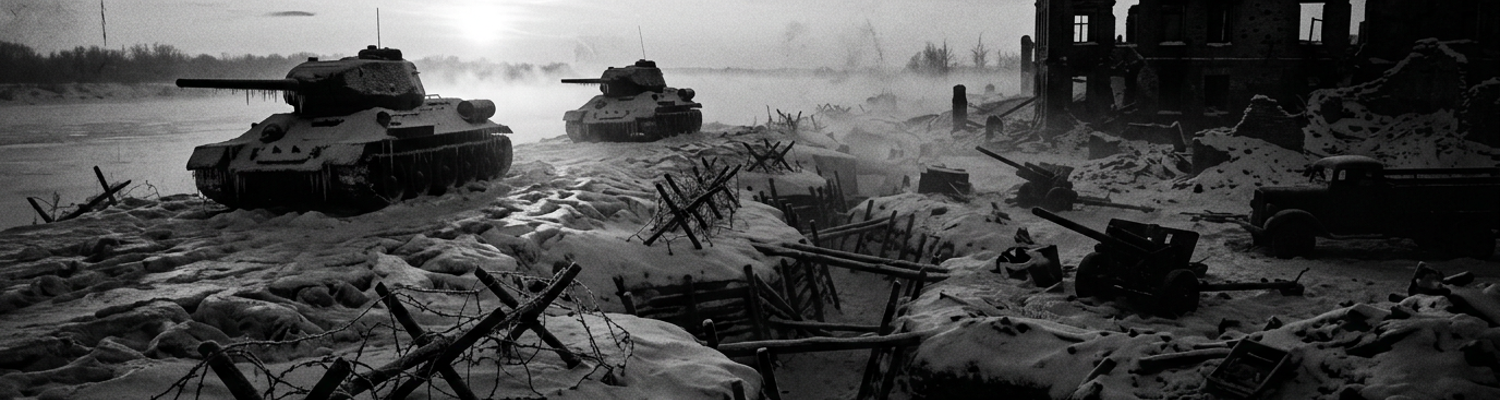

Post-Engagement Silence Along the Moder River
Thirty-four battalions of field and corps artillery massed across the northern Alsace sector. They drew on depots holding one hundred thousand rounds of 105mm high-explosive M1 shells. Ammunition dumps contained forty thousand 155mm M107 projectiles. Canisters of white phosphorus sat beside 76mm M93 high-velocity armor-piercing shot. Three hundred tons of cratering dynamite remained stacked in muddy forward dumps.
The guns ceased firing at midnight.
A close review of operational logs indicates that VI Corps executed an orderly nocturnal retrograde on January 21, 1945. This movement followed severe armored attrition at Hatten-Rittershoffen. Elements of the 14th Armored Division and the 79th Infantry Division had exchanged direct fire with the 21st Panzer and 25th Panzergrenadier Divisions inside collapsed villages for eleven days. Muddy farm lanes had frozen into jagged ruts. These ruts snapped track pins and ground away suspension bogies. They stripped the rubber pads off M4A3 Sherman tanks. Differential housings cracked under sub-zero thermal shock. Carbon residue fouled the recoil cylinders of 76mm guns after crews fired dozens of point-blank salvos into reinforced stone barns. Major General Edward H. Brooks ordered the withdrawal southward. He intended to keep his formation from disintegrating. Under cover of freezing ground fog, vehicle crews smeared river clay across their white star markings. They idled their engines to deaden acoustic signatures. Infantry rear guards from the 313th Infantry Regiment pulled back along roads coated in thick black ice.
Recovery teams burned stalled vehicles in roadside ditches.
Archival evidence shows that engineers and infantry secured defensive sectors along the frozen south bank of the Moder River near Haguenau by dawn. The 315th Engineer Combat Battalion rigged shaped charges against the masonry piers of five road crossings. These bridges linked Schweighouse, Haguenau, and Kaltenhouse. Ground frost penetrated eighteen inches deep. This frozen layer resisted hand picks and entrenching tools. Squads had to crater defensive weapon pits out of the frozen topsoil with two-pound blocks of composition C-2 explosive. Machine gun squads from the 42nd and 79th Infantry Divisions hauled water-cooled Browning M1917A1s into industrial tanneries and brickyards. They positioned interlocking fields of fire over open marshland. The river narrowed to thirty feet in this sector. Working in total blackout conditions, combat engineers planted thousands of M1A1 anti-tank mines. They buried wooden-cased anti-personnel ordnance. They anchored double-apron concertina wire deep into the frozen mud along the waterline.
The river ice measured two inches thick.
It was too brittle for armor but solid enough for infantry crossings.
When examining the historical record from the 79th Division command post at Bischwiller, immediate staff actions centered on recording tactical deficiencies. Company clerks worked under blacked-out canvas tarpaulins. They cataloged depleted battery packs for SCR-300 radios. They recorded destroyed M10 tank destroyers. They tracked mounting casualties from severe trench foot. Mortar crews from the 314th Infantry Regiment leveled their 81mm tubes toward the northern factory district of Haguenau. They transferred registration coordinates onto gridded firing charts with grease pencils. Technical ordnance teams reported an absolute deficit of replacement tracks across all subordinate units.
Static Fortifications and Wire Obstacles at Haguenau
Archival evidence shows that the 315th Engineer Combat Battalion confronted ground frozen solid to a depth of nearly two feet. Standard issue M1910 entrenching tools shattered under initial impact. Entrenchments were dug into frozen earth using pickaxes and explosive cratering charges. Squads deployed heavy pickaxes to chip through the hard crust of topsoil. The steel picks bounced off without biting into the permafrost. This dulled the points and jarred the shoulders of exhausted riflemen. Combat engineers brought forward forty-pound M3 shaped demolition charges. They used standard two-pound tetrytol blocks to shatter the frozen ground. Pioneer details drilled pilot holes with pneumatic rock drills from air compressor trucks. They dropped cratering charges beneath the freeze layer. They detonated them electrically behind blackout blast mats. The concussive blasts blew ragged craters into the earth. Infantry squads hastily scraped these into two-man foxholes using shovel blades before the loose soil could freeze solid again.
Steel picks shattered against the permafrost.
A close review of operational logs indicates that the 314th Infantry Regiment struggled to stabilize these fragmented holes against incoming splinter bursts. Heavy timber baulks stripped from razed warehouses provided crude overhead cover. Men laid these across the cratered rims and weighed them down with frozen turf blocks. Sub-zero temperatures caused hydraulic hoses on motorized earth augers to stiffen and split. This stranded heavy engineering equipment along the Rue du Moulin. Rifle squads expanded the blasted pits by hand. Frostbite cases surged among work parties stripping off wool gloves to clear pulverized shale. Machine gun crews from Company H set their M1917A1 water-cooled guns onto tripod mounts wedged against railroad ties. They circulated antifreeze solutions through the cooling jackets. This stopped expansion fractures from cracking the bronze water plugs.
Cold metal peeled flesh from fingers.
When examining engineering maps preserved from the 79th Division, tactical wire entanglements were emplaced along exposed river bends. In the looping oxbow bends east of Kaltenhouse, the Moder narrowed into slow-moving shallows. Drifting ice floes threatened to bridge the banks. Engineer crews drove steel screw pickets into the gravel riverbed with wooden mallets. They suppressed acoustic warnings. They ran triple-strand Danish concertina coils along the shoreline shallows. Work details buried thousands of M2A1 bounding anti-personnel mines behind this tangled barrier. They used wooden-box Schu-mines taken from captured German supply caches. They set tripwires taut six inches above the snow line. Heavy M1A1 anti-tank mines were laid in checkerboard grids across the open alluvial meadows. Each pressure plate was adjusted for a four-hundred-pound trip weight.
Tripwires disappeared beneath fresh snowdrifts.
Field reports from the 103rd Infantry Division liaison unit confirm that forward security detachments coordinated interlocking bands of final protective fire. Double-apron barbed wire fences were fixed at right angles to the river meanders. This channeled any prospective German bridgehead directly into pre-registered kill zones. These zones were calibrated for 60mm and 81mm mortar batteries. Men worked without illumination under freezing river mist. They used friction igniters on non-electric blasting caps whenever dry-cell battery boxes failed in the fifteen-degree cold. Combat engineers anchored the outer wire aprons into stone bridge abutments. They drove stakes into frozen silt to prevent the surging current from dislodging the submerged barbed wire.
Repulse of the Forty-Seventh Volksgrenadier Division
A close review of operational logs indicates that the 314th Infantry Regiment received the primary assault launched across the Moder River by the German 47th Volksgrenadier Division. Assault engineers from Grenadier Regiment 103 and Grenadier Regiment 104 pushed collapsible wooden punts into the swift current north of Haguenau after 2200 hours on January 25. German infiltration parties exploited blind spots between forward observation outposts. They cut through the outer tripwires near the Schweighouse rail spur. They established foothold pockets along the railroad embankment. Riflemen from the 314th Regiment 1st and 3rd Battalions held their fire until German shock troops reached thirty yards from the forward slit trenches. They triggered fixed defensive fire lines with .30-caliber M1919A4 light machine guns and M1 Garand rifles. Hand-to-hand fighting surged through the ice-slicked drainage ditches throughout the pitch-black morning hours. German squads armed with MP 40 submachine guns and Panzerfaust hollow charges attempted to outflank Company B.
Frozen mud jammed weapon ejectors.
Archival evidence shows that rifle platoons burned out three spare barrels per Browning gun before 0400 hours. They beat back waves of German grenadiers rushing the riverbank shallows. German demolition details blew two gaps through the outer concrete perimeter wall in the factory yards on the western fringe of Haguenau. They used concentrated teller mines. Colonel Warren A. Robinson committed reserve squads from Company G to plug the breach. They engaged German assault teams at point-blank range among collapsed brick piles with M9A1 bazookas and fragmentation grenades. Gun crews on 57mm anti-tank guns M1 fired canister rounds directly into the tree line. They peeled away advancing German grenadier elements carrying ladder sections. The sustained pressure never broke the American main line of resistance. The German forward companies began losing cohesion by 0600 hours. Nocturnal infiltration assaults by the 47th Volksgrenadier Division collapsed at dawn on January 26, 1945. Isolated squads were stranded on the American side without ammunition or radio contact.
German survivors retreated into open reed beds.
When examining fire direction center records from the 79th Division Artillery, three field artillery battalions systematically crushed the German bridgehead attempts. The 310th, 311th, and 312th Field Artillery Battalions operated 105mm M2A1 howitzers. They worked in battery salvos with the 155mm howitzers of the 904th Field Artillery Battalion. Gun crews fitted their high-explosive shells with the newly cleared T-98 radio proximity fuze. This fuze used a miniature five-tube transceiver circuit to sense proximity to the frozen terrain. Each shell triggered forty feet above the ground instead of plunging harmlessly into deep mud. This sprayed supersonic casing fragments downward into the unprotected German pontoon details. Battery forward observers stationed in church steeples inside Haguenau directed rolling barrages onto the northern river approaches. They walked high-explosive airbursts back and forth across every surveyed assembly ditch.
Splinters from proximity airbursts shredded rubber rafts before they touched water.
Artillerymen sustained rates of four rounds per minute per tube for ninety continuous minutes. This overheated howitzer recoil cylinders and blistered paint off the gun tubes. The 79th Division Artillery had expended four thousand rounds of proximity-fuzed ammunition into the crossing lanes between Kaltenhouse and Schweighouse by 0630 on January 26. German wounded lay trapped beneath fallen branches in the riparian forests north of the water. They were cut off from medical evacuation by saturated fragmentation zones. Division fire registers recorded zero operational German bridgeheads remaining intact along the regimental front.
Empty brass shell casings piled four feet deep outside the howitzer pits.
Signal Battery Failures and Tactical Communications Breakdowns
A close review of operational logs indicates that communications breakdowns exposed severe vulnerabilities in division-level tactical coordination. Forward observers from the 314th Infantry Regiment found that dry-cell BA-70 batteries powering SCR-300 walkie-talkies died within thirty minutes. This occurred when exposed to ambient temperatures below twenty degrees Fahrenheit. Radiomen shoved spare batteries under their armpits inside their field jackets. They needed to keep cells warm enough to sustain reception. Standard W-110-B field telephone wire coated with glaze ice became brittle. It snapped when shaken by nearby shell bursts or severed by the steel cleat treads of moving halftracks. Line repair teams from the 79th Signal Company patrolled the road between Haguenau and Bischwiller on foot through the night. They spliced severed twin-lead wire by hand with friction tape in deep snowdrifts. Radio transceivers operating on standard high frequencies suffered atmospheric distortion from low-hanging ground fog. Forward outposts had to communicate via runner or emergency smoke pots.
Field phones went dead every eleven minutes.
Archival evidence shows that the SCR-284 radio sets mounted in command vehicles failed to maintain contact with division headquarters. The dynamotors required to generate transmission power froze solid. Operators attempted to thaw the hand-cranked generators using exhaust heat from idling jeep engines. This melted the internal wiring insulation and caused short circuits across the copper commutators. Battalion command posts resorted to using EE-8 field telephones wired directly to switchboards in damp cellars. The moisture in these unventilated basements corroded the brass terminal posts within hours. Signal corps technicians logged over two hundred separate wire breaks along a three-mile stretch of the main line of resistance.
Runners carried handwritten messages across open intersections targeted by German snipers.
When examining the historical record from the 14th Armored Division, tank commanders experienced identical communication blackouts. The SCR-508 radio sets installed in M4 Sherman turrets relied on vehicle batteries that rapidly lost charge in the sub-zero cold. Idling the tank engines to recharge the batteries consumed excessive amounts of 80-octane gasoline. Supply officers had already rationed fuel due to the frozen supply routes. Platoon leaders resorted to visual signaling with colored smoke grenades and signal flags. The dense winter fog rendered these visual cues useless beyond fifty yards. Tank destroyers operating in support of the infantry fired blindly into suspected German assembly areas based on outdated coordinate maps.
Post-Combat Casualty Accounting and Refugee Manifest Processing
Blood froze solid on the litter canvas before ambulances reached the clearing station.
Archival evidence shows that forward command posts across the 314th and 313th Infantry Regiments logged immediate casualty counts during the dawn lull of January 26, 1945. Battalion aid stations operating out of shell-shattered cellars in southern Haguenau confronted a sudden influx of blast trauma and severe hypothermia cases. Litter bearers dragged wounded men on corrugated tin sheets across frozen cobblestones. Rubber-tired wheeled litters skidded uncontrollably across the iced roads. Company clerks sat at folding wooden desks in damp basements. They tallied casualty tag numbers against company rosters with indelible pencils. Kerosene lamps flickered against the damp walls. Field medical officers recorded 187 urgent surgical cases requiring immediate evacuation southwest along Route Nationale 63. Dodge 3/4-ton WC54 ambulances stalled along the single available supply route when radiator fluid froze inside exposed hose lines. Drivers wrapped wool blankets around engine blocks to prevent cracked cylinder heads. Morphine syrettes froze solid inside wool overcoat pockets. Aid men held the metal tubes in their mouths for five minutes to thaw the liquid before injection.
Paper tags detached from frozen uniforms.
When examining the historical record from the 79th Division Provost Marshal office, regimental personnel simultaneously processed civilian refugee manifests. Displaced Alsatian populations crossed military bridgeheads over the Moder. Fear of German artillery retaliation drove hundreds of Alsatian civilians out of basements in northern Haguenau. They moved toward the shattered road spans at Schweighouse and Kaltenhouse. Military police established holding pens inside an unheated textile warehouse twenty yards from the southern bridgehead checkpoints. Regimental G-5 civil affairs officers typed handwritten manifests. They listed family names, national identification numbers, birthplaces, and local French identity card statuses on standard War Department form sheets. German infiltrators had discarded Wehrmacht overcoats in the river reeds to blend into the fleeing crowds. Intelligence sergeants inspected the armpits of all military-aged males for blood group tattoo marks. Language barriers complicated every inspection. Older Alsatians spoke only an Alemannic dialect. Younger men carried German military paybooks stamped with recent conscription notices from the Reich Labor Service.
Sub-zero drafts jammed typewriter ribbons.
A close review of operational logs indicates that the single open crossing span at Schweighouse created a severe bottleneck. Northbound ammunition trucks collided with south-bound casualty evacuations and four hundred displaced civilians pushing handcarts. S-1 administrative personnel worked without break through 1100 hours. They logged twelve dead-on-arrival records from aid stations. They recorded three hundred and forty-two civilian names on the division transit log. Engineers from the 315th Engineer Combat Battalion restricted civilian traffic to a four-foot wooden footbridge erected alongside the main pontoon span. Ice floes slamming against the temporary timber trestles threatened to shift the bridge alignment. Pioneer squads fended off floating river ice with iron-tipped pike poles. Clerks completed processing seventy-eight wounded riflemen for priority ambulance convoy movement to the evacuation hospital at Brumath by midday. Sixty-one local civilian suspects remained detained under armed guard in a brickyard cellar for formal screening by the Counter Intelligence Corps.
Ten tons of wet snow collapsed the holding compound canvas.
Strategic Friction Between SHAEF and French Command
Contradictory orders arrived via teletype every four hours.
Archival evidence shows that paralyzing political discord erupted between the Supreme Headquarters Allied Expeditionary Force (SHAEF) and the French Provisional Government. General Dwight D. Eisenhower issued directives to pull the Sixth Army Group back to the eastern slopes of the Vosges Mountains. This planned withdrawal would shorten the Allied defensive lines and create a mobile reserve. It also meant abandoning the city of Strasbourg to advancing German forces. General Charles de Gaulle viewed the potential recapture of Strasbourg by the Wehrmacht as politically unacceptable. He threatened to withdraw French forces from the unified Allied command structure. De Gaulle ordered the French First Army to defend the city independently if American forces withdrew. This high-level standoff generated immediate tactical confusion along the Moder River line.
Teletype machines printed conflicting withdrawal coordinates.
When examining the historical record from VI Corps headquarters, Major General Brooks received overlapping and contradictory directives from the Seventh Army command staff. Planners at SHAEF demanded the immediate preparation of fallback positions near the Saverne Gap. French liaison officers embedded within the American command structure insisted on holding the forward positions at Haguenau to protect the northern approaches to Strasbourg. Staff officers at the 79th Infantry Division drafted three separate operational orders between January 22 and January 24. One order detailed a full retreat. Another outlined a static defense. The third mandated a localized counterattack. Battalion commanders on the ground received no clear guidance on whether to expend their limited supply of anti-tank mines or save them for a deeper withdrawal.
Clerks burned the obsolete operational orders in metal trash cans.
A close review of operational logs indicates that this command paralysis directly impacted the distribution of artillery ammunition. Quartermaster depots at Sarrebourg halted the forward deployment of 155mm shells. They anticipated a general withdrawal that would render forward dumps vulnerable to capture. Artillery batteries supporting the 314th Infantry Regiment received only half of their daily allotted ammunition quota on January 23. The 14th Armored Division held its reserve combat commands in a state of continuous readiness, burning precious fuel while waiting for a definitive order to either advance or retreat. The political dispute in Paris and Versailles forced riflemen on the Moder River to hold a static line without adequate logistical backing.
Logistical Gridlock on Winter Evacuation Routes
Black ice glazed the two-lane macadam highway between Haguenau and Saverne before dawn on January 26, 1945.
Archival evidence shows that military supply routes between Haguenau and Saverne were paralyzed by overlapping convoys of civilian evacuees and tactical vehicles. Withdrawing elements of the 14th Armored Division collided with three thousand Alsatian civilians fleeing the Moder River fighting along Route Nationale 419 and Departmental Road 421. Horse-drawn farm wagons and pushcarts heaped with featherbeds intermingled with M4A3 Sherman tanks and GMC two-and-a-half-ton trucks. Deep drainage ditches bordering both shoulders left zero room to maneuver. When a lead wagon threw an iron wheel rim near Pfaffenhoffen, the entire column halted for miles. Exhausted drivers kept engines idling to prevent coolant freezing. This rapidly drained fuel reserves and filled the freezing ground fog with toxic carbon monoxide. Military police from the 79th Military Police Platoon lacked the heavy equipment to clear the jams. Tank retrievers shoved civilian carts into water-filled ditches near Bouxwiller to reopen single-lane tactical passages.
Wagons loaded with household furniture blocked army ambulances at every stone culvert.
A close review of operational logs indicates that priority supply convoys carrying winter clothing and ammunition experienced catastrophic delays. Quartermaster convoys dispatched from railheads at Sarrebourg attempted to haul M-1943 field jackets, overshoes, and 105mm artillery shells up the western slopes of the Vosges foothills. Sheer ice sheets covered the six-percent grades outside Phalsbourg. Dual rear tires on 6x6 cargo trucks lost all traction on the crowned roads. Loaded supply vehicles slid backward into rock faces or tipped over embankments. Steel tire chains snapped under heavy transmission torque. They lashed through fenders and severed hydraulic brake lines. Convoys scheduled to complete the forty-mile transit in two hours spent twenty-four to thirty-six hours stranded on the frozen macadam. Frontline infantrymen of the 313th Infantry Regiment shivered in waterlogged leather combat boots along the Moder. Two hundred tons of rubber shoepacs sat motionless in stranded trucks twenty-five miles west.
Drivers lit open gasoline fires directly beneath frozen oil pans to turn sludge back into liquid.
When examining the historical record from the VI Corps G-4 section, supply officers tracked twenty miles of continuous gridlock between the Saverne railhead and the forward ammunition dumps near Schweighouse. Recovery crews from the 779th Ordnance Light Maintenance Company burned out winching assemblies attempting to right overturned ammo trucks. Artillery batteries defending the Moder line were restricted to emergency defensive fire rates of five shells per gun per day. Replacement ordnance could not bypass the frozen bottlenecks at Hochfelden. Ordnance teams abandoned forty-seven disabled cargo trucks along the road verges between Saverne and Steinbourg. They stripped their tire chains to keep an emergency convoy of 81mm mortar rounds creeping eastward at two miles per hour.
Tactical After-Action Assessments for Riverine Defense
Graphite grease turned to brittle stone inside the breech locks before the smoke cleared.
Archival evidence shows that within hours of repulsing the German assault on January 26, technical ordnance officers from the 79th Infantry Division drafted emergency equipment deficiency reports at Bischwiller. Tank mechanics discovered that standard heavy petroleum lubricants congealed into rigid tar inside track tensioners and road-wheel bogie assemblies. Light automotive oil OE-10 broke down under sustained sub-zero operation. Standard transmission fluids thickened to the point that differential gearboxes locked during rapid shifts. Crews stripped down .50-caliber M2 Browning heavy machine guns. They washed factory cosmoline and standard-issue gun oil out of receiver groups with boiling soapy water. They replaced the fluid with lighter kerosene washes to prevent sluggish bolt cycling. Firing pins on M1 Garand rifles snapped cleanly at the shoulder after firing continuous twenty-round salvos into the freezing spray along the water line. Ordnance recovery teams reported that eighteen out of twenty-four retrieved M4A3 Sherman tanks suffered from blown head gaskets or cracked steering differential housings.
Cold steel shattered under mechanical stress.
When examining the historical record from the VI Corps tactical headquarters at Saverne, Major General Edward H. Brooks and his G-3 operations staff integrated these riverline lessons into tactical containment directives. Brooks recognized that an entrenched riverline could serve as an economy-of-force barrier. This allowed depleted divisions to hold wide frontages with reduced manpower. Corps planners abandoned active offensive river-crossing doctrine. They codified a static perimeter scheme that linked all designated crossing points into a continuous fire trap. Planners mandated that all river bridges be wired with dual-redundant electric and non-electric demolition charges. Firing keys were kept under continuous guard by designated engineer officers (Field Manual 5-15 protocols). Forward infantry battalions were ordered to position primary fighting bunkers thirty to fifty yards behind the southern flood levees rather than right on the water edge. They used the reverse embankments to shield infantry from direct tank-cannon fire.
Combat commands of the 14th Armored Division were organized into mobile strike teams stationed five miles south at central road junctions. They were held in reserve to counterattack any hostile penetrations across the ice.
Corps headquarters distributed sixty mimeographed copies of the new doctrine by noon.