
NATO Southern Flank Doctrine Overview
Operational logs from the mid-1960s show that NATO commanders on the Southern Flank were given an impossible task. The official doctrine for air-ground cooperation, formalized in documents like the Allied Tactical Publications (ATP), was engineered for a single, specific conflict. That conflict was a massive armored assault by Warsaw Pact forces across the flat plains of Central Europe. The doctrine, known under the general heading of Offensive Air Support, presumed a level of integration and technological sophistication that was, for the southern members, purely theoretical.
It was a fantasy on paper.
The doctrine envisioned a battlefield where Forward Air Controllers, or FACs, on the ground could reliably communicate with high-speed jets, guiding them onto targets with precision. This system depended on clear lines of sight for radio equipment. It required a unified command structure where orders flowed seamlessly from a multinational headquarters to a pilot from any member nation. It also assumed air forces were equipped with aircraft suitable for the demanding Close Air Support (CAS) mission. The manuals described a clean, almost mathematical process. A process of identifying enemy formations, requesting air support, and delivering ordnance within minutes.
This entire model shattered upon contact with the geography of the Southern Flank. The region, encompassing Italy, Greece, and Turkey, was not the North German Plain. It was a landscape of jagged mountains, deep valleys, and fragmented coastlines. The Pindus mountain range in Greece and the Anatolian Plateau in Turkey presented immense physical barriers to the very concepts underpinning NATO’s air-ground doctrine. Radio signals, essential for coordinating air and ground units, were frequently blocked by the terrain. The communications equipment of the era was rendered ineffective. A Forward Air Controller team might be able to see an enemy tank column, but if they were on the wrong side of a mountain, their calls for an airstrike were lost. The expected combat was different. Instead of massive tank battles, a conflict in the south was more likely to involve dispersed, infantry-heavy engagements in complex terrain. Identifying friend from foe from the cockpit of a fast-moving jet was a perilous challenge. This created a gap between the paper plans formulated at SHAPE and the conditions facing a Turkish or Greek infantry battalion defending a remote mountain pass.
The Cold War context made overcoming these challenges a matter of extreme urgency. The primary role of Close Air Support was to act as a force multiplier, the equalizer against the numerically superior ground forces of the Warsaw Pact. Soviet military doctrine anticipated an aggressive, fast-paced offensive. NATO’s strategy relied on air power to blunt the tip of that spear, giving ground forces a chance to hold the line. The air forces of Italy, Greece, and Turkey were a hodgepodge of second-generation jets, many ill-suited for the CAS mission. Aircraft like the F-104 Starfighter, operated by all three nations, was a high-speed interceptor designed for zoom and boom tactics, not for loitering low and slow over a battlefield. While countries like Turkey also operated more suitable aircraft like the F-84 Thunderjet, the fleet was a mix of different types with varying capabilities and maintenance needs. This hardware problem was compounded by organizational fractures. The 1966 withdrawal of France from NATO’s integrated military command caused a major reorganization of the entire command structure, including in the south. Allied Forces Southern Europe (AFSOUTH) faced overlapping responsibilities and a proliferation of subordinate commands that hindered effective coordination. The result was a doctrinal framework disconnected from the geographical, technological, and organizational conditions of the very region it was meant to defend.
Italian CAS Communication Protocol Flaws
United States Air Force intelligence files from 1966 (classified under review designation AFSOUTH-INT-66-08B) reveal deep apprehension regarding the functional communication capabilities of the Italian Armed Forces. The analysis, compiled from observations of NATO exercises and reviews of Italian military records, painted a picture of a system that was theoretically sound but practically brittle. On paper, the Italian Army and Air Force adhered to standardized NATO Allied Tactical Publications for requesting Close Air Support. The command chain was clear. It ran from a Forward Air Controller on the ground, through a national Direct Air Support Center (DASC), and on to the 5th Allied Tactical Air Force (5ATAF) based in Vicenza, which controlled the relevant air assets. The USAF analysis, however, noted a significant gap between this documented procedure and the observed performance during simulated combat. A key point of failure was the reliance on VHF radio equipment, such as the man-portable AN/PRC-25. This radio, while reliable on flat terrain, suffered from severe signal degradation in Italy’s mountainous spine. The analysts flagged that line-of-sight limitations in the Apennines could, and often did, sever the link between ground units and their support elements. This problem was compounded by a lack of sufficient airborne radio relay platforms in the Italian order of battle. The intelligence summary concluded that while the Italian military possessed the doctrinal framework for modern air-ground warfare, its hardware and practical execution were suspect under the exact geographic conditions it was expected to defend.
This systemic weakness was laid bare during simulated CAS requests conducted throughout 1966 and early 1967. These exercises, designed to test the responsiveness of the air-ground network, consistently highlighted critical deviations from established protocols. Archival evidence from exercise after-action reports describes how Italian FAC teams, often operating under pressure in rugged terrain, would frequently truncate or incorrectly format the standardized nine-line CAS request. Instead of transmitting precise grid coordinates for the target in line six, controllers would often resort to descriptive, and dangerously ambiguous, references to local landmarks. This was a direct violation of NATO STANAG procedures. The problem was not one of training but of expediency under duress. Faced with intermittent signal quality from their AN/PRC-25 radios, operators attempted to push through a simplified message before losing the connection. This deviation cascaded through the command structure. A garbled or incomplete nine-line request arriving at the DASC could not be immediately actioned. It forced a time-consuming process of verification, with the DASC having to re-establish contact with the FAC to confirm target details, elevation, and the location of friendly forces.
The operational consequence of these communication flaws was the introduction of unacceptable delays. The doctrinal expectation for a pre-planned CAS mission was a response within minutes. During these simulations in Italy, the time from the initial call from a forward controller to the arrival of aircraft on target frequently ballooned to over 45 minutes. In some documented cases, it exceeded an hour. A typical failure unfolded chronologically: a FAC’s truncated message would be received at the operations center of a unit like the Folgore Motorized Infantry Division. The request, lacking precise data, would be relayed to the DASC, which would then have to query the FAC again, losing precious minutes. Meanwhile, a flight of Italian Air Force F-84F Thunderstreaks from the 5ª Aerobrigata, having been scrambled from Rimini, would be forced to orbit in a holding pattern. They burned fuel and awaited clear targeting information. This delay not only jeopardized the ground unit that made the initial request, which could be overrun in a fraction of that time, but it also reduced the combat effectiveness of the air asset itself. The F-84F, a capable fighter-bomber, had a limited loiter time. Every minute spent waiting for coordinates was a minute less it could spend prosecuting targets. This cycle of miscommunication, verification, and delay represented a complete failure of the air-ground system, rendering the potent firepower of 5ATAF largely irrelevant to the immediate tactical fight.
Air Asset Mechanical Degradation
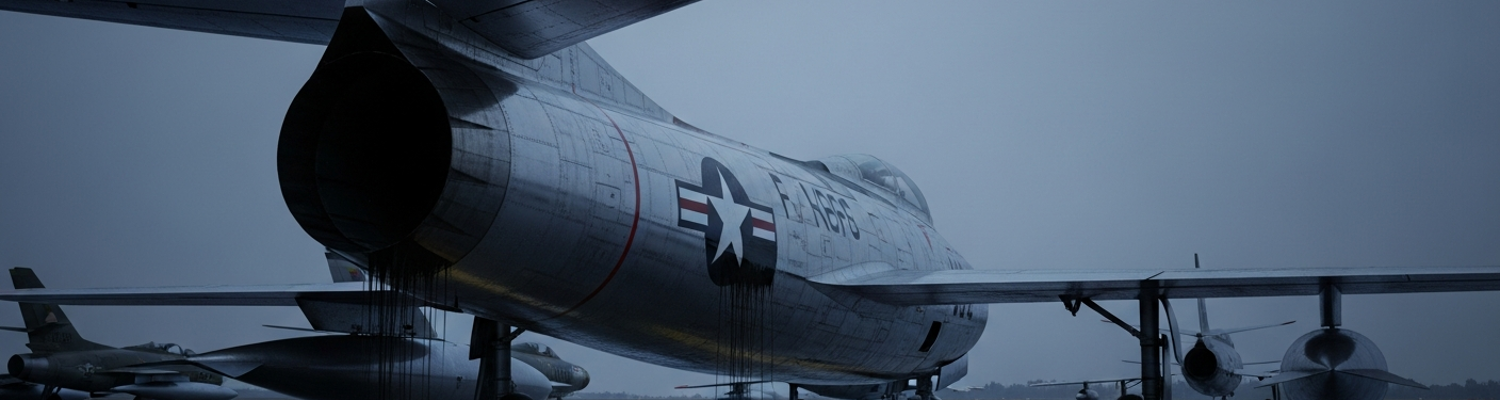
A forensic review of after-action reports and maintenance logs from NATO’s Southern Flank exercises between 1966 and 1967 exposes a troubling pattern of mechanical failure within the Italian Air Force’s Close Air Support fleet. The primary workhorse for this role, the Republic F-84F Thunderstreak, was a second-generation jet already approaching obsolescence. Photographic evidence compiled by NATO combat camera units, tasked with documenting these war games, provides a stark visual record of the fleet’s condition. The images, intended for operational analysis, instead captured endemic signs of wear. Pictures from flight lines at bases like Rimini or Aviano show F-84Fs from the 5ª Aerobrigata with dark streaks of hydraulic fluid weeping from control surface actuators and landing gear joints. Close-up shots reveal patch repairs on fuselage panels and visible stress marks around ordnance pylons. These were the very hardpoints expected to carry the thousands of pounds of bombs and rockets needed to blunt a Warsaw Pact advance. This material decay was not a secret. It was a visible, chronic condition that undermined the theoretical readiness of these key tactical assets.
This widespread material degradation was a direct symptom of deeper, systemic failures. The Wright J65 turbojet engine, the powerplant for the F-84F, was notoriously problematic. It was prone to compressor stalls and, most critically for the CAS mission, dangerous flameouts when operating in heavy precipitation. During the summer months in Southern Europe, the primary issue was heat. Maintenance records from exercises like MEDFLEX DRAGON describe repeated instances of J65 engines approaching their turbine temperature limits during low-level, high-power maneuvers. A pilot from the 51ª Aerobrigata, simulating a ground attack run in the rugged terrain of Sardinia, would see his exhaust gas temperature gauge spike into the red. This forced him to reduce throttle and abort the attack profile. This negated the entire purpose of the sortie. Instead of an aggressive, terrain-hugging attack, the pilot was forced into a higher, safer flight path that made him a simpler target for ground fire and reduced his accuracy. The problem was so pervasive that it became an accepted, unofficial limitation on the aircraft’s performance. A critical flaw that doctrinal manuals never accounted for. These engine troubles were a known issue across NATO for the type, but for the Italian units tasked with defending mountainous terrain, the performance degradation was especially severe.
The mechanical unreliability extended directly to the weapons systems. An aircraft that cannot reliably deliver its ordnance is merely a transportation vehicle. Reports from armament crews during the 1966-1967 period detail frustratingly high rates of malfunction in the F-84F’s ordnance delivery systems. Electrical faults in the pylon release mechanisms were common. This led to instances of hung ordnance, where a bomb would fail to detach from the aircraft after the pilot pressed the release. This not only represented a complete failure of the assigned mission but also created a hazardous situation. The pilot was forced to land with a live, armed weapon still attached to the wing. Rocket attacks were similarly compromised. Pods carrying 5-inch rockets frequently experienced partial failures, with several rockets failing to ignite and fire. A pilot expecting to ripple-fire a full salvo for area suppression would find his attack diluted and ineffective. Each mechanical fault, from a leaking hydraulic line to a hung bomb, compounded the disconnect between NATO’s air-ground doctrine and the capabilities of its southern members. The operational plans relied on the assumption of available, reliable, and effective air power. The grim state of the Italian F-84F fleet revealed that this assumption was built on a fragile foundation.
The Tyranny of Mediterranean Terrain
Italian Air Force training publications from the mid-1960s show a curriculum built for a different war. The manuals prescribed attack profiles and weapons delivery techniques fundamentally unsuited for the nation’s own geography. Pilots flying the F-84F Thunderstreak were trained in level bombing runs, shallow dive attacks, and predictable pop-up maneuvers. These were designed for engaging targets on open plains. These tactics assumed a stable flight environment, clear target identification from a distance, and ample space for recovery after releasing ordnance. The entire system was a direct importation of doctrine developed for the expected battlefields of Central Europe.
This theoretical framework disintegrated when confronted by the physical topography of the Italian peninsula. The Apennine Mountains, running down the spine of the country, and the Alps to the north, presented a nightmarish environment for jet aircraft operations. A pilot attempting a doctrinal shallow dive attack in a narrow valley would find himself without the required altitude to pull out, facing a wall of rock. The constantly shifting shadows and distorted sightlines made visual target acquisition almost impossible for a pilot traveling at over 400 knots. The mountainous terrain generated violent and unpredictable weather phenomena, including extreme downdrafts and sudden fog, that were not factored into standardized flight training. During NATO exercises held in Sardinia and the Alpine regions, pilots consistently reported being forced to deviate from their planned attack runs. They opted for higher, safer altitudes that drastically reduced bombing accuracy and exposed them to simulated anti-aircraft fire. The F-104 Starfighter, also in the Italian inventory and notionally available for ground attack, was even more ill-suited. Its high speed and poor low-altitude maneuverability made such missions borderline suicidal. The manuals provided instructions for a predictable, two-dimensional fight. The mountains enforced a chaotic, three-dimensional one where the environment itself was the primary adversary.
The Collapse of Response Time
The collision of flat-plains doctrine with mountain geography had a crippling effect on Close Air Support deployment and response times. The entire process, from a ground request to ordnance on target, was predicated on a speed that the terrain simply would not permit. An Alpini patrol from a unit like the Julia Alpine Brigade, tasked with defending a pass in the Julian Alps, might identify a target. The terrain’s radio shadow could render their equipment useless, initiating the first of many delays. Once a scrambled F-84F from the 5ª Aerobrigata arrived from a base like Rimini, its pilot faced a new set of temporal challenges.
The window for a successful attack was terrifyingly brief.
A target visible for one moment could be obscured by a ridge or shadow the next. A pilot had mere seconds to visually acquire the target based on a frantic radio description, align the aircraft, and release weapons before needing to execute a high-G pull-up to clear the surrounding peaks. Any hesitation, any difficulty in spotting the target, or any sudden downdraft would force the pilot to abort the run. This high rate of aborted attacks created a cascading failure that rippled through the operational structure of the 5th Allied Tactical Air Force in Vicenza. An F-84F aborting its first pass had to circle around for another attempt. This maneuver burned precious fuel, dramatically cutting the aircraft’s loiter time over the battlefield. After-action reports from 1966 and 1967 documented that CAS sorties planned for 20 minutes on station were often reduced to less than ten due to the fuel consumption of repeated, failed attack runs. The result was not just a slow response, but an unreliable one. Ground commanders could not count on the air support promised by NATO doctrine. There was a high probability that the assigned aircraft would be unable to successfully engage the target before being forced to return to base, sometimes with its full ordnance load still attached. The mountains dictated a pace of combat that systematically dismantled the speed and efficiency at the heart of NATO’s air-ground support model.
Fighting a Fictional Enemy
NATO training syllabi and tactical publications from the 1966-1967 period reveal a doctrinal fixation on a predictable, almost scripted enemy. The guiding documents for air-ground operations, principally the Allied Tactical Publication for Offensive Air Support (ATP-27), were constructed to defeat large, conventional Warsaw Pact formations moving along anticipated invasion routes. Training scenarios for pilots and Forward Air Controllers consistently involved pre-plotted target arrays representing tank companies or motorized infantry battalions. In major exercises, such as the annual Deep Furrow series, aggressor forces were often constricted, instructed to follow specific, telegraphed paths to test a particular defensive response. This methodology created a dangerous cognitive bias. It trained NATO air and ground crews to fight a war of attrition against a visible, slow-moving, and largely unintelligent opponent. The manuals contained extensive details on attacking static positions and massed armor. They provided almost no framework for countering a dispersed, guerrilla-style adversary who refused to present a convenient target and exploited the terrain for concealment and ambush.
The exercises were designed to validate the doctrine, not to challenge it.
The system’s fragility became apparent when planners attempted to inject a degree of unpredictability. After-action reports from more advanced training events in Greece and Turkey show that the entire Close Air Support chain of command would buckle when faced with a free-play aggressor force. In one simulated scenario, a small team representing a Soviet reconnaissance unit was tasked with infiltrating behind the main defensive line in the Pindus mountains. Instead of moving in the open, the team used deep ravines and dense forests for concealment, moving primarily at night. This simple change of tactics completely short-circuited the doctrinal CAS process. A Greek infantry patrol would make fleeting contact, but the aggressor unit would disengage and vanish before the patrol could even formulate a proper nine-line CAS request. By the time a request, often garbled by the mountainous terrain, reached an air operations center, the target information was hours old and useless. Planners also began simulating the presence of advanced, low-level air defenses. The Soviet 9K32 Strela-2 (NATO reporting name SA-7 Grail), a man-portable air-defense system (MANPADS), entered service in 1968 and full production in 1970. Its operational parameters were a significant concern for NATO planners in the preceding years. The simulated threat of such a weapon forced pilots to abandon the low, slow attack profiles required for accurate weapons delivery in complex terrain. This pushed them to higher altitudes where they were safer, but far less effective.
The practical effectiveness of CAS against a dynamic, unscripted opposition was catastrophically low. The entire sequence of events, from the initial call for help to the arrival of aircraft, was plagued by cumulative delays that rendered air power irrelevant. A typical failure unfolded with grim predictability during exercises in northern Greece. An infantry patrol, ambushed by a free-play enemy, would send a frantic call for air support. Due to terrain and procedural friction, it could take over 30 minutes for a flight of Hellenic Air Force F-84F Thunderstreaks from the 110th Combat Wing at Larissa to arrive on station. Upon arrival, the pilots would be met with a desperate description from the ground: the enemy was somewhere in that valley. From the cockpit of a jet moving at over 400 knots, distinguishing camouflaged soldiers from rocks and shadows was a near-impossible task. The pilots would be forced to make multiple passes, burning fuel while the FAC tried to guide them onto a target that was no longer there. After a few fruitless orbits, with fuel gauges dropping and the simulated MANPADS threat preventing any slower, lower passes, the flight would be forced to return to base, its ordnance unexpended. The ground unit, which doctrine promised would be saved by the swift application of air power, was left entirely on its own.
The Doctrinal Reassessment
The stark failures of 1966 and 1967 provided a brutal but necessary education for NATO planners. The core lesson was that air-ground doctrine could not be a monolithic, one-size-fits-all product. It had to be adapted for specific geographic, technological, and even atmospheric conditions. The exercises highlighted a desperate need for new hardware. The poor performance of high-speed jets like the F-84F and the even less suitable F-104 Starfighter pointed toward the requirement for slower, more rugged aircraft designed specifically for loitering and attacking targets in complex terrain. This was a conceptual forerunner to future dedicated CAS platforms like the A-10 Thunderbolt II. The constant communication breakdowns demanded more robust radio systems and the fielding of airborne relay aircraft to overcome the line-of-sight blockages imposed by mountains. Training itself required a revolution. Pilots and Forward Air Controllers needed to move beyond scripted scenarios and practice against a free-play enemy that used concealment and ambush tactics. The simulated introduction of man-portable air-defense systems like the SA-7 Grail further underscored the suicidal danger of the old, slow, and low attack profiles. The lessons learned in the mountains of Southern Europe necessitated a fundamental rethinking of the relationship between air and ground forces. The process began to move away from the clean mathematics of ATP-27 toward a doctrine that could function in the chaotic, three-dimensional reality of mountain warfare. This was not a quick process. It was a slow, painful admission that the existing plans were a hollow shell, and that real-world readiness required a complete overhaul of equipment, training, and tactical thought.