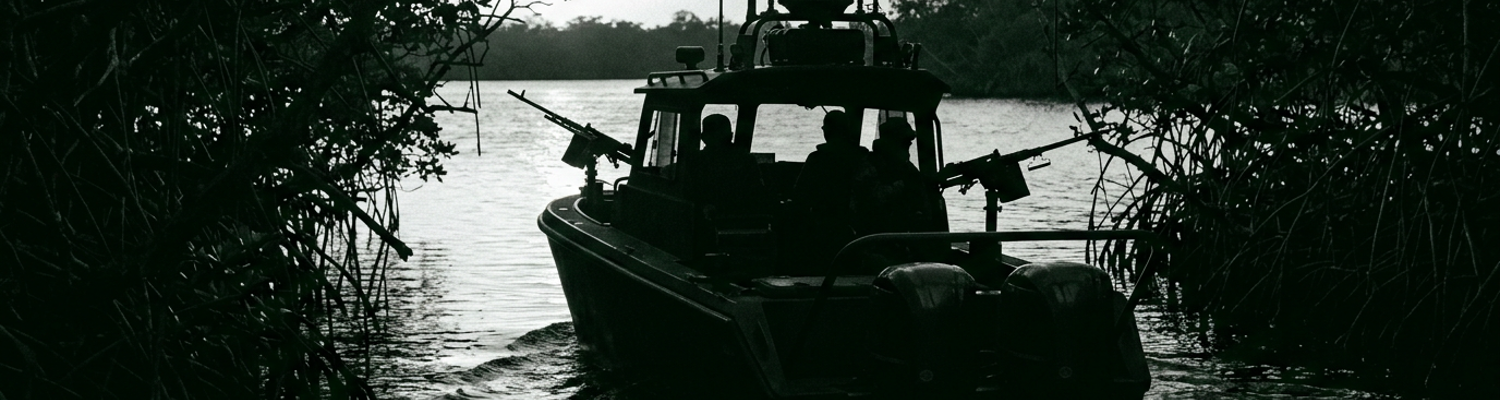

Special Operations Craft Deployment in Basilan Mangroves
Two GAU-17/A six-barrel miniguns fired 3,000 rounds of 7.62x51mm NATO per minute. Twin M2HB .50 caliber heavy machine guns sat loaded with armor-piercing incendiary belts. Mk 19 40mm automatic grenade launchers held 32-round canisters of high-explosive dual-purpose ammunition. Special Boat Team 12 brought this specific weapons load into the Sulu Archipelago. The detachment operated twin-engine Special Operations Craft-Riverine and eleven-meter Naval Special Warfare rigid-hull inflatable boats. Craft crews ran these armored platforms straight into the shallow littoral fringes of Basilan Island. They hunted insurgent motorized outriggers.
The tide provided six feet of water before dropping to mud.
A close review of operational logs indicates that the Joint Special Operations Task Force Philippines headquarters at Camp Navarro in Zamboanga operated in near-total electronic isolation from these engagements. Watch officers tracked mission progress on static acetate map boards. They waited out frequent twenty-minute tactical satellite blackouts caused by dense jungle canopy.
The headquarters bubble sat unaware of immediate mechanical crises.
Twin Caterpillar 3126 diesel engines routinely sucked up decomposing vegetation. Hamilton HJ292 waterjets ingested thick mangrove debris. Impeller grates jammed. This triggered rapid heat spikes in the cooling lines and disabled propulsion units under fire. Small-arms fire from the tree lines forced crewmen to lean overboard with hand tools. They cleared tangled wooden fibers from the intake tunnels. Staff officers back in the air-conditioned tactical operations center drafted theoretical containment coordinates based on eight-hour-old spot reports (NARA Record Group 338).
Electronics died under the salt spray.
Archival evidence shows that these teams spent hundreds of hours threading narrow estuarine mangrove channels cutting into Maluso, Sumisip, and Tuburan. Basilan presented an aquatic maze. Salt-tolerant Rhizophora trees created overhead bottlenecks less than ten meters wide. Craft commanders could not turn their thirty-three-foot hulls around inside the channels. Entering meant committing to forward throttle until reaching an open lagoon. The alternative involved reversing out through blind bends. High-tide surges pushed brackish water deep into interior swamps. Abu Sayyaf fighters stashed fiberglass skiffs and weapon caches far beyond the reach of conventional naval patrols. Boat crews drifted through the brackish water with engines idling at minimum revolutions per minute. They scanned root complexes with AN/PVS-14 night-vision optics. They sweltered in body armor amid ninety-five-degree heat and ninety-percent humidity.
These patrols directly cut the maritime supply chain connecting insurgent strongholds in the interior mountains to sympathetic fishing enclaves across the Celebes Sea. Abu Sayyaf depended entirely on small-boat runs to smuggle rice, medical supplies, Belgian FAL rifles, and kidnap-for-ransom funds between Basilan and Jolo Island. Special Boat Team 12 established persistent ambushes across these coastal avenues. A single interdiction run on August 12 intercepted three outriggers hauling 1,200 rounds of 7.62mm ammunition, forty gallons of kerosene, and two civilian radios. Five insurgent couriers were captured at grid coordinate WV 284 118.
Tactical Signals Intercept Operations Along Island Waterways
Intercept posts operated fifty yards from active insurgent trails.
A close review of operational logs indicates that Naval Security Group cryptologic technicians set up forward tactical radio intercept posts along muddy estuarine channels surrounding Maluso and the mouth of the Gumalarang River. These four-man collection teams inserted into the mangrove roots carrying portable AN/PRD-13 direction-finding systems sealed in waterproof Pelican cases.
Salt water constantly attacked the chassis connectors.
Working out of hides cut directly into the tidal brush, technicians spliced coaxial cables by hand. They stood thigh-deep in anaerobic mud. They braced whip antennas against overhanging boughs to prevent reflective signal loss from dense wet foliage. Tactical command back at Camp Navarro in Zamboanga expected uninterrupted intelligence feeds. Operators could rarely push continuous data streams through the forty-foot mangrove canopy with low-power tactical satellite transceivers. Technicians logged analog voice intercepts onto digital flash memory cards. They hand-carried raw magnetic tapes and written transcripts across river sandbars to riverine craft during pre-scheduled two-minute linkups under total blackout.
The staff officers in Zamboanga saw clean lines on acetate map boards.
Archival evidence shows that joint signals intelligence specialists intercepted and deciphered insurgent low-band VHF transmissions running primarily between 30 and 88 megahertz. Abu Sayyaf cells routinely used commercial handheld walkie-talkies, modified marine-band ICOM transceivers, and captured Philippine military radios to run tactical communications between mangrove staging points. These transmissions did not rely on standard military encryption. Fighters spoke across the tactical nets using a fluid mix of Tausug, Yakan, and broken Tagalog. They cloaked tactical directions inside regional fishing slang and maritime navigation markers. Army linguists working alongside Navy cryptologists listened through Sennheiser headsets. They transcribed intercepted audio under poncho shelters lit only by red-lens anglehead flashlights. Deciphering the calls meant matching ambiguous terms for cargo weights and tidal stages against known watercraft movements.
A single twenty-second transmission intercepted at 0240 hours near the mouth of the Sapah Bulak estuary revealed specific cargo. An Abu Sayyaf sub-commander had ordered three motorized bancas loaded with mortars and 60mm rounds to cross the channel at high slack water.
No electronic warfare aircraft flew overhead.
Ground intercept teams tracked militant tactical movements through complex estuarine terrain without dedicated electronic warfare support. National reconnaissance platforms and airborne direction-finding aircraft stayed committed to higher-priority taskings across the Middle East. Detachment personnel on Basilan fixed insurgent positions using ground-based equipment alone. Without EA-6B Prowlers or RC-135 Rivet Joint aircraft providing wide-area line-of-bearing fixes, operators manually plotted radio bearings using handheld loop antennas and analog magnetic compasses. Radio signals bounced erratically off brackish water channels, dense vegetation, and limestone bluffs. This multipath signal distortion routinely skewed azimuth calculations by up to twenty degrees. Collection teams countered this false bearing data by cross-referencing radio signal strength readings with physical observations of surface wakes and diesel exhaust fumes drifting downriver. Moving on foot between observation hides near grid coordinate WV 312 094, the cryptologists charted the exact path of an Abu Sayyaf resupply column. They passed the target coordinates directly to Special Boat Team 12 patrol craft three minutes before the craft initiated an ambush at the channel bottleneck.
Rear Task Force Directives and Administrative Inquiry Pressure
Paperwork traveled across the water when fire missions could not.
A close review of operational logs indicates that the personnel section at Camp Navarro subjected Special Boat Team 12 detachments to Department of Defense Directive 1304.26 compliance inquiries during the height of the summer interdiction push. Rear staff officers tasked with legal and administrative auditing demanded immediate verification of service eligibility forms, dependency data, and enlistment qualification paperwork for forward-deployed Special Warfare Combatant-craft Crewmen. Craft engineers and weapon station gunners stationed at the advanced support base in Isabela de Basilan were ordered to step away from mechanical upkeep on twin Caterpillar 3126 marine diesels. They had to track down missing signatures on moral eligibility annexes and accession questionnaires.
Administrative officers in Zamboanga flagged minor discrepancies in field service records.
They demanded written justifications for personnel who had deployed without updated medical qualification forms or administrative annex documentation. Forward craft commanders faced formal inquiries regarding the enlistment and retention standards of petty officers currently standing security watches behind sandbagged berms along the Isabela channel. These directives required boat captains to submit sworn administrative affidavits. They had to certify that every forward crewman met strict accession screening criteria before craft were cleared to run nighttime ambushes through the Tuburan estuary.
The staff demanded signed carbon sheets while armed bancas loaded mortar tubes.
Archival evidence shows that rear-echelon task force leaders prioritized administrative protocol directly over urgent tactical alerts detailing insurgent infiltration. On September 4, forward scouts from the Philippine Army 103rd Brigade passed an unencrypted VHF alert. They warned that an Abu Sayyaf logistics cell led by commander Hamsiraji Sali was assembling five motorized pump boats near Maluso at grid coordinate WV 193 048. Forward riverine craft sat fueled at the dock. They were ready to cast off lines and intercept the flotilla before it reached open water in the Basilan Strait. Rear headquarters held the sortie orders at the joint operations desk. Watch officers refused to release the mission package until detachment leaders accounted for four missing personnel readiness folders. They also required verification of standard compliance statements required under theater administrative standing orders.
Administrative approval filtered down forty-five minutes later.
The insurgent outriggers had slipped through the shallows under heavy rain squalls. The riverine craft patrolled an empty expanse of muddy water littered with abandoned gasoline cans and discarded supply sacks.
Data lines buckled under the load.
Procedural compliance inquiries generated severe operational friction across the task force satellite communication channels. Forward detachments depended on a single AN/PSC-5 tactical satellite terminal operating over a contested 25-kilohertz UHF satellite channel. It had a maximum throughput of 9.6 kilobits per second. Foliage attenuation and severe ionospheric interference across the Sulu Archipelago routinely degraded the carrier signal. Digital packet loss rates exceeded forty percent. Rear task force clerks broadcast multi-page text forms and bureaucratic questionnaire templates over the link instead of reserving this narrow bandwidth for real-time contact reports. Cryptographic synchronization frequently failed mid-transmission. This froze the KY-99 voice encryptors and locked out critical voice traffic for forty-five minutes at a time while forward technicians reset the cryptographic keys. Frontline radiomen repeatedly cut off outgoing administrative text files to transmit urgent flash-priority boat position updates. The automated queue at Camp Navarro restarted the failed administrative file transfer automatically. This severed tactical voice contact with craft stranded on shallow mudflats near Mangal Point.
The Tuburan Littoral Ambush and High-Volume Weapons Fire
Mudflats swallowed the incoming tide at four knots.
A close review of operational logs indicates that two Special Operations Craft-Riverine assigned to Special Boat Team 12 entered the shallow inlet south of Tuburan at grid coordinate WV 412 186 just past dawn. The waterway narrowed abruptly to twenty-five feet. This hemmed the thirty-three-foot aluminum hulls between dense walls of stilt-rooted mangrove timber. With low tide approaching, the draft dropped to thirty inches. Craft captains backed off the Caterpillar diesels to avoid sucking bottom silt into the impellers. Abu Sayyaf fighters belonging to a regional faction under Commander Isnilon Hapilon waited until both craft passed an oxbow turn before springing their ambush.
Hidden lookouts initiated contact with a coordinated volley of rocket-propelled grenades from point-blank range across both riverbanks.
One PG-7 rocket skipped off the surface of the brackish water and detonated against the portside aluminum sheer strake of the lead craft. The blast severed secondary electrical conduits and sent fragmentation across the open cockpit deck. Rear headquarters in Zamboanga received nothing more than an interrupted five-second UHF data burst before the tree cover smothered the signal.
Automatic weapons fire opened up from twenty paces away.
Archival evidence shows that the insurgent force had spent weeks building camouflaged firing nests raised four to six feet above the tidal waterline inside mature Rhizophora tree forks. These platforms gave Abu Sayyaf riflemen clear lines of sight downward into the unroofed boat interiors. Fighters directed concentrated streams of 7.62x39mm and 5.56x45mm automatic fire into pre-sighted kill zones where the channel pinched into its narrowest bottleneck. Steel-core rounds slammed into the ceramic-faced Spectra armor blankets hanging along the boat gunwales. They punched clean holes through unarmored engine cowlings and sliced fluid lines. Coxswains crouched behind forward ballistic shields while rounds fragmented across helm consoles. The fire shattered compass glass and disabled the digital engine monitoring gauges. Spun fiberglass shards and copper fragments sprayed across the deck plates as bullets chewed into the gear lockers. On the trailing craft, sustained rifle fire severed the manual hydraulic backup line on the port waterjet deflector. The crewman at the helm steered entirely with asymmetric engine throttles in water barely deep enough to float the hull.
Gunners held their triggers down until barrels turned white.
Combat craft gunners suppressed the riverbanks by expending thousands of rounds through mounted heavy weapons systems while trapped in an interlocking crossfire. Forward bow gunners brought their GAU-17/A six-barrel miniguns to bear directly on the elevated timber hides. They expended 7.62mm linked ammunition at fifty rounds per second to saw through thick mangrove limbs and collapse insurgent firing blinds. Starboard gunners manned twin M2HB .50 caliber machine guns. They drove armor-piercing incendiary projectiles into submerged mud bunkers. Aft positions loaded Mk 19 40mm grenade launchers to lay down high-explosive dual-purpose rounds every five meters along the opposing treeline. Spent brass casings accumulated four inches deep around the gun mounts. They jammed drain scuppers and mixed with spilled hydraulic fluid on the diamond-plate deck. Gunners endured incoming rifle fire that ricocheted directly off weapon receiver jackets. They conducted barrel changes on red-hot M240B machine guns with bare heat-resistant mittens under continuous sniper fire until both craft cleared the ambush lane at grid coordinate WV 418 191.
Combat Trauma Management and Riverine Field Triage
Blood mixed with fifty gallons of spilled river wash in the bilge of craft SOC-R 02.
A close review of operational logs indicates that Special Amphibious Reconnaissance Corpsmen assigned to Special Boat Team 12 treated catastrophic vascular trauma while insurgent rifle rounds struck the aluminum hull inches above their heads. As the patrol broke through the Tuburan ambush line, incoming 7.62x39mm rounds pierced the starboard gunwale. This severed the femoral artery of an aft M2HB gunner. With the craft bouncing over sandbars at twenty-eight knots, the corpsman wedged his knees against the ammunition lockers to anchor himself. Green tracer fire passed through the open cockpit canopy. Working without ballistic cover on the exposed deck floor, the medic drove a Combat Application Tourniquet high into the gunner's groin. He tightened the windlass rod until arterial spraying stopped. Salt spray and diesel soot covered the medic's latex gloves. This made plastic buckle clips slick and difficult to lock into the retention notches. Tactical headquarters at Camp Navarro received only broken status reports over the VHF net. Watch officers logged the craft as operational while the corpsman applied manual pressure to secondary brachial wounds with his bare thumbs.
Shrapnel had sheared the bone into splintered longitudinal spikes.
Archival evidence shows that severe automatic weapons trauma sustained during the retreat through the Tuburan mangrove corridor forced medical personnel to carry out emergency surgical field amputations inside the confined crew compartment. Insurgent fire from an elevated timber platform had struck a forward crewman with multiple steel-core rounds. The impacts pulverized the lower third of his left tibia and tore away all viable soft tissue. The limb hung by shredded tendons. Continuous vibration from the twin Caterpillar diesels threw the craft from side to side. The corpsman determined the leg was unsalvageable and actively blocking rapid evacuation. Space inside the thirty-three-foot craft allowed less than four feet of clearance between the weapon pedestals and the center console. Kneeling in pooled brackish water, the corpsman administered intravenous ketamine to blunt shock. He clamped the exposed popliteal vessels with curved hemostats. He severed the remaining necrotic tissue bands using heavy trauma shears and a scalpel blade. Crewmen held the casualty against the deck plates as the coxswain steered through blind river bends under manual throttle control.
The ambient humidity stood at ninety-six percent inside the mangrove swamp.
Treating hypovolemic shock under Basilan's tropical conditions presented medical responders with severe mechanical failures. High relative humidity and pouring tropical rain degraded first-generation zeolite hemostatic granules. These clumped into ineffective chalky masses when packs were torn open in the wet air. Corpsmen packed QuikClot mineral gauze directly into deep junctional groin and axillary wounds. They struggled to generate adequate local compression as blood dilution from ingested river water prevented normal platelet aggregation. Peripheral veins had completely collapsed from severe blood loss. This forced the medical responders to attempt emergency sternal intraosseous infusions using spring-loaded needles to push fluids into bone marrow. Responders administered emergency field transfusions using pooled whole blood drawn directly from uninjured boat crewmen via fresh donor kits. They balanced bags on inverted boat hooks while diesel exhaust fumes flooded the craft interior. Back at Camp Navarro, joint casualty evacuation dispatchers delayed launching Philippine Air Force UH-1H helicopters for fifty minutes. They cited unconfirmed cloud ceiling reports over the Basilan Strait. The craft detachment maintained fluid resuscitation using six-percent hetastarch solutions while running toward the coastal triage point at Maluso.
The lead boat arrived at the Maluso pier with zero surviving units of plasma and four bags of lactated Ringer's completely drained.
Headquarters Communications Latency and Medevac Complications
Static filled the tactical speaker at Camp Navarro while men bled twenty miles south.
A close review of operational logs indicates that the Joint Special Operations Task Force Philippines watch floor in Zamboanga operated under crippling communication latency during the critical thirty minutes of the firefight. Craft operators attempting to transmit urgent contact reports from the Tuburan estuary relied on AN/PRC-117F multiband radios pushed through an aging Ultra High Frequency Demand Assigned Multiple Access satellite channel. Heavy canopy foliage and torrential coastal rain squalls triggered continuous bit-error rates exceeding fifty percent. This severed the digital data stream. Cryptographic key synchronization between the watercraft and the Camp Navarro receiver banks failed five times in succession. Watch officers sat inside the air-conditioned operations hub staring at frozen Blue Force Tracker icons that showed the patrol idling miles away from its actual position. Urgent Nine-Line medical evacuation requests keyed by the forward radioman degraded into garbled carrier noise. Tactical air controllers in Zamboanga could not confirm craft coordinates. The command staff remained unaware that two crewmen were entering profound hypovolemic shock.
The flight line at Edwin Andrews Air Base sat silent.
Archival evidence shows that rear staff officers withheld launch clearance for casualty evacuation aircraft while demanding administrative verification from personnel fighting on the water. Two Philippine Air Force UH-1H Iroquois helicopters from the 205th Tactical Helicopter Wing sat on the tarmac with rotors turning. The joint task force battle captain refused to release them. Standard operating procedures established at Camp Navarro mandated that forward elements verify four distinct operational parameters before launching aviation assets. These included confirmed hostile fire cessation, an authenticated five-digit grid coordinate for an approved landing zone, visual smoke identification, and written authorization from the Philippine Western Mindanao Command liaison. Tactical radios on the riverine craft could not hold the link long enough to transmit the multi-page administrative casualty assessment checklist. Rear planners debated whether the cloud ceiling over the Basilan Strait complied with daytime visual flight rules. They ignored frantic voice transmissions from the river channel. Staff officers spent forty-two minutes logging clerical cross-checks and verifying airspace deconfliction agreements with regional infantry battalions. They kept the medical helicopters grounded.
Cold salt water flooded the deck plates as the throttle levers hit the stops.
This administrative gridlock and command isolation forced Special Boat Team 12 to transport its critically wounded personnel across thirty miles of open, hostile littoral waterways. Detachment leadership ordered both Special Operations Craft-Riverine to break out of the mangrove channels and run northwest toward the regional military hospital in Zamboanga City. Both boats plowed through the narrow Maluso Channel at thirty knots. They were exposed to continuous small-arms harassment from insurgent sniper nests hidden among the coastal stilt houses. Vibrations wracked the craft with the damaged waterjet. Its aluminum hull dragged low in the chop as the crew manually siphoned mixed blood and bilgewater over the transom. Casualty conditions worsened over the two-hour open-water transit across the Basilan Strait. Medic teams exhausted their stocks of intravenous fluids and morphine. They battled rough four-foot sea swells that dislodged arterial clamps and soaked open abdominal dressings with corrosive saltwater spray.
The trailing boat tied off at the Zamboanga naval pier at 1142 hours with seventy-two rounds of live ammunition remaining across its weapons stations and nine empty morphine syrettes rolling in the cockpit scuppers.