
The Unseen Battlefield
The guns of the Second World War fell silent, but a new, colder conflict settled over the globe. This war would not be fought with massive fleets clashing on the high seas, but in the shadows and across the invisible electromagnetic spectrum. For the United States Navy, the rapid descent of the Iron Curtain presented a formidable challenge. The collapse of wartime human intelligence networks in Eastern Europe created a profound information vacuum. A vast and secretive Soviet Union was rearming, its capabilities and intentions shrouded by geography and ideology. Understanding this new adversary demanded a new form of intelligence. The age of electronic intelligence, or ELINT, had arrived. It was born of acute necessity in a world suddenly dominated by radar and powerful new radio communications. The war was over, but for a select community of sailors and aviators, a secret struggle was just beginning. This new conflict required a new breed of operator, one who would fly unarmed to the edge of hostile airspace, listening for the faint electronic whispers that could betray an enemy’s next move.
Forging an Electronic Sword
The immediate post-war problem was stark. The Navy’s intelligence apparatus was effectively deaf to the electronic order of battle emerging from the Soviet bloc. Soviet advancements in radar, many based on captured German technology or even American systems provided via Lend-Lease, were progressing at a startling pace. Without a deep understanding of these systems, their operating frequencies, pulse repetition rates, and geographical locations, any future air or sea operation would be flying blind into a lethal, invisible web. The urgent directive was clear. Develop specialized ELINT receivers and advanced signal analysis techniques to map this new electronic terrain. Engineers at the Naval Research Laboratory and private contractors scrambled to create receivers like the AN/APR-9, a panoramic intercept receiver that allowed a single operator to sweep across a wide range of frequencies, hunting for signals of interest. These were quickly followed by more advanced systems like the AN/ALR-5.
The technical hurdles were immense. Early Soviet radars were often crude by Western standards, but they were numerous and effective. Their signals were often unstable, frequency-agile, and unlike anything U.S. operators had previously cataloged. The difficult task of interpreting these signals fell to a small, highly trained community of cryptologic technicians, or CTs. These men, often crammed into the unheated, vibrating fuselages of repurposed patrol bombers, would spend countless hours staring at the green glow of an oscilloscope. They tried to decipher the nature of a signal. Was it a P-8 'Knife Rest' early warning radar, a 'Fan Song' guidance radar for the new SA-2 missile system, or a 'Fire Can' gun-laying radar? Each new emission was a puzzle. Solving it could mean the difference between mission success and catastrophic failure for future combat crews. An operator from this era described the intense focus required.
“You were listening for a ghost. A change in the static, a chirp, a rhythmic pulse that wasn’t there five minutes ago. You had to learn the personality of your gear, its quirks, and the personality of the ether over the Barents Sea. When a new signal came up, strong and clear, the hair on your arms stood up. You knew you were the first American to ever hear it, and you had to get the analysis right. There was no room for error.”
A Doctrine of Provocation
The intelligence gathered by these nascent ELINT efforts quickly proved its value. Passive listening from a distance, however, had its limits. To truly understand the full scope of the Soviet air defense network, to map its layered defenses and assess its response times, the Navy had to get closer. This necessity drove a critical doctrinal shift, moving from opportunistic signals monitoring to dedicated, routine electronic reconnaissance missions. This new, more aggressive approach was formally known as the Special Electronic Search Project, or SESP. The missions, flown by so-called 'ferret' aircraft, were designed to deliberately 'tickle' or 'poke' Soviet and Chinese air defenses. They provoked them into turning on their search and fire-control radars so they could be mapped, analyzed, and cataloged for future exploitation or neutralization. This doctrine extended to the sea as well, with the deployment of Auxiliary General Environmental Research (AGER) ships, seemingly innocuous vessels packed with sensitive receivers, to loiter off foreign coasts.
This new doctrine demanded a new level of risk tolerance from naval leadership and, most pointedly, from the crews themselves. These were not simple patrol flights. Ferret missions were provocative by design, flying directly toward and along the borders of the Soviet Union and its allies. The aircraft were often slow, propeller-driven, and either completely unarmed or only lightly armed for self-defense against other patrol aircraft, not against determined fighter jets. Their only real defense was the skill of their pilots, the vigilance of their operators, and the vastness of the sea below. Commanders in the office of the Chief of Naval Operations understood the dangers, but the intelligence was deemed vital to national security. Every mission briefing included the stark reality that they would be operating alone, far from any potential support. If something went wrong, rescue was improbable. The crews, a mix of seasoned combat aviators and young electronic warfare specialists, accepted these risks.
“We were the bait. Our job was to make them light up their Christmas tree. We went to work every day knowing that Soviet fighter jocks were sitting on alert, waiting for us. You just had to put it out of your mind and fly the profile.”
Platforms and the Price of Knowledge
To execute these missions, the Navy adapted existing platforms. One of the first was the Consolidated PB4Y-2 Privateer, a lumbering, four-engine patrol bomber derived from the B-24 Liberator. On April 8, 1950, a PB4Y-2 from Patrol Squadron 26 (VP-26), bureau number 59645, departed Wiesbaden, West Germany, for a SESP mission over the Baltic Sea. The ten-man crew, commanded by Lieutenant John H. Fette, was tasked with probing Soviet air defenses off the coast of Latvia. They were flying in international airspace, but they were also flying toward a border that was becoming lethally intolerant of any perceived intrusion. Over the Baltic, near the port city of Liepāja, four Soviet Lavochkin La-11 fighters intercepted the Privateer. The American account stated the flight was on a routine navigation training mission and was unarmed. The Soviets claimed the aircraft violated their airspace and opened fire first. What is undisputed is the outcome. The Soviet fighters attacked the much slower, unescorted bomber and shot it down. No distress call was received. A massive international search and rescue effort found only an inflated life raft. None of the ten crew members were ever recovered. The Soviet Union eventually acknowledged the shoot-down. It was the first time an American reconnaissance aircraft had been lost to hostile action in the Cold War, a brutal confirmation of the risks inherent in the ferret missions.
The loss spurred the development of more capable platforms. The Martin P4M-1Q Mercator was a unique and powerful aircraft, a hybrid design featuring two massive Pratt & Whitney R-4360 Wasp Major piston engines for long-range cruising and two Allison J33 turbojets buried in the rear of the engine nacelles for bursts of speed. Beginning in 1951, surviving P4M airframes were converted into dedicated ELINT platforms. The bomb bay was gutted and replaced with a pressurized, windowless compartment for the expanded crew of CTs and their banks of new electronic surveillance gear. These aircraft, primarily flown by Fleet Air Reconnaissance Squadron One (VQ-1), the “World Watchers,” operated at night from bases in Japan. They often flew with false markings and transponder codes to confuse observers while they mapped the electronic coastlines of China and the Soviet Far East.
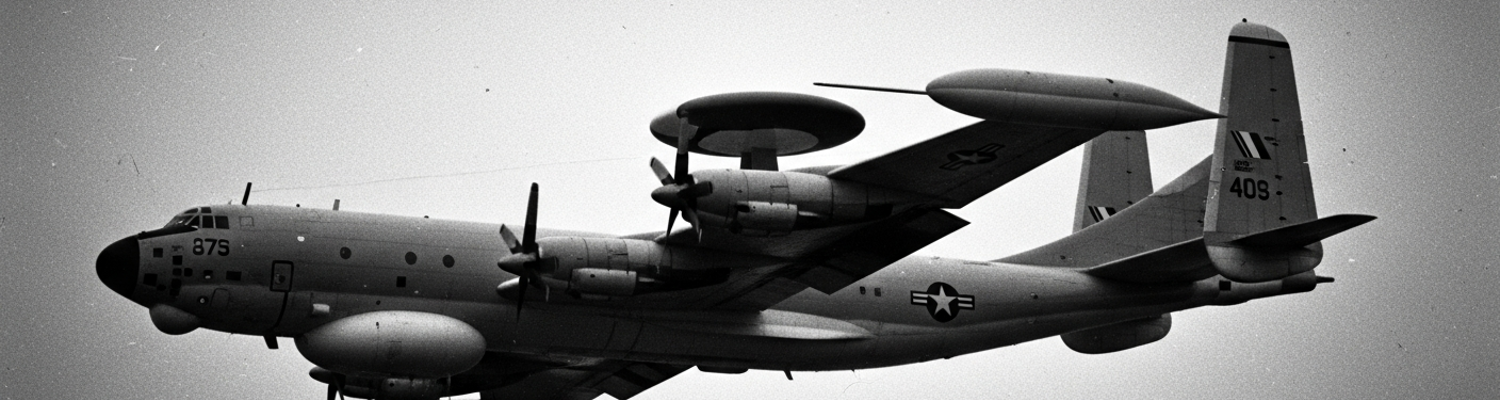
Another key platform was the Lockheed WV-2 Warning Star, later redesignated the EC-121. Based on the elegant Super Constellation airliner, the WV-2 was a flying electronic fortress. Its distinctive profile, featuring massive dorsal and ventral radomes, housed powerful search radars and a comprehensive suite of passive intercept equipment. With a crew of up to 31 personnel, including pilots, navigators, radar technicians, and a large contingent of ELINT operators and linguists, the 'Willie Victor' could remain on station for over 20 hours. It served as both an airborne early warning post and a premier electronic intelligence hub.
A former EC-121 radio operator described the interior as a “self-contained city at 20,000 feet. You had the front-end crew, the radar guys in their dark little world, and then you had us, the 'spooks', in the back. It was a constant hum of machinery and voices on the intercom. Long, long hours of just listening, watching, and waiting. The coffee was always on, and the tension was always just below the surface.”
These advanced platforms did not eliminate the danger. On August 22, 1956, a P4M-1Q Mercator from VQ-1 was on a nighttime mission 32 miles off the coast of Wenzhou, China, when its pilot sent a frantic Morse code message: “UNDER ATTACK BY ENEMY AIRCRAFT...” Then, silence. People’s Liberation Army Air Force MiG-17s had ambushed and destroyed the aircraft. A search found floating debris, but none of the 16 crewmen survived. The single greatest loss of life on an American aerial reconnaissance mission occurred years later, on April 15, 1969. An EC-121M Warning Star, call sign 'Deep Sea 129', took off from Atsugi, Japan, for a routine SESP flight over the Sea of Japan. The mission was considered 'minimal risk'. Nearly 200 similar flights had been conducted in the area without incident. Onboard were 31 men. Six hours into the flight, U.S. Army radar stations detected two North Korean MiG-21s taking off and heading directly for the EC-121. A coded warning was transmitted. Deep Sea 129 acknowledged the warning and began to abort its mission track. It was too late. The supersonic MiGs, armed with cannons and missiles, easily caught the lumbering, unarmed propeller plane. At 13:47 local time, the radar tracks merged. Two minutes later, Deep Sea 129 vanished from all radar screens. All 31 Americans were killed.
The Nixon administration chose not to retaliate militarily, a decision that caused deep anger within the military and reconnaissance communities. The incident, however, profoundly impacted operational strategy. Reconnaissance flights in the Sea of Japan were halted for eight days. When they resumed, they did so under the protection of Task Force 71, a carrier battle group that provided continuous fighter escorts. For the men of the ELINT community, it was another grim reminder of the price of vigilance. The names of the dead were etched onto memorials, their stories becoming a permanent part of the silent service they represented. The data they collected, paid for in blood, directly informed the development of electronic countermeasure systems and tactical deception techniques that would give American forces a decisive edge in future conflicts.