
Lunga Point's Precarious Beachhead
The invasion plan for Guadalcanal lasted less than thirty-six hours. It evaporated under the drone of twenty-seven Mitsubishi G4M bombers appearing from Rabaul on August 8th, 1942. For the men of the 1st Marine Division on the shore and the naval crews on the transports, the schedule for unloading gave way to pure survival. Anti-aircraft guns hammered at the sky. Japanese pilots pressed their torpedo attacks. Alarms blared across the water as Admiral Richmond K. Turner ordered the vulnerable, slow-moving transports to weigh anchor. Careful cargo handling was no longer an option. On the decks of ships like the USS George F. Elliott, set ablaze by a crashing bomber and later scuttled, cargo booms swung without control. Nets filled with ammunition boxes, fuel drums, and crates of rations were cut loose. Their contents were dumped into the churning surf to speed the ships' escape.
A panicked jettison.
The immediate result was a coastline choked with the materiel of war. Archival evidence (NARA Record Group 127) shows the beach became an impassable morass of supplies. The 1st Marine Pioneer Battalion, tasked with beach organization, was completely overwhelmed. There was no system. Boxes of medical plasma lay half-submerged next to cases of hand grenades. Sacks of flour, ruined by saltwater, split open and mixed with leaking oil. Heavy equipment, like the bulldozers and cranes needed to build fortifications, sat partially unloaded on transports forced to flee. What little gear made it ashore was used to drag crates from the water’s edge to any available patch of dry ground. These initial supply dumps were not depots; they were sprawling, exposed piles of gear clustered just inside the thin defensive perimeter around the future Henderson Field. Their placement was a matter of desperation, dictated by proximity to the beach, not tactical safety. This left mountains of ordnance and fuel within easy range of Japanese artillery.
The chaos on the beach was a symptom of a larger disaster at sea. On the evening of August 8th, Admiral Frank Jack Fletcher, citing fighter losses and low fuel, withdrew his aircraft carriers. They were the invasion’s only source of air cover. The next night, a Japanese cruiser force under Vice Admiral Gunichi Mikawa destroyed the Allied screening force in the Battle of Savo Island, sinking four heavy cruisers. Faced with this loss, Admiral Turner ordered the full withdrawal of his entire amphibious force on August 9th. It carried with it more than half of the total supplies intended for the Marines. The 1st Marine Division was stranded. The scheduled resupply was severed. There would be no steady stream of ships. From that moment, every supply run became a high-stakes gamble, a dash by fast ships, often converted World War I-era destroyers, through waters soon known as Ironbottom Sound. The constant threat of Japanese submarines and the nightly naval bombardment runs of the Tokyo Express made any large-scale logistical effort impossible. The Marines on Guadalcanal had to survive on what they had seized, salvaged from the surf, and received in sporadic, hazardous increments.
Engineers as Provisional Infantry
With the logistical chain severed and the defensive perimeter around Henderson Field dangerously thin, the distinction between a support troop and a combat infantryman evaporated overnight. The crisis forced a radical reorganization of manpower dictated by the most basic need: holding the line. Units like the 1st Engineer Battalion and the 1st Pioneer Battalion, whose primary functions were construction and unloading cargo, were immediately handed rifles and assigned sectors of the front. A close review of operational logs shows these men, trained to build and repair, were now expected to hold ground against seasoned Japanese attackers. Their days were a frantic effort of labor, using captured Japanese bulldozers to complete the airfield and fortify the perimeter. Nights were spent in foxholes, peering into the oppressive darkness of the jungle. The southern portion of the beachhead, a maze of dense, jungled ravines, was guarded almost exclusively by these and other combat support troops.
These engineers and quartermasters were tasked with conducting aggressive jungle patrols, seeking out an enemy who was an expert at infiltration. Japanese doctrine emphasized small, highly mobile units designed to slip through defensive lines, especially at night. Their targets were the rear areas, specifically the crude supply trails that snaked from the chaotic dumps on the beach to the frontline positions. These were not roads, but muddy, treacherous paths where a single man carrying a box of ammunition was an easy target. Japanese infiltration squads moved with exceptional stealth, their primary objective being the disruption of supplies and the erosion of morale. An attack could be a single, well-aimed shot from the jungle canopy or a sudden, frenzied charge with bayonets on a small group of Marines resting along the trail. The psychological toll was significant, as no place within the perimeter could be considered safe from enemy contact.
The battlefield itself erased traditional military roles. A Marine’s specialty became secondary to his immediate function as a rifleman. Archival evidence shows this was not a formal command decision but a spontaneous, ground-level adaptation to extreme circumstances. An engineer from the 1st Engineer Battalion might spend his day operating the single, vital bulldozer to fill in bomb craters on the airfield. He would then spend his night manning a machine gun nest along the Lunga River. Men from the 1st Amphibian Tractor Battalion found their supply vehicles pressed into service as mobile machine gun platforms and even as makeshift pontoons for bridges. This fusion of roles was absolute. Every Marine, regardless of his designated job, was expected to perform night defensive duty. The very definition of a rear area had ceased to exist, forcing every man to become a frontline combatant.
Jungle Fratricide and Disorientation
Operational logs from the Guadalcanal campaign (File Ref: USMC-G-2-8A) reveal a persistent and lethal problem that had little to do with the Japanese: the high frequency of friendly fire. The very environment was a primary antagonist. In the dense, dripping jungles flanking the Lunga perimeter, visibility could drop to mere feet. Perpetual twilight under the canopy, broken by blinding shafts of sunlight, played tricks on the eyes. Rain squalls turned the world into a gray, featureless wall of water. In these conditions, the standard-issue green herringbone twill (HBT) utility uniforms worn by Marines and the khaki uniforms of the Japanese became almost indistinguishable once coated in mud and soaked by rain. A helmet's silhouette, a fleeting shape moving between ferns, a rustle in the kunai grass. These were the only inputs a nervous sentry or jumpy patrol had to make a life-or-death decision. Formal systems of identifying friend from foe were designed for ships and aircraft, not for individual infantrymen swallowed by the jungle. This led to tragic, recurring incidents where Marine patrols, disoriented by the featureless terrain, would blunder into each other’s sectors and open fire.
This constant threat of misidentification inflicted a uniquely corrosive psychological toll. A naval hospital report from the period on combat fatigue described men subjected to a prolonged strain previously unseen in warfare. The enemy was not just in front; he was potentially beside you, or even within your own mind as you questioned your senses. Every Marine understood the Japanese doctrine of infiltration. Small units were designed to slip through lines at night, create chaos in the rear, and sow terror. They were known to use captured American gear and call out English phrases to lure patrols into an ambush. This knowledge turned the already frightening jungle nights into a period of acute paranoia. The snap of a twig could be a land crab or a Japanese soldier preparing a grenade. The whisper of a voice on the wind could be a fellow Marine or a Japanese infiltrator attempting to draw fire and reveal a position. The result was a state of hyper-vigilance that was impossible to maintain. Fatigue wore men down, and with it, fire discipline. The fear of being attacked by an unseen enemy was compounded by the fear of accidentally killing a comrade, a burden that archival evidence shows many survivors carried long after the campaign.
Distinguishing a friendly patrol from a Japanese infiltration unit in the close-quarters confines of Guadalcanal’s jungle ravines was a tactical nightmare with no clear solution. Japanese units often moved in smaller, quieter groups than American patrols, using terrain to their advantage. They preferred to move along stream beds and hidden trails, often at night, to probe for weaknesses in the thinly held American line around Henderson Field. A Marine patrol, by contrast, might be larger and more heavily armed, but this also made it louder and easier to detect. When two patrols unexpectedly met at a range of ten yards in the dense undergrowth, there was no time for formal challenges or verification. The split-second decision to shoot was based on gut instinct, a fleeting glimpse of a uniform, or the perceived threat of a weapon being raised. The consequences of hesitation were just as deadly as the consequences of a mistake. This problem was most acute along the southern perimeter and in the tangled terrain west of the Matanikau River, where engineer and pioneer battalions, men not primarily trained as infantry, were thrust into frontline patrol duties. There, the lines were poorly defined and the jungle was thickest, creating the perfect conditions for fatal confusion.
A War Against the Earth Itself
The island’s very composition was an enemy. Guadalcanal’s soil was a deep, volcanic clay that, when subjected to the near-daily torrential downpours of the tropical monsoon season, transformed into a viscous, glutinous morass. There were no existing roads, only narrow, winding jungle tracks. The relentless rain turned these paths into channels of thigh-deep mud that possessed a suction-like quality, pulling at boots and swallowing the wheels of handcarts. A close review of operational logs from the 1st Marine Division shows that moving a single artillery piece a few hundred yards could consume an entire platoon for a full day. The rain was a constant, drumming presence that not only impeded movement but also accelerated the decay of everything from sandbags to clothing, fostering an environment where tropical diseases flourished. For the men of the 1st Engineer Battalion, tasked with creating a road network from scratch, the environment presented a challenge that no training could have fully prepared them for. Every cleared path was a temporary victory, as a single afternoon storm could wash away a day’s labor, collapsing culverts and turning graded surfaces back into impassable rivers of mud.
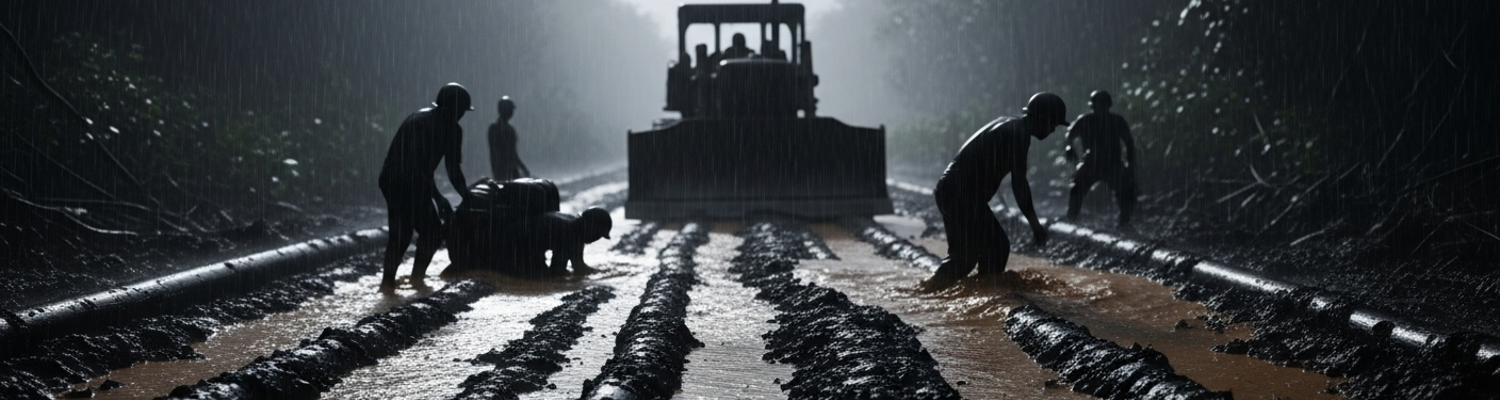
In response to the bottomless mud, engineers of the 1st Engineer Battalion and, later, the Naval Construction Battalions, or Seabees, resorted to an ancient and punishingly labor-intensive technique: the corduroy road. Lacking rock and gravel for proper roadbeds, they felled thousands of coconut palms and jungle hardwoods, laying the logs perpendicular to the direction of travel. These logs, laid side-by-side directly onto the mud, formed a semi-stable surface that could, in theory, support wheeled and tracked vehicles. The construction was punishing. Men worked with hand tools and the few captured Japanese bulldozers, felling, trimming, and hauling massive logs under the constant threat of air raids and sniper fire. The resulting roads were a nightmare to traverse, a jarring, bone-shaking surface that caused vehicle suspensions to fail and threw tracks. The logs would shift and sink under the weight of heavy trucks and tanks, creating gaps that could snap an axle. Constant maintenance was required, with crews working around the clock to replace broken or submerged logs just to keep the arteries between the beach, the airfields, and the front lines open. The same ingenuity was applied to the island’s many rivers and ravines, where engineers constructed timber bridges from the same felled trees, often building and rebuilding them multiple times after they were washed away by flash floods.
The difficulty of moving heavy equipment was a defining characteristic of the campaign. The few American bulldozers that made it ashore before the Navy’s withdrawal were treated like sacred objects, essential for everything from completing Henderson Field to burying the dead. A single International TD-18 tractor became the linchpin for airfield repair. Its operators from the 6th Naval Construction Battalion worked relentlessly to fill bomb craters, often while under fire, knowing the survival of the Cactus Air Force depended on their ability to keep the runway operational. The standard 2.5-ton GMC CCKW trucks struggled immensely. Their powered front axles gave them an advantage, but even they would become hopelessly mired in the churned-up clay of the main supply routes. A close study of unit reports reveals that supply columns frequently had to be broken down, with cargo offloaded and man-handled past the worst sections of a road before the empty trucks could be winched or bulldozed out of the mud. This process was agonizingly slow and exposed supply parties to enemy attacks, turning every logistical movement into a tactical operation.
The High Command Disconnect
A deep chasm existed between the Guadalcanal campaign as envisioned by planners in Nouméa and Pearl Harbor and the one experienced by the Marines clinging to the Lunga perimeter. High command, particularly the staff of Vice Admiral Robert L. Ghormley, operated on projections and timetables that bore little resemblance to the conditions on the island. A close review of operational logs shows that initial planning for Operation Watchtower assumed a rapid, orderly offloading of supplies sufficient for 60 days, a figure already reduced from a standard 90-day loadout. Planners like Admiral Turner and his staff had calculated that three days would be enough to get the men and materiel ashore. This projection completely failed to account for the ferocity of the Japanese naval and air response, which forced the transport fleet to withdraw after only a fraction of the cargo was unloaded. From his headquarters, Ghormley continued to view the situation through a lens of anxiety, constantly petitioning Admiral Nimitz for more assets while demonstrating a distinct lack of understanding of the tactical situation on the island itself. Archival evidence shows Ghormley never set foot on Guadalcanal, and his messages to his superiors often painted a picture of near-desperation that was not coupled with the aggressive, hands-on solutions the situation demanded. The command structure was creating plans for a conventional campaign while the men on the ground were fighting for survival with what they had managed to drag from the surf.
The men tasked with building the infrastructure to support the beachhead, primarily the 1st Engineer Battalion and later the Seabees, became the primary authors of a narrative that directly contradicted the sanitized reports moving up the chain of command. Their reports were not about strategic objectives; they were blunt assessments of mechanical failure and environmental hostility. Where high command saw a captured airstrip to be made operational, the engineers reported on the 53 bomb and shell craters that pocked the runway and the chaotic sludge that was destroying more aircraft through accidents than combat. They documented the losing battle against the island’s volcanic clay and torrential rains, which made standard road construction impossible. While headquarters requested progress reports on road networks, the engineers sent back details of having to fell thousands of coconut palms by hand to create primitive, bone-jarring corduroy roads that constantly sank into the mud. A review of their operational logs indicates a constant struggle with equipment. Much of their heavy machinery had never made it ashore, forcing them to rely on captured Japanese equipment. These ground-truth reports, detailing the lack of spare parts, the inadequacy of hand tools, and the sheer impossibility of meeting construction timelines under daily air and artillery bombardment, painted a bleak picture that stood in stark contrast to any optimistic strategic assessment.
Faced with a logistical pipeline that was, for all practical purposes, severed, the engineers and support troops on Guadalcanal were forced into a state of continuous, desperate improvisation. This was a basic requirement for survival. A close study of unit records reveals a near-total reliance on salvaged and repurposed materials. Seabees from the 6th NCB kept captured Japanese trucks operational by fabricating new radiators from metal ammunition boxes, a technique that was soon replicated across the island. When bulldozer radiators failed, mechanics learned to mount 55-gallon fuel drums in their place to keep the vital machines running. These same fuel drums were cut open and welded into culverts or flattened into roofing material. The 1st Amphibian Tractor Battalion found their LVT(1) supply vehicles, designed to carry cargo, pressed into service as makeshift pontoons for bridges across the island’s rivers. There was no part too small or insignificant to be repurposed. Worn-out tires that could no longer hold air were filled with a mixture of sawdust and cement. Beer and Coke bottles were used as insulators for communication lines, and mechanics even fashioned replacement watch crystals from the plexiglass of wrecked aircraft. This resourcefulness extended to sustenance; with their own rations ruined or at the bottom of Ironbottom Sound, Marines subsisted for weeks on captured Japanese rice, often infested with maggots, because there was nothing else.