
Backcountry Militia Legends and Operational Deficits
By late summer 1780, the men mustered across the Salisbury District were marching on empty stomachs through the humid river bottoms along the Yadkin River. Days of forced movement over rutted red-clay wagon tracks in ninety-degree heat dissolved rotted leather shoes. Dozens of North Carolina militiamen bound their split feet in greasy rags. Others marched completely barefoot across flint-strewn roads. Sleep occurred in brief increments directly on waterlogged soil without wool blankets, oilcloths, or canvas tents. Rations rarely amounted to more than parched corn meal mixed with river water and green peaches scavenged from abandoned Loyalist farmsteads. This diet induced widespread bacterial dysentery. Companies were violently dehydrated before they ever sighted a British patrol. Constant exposure brought camp fevers and ague. Physical strength degraded to the point where men dropped along the road during twelve-mile route steps.
Exhaustion broke men long before muskets fired.
Pop-culture narratives persistently frame these backcountry fighters as self-reliant woodsmen armed with pristine Pennsylvania long rifles. When examining the historical record, a radically different picture emerges from Salisbury District military returns and county court records. Muster rolls recorded for Colonel Francis Locke's Rowan County regiment prior to the June 1780 engagement at Ramsour's Mill reveal severe supply deficits. Nearly half the assembled force arrived without serviceable military firearms. Men reported for duty clutching rusted fowling pieces. Others carried ancient civilian bird guns with cracked stocks or Dutch-manufactured trade muskets incapable of handling standard powder charges. A close review of operational logs indicates that local gunsmiths could not replace snapped mainsprings. Worn frizzens failed to strike spark against poor-grade local chert. Flints were so scarce that men fitted rough gravel into hammer jaws with scraps of leather. They misfired every third attempt. Lead supplies were equally dry. Men melted pewter dining plates and fishing weights into irregular slugs. These irregular projectiles rapidly jammed rifled barrels. Backcountry soldiers carried coarse black powder in cattle horns that spoiled in rain. They possessed zero watertight leather cartridge boxes. Bayonets were completely absent from the Salisbury district roster.
The militia carried scrap metal into battle.
Archival evidence shows that the Continental Army Southern Department under Horatio Gates allocated zero medical chests to the Salisbury District militia. Continental purveyors concentrated every dram of laudanum and clean surgical lint in designated regular depots. They forbade distribution to regional irregulars. When Rowan County companies sustained severe casualties at Ramsour's Mill and Colson's Mill, not a single military surgeon was assigned to their column. Wounded men fell back on civilian practitioners. These men rode miles through the brush carrying domestic straight razors and iron butcher knives. They used carpenter saws to perform emergency field amputations. Operating without clean sponges or standardized tourniquets, these local healers clamped hemorrhaging femoral arteries with bent needle pliers. They wrapped crushed bone in soiled linen stripped from horse packs. Infection and sepsis spread unimpeded through makeshift field stations established in drafty barns. Men suffering from sucking chest wounds drowned in their own fluids on dirt floors. They received zero doses of pain-relieving opium.
Rowan County companies fought the entire summer campaign without a single assigned medical officer.
Forced Marches and Physical Attrition Under Locke
Archival evidence shows that Francis Locke issued urgent mobilization circulars across Rowan, Burke, and Mecklenburg counties on June 18, 1780. This followed verified intelligence that Loyalist Lieutenant Colonel John Moore was assembling over one thousand recruits along the South Fork of the Catawba River. Locke bypassed formal Continental lines of communication. He dispatched couriers on horseback through scattered frontier settlements along Second Creek, Dutchmans Creek, and Coddle Creek. District officers received orders to muster every able-bodied male between sixteen and fifty years old with whatever firelock, shot pouch, and powder horn they could pull from farmsteads. Gathering at Oliver's Bridge and Mountain Creek, company commanders including Captain James Falls, Captain John Brandon, and Major David Wilson collected roughly four hundred partisan fighters without standard-issue military supplies. General Griffith Rutherford was still marshaling Continental-aligned units fifty miles south near Charlotte. Locke made the unilateral command decision to initiate an offensive intercept without waiting for Rutherford's heavy column or supporting baggage wagons.
Speed replaced basic supply lines.
Operational logs indicate Locke pushed his column into a punishing thirty-five-mile forced night march through dense Carolina scrub oak, low pine barrens, and thick blackberry briars. Backcountry temperatures hovered in the high eighties with heavy humidity. This turned clay roads into thick paste that systematically suctioned home-tanned cowhide brogans and civilian shoes off the men's feet. Hand-stitched flax thread holding cheap leather soles together dissolved within six hours of repetitive wading across swollen creek bottoms and marshy tributaries of the Catawba River. Lacking spare footwear or cobbler tools, dozens of Rowan County militiamen continued marching with bare heels and torn arches directly over jagged chert rocks and broken sapling stumps. Backcountry soldiers wrapped their split, bleeding soles with greasy linen rags torn from hunting frocks. This trapped anaerobic bacteria, grit, and stagnant drainage water against open lacerations. Within eighteen hours, severe maceration and fungal foot rot spread across the companies. Bottom skin turned white and spongy while causing raw dermis to peel away under the friction of rapid marching.
Untreated leather fell apart in the swamp water.
When examining the historical record preserved in post-war pension applications and company rosters, the attrition inflicted by Locke's pace becomes obvious before a single shot was exchanged. Locke's column advanced without an organic commissary train or flour wagons. Soldiers subsisted entirely on dry parched corn meal shoved into cotton ticking sacks. Partisans went over thirty hours without a hot meal or verified potable water. They drank from stagnant drainage pools that triggered acute bacterial enteritis and rapid salt depletion under the Carolina sun. Soldiers began falling out of line along the rutted wagon trace north of Mountain Creek as heat prostration paralyzed their leg muscles. Company captains maintained no medical wagons or rear-guard details to retrieve those who dropped. They simply left dehydrated men where they collapsed on the roadside to fend for themselves in hostile Loyalist territory. Records from Captain William Alexander's detachment note that pack horses broke down under overloaded saddles. Men dumped their meager spare clothing to keep up with the column.
Locke arrived at Ramsour's Mill with three hundred and fifty effective men. He shed more than one-fifth of his original force to pure physical exhaustion on the approach march.
Endemic Dysentery and Nutritional Collapse in Rowan County
Archival evidence shows that during the sweltering months of July and August 1780, backcountry water sources transformed into primary vectors of incapacitating disease. Salisbury District militia detachments under Griffith Rutherford and Francis Locke operated across low swales along the Yadkin River basin. They traversed creeks such as Dutchmans Creek and Coddle Creek in temperatures consistently exceeding ninety degrees. Summer heat dried seasonal headwaters into stagnant oxbows, mud wallows, and roadside drainage depressions laden with agricultural run-off and decaying organic matter. Partisan units lacked iron camp kettles, entrenching tools to dig proper latrines, or command discipline to enforce boiling before consumption. Within forty-eight hours of consuming water from these swamp pools, companies were struck by severe bouts of camp fever. This was identified clinically as typhus and acute enteritis, alongside virulent bacillary dysentery known locally as the bloody flux. Shivering fits and temperatures spiking above one hundred and three degrees incapacitated dozens of militiamen. Severe intestinal ulceration triggered rapid fluid evacuations. This drained electrolytes from partisan companies until soldiers collapsed on the road from hypovolemic shock.
Backcountry irregulars drank directly from livestock wallows.
A close review of commissary accounts and regional quartermaster vouchers indicates that Rowan County units marched without grain supply trains, portable gristmills, or bread rations. Frontline partisans regularly resorted to stripping unripened green corn directly from farm fields along their operational axes between Rocky River and the Catawba ford. Consumed raw or charred over open pine wood, the immature ears contained high concentrations of indigestible complex starches and moisture that human enzymes could not break down. When field commissaries managed to seize dry wheat or unbolted flour from local farmsteads, the lack of mess pans and baking ovens forced soldiers to mix the raw powder with brackish swamp water inside the crowns of their wool hats. Militiamen swallowed this wet, uncooked paste on the march. The mixture of fermenting raw dough and green corn caused severe abdominal distension, severe stomach cramps, and debilitating vomiting. Intestinal tracts became severely inflamed. This accelerated dehydration and stripped frontline companies of able-bodied muskets through violent, uncontrolled diarrhea.
Severe gastrointestinal purging left entire squads physically incapable of shouldering arms.
When examining the historical record preserved in post-war pension applications, the micro-level breakdown of individual partisan effectives becomes explicit. In his official sworn deposition, Charles Blackwelder described how severe physical incapacitation crippled his military service during active field maneuvers through the Salisbury District in 1780. Blackwelder volunteered into the regional militia, serving under company officers including Captain John Barringer and Captain Reese across the Carolina piedmont. Instead of facing combat at full physical capacity, he succumbed to debilitating endemic sickness that incapacitated his digestive tract and induced recurring fever during aggressive marches. Sworn testimony from his file indicates that systemic illness prostrated him so severely during tactical operations that he could neither stand in ranks, bear arms, nor complete routine reconnaissance patrols. His deposition confirmed that backcountry officers possessed no pharmaceutical stores to arrest the fever and no medical baggage wagons to transport the sick. Left behind in civilian cabins along Rocky River to recover from visceral inflammation, Blackwelder joined a documented cohort of irregulars who were eliminated from combat by acute systemic disease.
Rowan County company rosters recorded by July 1780 listed up to thirty percent of mustered men as sick absent without leave or unfit for duty. Field returns filed at Salisbury noted that Captain John Brandon retained only twenty-four fit rank-and-file soldiers out of fifty-two enrolled names before crossing the Catawba River.
Absence of Institutional Field Hospitals and Standardization
Archival evidence shows that the North Carolina General Assembly never established medical establishments for county partisan units. Continental Army regiments maintained a formal medical hierarchy authorized by the Continental Congress. They deployed one commissioned regimental surgeon and two surgeon's mates to administer field dressing stations, manage surgical instruments, and direct hospital wagons. Salisbury District militia rolls for the Rowan County regiment under Francis Locke list zero medical personnel. Not a single line on company rosters for Captain John Brandon, Captain James Falls, or Captain William Alexander designates a surgeon, surgeon's mate, orderly, or triage clerk. County courts allocated militia funding exclusively for lead bars, unrefined powder, and horse gear. They treated tactical field medicine as an individual responsibility. Board of War correspondence from Hillsborough confirms that regional administrators dispatched weapons, not surgical instruments, to backcountry staging areas along the Yadkin River. Wounded soldiers received no administrative recognition on casualty tables. Irregular units operated without institutional medical infrastructure when bullets hit.
No doctor marched with Locke.
A close review of operational logs indicates that Rowan County companies possessed zero standard military evacuation equipment when deploying into the pine barrens along the South Fork of the Catawba River. Standard two-pole canvas litters and folding stretchers simply did not exist in Salisbury District stores. Men carrying arterial lacerations or shattered femurs had to be dragged by their collarbands across rough gravel tracks. Others were slung face-down over wooden saddle pommels, bouncing against sweating draft horses until hypovolemic shock ended their lives. Regular army quartermasters in Hillsborough withheld pre-rolled linen bandages. This left militia officers without sterile lint compresses to plug gaping entry holes. Rowan County combatants improvised wound dressings by ripping filthy homespun hunting frocks and greasy wool waistcoats directly from dead men on the field. To control rapid hemorrhaging, soldiers lacked the brass-threaded Petit tourniquets standard in European armies. Backcountry fighters twisted rough hemp plow-ropes and ash twigs into crude Spanish windlasses. This mechanical setup routinely slipped off slick skin or crushed nervous tissue without completely sealing severed femoral arteries.
Pressure gave way, and men bled out into the mud.
When examining the historical record preserved in post-war disability depositions, surviving partisans described agonizing extractions executed without a single grain of pain-relieving laudanum or clean instrumentation. British and Loyalist smoothbore muskets threw soft lead balls weighing over an ounce. These projectiles flattened upon contact with human flesh and splintered cortical bone into jagged, free-floating shards. Backcountry companies possessed no specialized bullet forceps or bone-saws. Extraction fell to blacksmith pincers, iron bodkins, or civilian pocket knives whetted on river slate. These tools were driven into blind muscle tracks by lantern light inside drafty tobacco barns. To treat shattered limbs, local women and uninjured soldiers slapped poultices of mashed hickory bark, warm cow dung, and wood ashes directly over exposed, weeping bone ends. These domestic mixtures sealed anaerobic soil microbes inside open tissue cavities. Infection took hold within thirty-six hours. Open fractures turned into putrid wells of yellow pus that forced splintered bone fragments out through draining fistulas for decades.
Locke's wounded spent months extracting their own bone splinters with sewing needles in frontier cabins.
Civilian Farm Wagons and Improvised Evacuation Failures
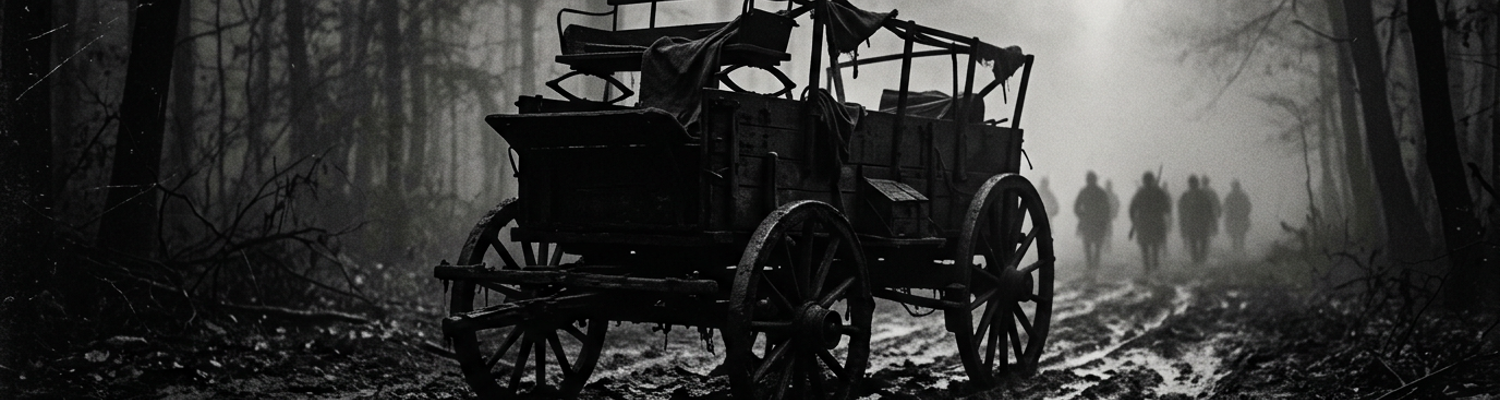
Archival evidence shows that county press-masters under Colonel Francis Locke executed emergency requisitions across the Salisbury District. They seized civilian farm transport by force of warrant. Militiamen stripped two-horse utility carts and heavy four-horse farm wagons directly from tenant fields along Grant's Creek and the Yadkin River settlements. These seized conveyances were crude agricultural tools designed for hauling unshelled corn and timber. They were not engineered for human bodies. Local wheelwrights constructed them out of green white-oak timbers. Ash axle bolsters were bolted directly onto unsprung running gears. Flat iron tire bands measured three-eighths of an inch thick. These bands were shrink-fitted directly onto rigid hickory felloes. Lacking any elliptic steel springs, leather suspension braces, or dampening straps, the wooden wagon boxes rested in unbroken contact with the raw wheel carriages. Every jolt from the axle transferred directly into the bed planks.
The requisitioned wagons possessed zero mechanical suspension.
A close review of operational logs indicates that Rowan County commanders drafted local civilian teamsters alongside their livestock. This was done under penalty of property confiscation. These conscripted farmers received neither firearms nor military status. They were positioned at the tail of Locke's advancing column without defensive escorts. When the opening rifle volleys detonated through the scrub oak thickets along the South Fork of the Catawba River, the civilian drivers broke into immediate panic. At the first crack of close-range fire from Loyalist pickets, teamsters abandoned their foot brakes. They pulled hunting knives from their belts to slash the hemp traces and leather harness rigging. Drivers mounted the uncoupled lead horses. They kicked free of the traces and fled south along the cart track toward the Salisbury crossroad. Abandoned four-horse wagons drifted across the single-lane road. Frightened wheel horses panicked and overturned the heavy wooden beds into drainage ditches.
Conscripted teamsters severed the wagon traces and deserted the column within minutes of the opening shots.
When examining the historical record preserved in regional court claims and pension depositions, the physical trauma inflicted by wagon evacuation over unpaved cart tracks surpassed the initial ballistic injury. Backcountry roads connecting Ramsour's Mill to Salisbury were unpaved logging paths. These paths were crosscut by deep rain ruts, exposed granite shelves, and washed-out pine root washboards. Unstabilized casualties placed onto the bare oak floorboards were subjected to vertical impacts exceeding four inches each time iron-banded wheels dropped into sunken mud holes. For men suffering compound fractures from large-caliber soft lead rounds, these uncontrolled vibrations proved fatal. Free-floating cortical bone fragments slid violently against deep muscle beds. This friction cut the adjacent deep femoral artery branches and shredded the sciatic nerve sheath. Fresh fibrinous clots formed at the entry points were physically jarred loose. Closed wounds tore back open and initiated fatal internal bleeding.
Severe kinetic bouncing accelerated systemic hypovolemic shock across the transport line. Blood pressure dropped rapidly as whole blood escaped into surrounding fascia. Arterial pulse rates drove past one hundred and forty beats per minute. Partisans bled directly into the porous floor planks. Dry summer dust kicked up by the iron tires caked open thoracic and abdominal wounds. Dehydrated men lapsed into cold, clammy stupor within three miles of travel. Their core body temperatures plummeted despite ambient air temperatures above eighty-five degrees. By the time abandoned carts were dragged into temporary collection points along Mountain Creek, multiple militiamen loaded alive had succumbed entirely to exsanguination caused by mechanical agitation.
Partisan Ambushes and Deserted Casualty Convoys
Retreating columns severed the draft harnesses and rode away.
A close review of operational logs indicates that Rowan County militia commanders repeatedly discarded their own wounded when tactical withdrawals degenerated into running fights along the Yadkin River basin. During retrograde movements following skirmishes near Colson's Mill and along the road to Salisbury, transport teams found themselves trapped in narrow sunken cuts. Red clay mud climbed past the wheel hubs. When Loyalist horsemen pressed the rear guard, company captains ordered immediate disengagements that left transport carts behind. Teamsters drove axes through harness trees. They hammered out iron linchpins to free the traces and commandeered draft horses for frontline officers. Immobile casualties were pinned under split-oak sideboards with compound fractures or gut wounds. They were left lying on water-soaked corn husks inside unhitched wagons. Axles were left buried in mud ruts across the cart trace. This blocked subsequent wagons and caused entire casualty columns to back up into indefensible defiles without draft power.
Wagons full of bleeding men were shoved off road shoulders to clear escape paths for mounted infantry.
Archival evidence shows that Loyalist partisan detachments under Colonel Samuel Bryan routinely intercepted these abandoned baggage trains. They slaughtered surviving casualties where they lay. Bryan's irregular cavalry operated out of the Tory enclaves along the forks of the Yadkin. They stalked the flanks of retreating Patriot detachments through the scrub oak thickets. When scouting elements discovered deserted carts stalled near creek bottoms, partisan raiders offered no quarter to soldiers unable to raise weapons or stand on their feet. Loyalists dragged injured Rowan County men over wagon tailgates into the dirt. They executed them with dragoon sabers, hunting swords, and point-blank blasts from heavy fowling pieces loaded with buckshot. Pension depositions from survivors record finding wounded militiamen stripped of their shirts, coats, and boots. Their skulls were crushed by the flat iron butts of muskets. Their chests were repeatedly pierced with bayonets inside roadside ditch lines.
Bryan's raiders spared neither cart nor invalid along the road north to Salisbury.
When examining the historical record preserved in county land registries and militia pension rolls, the isolation of injured partisans in remote civilian farmsteads reveals a complete absence of post-combat care. Rowan County officers lacked the transport capacity to move trauma cases across county lines. They offloaded shattered men at isolated tenant cabins along Dutchmans Creek and Coddle Creek. Detachments deposited two or three casualties per homestead. They left them in the hands of civilian women and children without assigning defensive pickets, perimeter sentries, or surgical personnel. Militia units rode eastward without posting relief details. They left these isolated structures exposed across a lawless zone where Tory patrols operated at will. Within unfortified log cabins, casualties languished on grease-soaked pine floorboards without access to surgical probes, lint dressings, or clean water. Deep bacterial infections set in within forty-eight hours. Gas gangrene turned muscular tissue black and necrotic. Civilian hosts lacked even bone saws to halt systemic sepsis.
Unprotected cabins frequently became death traps when Loyalist scouts traced blood trails from the main wagon roads directly to the cabin doors. Hostile detachments surrounded these isolated farmsteads. They set fire to outbuildings and dragged disabled soldiers out into farmyards.
Disrupted Courier Communications and Misdirected Evacuations
Archival evidence shows that Whig presses in New Bern and Hillsborough flooded regional settlements with broadsides. These papers proclaimed total Patriot dominance across the Western Carolinas by mid-summer 1780. Printers struck off sheets boasting that county irregulars had swept the forks of the Yadkin clean of British sympathizers. Inside the Salisbury District, the frontline communication network experienced total systemic failure. General Griffith Rutherford and Colonel Francis Locke relied on ad hoc mounted express riders. These riders operated without cipher books, reliable compasses, or standardized dispatch logs. Riders galloped half-starved plow horses down unmarked bridle paths through Rowan and Lincoln counties. They carried written messages scribbled on scrap paper with charcoal or diluted berry ink. Summer thunderstorms routinely dissolved these unsealed paper slips inside damp canvas saddlebags before couriers covered ten miles. When riders were ambushed or thrown, operational intelligence vanished entirely. Salisbury District headquarters routinely functioned on information forty-eight to seventy-two hours out of date. They issued troop movements based on enemy dispositions that no longer existed.
Paper victories printed in coastal towns did not reach the pine barrens.
A close review of operational logs indicates that garbled courier messages routinely steered requisitioned hospital transport directly into hostile sectors. Following engagements along the South Fork of the Catawba River, wounded men were loaded onto unsprung civilian timber wagons. They received orders to fall back toward presumed safe depots near Oliver's Bridge. Verbal orders transmitted through exhausted subalterns became scrambled over successive handoffs. In one instance along the rutted track between Mountain Creek and the Catawba ford, an illiterate courier misdirected a convoy of four ox-drawn carts. These carts carried thirty-two wounded Rowan militiamen. The teamsters were instructed to turn south toward a road junction that had fallen to Loyalist raiders eighteen hours earlier. Without cavalry scouts to verify the crossing, the transport column creaked straight into a Loyalist picket line. This line held the road intersection near modern-day Lincolnton. The Tory detachment opened fire with buckshot from point-blank range. They killed two unarmed civilian drivers before bayoneting the immobilized casualties inside the wagon beds.
No defensive escort accompanied the transport wagons.
When examining the historical record preserved in pension depositions and casualty rosters, the designation of ambiguous backcountry rallying points fractured retreating units into defenseless fragments. Backcountry commanders selected rally markers based on informal topographical descriptions. They used terms like the white oak spring or the second mill race rather than surveyed coordinates. Along the Yadkin River basin, multiple waterways shared near-identical local monikers. This led detached companies to disperse across entirely different drainages. Captain John Brandon's detachment separated from Locke's primary column after receiving a garbled verbal order to reform at a creek ford twelve miles northeast. Brandon's men marched through dense scrub oak toward the lower crossing of Dutchmans Creek. They were unaware that the actual assembly point was five miles west on Second Creek. The separated company marched directly into a settlement occupied by Colonel Samuel Bryan's Loyalist irregulars. Cut off from Rowan County reinforcements by swollen creek waters and heavy underbrush, Brandon's thirty-five men were encircled in an open farm lot. They lost eleven men killed or captured within twenty minutes of scattered small-arms fire.
Salisbury District Depositions and Historical Casualty Records
Operational logs from the Salisbury District demonstrate that surviving split squads spent days evading Tory search parties in the swampy bottoms along Crane Creek. Disoriented partisan groups discarded their dead comrades in drainage ditches without recording burial coordinates or casualty names on company books. Mounted dispatch riders sent out to relocate missing platoons were systematically picked off by small-arms fire from concealed Loyalist snipers positioned behind split-rail fences. Without courier links, field officers could not coordinate counter-attacks. They could not redistribute ammunition cartridges or locate medical supply points. The breakdown left county officers operating in total tactical isolation across a forty-mile combat zone.
The administrative erasure of the wounded was absolute.
When examining the historical record preserved in the Pension Act of 1832 files, the bureaucratic indifference toward backcountry casualties becomes a matter of public record. Men who survived the forced marches, the dysentery, and the unhitched wagon evacuations returned to Rowan County with shattered limbs and chronic infections. The North Carolina General Assembly provided zero post-war medical pensions for militiamen who lost limbs prior to 1781. Charles Blackwelder and his contemporaries filed sworn depositions detailing their physical destruction under Colonel Francis Locke. County magistrates routinely rejected these claims. The state required written discharge papers signed by commissioned Continental officers. Locke's irregulars possessed no such documentation. Their service was recorded only in the memories of the men who marched beside them.
They bled for a government that refused to acknowledge their presence on the field.
A close review of Salisbury District court minutes reveals that local authorities prioritized property compensation over human casualties. Farmers who lost horses or wagons during the chaotic retreats from Ramsour's Mill received state reimbursement certificates. Men who lost legs to British musket balls received nothing. The requisitioned white-oak wagons were assigned a specific monetary value in the county ledger. The militiamen who bled to death on their floorboards were left off the official casualty rolls entirely. The partisan war in the Carolina backcountry was fought without standardized supply lines, medical care, or administrative oversight.
The men were treated as expendable local resources.
The documented events of the 1780 campaign stand in direct opposition to the sanitized narratives of independent, well-supplied frontier marksmen. The Rowan County militia fought a war defined by physical attrition, disease, and supply collapse. They marched without shoes, fought without bayonets, and died without surgeons. The deposition records of the Salisbury District document a military force pushed past the limits of human endurance. They were abandoned by their commanders in the mud of the Yadkin River basin.
The final entry in the 1781 Rowan County ledger lists a payment of four pounds sterling to a local wheelwright for a damaged axle. No corresponding entries exist for the thirty-two militiamen who died in the wagon bed.