
Hydrodynamic Defects and Troop Debarkation Failures
Soldiers assigned to amphibious assault formations arrived at coastal staging ports after four days of forced railway transfers. They carried sixty-pound combat loads. Rations ran short during these movements. Infantry platoons survived on cold canned meat and unheated water. Chronic sleep deprivation degraded reaction times across entire companies before a single vessel left its slipway. Men were crowded into damp staging barracks along the Virginia coast. They waited under continuous wet winter rain that rotted their wool uniforms. Whole battalions were physically drained by the time boarding orders arrived. Their feet were blistered. Their core body temperatures were depressed.
The landing ships offered no relief.
Archival evidence from the 158-foot Landing Craft Infantry sea acceptance trials conducted off Norfolk Virginia in late 1942 uncovered severe hydrodynamic defects. Naval designers built the hull with a shallow draft of barely five feet forward and a rounded bilge. This geometry permitted direct beaching on low-gradient shores. It also produced an excessive metacentric height. Operating in moderate North Atlantic swells of four to six feet, the vessel exhibited a violent snap roll with a period of less than four seconds. The hull whipped back from thirty-degree angles with abrupt lateral acceleration. Operational logs from Task Force 65 trials record the physical toll on the embarked troops. Inside troop compartments one and two, men stacked four tiers high on pipe-frame bunks were hurled against steel bulkhead stiffeners. Bilges filled with vomit.
Fuel fumes from the twin Quad General Motors 6-71 diesel installations escaped through unsealed hatchway gaskets.
Acute dehydration spread through the embarkation force within six hours of clearing Chesapeake Bay. Combat readiness dropped instantly. Entire infantry units arrived at practice anchorages physically paralyzed by vestibular sickness. They were unable to shoulder weapons or clear deck ladders without assistance. Engineering errors at the bow compounded the crisis. Test landings at Solomons Island Maryland and subsequent assault exercises off North Africa revealed fatal vulnerabilities in the primary debarkation mechanism. Early production craft (designated hulls 1 through 350) used twin external gangways hung along the port and starboard sides of the sharp bow stem. Two hand-cranked wire-rope winches lowered these ramps down to the wet sand.
Each ramp measured just thirty-four inches in width.
Lightweight iron guide chains bordered the edges. These chains gave way under physical strain. Assault infantry carrying full packs, Springfield M1903 rifles, and Bangalore torpedoes squeezed through narrow eighteen-inch watertight doors on the superstructure before funneling down the gangways in single file. Waves crashing against the hull shoved the vessel laterally across sandbars. The wooden ramp bottoms buckled and ground against coral heads. When a craft broached in heavy surf, the ramps twisted on their pivot pins. They pinned soldiers against the steel hull plates or threw heavily burdened troops directly into deep surf channels.
Men drowned.
On contested shores, this single-file queue halted troop egress completely. Defensive gunners sighted automatic weapons directly onto the twin ramp throats. The exposed debarkation chutes became static firing zones. Naval planners recognized that offloading two hundred men under fire through two thirty-four-inch chutes took up to seven minutes. The unarmored craft held position during this window, pinned to the sand by its stern kedge wire. Reports from early Mediterranean operations confirmed that three well-placed 7.92mm machine guns could wipe out an entire assault wave before the ramps cleared the water line.
Intelligence Suppression and Littoral Defense Projections
A close review of operational logs indicates that in May 1945, War Department strategic planning was dominated by a single calculation. Soviet entry into the war against Japan was required to pin down the Kwantung Army in Manchuria. Lieutenant Colonel John H. Van Vliet Jr. arrived at the Pentagon after escaping German captivity. He submitted a detailed written report documenting German-discovered mass graves in the Katyn Forest. The report concluded that Soviet NKVD forces executed thousands of Polish officers. Major General Clayton Bissell, head of the Military Intelligence Division, immediately intervened.
Under the administrative tracking of Investigation 403, Bissell stamped the report top secret.
He suppressed it from distribution. The document disappeared from military intelligence archives (NARA Record Group 319). Bissell acted intentionally to prevent any political disruption that might cause Moscow to renege on its Yalta Conference pledge to invade Manchuria within three months of the defeat of Germany. Army planners calculated that without Soviet mechanized divisions neutralizing the 1.2 million Japanese troops positioned on the Asian mainland, those enemy formations would transfer to the Japanese home islands to contest Allied amphibious landings. Washington traded diplomatic silence for Soviet armor.
Joint Chiefs of Staff casualty estimates for Operation Olympic (the scheduled November 1945 invasion of southern Kyushu) predicted between 250,000 and 500,000 Allied casualties. These figures reflected the tactical lessons learned during amphibious assaults across the Central Pacific. Japanese defensive doctrine abandoned counterattacks at the water line in favor of organized defense-in-depth. Imperial Japanese Army engineers converted limestone ridges, coral caves, and reverse slopes into interconnected firing complexes. At Peleliu and Iwo Jima, they positioned Type 1 47mm anti-tank guns, 150mm mortars, and heavy machine guns inside hardened embrasures.
Five feet of reinforced concrete and coral aggregate shielded these weapons.
These positions sat completely silent during preliminary naval bombardments. They opened fire only when the initial landing waves crossed the fringing barrier reefs. Landing craft engines stalled on exposed coral heads. Assault infantry were stranded under crossfires that obliterated landing formations before riflemen reached dry sand. Traditional naval gunfire could not breach these subterranean positions. Naval commanders faced an insurmountable hydrographic barrier in early 1945. Standard fleet destroyers like the Fletcher class drew over seventeen feet of water. They kept their 5-inch 38 caliber batteries more than two thousand yards offshore to avoid grounding on jagged reef lines.
Heavy cruisers and battleships stood even farther out.
They fired high-velocity shells with flat trajectories that skimmed over reverse-slope revetments and buried targets. The five-hundred-yard gap between the reef margin and the high-water mark became a tactical dead zone. Landing craft carrying rifle companies lacked organic heavy weapons to neutralize these positions at zero range. Fleet planners in the Pacific Amphibious Forces recognized that assault waves faced certain destruction without dedicated shallow-draft fire support vessels. These platforms needed to cross barrier shallows, take direct hits, and smother coastal bunkers with point-blank automatic fire and barrage rockets. The discarded, roll-prone hull of the Landing Craft Infantry presented the only available platform wide enough to carry the necessary ordnance.
Field Conversions and Structural Overloading
Conversion work began in forward staging anchorages like Purvis Bay in the Solomons and Manus in the Admiralty Islands. Shipfitters from advanced base repair units boarded stripped LCI hulls armed with oxyacetylene cutting torches. Inside compartments two and three, workers sliced through hundreds of steel pipe-frame berths. They unbolted canvas cot stretchers and tossed the mess decks over the side. Clearing two hundred racks freed internal cubic volume below the waterline. This newly cleared void immediately took on thousands of rounds of 40mm ammunition and crated rocket motors. Deck crews simultaneously attacked the superstructure.
The original unarmored pilot house consisted of quarter-inch mild commercial steel plate.
This material offered zero defense against Japanese 7.7mm Type 92 machine gun rounds or fragmentation. Repair teams took scrap twenty-pound high-tensile steel plates salvaged from bombed cargo hulls. They welded them directly over the wheelhouse, steering flat, and engine hatchways. Exposed gun crews received bolted splinter shields fabricated from curved steel boilerplate. Torches burned day and night across the forward anchorages. This crude armor package added more than twelve tons of deadweight to the forward superstructure.
Ship designers never engineered the narrow 23-foot beam to support high center-of-gravity plating.
Whenever repair personnel welded heavy plate to the upper deck, the craft lost four to six inches of freeboard. The bow pulled down. Below deck, shipfitters braced the engine room bulkheads with welded angle irons to counteract the hull flexing caused by the uneven weight distribution. Electricians rewired the auxiliary circuits. They bypassed scorched junction boxes to feed power directly to high-capacity bilge pumps. Every square foot of usable deck became an equipment foundation. Weight calculations were abandoned. Navy ordnance depots could not supply enough standard dual-purpose Mark 1 40mm gun mounts to keep pace with conversion schedules.
Forward base commanders scavenged United States Army supply depots on Guadalcanal and Espiritu Santo for surplus Army M1 40mm anti-aircraft pieces.
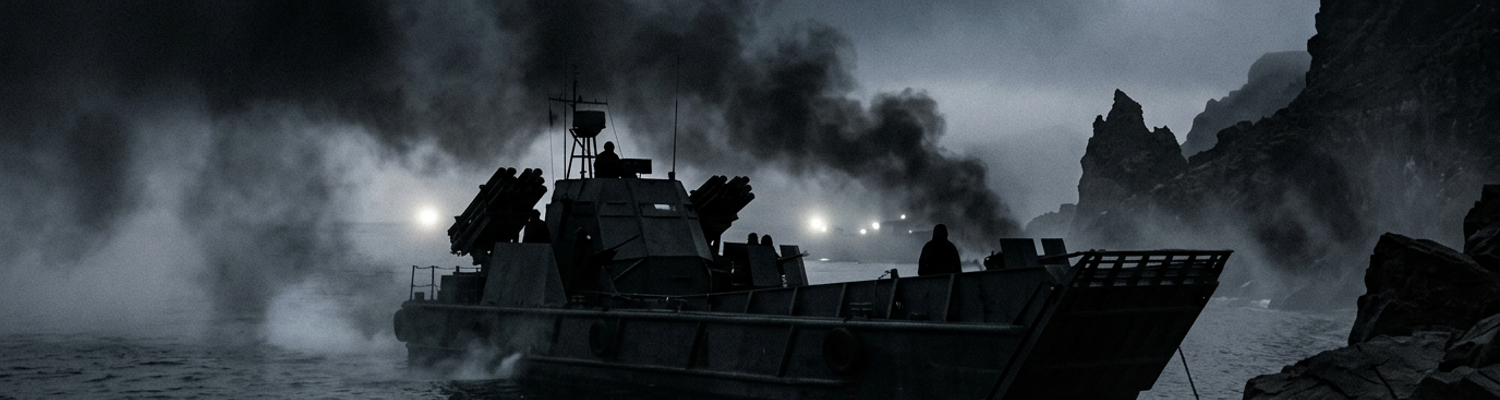
Yard mechanics removed the mobile carriage assemblies. They welded the raw four-legged pedestal bases straight onto structural doubler plates laid over the LCI forward forecastle and waist. Deck framing buckled during early live-fire checks. Structural carpenters and welders countered this by running four-inch vertical steel H-beams from the main deck down through the emptied troop bays to the keel. This modification transmitted firing recoil straight into the bottom frames. Next came the bombardment ordnance. Shipfitters mounted rows of Mark 7 rocket launchers along the forward deck rails and atop the deckhouse.
These gravity-fed assemblies fired 4.5-inch spin-stabilized rockets in continuous ripples.
They sent twenty-four high-explosive projectiles downrange within seconds. Rocket exhaust gasses washed over open decks at temperatures exceeding one thousand degrees. Crews welded sheet-metal deflector plates against the pilot house bulkhead and fitted steel blast shutters over forward viewports. These modified hulls were redesignated as LCI(G) gunboats. Operational records from Flotilla Three confirm that fifty-two of these field-converted craft were ready for action by March 1945. Each craft carried three single 40mm Bofors mounts, two 20mm Oerlikon automatic cannons, and up to forty-two Mark 7 launchers. Fuel consumption surged forty percent under the drag of the reconfigured forward profiles. Propeller shafts vibrated violently at sixteen knots. The vessels were dispatched north toward the Kerama Retto anchorage off Okinawa with ammunition lockers loaded to capacity.
Electromagnetic Isolation and Point-Blank Engagements
Task Group 51.1 directed its converted gunboats into the narrow winding channels separating Tokashiki, Zamami, and Aka islands during preliminary landings on March 26 1945. Steep volcanic ridges rising over six hundred feet vertically from the water line hemmed the 158-foot steel hulls into isolated anchorages. Tactical voice communications relied on very-high-frequency transceivers. These included line-of-sight SCR-608 and SCR-522 shipboard sets operating between 100 and 156 megahertz. Gunboat Divisions Three and Four pushed into the deep twisting inlets of Kerama Kaikyo. The jagged basalt cliffs physically blocked line-of-sight electromagnetic wave paths.
Signal attenuation dropped radio strength across operational circuits to zero.
Radio operators faced deafening static bursts as carrier waves scattered against sheer granite walls. This severed voice links between gunboat flotilla leaders and individual vessel commanders operating less than two nautical miles away. Radio silence descended without warning across the forward combat groups. This electromagnetic isolation paralyzed centralized fire coordination. Onboard LCI(G)-396 and LCI(G)-397, mast-mounted whip antennas flexed violently against cross-strait winds. This grounded receiver leads and caused the sensitive glass vacuum tubes of the BC-683 receiver modules to overheat and fail.
Division commanders lost direct contact with the task force flagship.
Senior officers in the forward channels had to rely on visual signaling. They positioned crewmen on forward splinter shields to transmit bearing coordinates with Aldis daylight signaling lamps. Heavy smoke from preliminary mortar barge bombardments drifted across the bays at 0830 hours. Visual signaling collapsed. Coxswains in unarmored wooden motor whaleboats were dispatched through contested littoral channels under small-arms fire. They physically carried written coordinate slips from hull to hull. This communications breakdown occurred precisely as the gunboats entered point-blank engagement range with the Japanese Sea Raiding Regiments.
Imperial headquarters stockpiled roughly three hundred and fifty Shinyo suicide attack craft inside the sheltered coves of Kerama Retto.
They prepared to launch mass nocturnal sorties against Fifth Fleet troop transports scheduled to arrive off the Hagushi beaches of Okinawa on April 1. These eighteen-foot plywood hulls were equipped with converted six-cylinder automobile engines. They were packed with a five-hundred-pound Type 98 high-explosive charge in the bow, primed by mechanical impact detonators. Japanese soldiers concealed the boats inside natural limestone sea caves, stone revetments, and brush-covered ravines cut into the island margins. They draped them with green coconut palm thatch and wet mud to defeat high-altitude aerial reconnaissance.
Neutralizing this hidden armada required the converted gunboats to close to thirty yards.
Beginning on the afternoon of March 27, LCI(G) units formed two-craft sweep elements to clear the shoreline foot by foot along the coastlines of Tokashiki and Hokaji. Gunnery officers ordered the forward single 40mm Bofors mounts to depress below horizontal. They sighted directly into darkened cave mouths and coastal foliage lines at point-blank range. Gun crews fired high-explosive point-detonating shells into every suspicious inlet. Waist-mounted 20mm Oerlikon gunners sprayed the rocky scree with continuous high-angle armor-piercing tracer streams to detonate fuel storage barrels.
Contact was confirmed.
The craft opened with their deck-mounted Mark 7 rocket launchers. They rippled forty-two 4.5-inch fin-stabilized rounds directly into cave throats. These direct strikes collapsed the soft limestone roofs. They detonated the internal Shinyo explosive loads and ignited cached drums of low-grade aviation gasoline. By the evening of March 29, the gunboat sweep located and neutralized approximately three hundred suicide craft across thirty-five separate island coves. They did not allow a single Shinyo squadron to break out toward the main transport fleet.
Structural Deformation and Fleet Register Disposal
Naval surveyors at Subic Bay and San Pedro documented irreparable hull distortion across the surviving gunboat flotillas during fleet inspections conducted in the autumn of 1945. Field modifications overwhelmed the structural tolerances of the 158-foot platform. The repeated recoil of forward Army M1 40mm mounts combined with the deadweight of twelve tons of welded boilerplate armor. This transferred continuous shear stresses down through the vertical H-beam supports directly into the bottom frames. Transverse deck beams between frames 14 and 38 showed upward hogging of up to three inches. Welded seams along the longitudinal stringers separated under the dynamic shock waves of ripple-fired Mark 7 rocket batteries.
Austere maintenance in anchorages like Kerama Retto and Ulithi compounded these structural failures.
Advanced base tenders lacked drydock capacity to replace depleted zinc sacrificial anodes. Galvanic electrolysis corroded the quarter-inch hull plating down to paper-thin margins around the sea chests. The gunboats were breaking apart from the inside. Operational logs from repair basins at Terminal Island confirm that the engineering plants suffered an identical breakdown. The twin Quad General Motors 6-71 diesel assemblies ran continuously above rated output to drive overloaded hulls through Pacific swells. They showed widespread mechanical exhaustion.
Salt encrustation choked raw-water cooling loops.
This caused cylinder liner warping, blown head gaskets, and contaminated crankcases. Propeller shafts were chronically out of alignment. Their bronze strut bearings were scored by coral grit ingested during close-support beach runs. Navy Bureau of Ships estimators calculated that restoring a single converted LCI(G) hull to baseline seaworthiness required more shipyard labor hours than building a fresh vessel from the keel up. Peacetime budgets possessed no allocation for repairing improvised platforms engineered for a single campaign. The combat doctrine that forged them disappeared overnight.
Chief of Naval Operations assessments completed in early 1946 discarded the concept of close-in shallow-draft gunboat rushes.
Operation Crossroads tests at Bikini Atoll demonstrated that massed amphibious concentrations off contested shorelines were defenseless against atomic ordnance. Fleet doctrine shifted toward rapid vertical envelopment, standoff carrier airstrikes, and high-velocity fire support from dedicated rocket ships. The 203-foot Landing Ship Medium (Rocket) mounted enclosed automated 5-inch rocket launchers possessing three times the range of the crude Mark 7 deck racks. The improvised LCI gunboats were obsolete. The Navy struck hundreds of hulls from the naval register between December 1945 and late 1948.
They towed long lines of stripped craft to berthing yards at Green Cove Springs Florida and the Columbia River Reserve Fleet.
Scrap merchants and foreign buyers took the rest. Under the direction of the Foreign Liquidation Commission, Washington transferred dozens of worn gunboat hulls to allied governments facing regional insurgencies. This included the Republic of China Navy during Yangtze River operations and the French Navy for riverine combat along the Mekong Delta. Hulls rejected for foreign military aid were auctioned off as commercial scrap. At shipbreaking yards along the Willamette River in Portland Oregon, commercial torches cut the welded armor, recoil beams, and splinter shields into twenty-ton slabs of raw steel. They fed open-hearth furnaces at twelve dollars a ton.