
The Falaise Breakout and the 400-Mile Chase
20:00 hours, 19 August 1944. Near the French village of Chambois, coordinates 48°48′21″N, 00°06′22″E. Elements of the American 90th Infantry Division made contact with the Polish 1st Armoured Division. This was no ceremony. It was the violent closing of a steel door on the German Seventh Army and Fifth Panzer Army. The Falaise Pocket was sealed. For days, Allied forces had squeezed this encirclement. American and Free French units formed the southern pincer. British, Canadian, and Polish forces drove from the north. The result was a cauldron of destruction. German units, numbering between 80,000 and 100,000 men before the final closure, were now annihilated, captured, or attempting to break out through any available gap. The landscape became a graveyard of equipment.
The breakout was immediate.
With the German command structure in western France shattered, the operational directive for Patton's Third Army was simple: exploit the collapse. What followed was a 30-day blitz across France, an advance covering 400 miles from the hedgerows of Normandy to the banks of the Moselle River. Activated on August 1, the Third Army, spearheaded by armored divisions like the 4th Armored, moved with a speed that consistently outpaced enemy attempts to form a coherent defensive line. A close review of operational logs indicates that units were often advancing 30 miles per day, literally driving off the edges of their issued maps. After helping to seal the pocket at Argentan, Patton’s corps wheeled east. They overran Chartres, crossed the Seine, and pushed through Verdun toward Metz and the German border. This unprecedented velocity of advance, however, created a new, internal crisis. The teeth of the army, its armored spearheads, were moving far faster than its tail.
By the last week of August 1944, the Third Army’s logistical tail stretched over 350 miles back to the beaches and improvised supply depots in Normandy. This supply line was a fragile, fraying tether. The primary solution for this problem was the Red Ball Express, a massive, round-the-clock truck convoy system initiated on August 25. At its peak, it utilized nearly 6,000 vehicles, staffed primarily by African American soldiers from segregated quartermaster and transportation units. These drivers operated under immense pressure, pushing their 2.5-ton GMC trucks on one-way loops closed to civilian traffic, often for days without rest. Archival evidence (NARA Record Group 407) shows the mechanical strain was extreme. Tires shredded on debris-littered roads. Engines failed from overuse. Inadequately trained maintenance crews struggled to keep the fleet operational. The consumption rates were enormous. Patton’s army required 400,000 gallons of fuel per day to maintain its offensive tempo. By August 30, it was receiving only about 32,000 gallons. The trucks hauling the gasoline were themselves consuming a significant portion of it just to make the journey, an equation of diminishing returns that would soon bring the celebrated advance to a halt.
The Tyranny of Fuel and Ammunition Consumption
The theoretical daily fuel requirement to keep the Third Army’s mechanized spearheads in offensive motion was 400,000 gallons. This figure was a hard calculation based on the known consumption rates of its thousands of vehicles. The core of this thirst was the M4 Sherman tank. The most common variants, the M4 and M4A1, used a Continental R975 radial engine, a 400-horsepower powerplant adapted from aviation use. A close review of operational logs and technical manuals shows this engine consumed gasoline at a punishing rate, often achieving less than one mile per gallon. An M4A1 held about 175 gallons of fuel, giving it a road range of only around 120 miles under ideal conditions. When operating cross-country, through the mud and rolling hills of Lorraine, this range dropped precipitously. This fuel usage was compounded by the fleets of M3 half-tracks, M8 Greyhound armored cars, self-propelled guns, and the thousands of GMC trucks and jeeps that made the infantry divisions “motorized.” For a five-day period at the beginning of September, the advance was effectively stalled. On August 30, the entire Third Army received only 32,000 gallons of fuel, a catastrophic shortfall that left armored columns immobile. The Red Ball Express, the truck convoy system designed to solve this problem, was itself a major consumer, burning an estimated 300,000 gallons of fuel per day just to make its deliveries.
Firepower was weight.
American tactical doctrine of the period relied heavily on overwhelming artillery fire to suppress enemy defenses, neutralize German artillery, and shatter counterattacks before they could fully form. This created a colossal demand for 105mm and 155mm artillery shells. The standard light howitzer of an infantry division’s artillery was the 105mm M2A1, which fired a high-explosive shell weighing approximately 33 pounds. The heavier 155mm howitzer, used at the corps level and in dedicated artillery battalions, fired a 95-pound shell. During the intense fighting around the Moselle River bridgeheads, expenditure rates were high. Archival evidence shows that a single artillery battalion could easily expend thousands of rounds in a single day’s engagement. Transporting this ammunition from the depots in Normandy was a severe challenge. A standard 2.5-ton GMC truck could carry a finite amount of this heavy ordnance. A load of 155mm shells, for example, meant that a single truck could carry roughly 100 projectiles, not including their separate propellant charges. To sustain the artillery barrages needed to support the assaults on fortified positions like those around Metz, hundreds of truckloads of shells were required daily, competing for space on the same strained road network with fuel, food, and other supplies.
The Third Army's structure was built around the synergy of gasoline-powered armor and infantry supported by heavy artillery. The M4 Sherman's Continental R975 was a gasoline engine, a design choice that prioritized horsepower at the cost of fuel efficiency. The motorized infantry divisions, designed to keep pace with the tanks, relied on their own fleets of gasoline-powered half-tracks and trucks. When the fuel supply faltered, this entire combined-arms machine seized up. Armored columns from the 4th Armored Division, which had spearheaded the race across France, found themselves parked on roadsides east of the Meuse. Not by enemy action. By empty fuel tanks. This immobility stripped them of their primary advantage and made them vulnerable. A tank without fuel is a pillbox. An infantry unit without its transport is tied to the speed of a man on foot, unable to exploit breakthroughs or properly support the now-static armor. The halt in early September gave German forces critical time to rush reinforcements to the Moselle line, turning what might have been a continued pursuit into a grinding, attritional battle for fortified river crossings.
SHAEF's Market Garden Supply Diversion
Strategic doctrine fractured at Supreme Headquarters Allied Expeditionary Force (SHAEF) in late August 1944. The disagreement was fundamental: a broad front advance or a single, narrow thrust. General Eisenhower, the Supreme Allied Commander, favored a general advance by all army groups to close on the Rhine before launching a final assault into Germany. This approach was seen as methodically sound, maintaining pressure along the entire front and preventing German forces from concentrating against a single point. Field Marshal Bernard Montgomery, commanding the British 21st Army Group in the north, argued for a concentrated, 40-division assault on a narrow front. He contended that a single powerful blow could slice through the weakened German defenses, seize the industrial Ruhr valley, and end the conflict by Christmas 1944. On September 10, Eisenhower made a decision that would have immediate and severe consequences for the Third Army. He approved Montgomery’s audacious plan, codenamed Operation Market Garden, and gave it priority for supplies.
The decision was a gamble. It committed the First Allied Airborne Army, over 34,000 men from the American 101st and 82nd Airborne Divisions, the British 1st Airborne Division, and a Polish brigade, to seize a series of nine critical bridges along a 64-mile corridor in the Netherlands. The ground component, Operation Garden, required the British XXX Corps to advance rapidly along a single road, linking up with the airborne forces and securing a bridgehead over the Rhine at Arnhem. Eisenhower’s directive promised Montgomery an additional 1,000 tons of supplies per day, delivered by truck and aircraft, to fuel this massive undertaking.
This redirection of resources was catastrophic for Patton’s Third Army. Already operating on a dangerously overstretched supply line, the Third Army’s daily requirement for offensive operations was a calculated 400,000 gallons of fuel. Following the SHAEF directive, this artery was constricted almost to nothing. A close review of operational logs shows that on August 30, the entire Third Army received just 32,000 gallons of fuel. For five critical days at the beginning of September, the advance came to a complete standstill. Not because of enemy action. Due to empty fuel tanks. On September 23, General Omar Bradley formally ordered Patton to assume a defensive posture until further notice, explicitly citing the need to divert fuel and ammunition to the northern sector for Market Garden. The armored columns of the 4th Armored Division, which had been poised to break through to the Saar, were now stationary targets. Their operational momentum was completely lost.
The logistical shift was a physical, not just a theoretical, event. Entire convoys of the Red Ball Express were rerouted. Archival transportation manifests show that trucks laden with gasoline, 105mm artillery shells, and engineering equipment originally bound for Patton’s XII and XX Corps near the Moselle River were given new orders. Their destinations were now the staging areas in Belgium for Montgomery’s 21st Army Group and the British XXX Corps. The supply crisis was so acute that Allied transport aircraft, which had been held in reserve, were pressed into service just to move supplies for the armies. The focus was absolute. The road to Arnhem received everything. This left the spearheads of the Third Army immobile, providing German Army Group G the time it desperately needed to rush reinforcements to the Moselle line and organize a coherent defense of the West Wall.
The Lorraine Quagmire and Autumn Rains
The advance across France had been defined by speed. The fight for Lorraine would be defined by mud. Archival meteorological records for northeastern France in late 1944 detail a period of exceptionally severe weather that began in September and intensified through October and November. This was not intermittent autumn showers. It was a relentless, ground-saturating deluge. For the month of November, the area around Nancy received 7.2 inches of rain, more than double its historical average. This constant precipitation fell upon the region’s dense clay soil, transforming the entire operational area into a vast, impassable morass. For the mechanized formations of the Third Army, this environmental shift was catastrophic, nullifying their primary advantage of mobility. The same M4 Sherman tanks and M3 half-tracks that had covered hundreds of miles in August were now struggling to gain hundreds of yards.
This was not a war of maneuver.
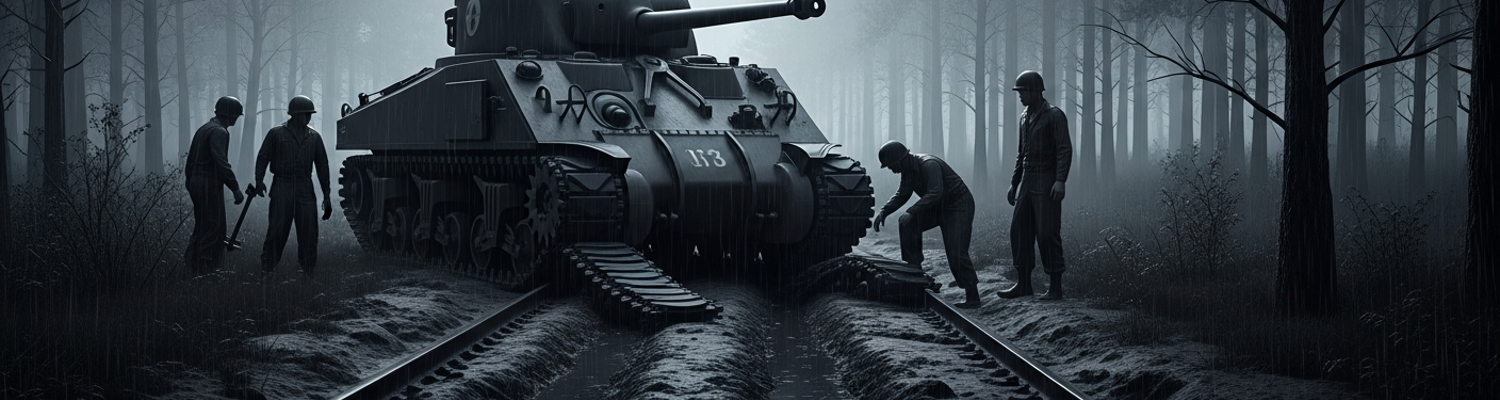
The Moselle River valley, a key geographical feature on the path to the German border, became a formidable obstacle. The torrential rains caused the river and its tributaries to swell, overflowing their banks and turning adjacent pastureland and agricultural fields into a deep quagmire. A close review of operational logs from XII and XX Corps shows repeated instances of engineering units failing to secure stable footing for pontoon bridges. Riverbanks, sodden and soft, would collapse under the weight of bridging equipment and vehicles, making crossings hazardous or impossible. The 5th Infantry Division’s attempt to establish a bridgehead at Dornot on September 8 was severely hampered when German artillery, firing from elevated positions like Fort Driant, could easily target the bogged-down American engineers. Wheeled vehicles, essential for hauling fuel, ammunition, and rations, found the rural roads nearly impassable. Even tracked vehicles struggled. The narrow tracks of the M4 Sherman, compared to the wider tracks of German Panther tanks, often proved insufficient, causing tanks to become mired and abandoned. The advance slowed from miles per day to a crawl measured in the hundreds of yards.
Nowhere was the grinding nature of this new phase of the war more apparent than in the Forêt de Parroy. This dense, 29-square-mile forest east of Lunéville became a month-long battle for the 79th Infantry Division starting on September 28. The forest was a defender’s dream: thick-boled ancient trees, dense undergrowth, and a limited network of logging trails that the rain had churned into channels of viscous mud. German defenders from the 15th Panzer Grenadier Division expertly used this terrain, adding their own mines, felled-tree roadblocks, and timber-roofed dugouts to the natural obstacles. For the soldiers of the 79th, it was a nightmarish, tree-to-tree fight in ankle-deep mud and chilling rain. A review of after-action reports indicates that vehicle losses were high, not primarily from enemy fire, but from becoming hopelessly bogged down. Tanks would throw tracks. Half-tracks would sink to their chassis. Jeeps became completely useless. The fighting was so slow and attritional that the battle for the forest lasted until late October, an engagement that consumed men and materiel for an advance of only a few miles.
Heavy Artillery's Immobility in the Mud
The tactical doctrine of the Third Army was predicated on the violent application of concentrated artillery fire. This was the force that would shatter German defenses and suppress enemy batteries before the infantry and armor moved in. In the autumn of 1944, this doctrine slammed into the physical constraints of the Lorraine terrain. The corps-level heavy artillery battalions, armed with the 155mm M1 “Long Tom” gun and the massive 240mm M1 howitzer, found their primary advantage of mobility completely negated by the weather. The Long Tom, a 15-ton weapon system, and the 240mm howitzer, weighing over 30 tons when ready for transport, were moved by large, tracked high-speed tractors like the M5. A review of after-action reports from the field artillery groups of both XII and XX Corps shows that as the rains intensified, these prime movers became liabilities. Their tracks, designed for solid ground, churned the saturated clay of Lorraine’s fields and unpaved tracks into a bottomless quagmire, losing traction and sinking the multi-ton guns into the earth. The process of emplacing or displacing a single heavy artillery battery, a task that should have taken hours, could stretch into days of desperate recovery operations with winches and heavy wreckers.
The guns were sinking.
This immobility was not limited to the heaviest pieces. It crippled the entire supply chain that fed them. The secondary and tertiary road network of northeastern France, upon which the entire logistical effort depended, effectively disintegrated under the combined assault of constant rain and heavy military traffic. These were not modern paved highways. Many were little more than dirt tracks or gravel farm roads never intended to bear the weight of thousands of 2.5-ton GMC trucks, much less armored vehicles. As the autumn rains fell, these roads dissolved. What had been a road became a channel of viscous, axle-deep mud. Archival transportation logs document a catastrophic drop in convoy speed and an increase in mechanical failure. GMC trucks, the backbone of the supply effort, were overloaded and pushed to their limits, their tires unable to find purchase in the slurry. Convoys would become hopelessly bogged down, creating miles-long traffic jams that paralyzed the movement of all supplies. A single stuck truck on a narrow, muddy road could delay an entire battalion’s supply for hours, leaving frontline units isolated.
The direct consequence of the immobilized guns and the failing road network was a severe reduction in the delivery of artillery shells to the batteries. The American way of war was ammunition-intensive. A single 155mm high-explosive shell weighed 95 pounds; a 240mm shell weighed 360 pounds. Transporting this ordnance in the required quantities was a Herculean task even in good weather. With the supply lines mired in mud, it became nearly impossible. By early September, Third Army’s artillery batteries were receiving only one-third of a unit of fire per day, a crippling restriction on their ability to support offensive operations. A review of XX Corps records shows that the ammunition shortage became so acute that they were forced to press captured German, French, and even Russian artillery pieces into service, firing thousands of rounds of captured enemy ammunition to supplement their own dwindling stocks. Planned barrages were canceled. Fire missions requested by infantry units engaged in desperate firefights were frequently denied by fire direction centers that had to hoard their few remaining rounds.
The Consequence of Stagnation on the Moselle
The order from General Omar Bradley’s 12th Army Group headquarters on September 25, 1944, was unequivocal. Third Army was to halt its general offensive and assume a defensive posture. For the spearhead formations like the 4th Armored Division of XII Corps and the infantry divisions of XX Corps encircling Metz, this was not a tactical pause. It was a full stop. A close review of operational logs indicates that armored columns, which days before had been poised to break through to the Saar River, were now restricted to using their scant fuel reserves only for local defensive maneuvers. The great advance across France was officially over. The momentum that had shattered the German Seventh Army was spent, not on the battlefield, but in a SHAEF conference room and along the clogged supply routes stretching back to Normandy.
The war of movement was replaced by a war of mud and misery.
Archival meteorological data confirms that the autumn of 1944 brought some of the worst weather northeastern France had seen in decades. Relentless, cold rain fell for days on end, turning the clay soil of Lorraine into a viscous, all-consuming quagmire. For the individual soldier, this environmental shift was a catastrophe. Men of the 5th and 90th Infantry Divisions, still wearing the same summer uniforms they had been issued in Normandy, found themselves living in waterlogged foxholes, their feet perpetually submerged in cold mud. Medical reports from the period (Record Group 112, Records of the Office of the Surgeon General) document a dramatic spike in non-battle injuries, chief among them trench foot. The condition, caused by prolonged exposure to cold, damp conditions, led to thousands of evacuations. The psychological impact was severe. The elation of the rapid pursuit across France evaporated, replaced by the grim, attritional reality of static warfare. A pervasive sense of frustration took hold, born from the knowledge that they were being held in place not by German strength, but by empty fuel tanks and a perceived indifference from high command.
This stagnation bled into every aspect of frontline existence. The supply shortages extended far beyond gasoline and artillery shells. Winter clothing was delayed. Replacement parts for worn-out vehicles were unavailable. Even basic rations became scarce, with frontline units often subsisting on cold K-rations for extended periods. A review of after-action reports from the 79th Infantry Division during the fighting in the Forêt de Parroy shows that morale was directly tied to the arrival of supply trucks carrying hot food. The inability to properly prosecute the offensive created a vicious cycle. Static American units became easy targets for German artillery, which seemed to have no shortage of ammunition. This forced American batteries to reply, expending their own severely rationed shells, which in turn required more supply trucks that were mired on impassable roads.
The strategic implications of this halt were profound and would shape the remainder of the war on the Western Front. The pause, lasting from late September through October, handed the German High Command a gift it could not have anticipated: time. A close analysis of German records shows that Army Group G, under General Johannes Blaskowitz, used this period to execute a highly effective reorganization. Shattered divisions were pulled off the line and refilled with replacements. New, hastily raised Volksgrenadier divisions were rushed to the front. Most critically, the defenses of the West Wall, which had been thinly manned and in disrepair, were re-occupied, strengthened, and prepared for a protracted defense. The failure to maintain pressure on this southern sector allowed the Wehrmacht to stabilize the front and begin covertly assembling the forces, specifically the Sixth Panzer Army, that would be used to launch the Ardennes Offensive in December.