
Yangtze Patrol Redeployment and Manila Bay Defense
Feedwater pump valves fractured inside the engine spaces of USS Mindanao as her twin triple-expansion steam engines shuddered against heavy ocean swells. Machinist mates scrambled across the vibrating steel deck plates, wrenching open bypass lines while scalding water hissed into the bilge from cracked brass valve seats. Men wrapped canvas around hot piping and swung heavy spanners to seat emergency replacement studs before boiler pressure could drop low enough to kill the vessel in open water. This flat-bottomed river gunboat was never designed for deep-sea passages, yet in December 1941, USS Mindanao completed a hasty withdrawal from the South China Patrol into Manila Bay to bolster local naval forces under the Inshore Patrol. Lieutenant Commander Alan McCracken kept his repair crews working without pause through the final miles of the crossing, determined to deliver his shallow-draft combatant intact to the Philippine defenses. Exhausted sailors finally secured the repaired pump lines just as lookouts spotted thick columns of black smoke rising over the naval stations across the water.
Smoke plumes guided the gunboat toward the Cavite Navy Yard and Manila Bay anchorages, where Japanese air raids had already destroyed critical infrastructure and forced naval assets into dispersed littoral hides. Falling bombs wrecked the machine shops, demolished the dry docks, and set shore fuel storage tanks on fire, wiping out the only facilities capable of overhauling naval vessels. Shrapnel and falling masonry crushed repair personnel on the wharves, leaving gunboats without shore support or access to replacement machinery parts. McCracken ordered his helmsmen to swing the gunboat away from the burning navy yard and maneuver into the shallow waters along the Bataan peninsula. Crewmen tied cut branches and green camouflage netting across the gun mounts and pilot house, tucking the steel hull beneath coastal cliffs and mangrove trees to escape high-altitude reconnaissance flights. These hidden anchorages offered temporary safety from overhead bombers, but they severed the ship from central workshops and left the crew dependent on whatever provisions they could secure from regional supply depots.
Depot supply officers on Corregidor and Bataan immediately shut down open distribution, sparking bitter arguments between Army base commanders and Navy ship captains over who held authority over remaining stockpiles. Under the strict strictures of War Plan Orange-3, the Asiatic Fleet placed extreme restrictions on bunker fuel and ammunition reserves for surviving surface combatants. Admiral Thomas Hart ordered primary fleet units to pull back to the south, while naval administrators in Manila hoarded remaining fuel oil and shells for submarines and evacuation craft. Army logistical clerks refused to release shared fuel drums or ammunition to naval personnel without formal vouchers signed by headquarters staff who had already abandoned their offices. McCracken sent armed working parties ashore with rowboats to track down stubborn quartermasters, demanding rations and boiler fuel for the Inshore Patrol before the retreating Army set fire to uncollected supply dumps. Gunboat officers signed emergency receipts under protest, loaded three-inch shells and fuel drums onto open wooden barges by hand, and ferried the supplies back to their camouflaged moorings along the shoreline.
Logistics Disputes and Fuel Rationing
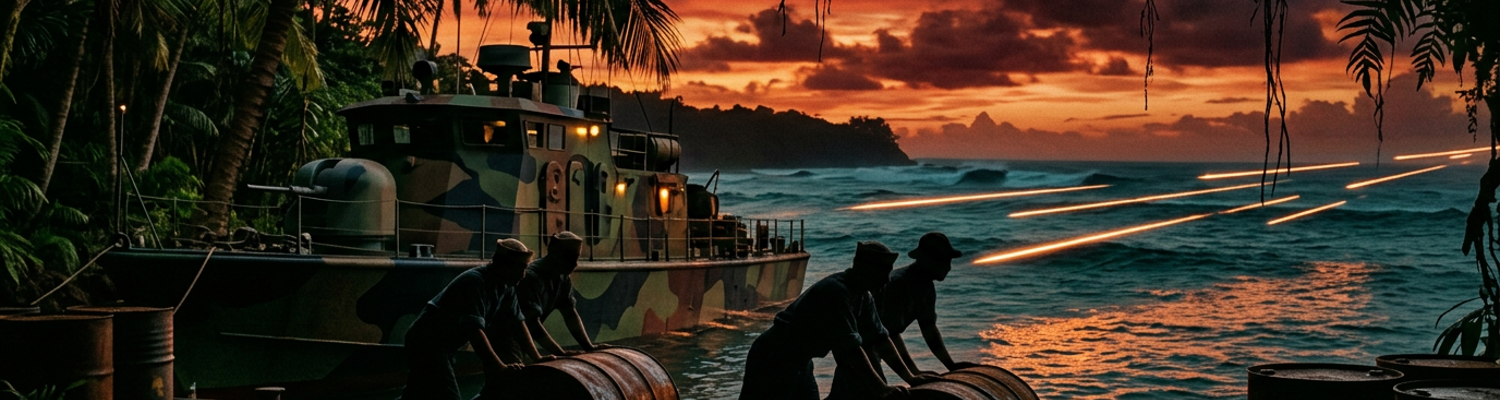
Sailors rolled the heavy steel fuel drums across the wet deck plates of Mindanao, but this hand-carried haul barely filled a fraction of the empty bunker tanks. Operational command friction escalated between USAFFE headquarters and the 16th Naval District over fuel prioritization and defensive vessel assignments. Army staff officers inside the Malinta Tunnel on Corregidor claimed supreme authority over every gallon of petroleum remaining around the bay, insisting that shore defenses took priority over naval maneuvers. Naval leaders from the 16th Naval District argued that starving the Inshore Patrol left the minefield channels unguarded and allowed Japanese landing craft to slip past the fortress at night. Army planners dismissed these warnings and demanded that the Navy hand over gunboats for static beach defense batteries, creating bitter arguments over who held operational control of the surviving vessels. Lieutenant Commander McCracken watched his boiler fires die down to a dull simmer as headquarters clerks argued over requisition vouchers instead of clearing his ship for combat patrols.
Quartermasters on Bataan enforced these paperwork disputes by locking shoreline fuel valves and posting armed military police over the remaining fuel dumps. Army authorities restricted bunker oil access for Inshore Patrol gunboats to preserve supplies for land defense and static generator networks on Bataan. Field commanders insisted that every available barrel of fuel was needed to power underground surgery rooms, water filtration plants, and command radios buried in the jungle hills. These static generator networks consumed hundreds of gallons of oil daily, leaving the naval vessels with only small allotments of low-grade petroleum that clogged burner tips and produced thick soot. Black gang sailors on Mindanao scraped heavy carbon deposits out of cold fireboxes by hand because this sludge fouled the draft blowers and choked the boilers. Dense smoke from the dirty fuel betrayed the shoreline hideaways to enemy spotter planes, forcing McCracken to extinguish his burners entirely during daylight hours.
Boilers remained cold, imposing acute operational limitations as administrative squabbles delayed necessary repairs and vital defensive sorties across the bay. Worn engine bearings and fractured steam joints remained unfixed because Army depot managers refused to release copper tubing, packing grease, and replacement gaskets without written approvals from naval district staff. Repair machinists sat idle in the engine spaces while administrative officers in two separate headquarters debated over which service held financial responsibility for parts salvaged from sunken civilian freighters. Corroded bilge piping leaked oily water into the hull, yet maintenance crews could not obtain welding rods or cutting torches without personal intervention from senior naval commanders. These persistent maintenance delays kept the gunboat tied to coastal trees for days at a time, preventing her shallow-draft hull from supporting frontline troops along the southern beaches.
Lookouts on Mindanao tracked enemy troop movements along the Cavite coast that the three-inch guns could have broken up, but shortages of steam kept the ship anchored in place. Orders from USAFFE to escort unarmed supply barges to front lines arrived hours late, caught in communication bottlenecks between Army radio operators and Navy signalmen. Japanese dive bombers attacked two supply boats in plain sight of the crew while officers waited for fuel vouchers to clear through regional headquarters. McCracken finally received permission to light off his boilers after midnight, but he had to navigate without escort and ration his bunker fuel to five knots. Helmsmen guided the sluggish gunboat out into the dark waters of the bay, steering clear of defensive minefields while engineers watched the fuel gauges drop toward empty.
Gunboat Combat Sorties Under Lieutenant David Nash
Engineers monitored the dropping fuel gauges as Lieutenant David Nash throttled the steam valves down to dead slow on the flying bridge, conserving the remaining bunker fuel as USS Mindanao slipped into the shallow shoals off southern Bataan. Standing beside the forward optical rangefinder, the executive officer directed shallow water gunnery actions against Japanese positions encroaching along the shoreline. Sharp-eyed lookouts spotted motorized landing barges attempting to ferry enemy infantry across coastal inlets under the cover of darkness. Gun crews rapidly cranked the manual training wheels of the forward three-inch guns, slamming high explosive rounds into the wooden hulls of the landing craft while machine gunners swept the water with sustained automatic fire. Heavy shrapnel from concealed Japanese shore batteries burst against the thin steel side plates of the gunboat in return, forcing Nash to maneuver his flat-bottomed vessel through narrow channels between sandbars to throw off the enemy artillery spotters.
Artillery flashes from those hidden enemy howitzers guided Nash into relentless night counter-battery harassment missions along the rugged Bataan shoreline. Gun crews loaded timed single gun salvos into the three-inch weapons and fired into Japanese staging positions concealed beneath the jungle canopy, systematically suppressing enemy troop concentrations before they could mount ground assaults against American beach defenses. Severe ammunition caps imposed by regional commanders limited the warship to only a few dozen shells per patrol, forcing Nash to sign strict accounting sheets between firing runs and order gun captains to shoot only at confirmed targets. Loaders swabbed the smoking gun breeches with wet burlap between rounds and stacked the spent brass casings on the deck plates for salvage, ensuring that not a single piece of ordnance was wasted under the strict rationing orders. These suppressed Japanese staging positions fell silent after each naval bombardment, giving frontline infantry units on land brief windows of quiet to reinforce their foxholes without facing heavy artillery barrages.
Infantry units in those reinforced foxholes relied on Army coastal spotting batteries positioned on the cliff tops above them, but tactical coordination between Mindanao and the shore observers was routinely undermined by radio incompatibility and inter-service command rivalry. Radio operators inside the cramped radio shack discovered that Navy receivers could not tune to the specific frequency bands used by Army field sets without specialized quartz crystals that were impossible to obtain in the besieged bay. Signalmen scrambled onto the deck with hooded blinker lamps and hand-held semaphore flags to transmit target coordinates, but organizational friction between military branches created obstacles that visual signals could not overcome. Army artillery officers insisted on treating the naval vessel as a subordinate offshore battery that had to await clearance from land-based headquarters before firing, while naval commanders refused to surrender their tactical authority to Army staff who were unfamiliar with naval firing arcs and shifting tidal currents. Conflicting map coordinates and delayed clearances repeatedly stalled planned bombardments, leaving several identified Japanese troop columns completely unmolested while officers on both sides argued over message logs. Nash bypassed the stalled radio network entirely, brought his guns to bear using his own visual corrections against the shoreline, and ordered his gunners to engage the next wave of targets on his own direct authority.
Night Rescue Sorties Across Boca Chica Channel
Muzzle flashes from the independent bombardments directed by Nash illuminated the smoking shoreline and bought brief reprieves for American and Filipino battalions collapsing toward the beaches of Cabcaben. Army headquarters on Corregidor suddenly diverted the gunboat from shore bombardment to urgent rescue duty, demanding that Lieutenant Commander Alan McCracken bring his vessel across the two-mile Boca Chica channel to pull troops out before Japanese infantry overran the docks. Mindanao conducted dangerous evacuation runs through the Boca Chica channel to extract retreating military personnel and nurses from Cabcaben to Corregidor, packing hundreds of wounded soldiers and staff into her cramped mess compartments and open deck spaces. Panicked shore quartermasters and Army staff officers on the pier argued with naval beach parties over boarding manifests and priority lists, refusing at first to release Army nurses and medical equipment until naval ensigns took charge of the gangways to hasten loading. Sailors hauled exhausted Army nurses over the low steel gunwales by their field jackets while soldiers threw discarded rifles and field gear onto the decks to clear space for stretcher cases. Engineers kept the steam engines turning just fast enough to hold the flat-bottomed hull against the wooden pilings while mortar fragments struck the harbor water around them.
Mortar fragments tore through the canvas awnings and struck the armored bridge shields as McCracken rang for flank speed to break away from the blazing Cabcaben waterfront. Sorties were executed under artillery barrages and frequent air attack while maneuvering through defensive naval minefields and burning harbor debris. Japanese twin-engine bombers and Aichi dive bombers dropped high explosive ordnance across the crossing lanes, while heavy Japanese siege guns emplaced on the Bataan heights adjusted artillery brackets along the channel. Helmsmen spun the brass steering wheel back and forth to dodge burning wooden lighters and floating timber, following narrow navigational paths through the controlled contact minefields laid across the bay entrance. Army coastal artillerymen stationed on Corregidor controlled the secret electrically fired mine arrays and occasionally aimed searchlights across the water without warning, temporarily blinding the lookouts and sparking fierce radio arguments between shipboard signalmen and shore battery commanders. Gunners on the three-inch mounts and antiaircraft machine guns fired continuous tracer bursts into the low clouds to drive off strafing planes until the vessel bumped against the concrete quays of Corregidor to disembark her passengers.
Passengers stumbled off the gangways onto the Corregidor docks while the boilers consumed the final reserves of usable fuel oil. Severe fuel exhaustion by late March and early April 1942 confined the gunboat to static perimeter defense and short-range intercept missions. Army logistics officers inside the Malinta Tunnel hoarded the final underground fuel reservoirs for fortress power generators and diesel trucks, flatly refusing repeated written requests from McCracken for bunker oil top-offs. Machinist mates measured the bunker soundings with weighted steel tapes and found only a few inches of dirty sludge remaining at the bottom of the fuel tanks, forcing the command staff to shut down all long-distance patrols across the bay. McCracken anchored the warship near the eastern cliffs of Corregidor, using her three-inch guns as an anchored floating battery to guard the inner harbor approaches against night infiltrations by enemy landing barges. Sailors rigged wire camouflage netting over the superstructure and stood watch by the manual training wheels, preserving their last gallons of fuel oil solely for short dashes to intercept Japanese reconnaissance boats that ventured within range of the fortress batteries.
Scuttling at Fort Mills and Corregidor Infantry Action
Gunners tracked incoming Japanese air formations across the eastern sky on 2 May 1942, rapidly spinning the manual elevation wheels to direct their three-inch guns against the diving planes. Loaders fed the final ready service racks into the smoking breeches until the ammunition lockers sat entirely empty, leaving the warship defenseless against subsequent raids. Officers recognized that the fuel-starved vessel was trapped in plain view of enemy shore batteries, so on 2 May 1942, after depleting remaining ammunition against incoming Japanese air formations, Mindanao was scuttled off Fort Mills to prevent capture. Machinist mates descended into the sweltering bilge spaces, opened the sea cocks with heavy wrenches, and detonated demolition charges to tear through the bottom hull plates. Saltwater surged into the engine compartments and drowned the dead boilers, dragging the gunboat beneath the harbor surface as the crew pulled away in utility boats toward the bomb-cratered docks of Corregidor.
Boats bumped alongside the splintered pilings of the Corregidor docks, where Lieutenant David Nash immediately ordered the displaced gunboat sailors to salvage small arms, ammunition belts, and medical kits from the boats before securing the waterfront. Army logistical officers inside the Malinta Tunnel headquarters immediately challenged the presence of the naval personnel, arguing that fleet sailors without ground combat training would drain scarce rations and refusing at first to distribute infantry helmets or web gear. Marine commanders from the Fourth Marine Regiment clashed with Army staff over these administrative delays, insisting that every armed sailor was desperately needed to fill gaps in the crumbling beach defense perimeter. Lieutenant David Nash and the displaced naval crew salvaged small arms and were integrated into ad-hoc provisional infantry and coastal mortar crews across the island to bypass the bureaucratic deadlock. Gunboat crewmen strapped on salvaged gear, hoisted heavy mortar baseplates onto their shoulders, and climbed through bomb-shattered ravines to establish defensive positions along the rocky ridges of the island.
Sailors anchored the steel mortar baseplates into the dry volcanic soil, only to encounter immediate communication breakdowns between Army fire control centers and frontline Marine sectors. Army battery directors utilized landline telephone networks that were repeatedly cut by incoming artillery, while the former sailors lacked training in Army grid systems and possessed no compatible field radios to call for support. Marine platoon leaders on the bluffs bypassed the severed phone wires by sending runners on foot, relaying direct target coordinates to the sailors manning the coastal mortar pits. Gunboat crewmen rapidly adjusted the manual traverse screws and dropped sixty-millimeter and eighty-one-millimeter mortar shells down the tubes, hurling defensive barrages into the ravines where Japanese reconnaissance parties probed the American lines. Shrapnel from heavy Japanese siege guns emplaced across the channel on Bataan battered the exposed mortar pits in return, forcing sailors and soldiers to drop their tools and dig out wounded comrades from collapsed trenches.
Trenches collapsed under that relentless artillery barrage on the night of 5 May 1942 as barges carried Japanese assault troops onto the eastern beaches, driving enemy platoons through the outer wire barriers toward Malinta Tunnel. Bureaucratic divisions between service branches vanished under the immediate pressure of the assault as naval sailors grabbed rifles and ammunition belts to reinforce collapsing frontline positions. The gunboat sailors fought alongside Marine and Army personnel in the final defense of Corregidor until the fortress fell on 6 May 1942. Sailors stood alongside Fourth Marine riflemen and Army coast artillerymen behind shattered concrete parapets, firing continuous rifle volleys at advancing enemy squads and using bayonets to clear jammed rifle breeches. Heavy Japanese tank fire and concentrated machine gun sweeps eventually overwhelmed the final defensive pockets around the tunnel entrance, forcing the surviving sailors, soldiers, and Marines to smash their weapon breeches and surrender the fortress ruins.