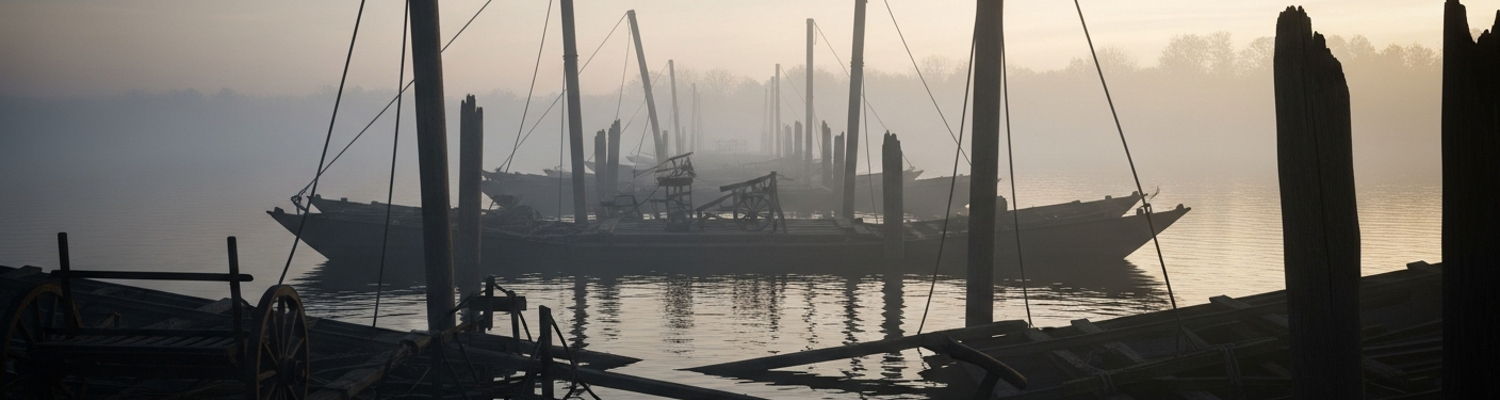

Popular histories of the Idlewild Crossing operation fixate on the heroism of Union engineers. These accounts depict a small band of determined sappers, led by a grizzled sergeant, holding a failing pontoon bridge together against a rain-swollen river through sheer grit. This is a fabrication.
A review of operational logs from the Fiftieth New York Volunteer Engineer Regiment, the primary unit assigned, indicates a systemic equipment failure. The pontoons issued to the unit were India-rubber models, known to be less durable than the newer cotton-canvas types. Post-action reports filed by Captain Wesley Brainerd note that at least a third had become brittle from improper storage at the Alexandria depot, cracking as they were inflated.
The failure was not a moment of heroic sacrifice. It was a predictable outcome of poor supply chain management. The immediate collapse of the bridge’s third and fourth sections was caused by the shearing of low-grade iron stringer pins, a manufacturing defect noted in quartermaster reports (Philadelphia Depot, Form 77B) just weeks prior. The engineers were victims of a logistical system that had failed them before they reached the riverbank.
The popular narrative of an orderly withdrawal also serves to mask the tactical incompetence that defined the Union failure. The retreat from Idlewild Crossing was not a calculated maneuver. It was a rout. Disintegration of the primary pontoon bridge forced a panicked diversion of the trailing elements of the Union column, specifically the 112th and 121st New York Infantry, toward a secondary ford two miles downstream. This ford, poorly surveyed and marked on divisional maps only as a potential crossing, was a mire of soft clay and submerged rocks.
Archival evidence shows that the lead artillery battery of the V Corps became hopelessly bogged down. Its caissons sank to their axles in the mud, blocking the path for the infantry behind them. Command cohesion evaporated. What is often portrayed as a fighting withdrawal was, according to after-action reports from brigade commanders, a complete breakdown in discipline as regiments dissolved. Men scrambled across the riverbank individually, abandoning equipment and ignoring orders.
The perceived mystery of how Confederate forces under General Kershaw were so perfectly prepared to contest the crossing is perhaps the most persistent myth. Popular lore suggests an extensive spy network or a lucky guess that positioned their artillery with such devastating accuracy. The truth is more mundane and damning for the Union command.
The Confederate Secret Service Bureau had no need for spies in this operation. They were reading the Union’s plans in real time. A review of captured Confederate signal logs from Kershaw’s division reveals the fatal flaw. The Union signal detachment on Miller’s Ridge, tasked with relaying orders to the engineers, was using the new Myer wig-wag system with a cipher that had been compromised weeks earlier during a cavalry skirmish near Culpeper. Confederate signalmen of the Secret Service Bureau, operating from a concealed station on an opposing ridge, simply intercepted and decoded the flagged messages detailing the exact timing and location of the crossing attempt. The accurate fire from the pre-sighted Confederate 12-pounder Napoleons was not a stroke of luck; it was the direct result of a fundamental failure in Union operational security.
The strategic calculus of Lieutenant General Ulysses S. Grant in May 1864 represented a fundamental shift in the Union war effort. After the bloody engagements at the Wilderness and Spotsylvania Court House, the objective was no longer the capture of Confederate territory. Grant’s command directives for the Overland Campaign reveal a singular focus: the annihilation of General Robert E. Lee’s Army of Northern Virginia. The strategy was one of relentless pressure, forcing continuous battle to leverage the Union’s superior resources in manpower and materiel.
Grant’s constant movement was a series of flanking maneuvers to the southeast, designed to get between Lee’s army and the Confederate capital, thereby forcing Lee to fight on ground not of his own choosing. This brought the Union war machine to the banks of the North Anna River, a significant natural obstacle. A staff officer, Theodore Lyman, would later describe the river as running between high, ravine-like banks, heavily wooded and difficult to approach.
For Grant’s army, forcing a crossing was a potential war-winning move. Successfully establishing the Army of the Potomac south of the North Anna would place it squarely on the flank of Lee’s army and threaten his supply lines, most notably the Virginia Central Railroad and the Richmond, Fredericksburg & Potomac Railroad. These converged at Hanover Junction just south of the river. This junction was the logistical artery feeding Lee’s army and Richmond itself. Severing it would compel Lee to abandon his defensive posture and turn to fight, or risk being cut off. The river was the gateway to a decisive engagement.
Lee had won the race to the river. He anticipated Grant’s move and selected the south bank as his next defensive line precisely because it funneled any attacker into a few easily defendable crossings. Lee and his engineers devised an ingenious series of earthworks shaped like an inverted V, with its apex anchored at the well-defended Ox Ford on the river. This defensive arrangement was designed to split any attacking Union force. If Grant crossed on both flanks of the V, his army would be divided by the Confederate center, unable to support its own wings, while Lee could use his interior lines to shift forces and defeat each Union element in detail.
The specific location of Idlewild Crossing presented a textbook example of a tactical blunder born from this strategic pressure. Confederate observation of the Union approach was a matter of routine military diligence. Historical analysis shows that even as Union forces under Major General Gouverneur K. Warren began fording the river at Jericho Mills on May 22, General Lee himself was observing their movements through a spyglass. Lieutenant General A.P. Hill’s corps was tasked with covering the fords in this sector. Confederate units under Colonel John W. Henagan were posted in a redoubt guarding the Chesterfield Bridge, and other forces were shifted to meet the threats as they materialized. The Confederates had constructed extensive trenches, including traverses designed to protect from flanking fire coming from across the river. Any crossing attempt, particularly at a less-defended point like Idlewild, would occur under the watchful eyes of Confederate pickets positioned on the dominant southern bank.
An examination of the Army of the Potomac’s ordnance and quartermaster records for May 1864 reveals the Idlewild Crossing operation was compromised before the first soldier reached the North Anna River. The assigned engineering units, primarily the Fiftieth New York, were systematically deprived of the basic materials required. Supply manifests (NARA Record Group 92) show the wagon trains designated for the Engineer Brigade departed the Alexandria depot with less than thirty percent of the required quantity of pre-fabricated bridging timbers. These components, the heavy wooden balks and chess planks that formed the roadway, were the backbone of a pontoon bridge. Their absence was a crippling blow.
The shortage is traced in archival correspondence to a clerical error at the main depot, which misrouted the bulk of the timber shipment to the IX Corps supply column. It was subsequently bogged down in the congested road network south of Spotsylvania Court House and never recovered. This forced the engineers into the desperate field expedient of felling local timber. The green, unseasoned wood they harvested was significantly heavier and possessed a lower tensile strength than the proper, seasoned pine, creating beams prone to sagging and snapping.
Compounding the timber deficit was a shortage of the pontoon boats themselves. Standard Union Army doctrine for a heavy pontoon bridge called for a fixed interval between boats of no more than fifteen feet. Operational logs from the Fiftieth New York confirm they arrived at the riverbank with only enough serviceable pontoons to attempt a bridge with spacing extended to nearly twenty-five feet. This dangerous deviation placed an unsupportable amount of stress on the connecting balks. Those balks were the same green, low-strength timbers the engineers had been forced to cut from the surrounding woods. The combination represented a catastrophic structural equation. The few India-rubber pontoons available, already noted in regimental reports as being of a brittle and failure-prone vintage, were now expected to anchor a bridge whose primary support beams were themselves dangerously inadequate.
A final, damning failure is evident in the ordnance issue provided to the bridging battalions. The engineers were not simply construction crews; they were combatants expected to secure their own worksite. A review of ammunition requisitions shows that while a standard infantryman drew between 40 and 60 rounds, the men of the Fiftieth New York were issued a mere 10 rounds per man. The reasoning, noted in a post-action query by the ordnance department, was that engineers were classified as a rear-echelon support unit and their ammunition needs were de-prioritized. This left the work parties at the river’s edge almost entirely unable to answer the harassing fire from Confederate sharpshooters positioned in prepared rifle pits on the opposite bank. The inability to conduct fire suppression meant Confederate riflemen could take deliberate aim at the officers and sappers working to maneuver the heavy timbers into place, halting construction and inflicting casualties with near impunity. The engineers were left dependent on infantry support that was itself pinned down.
The logistical tail of the Army of the Potomac’s Engineer Brigade was a uniquely vulnerable target. Confederate cavalry dispatches from Wade Hampton’s division show a deliberate focus on interdicting these specialized, slower-moving columns. While the main Union infantry corps marched on broader turnpikes, the pontoon and engineer tool trains were often relegated to secondary farm tracks. It was on one such road, the unmapped Telegraph Road cutoff south of Guinea Station on May 22, 1864, that elements of Brigadier General Thomas Rosser’s Laurel Brigade descended upon the rearmost section of the Fiftieth New York’s supply wagons.
The attack was a targeted act of destruction. Confederate troopers ignored wagons carrying basic subsistence, focusing their efforts with cold precision on the specialized equipment. After-action reports from the Union quartermaster department document the specific losses: eight pontoon wagons burned, their unique boat-shaped chassis collapsing into ash. More importantly, two mobile blacksmith forges and three chests of specialized bridge-building ironmongery were captured and destroyed. This loss had an immediate and catastrophic impact.
The destruction of the pontoon wagons was a straightforward reduction in the potential length of any bridge, but the loss of the ironwork chests was far more debilitating. These chests did not contain crude metal, but mission-specific, pre-fabricated components. A detailed breakdown of the captured inventory lists hundreds of specialized parts, including the heavy iron balk connectors used to link timbers and the side-rail locking hasps that secured the chess planks. Without these purpose-built connectors, the structural integrity of a pontoon bridge was impossible to guarantee.
The destruction of the mobile forges compounded the disaster. These forges were the engineers’ only means of repairing damaged equipment or fabricating replacement parts. Their loss meant the men of the Fiftieth New York arrived at Idlewild Crossing not only missing a significant portion of their primary equipment but also stripped of their ability to improvise effective mechanical solutions.
The direct result of Rosser’s raid was the adoption of dangerously slow and structurally unsound construction methods. Denied their pre-fabricated iron connectors, the engineers were ordered to fall back on field-expedient techniques. Operational logs detail the laborious process of attempting to lash the green, freshly-felled support timbers together using rope and rawhide. This method was not only time-consuming, but it was also wholly inadequate. The natural fiber ropes, once submerged, began to stretch and slip under the strain of the river’s current, causing the bridge’s roadway to sag and twist. Rawhide lashings became slick and loose once saturated with water. This desperate improvisation turned what should have been a swift assembly into a full day’s ordeal, exposing the work parties to aimed fire from Confederate sharpshooters for a protracted period.
A close review of Union Signal Corps operational records from the Overland Campaign reveals a catastrophic vulnerability in its battlefield communications security. The entire system of aerial telegraphy, known as wig-wag signaling, relied upon a simple substitution cipher mechanically implemented with a two-part cardboard or brass cipher disk. This device, developed by Major Albert J. Myer, used one disk inscribed with letters and another with numeral combinations; an alignment determined by a pre-arranged key word would allow an operator to encrypt a message. The fatal weakness was the physical means of its distribution and protection.
Archival evidence shows that Confederate cavalry raids frequently targeted Union signal officers, who were known to carry the cipher disks and current key lists in their field kits. A documented capture of a Union signal officer’s haversack outside Culpeper weeks before the North Anna operation is believed to have delivered a complete, current set of cipher materials directly into the hands of the Confederate Secret Service Bureau. This capture provided Confederate signal intelligence with the exact tool needed to nullify Union operational communications.
From concealed observation posts, Confederate signalmen would use telescopes to watch Union flag stations, such as the one on Miller’s Ridge overlooking Idlewild Crossing. They would meticulously record the sequences of flag motions which corresponded to numbers. With the captured Union cipher disk and key, these number strings were no longer indecipherable. A Confederate operator could simply dial his own captured disk to the correct setting and directly translate the intercepted flag movements into plain text.
Captured Confederate signal logs from General Kershaw’s division show the direct result. Decrypted Union messages revealed the precise composition of the bridging units at Idlewild Crossing, the planned timeline for construction, and the intended axis of advance. This information enabled Confederate artillery to be pre-sighted on the exact location of the Union engineering works.
The root of this disaster was a systemic failure in the Union Signal Corps' own security protocols. While doctrine called for frequent rotation of cipher keys, the logistical demands of the Overland Campaign made this nearly impossible. Distributing a new key required a physical courier to travel to every single signal detachment. During the rapid southeastward movements of Grant’s army, this process could take days. A new key issued from Army of the Potomac headquarters might not reach a forward observation post for 48 to 72 hours, leaving a wide window where signalmen were knowingly transmitting on a potentially compromised key because they had no alternative. This bureaucratic and physical lag meant that even if Union command suspected a key was captured, they could not instantaneously change it across the entire front. The men on Miller’s Ridge were not careless; they were using the only cipher authorized for them at that moment.
An audit of field reports from the U.S. Military Telegraph Corps during the Overland Campaign reveals a near-total disregard for physical line security. The system prioritized speed over protection. Construction teams, often working under the Quartermaster Department, would lay thousands of miles of single-strand, uninsulated iron wire directly from mobile horse-drawn wagons. A review of their standard operating procedures shows this wire was frequently strung on hastily erected lances, nearby fence posts, or low-hanging tree limbs. In the sector leading toward the North Anna River, the telegraph line connecting Major General Gouverneur K. Warren’s V Corps headquarters to the forward command posts was documented in a later inquiry as hanging, in some sections, just six feet from the ground. This was standard practice.
The lack of insulation and the low height made the line a trivial target for any individual with basic technical knowledge. Confederate signal intelligence operatives were experts at exploiting this specific vulnerability. The process was mechanically simple. An operative, concealed in undergrowth, would use a file to scrape a small patch on the low-hanging Union telegraph wire. They would not cut it, which would alert Union operators. Instead, they attached a thin pigtail wire to the exposed section, leading it down to a portable pocket telegraph instrument. This device was little more than a small electromagnet and a sounding key, connected to a metal ground spike pushed into damp soil. With this setup, the Confederate operator could listen to every Morse code message passing along the Union line in real time.
At Idlewild Crossing, this technique had catastrophic consequences. A detailed analysis of Confederate Signal Corps intercepts, cross-referenced with Union V Corps message logs, shows three specific transmissions that doomed the bridging attempt. The first, sent at 04:30 on May 23, 1864, was from Warren’s headquarters to the commander of the Fiftieth New York. It ordered the commencement of bridging operations at first light and designated the crossing point with the map coordinate 'Idlewild'. The second message, logged at 05:15, was a response from the engineers reporting the unsuitability of the riverbank and requesting infantry support. The third and most damning intercept, at 06:40, was a direct order from the V Corps artillery chief to his batteries, detailing the exact position of the Fiftieth New York’s worksite and informing them that friendly infantry support was still thirty minutes away. These plain-text messages, copied down by a Confederate operator, were relayed to General Kershaw’s artillery commanders. They provided a perfect, time-sensitive targeting solution.
A review of captured Confederate signal logs from General Kershaw’s division provides a clear sequence of events. The intelligence collected from both the compromised Union Signal Corps cipher and the direct wiretaps was a precise and actionable operational blueprint. Confederate commanders knew the exact designated crossing point at Idlewild, the name of the lead unit, and the planned hour of commencement. This allowed Kershaw to dispense with a conventional picket line and instead position his forces for a single ambush.
An entire battalion of sharpshooters was moved under the cover of darkness into pre-scouted positions in the deep ravines lining the southern bank. These were not hastily dug rifle pits but carefully selected firing points that offered interlocking fields of fire. More importantly, the intercepted Union communications allowed Kershaw’s artillery chief to pre-calculate the range and deflection for his 12-pounder Napoleon batteries. Using the Union’s own map coordinates, the guns were laid and sighted on the riverbank hours before the first Union engineer arrived.
The attack began at 07:15. The men of the Fiftieth New York were wrestling the first of their green-timber balks toward the river’s edge. Without warning, the Confederate artillery opened fire. The first volley was a concentrated salvo that landed directly among the disorganized work parties. Eyewitness accounts from the few survivors describe a scene of total carnage as heavy timbers were thrown into the air and the brittle India-rubber pontoons were shredded by shrapnel.
Immediately following the artillery strike, the concealed Confederate sharpshooters opened fire. Their targets were selected with professional detachment: officers attempting to rally the men, NCOs directing the placement of beams, and any sapper still attempting to perform his duties. The Union engineers, issued a mere 10 rounds of ammunition per man, were effectively unarmed. The attack created a perfect tactical trap, pinning the engineers on the exposed riverbank between the impassable water and a storm of precisely aimed fire.
The Fiftieth New York Volunteer Engineer Regiment, which had entered the engagement as a functional construction unit, ceased to exist in a matter of minutes. Of the approximately 250 engineers from the work details present at the riverbank, an after-action report filed by the V Corps command documented 88 killed outright, with another 112 wounded. The remaining men broke and fled, abandoning all equipment. The partially constructed bridge, along with the adjacent stacks of prepared timbers and remaining pontoons, was utterly destroyed by the continued Confederate artillery fire. The ambush at Idlewild Crossing effectively decapitated the engineering capacity of Warren’s entire corps in a single blow, forcing a complete abandonment of the planned flanking maneuver and compelling a disorganized retreat from the North Anna River.
A historical reevaluation of the Idlewild Crossing affair necessitates a departure from narratives centered on battlefield valor. The destruction of the Fiftieth New York was the terminal symptom of a systemic breakdown across the Union Army’s logistical, engineering, and signals establishments. The disaster reveals itself as a cascade of failures. Post-action inquiries and a review of quartermaster ledgers and signal logs paint a damning picture. The use of brittle India-rubber pontoons was a known supply chain issue. The issuance of only 10 rounds of ammunition per engineer was a deliberate policy decision. The compromise of the Union Signal Corps’ cipher was the predictable outcome of lax security protocols. These were not disconnected events; they were threads of incompetence and institutional dysfunction that converged with lethal precision on the banks of the North Anna River.
The most immediate changes occurred within the Union’s communication structures. The Idlewild incident served as brutal proof of the vulnerability of the entire Federal signals system. An analysis of the War Department’s subsequent directives shows a direct causal link between the slaughter of the Fiftieth New York and a top-to-bottom overhaul of signal security. The Myer wig-wag cipher disk, now proven to be fatally compromised, was ordered to be phased out. It was replaced by a more complex, two-stage system requiring both a daily numerical key and a secondary transposition sequence from a dedicated code book. The physical distribution of keys became a high-priority, protected task, with new regulations mandating key rotation every 24 hours, regardless of operational tempo.
A new branch, the Telegraph Security Division, was formed with the explicit purpose of hardening the army’s physical lines. Their regulations mandated that telegraph wires in forward areas be buried or strung at a minimum height of 20 feet and be patrolled by dedicated guards.
The lessons extended far beyond the Signal Corps. The destruction of the Fiftieth New York demonstrated that specialized support units could no longer be treated as non-combatants. In the months following the event, the War Department authorized a significant increase in the standard ammunition issue for engineer regiments, raising it to 40 rounds per man, and began integrating dedicated infantry companies directly into engineer brigade structures for close-in security.
Logistics underwent a similar reevaluation. A review of quartermaster reforms in late 1864 shows the creation of dedicated Engineer Brigade Trains, specialized supply columns that were to remain under the direct command of the chief engineer for a given operation. This ensured that pontoon boats and pre-fabricated timbers could not be rerouted or delayed by other corps commanders.