
IX Troop Carrier Command Headquarters Operations
Two thousand four hundred and seventy-four airframes crossed the Rhine on March 24, 1945.
They carried seventeen thousand combat troops into German territory.
The manifest listed ten thousand pounds of high explosives, six hundred drums of aviation fuel, and thirty-two tons of combat rations. Crates of M18 smoke grenades sat stacked alongside pack howitzers in the unpressurized bellies of C-47 Skytrains and C-46 Commandos. Archival evidence shows this assemblage of kinetic hardware took off across northern France and southern England to assault the final German perimeter guarding the Ruhr industrial corridor.
The sky cleared by midday.
The ground remained saturated with burning aluminum.
When examining the historical record, the physical accounting fell directly to the Women's Army Corps detachment stationed inside the IX Troop Carrier Command forward headquarters tents at Saint-André-de-l'Eure. Working in the immediate aftermath of Operation Varsity, these female administrative specialists documented the systemic destruction of tactical airlift elements assigned to the 313th Troop Carrier Group. The newly introduced Curtiss-Wright C-46A Commando operated without self-sealing fuel tanks. It suffered heavy damage under concentrated fire from German 20mm and 37mm anti-aircraft batteries positioned around Drop Zone X.
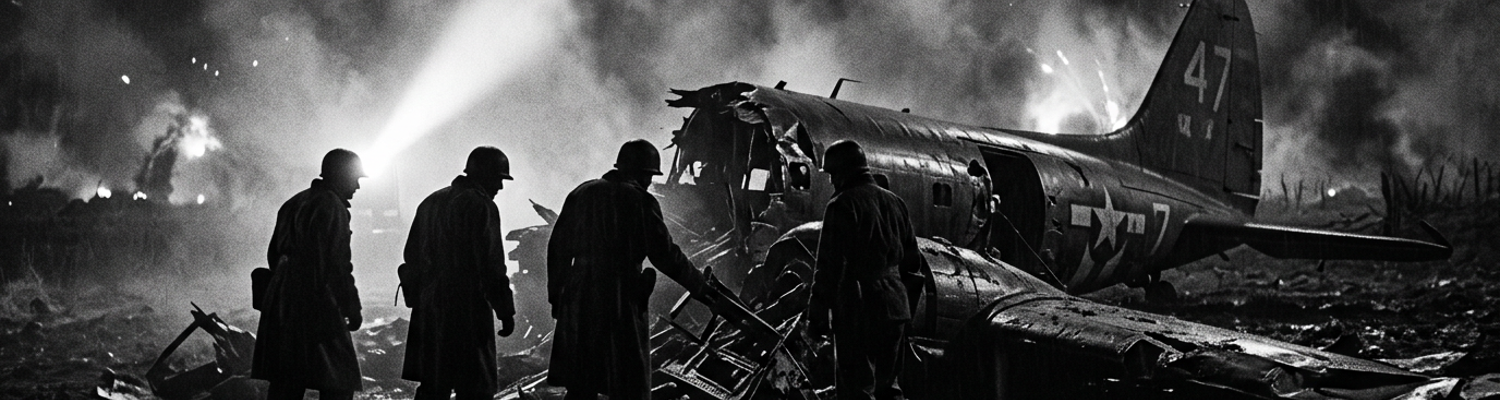
Nineteen out of seventy-two C-46 transports burned in the air within twenty minutes of crossing the riverbank.
Dozens of aircrews and paratroopers died before stick exits could occur.
Dispatch couriers and scrambler telephone lines fed fragmented casualty counts from forward recovery strips into the headquarters. WAC personnel converted broken engine serials and airframe serials into empirical casualty ledgers. They tracked the physical consumption of an entire transport fleet. Logistics clerks sat at bare folding tables under the hiss of sputtering carbon-arc lanterns. They fought heavy drafting draughts and thick blue-white ozone haze to process incoming field tallies. The carbon rods burned unevenly. They cast oscillating shadows across carbon-paper forms, flight surgical files, and field hospital intake sheets forwarded from stations near Châteaudun.
A close review of operational logs indicates the clerks prioritized incoming medical evacuation logs.
These documents recorded severe burns, traumatic amputations, and blast injuries sustained by aircrews struck by high-velocity fragmentation while flying at altitudes below five hundred feet. Each handwritten triage tag forwarded from forward airstrip casualty staging clearing stations was matched against the central missing personnel rosters. Clerks mechanically separated returned pilots from dead co-pilots. They used manual steel typewriters to transcribe messy field tags onto standard War Department punch cards before the cold could seize their fingers. Clerical officers cross-referenced grease-penciled radio logs against initial airfield departure manifests to identify missing transport crews.
Flight clearance sheets recorded the precise aircraft tail numbers, pilot rosters, and chalk assignments for each serial.
As operations expanded over the drop zones, tactical air controllers scribbled incoming distress transmissions onto vertical acetate plotting boards using red and green chinagraph grease pencils. The clerical officers inspected these raw radio notations. They isolated emergency frequency distress breaks on 116.1 megacycles where pilots reported starboard engine fires or hydraulic control failures over the Diersfordter Wald. By comparing the departure manifests line by line with the last recorded radio bearings and emergency bail-out coordinates, the officers established which aircrews had crashed inside enemy-held territory along the Issel canal.
At dawn, tail number 44-77512 lacked a confirmed disposition on the master chart.
Operational Deployment of Curtiss C-46 Commandos
Seventy-two transport planes crossed the English Channel to test a new doctrine of rapid airborne delivery under daylight conditions.
Archival evidence shows the 313th Troop Carrier Group deployed seventy-two newly fielded Curtiss C-46 Commando transports during Operation Varsity. They staged directly out of Advanced Landing Ground A-64 at Achiet, France. Command elements within the IX Troop Carrier Command had pushed the twin-engine C-46A into theater service only weeks prior. They replaced the battle-tested Douglas C-47 Skytrain without providing flight crews adequate conversion training. The C-46 possessed roughly double the payload capacity and cubic cargo volume of the older airframes. It featured two Pratt and Whitney R-2800-51 Double Wasp radial engines generating two thousand horsepower each.
Colonel James J. Roberts Jr. led serials of these twin-tailed transports along the southern assault corridor toward Drop Zone X.
Operating at cruise weights exceeding forty-five thousand pounds, the heavily burdened aircraft flew in tight four-ship vic formations spaced at thousand-foot intervals. Maintenance logs compiled at Achiet reveal ground crews struggled for days to resolve persistent oil leaks in the Hamilton Standard propeller governors. They also fought fuel distribution manifold pressure fluctuations before clearing the seventy-two airframes for combat dispatch. A close review of operational logs indicates the double-door design of the C-46 was intended to double the discharge speed of paratroopers over drop zones near Wesel.
Tactical designers cut jump exits on both the port and starboard sides of the rear fuselage.
This altered standard airborne exit procedures. When paratroopers from the 507th Parachute Infantry Regiment hooked their static lines to dual overhead anchor cables, two concurrent sticks of eighteen men were cleared to jump simultaneously. Ninth Troop Carrier Command planners reasoned that clearing thirty-six armed paratroopers out of the aircraft in under twelve seconds would cut the jump dispersion pattern along Drop Zone X from two miles down to less than one thousand yards. Over the target coordinates east of the Rhine, this rapid exit mechanism broke down.
Strong prop-wash turbulence from the four-bladed propellers whipped jumpers outward and backward.
Men exited opposite doors at one hundred and twenty miles per hour. Static lines twisted. Suspension lines entangled. Heavy equipment bundles jammed in the starboard door tracks. This temporarily halted stick discharges while the aircraft flew straight through intersecting fields of low-altitude machine gun fire. The lack of self-sealing fuel tanks in the C-46 airframe left it acutely vulnerable to incendiary anti-aircraft rounds. Curtiss-Wright engineers had routed the main fuel system through unlined structural aluminum tanks integrated directly into the center wing section and outer wing panels.
These tanks held over one thousand four hundred gallons of volatile 100/130-octane aviation fuel.
Without rubberized self-sealing bladders, any penetration by 20mm Flak 38 or 37mm Flak 43 incendiary projectiles instantly ruptured the thin aluminum skin. Uncontained fuel flooded wing root voids. It trailed back along the engine nacelles and unpressurized hydraulic line conduits. High-octane vapor pooled inside unvented wing cavities until electrical shorts or superheated exhaust manifolds ignited the mixture. Wing spars lost structural integrity within sixty seconds of initial ignition. Wings sheared off completely before flight crews could initiate trim adjustments or emergency descent procedures over the Diersfordter Wald.
Mechanical inspection reports from recovered wreckage confirmed unarmored fuel lines running beneath the cockpit floorboards severed under direct blast pressure.
This cut hydraulic booster pressure to the flight controls. Pilots lost rudder and elevator response while attempting to hold wings-level attitudes over the drop coordinates. Disabled transports failed to maintain altitude or evade point-blank ground fire. Fourteen of the lost transports burned completely in mid-air prior to crew escape. They crashed into the farm fields surrounding Wesel with their payloads still aboard.
German Air Defense at the Rhine Crossing
Wesel housed the densest concentration of anti-aircraft artillery stationed along the Western Front.
Archival evidence shows German Flak-Regiment 43 established interlocking kill zones radiating five miles outward from the Wesel railroad bridges. They organized over one hundred heavy and light guns into integrated firing sectors. Oberstleutnant Rudolf Schultz directed these batteries from reinforced concrete bunkers east of the Diersfordter Wald. He fed target tracks to dual-purpose 8.8cm Flak 36 and Flak 41 guns using mobile FuMG 65 Würzburg radar sets. These radar units fed continuous range and azimuth coordinates into Kommandogerät 40 mechanical analog computers.
Gun crews set clockwork mechanical time fuses without visual target acquisition.
Below the high-altitude engagement ceiling, batteries of 20mm Flak 38 quad-mounts and single-barrel 37mm Flak 43 guns ringed the agricultural flats. Dug into sunken revetments reinforced with railway ties and camouflaged behind haystacks, these light guns maintained overlapping traverse arcs across every open clearing. Crews pre-registered their weapon barrels on prominent river landmarks. They calculated traversal leads for low-altitude airspeeds of one hundred and forty miles per hour. German ammunition stockpiles along the Issel River held thousands of rounds of high-explosive incendiary ammunition.
They sat ready for rapid manual loading via ten-round clips.
A close review of operational logs indicates Allied ground forces unintentionally worsened cockpit visibility by deploying a sixty-mile chemical smoke screen along the western bank of the Rhine. Beginning fifty-four hours prior to H-Hour, British XXII Corps and American chemical mortar companies operated thousands of ESS-type smoke pots and mechanical M2 fog-oil generators. They dumped hundreds of tons of vaporized petroleum oil into the atmosphere to conceal bridge-laying equipment from German observation posts. Prevailing westerly winds pushed this dense chalky haze across the water. It pooled twenty to one hundred feet thick directly over Drop Zones W, S, and X.
Flight leaders aboard low-flying transport serials lost all visual reference to treelines, canal networks, and cleared drop pastures.
The sulfurous smog trapped combusted powder residue from earlier artillery barrages. Forward visibility dropped from three miles down to less than four hundred yards. Airborne navigators could not identify pre-designated terrain funnels. Paratroopers descending through the gray soup slammed into undetected high-tension electric cables, stone farmhouse roofs, and hidden drainage canals. Ninth Troop Carrier Command operational orders forced transport formations to throttle back and descend to drop altitudes between five hundred and six hundred feet.
Planners selected this low flight profile to minimize parachute drift and speed up infantry consolidation on the ground.
The decision placed unarmed C-47s and C-46s squarely inside the maximum effective range of German light anti-aircraft weapons. At six hundred feet, transport airframes presented broad ninety-foot silhouette targets. German gunners tracking with optical Flakvisier 38 sights engaged them without requiring lead-computing radar. Four-barrel 20mm Flakvierling mounts fired eight hundred rounds per minute of 2cm armor-piercing incendiary shells into the low-flying waves. They penetrated unarmored cockpit bulkheads and shredded control cables within two seconds of trigger depression.
The traverse rates of 37mm Flak 43 automatic cannons matched the low ground speed of laden transports.
They sent steel-cased fragmentation rounds through engine cowlings, oil coolers, and unshielded wing fuel lines. Transports had zero altitude buffer to dive out of fire cones or trade height for airspeed when an engine failed.
Catastrophic Airframe Losses and Crew Casualties
Thirty minutes over the Rhine eradicated over a quarter of the group's flight inventory.
Archival evidence shows nineteen of the seventy-two C-46 transports operated by the 313th Troop Carrier Group were destroyed within thirty minutes over the objective. Between 1000 and 1030 hours on the morning of March 24, 1945, the group flew through the target approaches east of Wesel at drop altitudes below six hundred feet. German anti-aircraft gunners belonging to Flak-Regiment 43 concentrated their fire on the leading four-ship serials as they passed over the perimeter of Drop Zone X. The large twin-engine airframes presented broad cross-sections against the morning sky.
They flew straight and level at one hundred and forty miles per hour to preserve jump formations.
Twenty-two aircraft sustained major damage within the initial five minutes of target approach. By the time the final serial completed cargo bundle releases over the drop coordinates, nineteen Commandos had crashed across the fields and orchards between the Rhine and the Issel River. Post-mission field inventories compiled at Advanced Landing Ground A-64 recorded this toll as the sharpest loss rate sustained by any single troop carrier group during an airborne drop in the European theater. A close review of operational logs indicates fuel line punctures and uncontained wing tank fires triggered multiple mid-air structural disintegrations before crews could bail out.
Standard C-46A transports lacked self-sealing fuel bladders.
They relied on wet-wing aluminum fuel cells and unarmored plumbing routed straight through the wing root fairings. Hits from 20mm high-explosive incendiary ammunition pierced the fuel transfer lines beneath the engine firewalls. Pressurized 100/130-octane aviation fuel sprayed directly onto cherry-red exhaust collectors and unshielded electrical wiring. The resulting vapor fires expanded instantly within the internal rib cavities of the main wing surfaces. Within forty to sixty seconds of combustion, the intense localized heat altered the temper of the structural aluminum alloy.
Center wing spars buckled under aerodynamic load.
Six aircraft suffered complete wing separations while still carrying full combat sticks at five hundred feet. They rolled violently into inverted dives. Centrifugal forces pinned pilots to their armored seatbacks. Paratroopers jammed against bulkheads. Jumpmasters and aircrew failed to reach escape hatches before the fuselages struck the soil. Surviving damaged transports returned to forward staging airfields carrying dead jumpmasters and severely wounded paratroopers. Anti-aircraft shells had burst directly alongside the dual fuselage jump doors while sticks stood hooked up to overhead anchor cables.
Jumpmasters from the 507th Parachute Infantry Regiment absorbed point-blank 20mm fragmentation.
They died instantly. Their bodies fouled the static lines with their equipment harnesses. Paratroopers stacked behind them suffered severe shrapnel lacerations, severed limbs, and facial burns from exploded flares. Fourteen Commandos that sustained engine or wing damage aborted stick drops after enemy fire destroyed cabin control lights. They turned back westward with dead jumpmasters wedged against the door frames and screaming wounded lying across the floorboards. When these battle-damaged aircraft landed at Achiet and Épinoy, mechanics found cockpit floors washed in hydraulic fluid.
Rear fuselages contained over two hundred individual shrapnel holes.
Ground crews removed eleven dead paratroopers and dozens of critically wounded infantrymen directly from the cargo holds before moving the shot-up airframes into field repair bays.
War Department Decimal File Series 726.1 Audits
Bureaucracy tracked human fragmentation on carbon paper.
When examining the historical record, casualty and airframe losses were formally compiled and analyzed under War Department decimal file series 726.1. Inside the forward clerical tents at Saint-André-de-l'Eure, WAC statistical personnel logged each shattered fuselage, amputated limb, and crew fatality onto standardized cross-indexed return sheets. Decimal category 726.1 designated theater-level audits of battle casualties, aircraft combat damage, and post-mission physiological trauma. Clerks fed handwritten triage tags from the 814th Medical Air Evacuation Squadron into mechanical sorting trays.
They isolated reports from the 313th Troop Carrier Group.
Each entry tied a specific five-digit tail number to an airframe assembly failure, fuel fire, or projectile penetration. Typewritten punch slips separated minor shrapnel gouges on control surfaces from lethal hits that ripped through cockpit bulkheads. These files consolidated data on pilot deaths, dead jumpmasters from the 507th Parachute Infantry Regiment, and missing crewmen across operating sectors into centralized statistical registers. Statistical audits demonstrated poor river valley visibility and thermal turbulence multiplied the lethality of ground-based anti-aircraft fire.
A close review of operational logs indicates sulfurous chemical fog from British M2 oil generators merged with humidity over the Rhine marshes.
This trapped soot from the burning Diersfordter Wald beneath a static inversion layer. This dirty bank stripped pilots of horizon references below seven hundred feet. Intense thermal plumes from detonating ammunition dumps and burning farmsteads along Drop Zone X created localized vertical updrafts. Transports flying at one hundred and forty miles per hour hit these thermal pockets. Sudden elevation surges of fifty to one hundred feet occurred. Control columns jerked violently in the pilots' hands. Flight crews fought heavy rudder flutter and wing buffeting.
They failed to hold level trim without continuous throttle adjustments.
German gunners belonging to Flak-Regiment 43 exploited this instability. Instead of tracking erratic single targets through the murk, anti-aircraft crews aimed quad-mount 20mm Flak 38 and single-barrel 37mm Flak 43 guns at fixed reference points along the Rhine embankment. Shifting thermal currents lifted laboring C-46s and C-47s straight into pre-set kill zones. High-explosive incendiary rounds detonated against stressed wing spars and severed unarmored hydraulic plumbing. The clerical audit quantified second-wave serials suffered disproportionately higher attrition rates than initial assault waves.
Archival evidence shows the lead serials of the 313th Troop Carrier Group took advantage of residual artillery suppression to deposit sticks with acceptable losses.
Trailing waves entered airspace where German defenders had recovered full tactical coherence. Flak crews along the Wesel-Emmerich railway line had reloaded their ammunition trays. They cleared jammed extraction mechanisms and corrected traversal leads based on the speed of the opening serials. By 1045 hours, subsequent elements carrying heavy equipment bundles and glider combinations crossed the river. German light flak density surged to peak output. Serial audits filed under decimal 726.1 confirmed trailing elements experienced loss rates exceeding thirty-five percent.
Initial wave leaders experienced nine percent loss rates.
Second-wave C-46 transports sustained fire from an estimated forty additional light anti-aircraft emplacements that had remained silent during early artillery preparation. Shrapnel density doubled along the southern approach corridor. Trailing four-ship vic formations turned into burning wreckage before jumpmasters could trigger cabin exit bells. Flight clearance rosters recorded twenty-three battle-damaged transports aborting bundle drops in the second wave alone.
Aircrew Psychological Attrition and High Operational Tempo
Men broke inside cockpits that smelled of scorched insulation and vomit.
Archival evidence shows IX Troop Carrier Command aircrews entered Operation Varsity carrying deep physiological deficits from eleven continuous months of combat airdrops across Western Europe. Squadrons operating out of Advanced Landing Ground A-64 at Achiet and A-41 at Dreux had cycled without operational pauses through the Normandy drop zones, Operation Dragoon, the airborne assault across the Netherlands, and winter resupply runs into the Bastogne pocket. Flying low-level routes across the Rhine forced these exhausted crews to witness catastrophic mechanical incinerations at point-blank range.
Cockpit side-windows sat barely two hundred feet apart in four-ship vic formations.
Pilots watched companion Curtiss C-46 Commandos take 20mm incendiary hits directly into their unarmored center wing tanks. Transports turned into burning debris within four seconds. Pilots observed friends burning behind cockpit windshields before aerodynamic structural failure tore the wings away. Inverted fuselages plowed into the earth near Wesel. Operational medical logs recorded acute combat exhaustion across forty percent of returning 313th Troop Carrier Group pilots. Symptoms included uncontrollable motor tremors, temporary mutism, violent gastrointestinal spasms, and persistent auditory hallucinations of anti-aircraft fire bursts.
A close review of operational logs indicates surviving transport crews suffered immediate psychological decompensation.
This was caused by their complete inability to defend towed gliders over Landing Zones S and P. Transport doctrine compelled C-47 and C-46 pilots to maintain an unyielding heading at one hundred and ten miles per hour while towing loaded Waco CG-4A and Airspeed Horsa gliders through dense German anti-aircraft cones. Pilots felt the violent jerk on the rear tow shackles as 37mm explosive shells severed 11/16-inch nylon tow lines or detonated inside the plywood cabins behind them. In dozens of documented instances along the western edge of the Diersfordter Wald, tow crews looked through their rear plexiglass observation domes.
They saw gliders carrying twenty armed infantrymen shear in half, cartwheel uncontrollably, and plunge vertically into tree canopies.
Transport crews could neither take evasive maneuvers nor return fire. Upon touching down back at French recovery airstrips, surviving pilots exhibited severe dissociative reactions. Triage personnel at Advanced Landing Ground A-64 physically pried pilots' hands from control yokes due to catatonic muscular rigidity. Others suffered hyperventilation, acute disorientation, and complete emotional detachment from their immediate physical surroundings. IX Troop Carrier Command flight surgeons weaponized statistical audits compiled under War Department decimal file series 726.1 to force command changes in personnel management.
Group flight surgeons stationed at Saint-André-de-l'Eure analyzed the WAC clerical casualty registers.
They correlated aircrew casualty ratios against cumulative combat flight hours. The data proved aircrews subjected to three or more major combat drops suffered an eighty percent jump in severe psychiatric casualty rates when airframe loss rates exceeded ten percent. Surgeons presented these mathematical casualty matrices directly to Major General Paul L. Williams. They demonstrated combat exhaustion was an unavoidable physiological failure of the central nervous system under sustained fire rather than an absence of pilot discipline.
Daily administrative returns showed the 313th Troop Carrier Group had lost over a quarter of its primary operational strength in thirty minutes.
Medical officers demanded the immediate enactment of mandatory combat rotation thresholds. Their proposed policy capped low-altitude assault drops at two major combat missions per crew member before mandatory transfer to non-tactical transport routes or stateside training commands. The Ninth Air Force adopted these rotation quotas across theater troop carrier wings three weeks after the Rhine assault. They grounded dozens of veteran transport pilots whose functional utility had been destroyed by repeated exposure to low-level anti-aircraft fire. Surgeons transferred forty-one pilots from the 313th Troop Carrier Group to psychiatric clearing stations at Châteaudun before the week ended.
Tactical Air Evacuation and Doctrine Overhaul
Daylight mass airborne assault died along the banks of the Rhine.
Archival evidence shows the heavy losses sustained over Wesel forced Army Air Forces planners to scrap the doctrine of daylight airborne drops against fortified ground positions. General Carl Spaatz and IX Troop Carrier Command evaluators studied the wreckage patterns across Drop Zones X, S, and P. Forty-four transport airframes and hundreds of gliders were neutralized or damaged within four hours. German gunners utilizing radar-cued 20mm Flak 38 and 37mm Flak 43 automatic batteries had transformed low-flying formation corridors into lethal engagement zones.
Transports held at slow jump speeds of one hundred and forty miles per hour could not execute evasive maneuvers without scattering sticks across miles of contested marshland.
Analytical staff reviewed the combat logs from March 24. They determined no air fleet could survive daytime descents through dense flak networks. Planners immediately canceled future theater-scale daytime drops planned for inner German river crossings. Doctrine pivoted permanently toward night drops, peripheral flank infiltrations, or rapid air-landing operations on previously sanitized airstrips rather than direct airborne assault onto enemy defense grids. A close review of operational logs indicates logistical reports compiled by the Women's Army Corps detachment directly generated emergency mechanical engineering mandates across the transport fleet.
WAC statistical clerks at Saint-André-de-l'Eure cross-tabulated the burn patterns of nineteen destroyed C-46 transports under War Department decimal file series 726.1.
They traced fire origin points directly to non-isolated auxiliary cabin tanks and wing root transfer conduits. Incendiary 20mm rounds penetrated unshielded alloy tanks. They ignited high-octane vapors that burned through primary wing spars before flight crews reached bailout altitudes. Air Technical Service Command engineers acted on these clerical tallies by issuing mandatory modification directives for all theater transport aircraft. Ground depots at Châteaudun and Burtonwood retrofitted auxiliary fuel cells with automatic carbon dioxide purge systems and self-sealing rubberized bladders.
Mechanics installed pressure-activated inert gas routing through dry bays surrounding auxiliary fuel tanks.
This starved oxygen from puncture sites, preventing fuel-air vapor detonations inside structural airframe voids. Aeromedical evacuation doctrine underwent a complete structural overhaul after the Rhine crossings demonstrated the failure of utilizing returning combat airframes as ambulances. Ninth Air Force command had previously relied on opportunistically filling empty C-47 and C-46 cargo holds with wounded paratroopers on return flights from Advanced Landing Grounds. Varsity exposed this procedure as lethal. Transports returning to Achiet and Dreux with field litters were already mechanically compromised.
They carried shattered hydraulic lines, ruptured floorboards, and trailing raw fuel vapors that contaminated medical dressings and asphyxiated shock casualties.
Medical officers from the 814th Medical Air Evacuation Squadron documented wounded infantrymen suffered secondary ballistic trauma inside unarmored cargo cabins caught in withdrawal flak belts. Theater planners formally stripped combat transports of casualty evacuation tasks. They established autonomous aeromedical evacuation units equipped with dedicated airframes. These modified retrieval aircraft featured armored floor plates, protective cockpit bulkheads, permanent electrical circuits for surgical suction devices, and dedicated flight tracks isolated from frontline combat corridors.
Flight surgeon intake registries recorded zero combat casualties transported on frontline ammunition carriers after April 12, 1945.