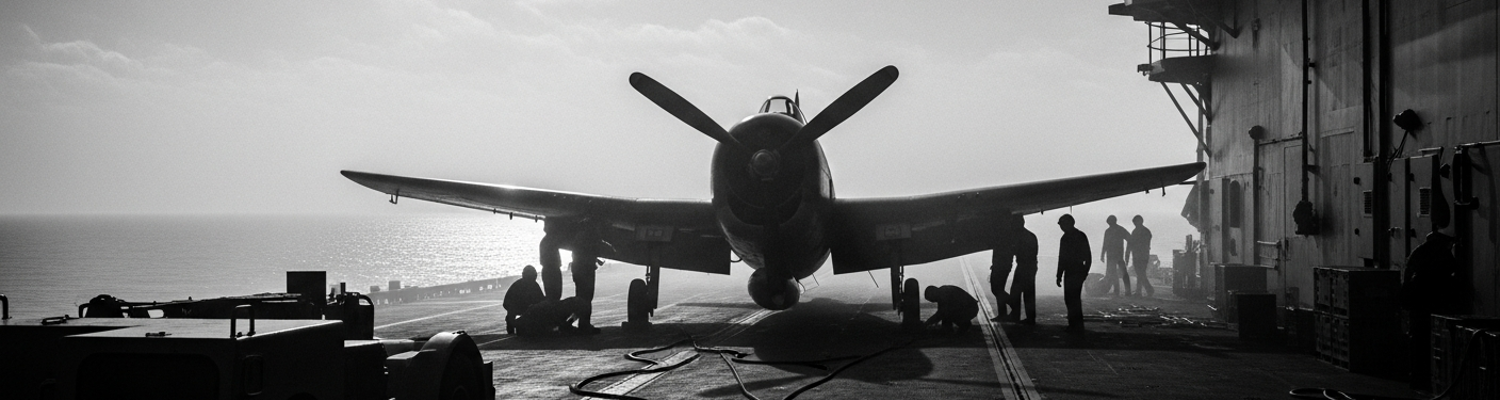

The Arming Wire
The air over the flight deck of the USS Wasp (CV-18) was a mix of JP-5 fuel, hydraulic fluid, and salt spray from the Philippine Sea. Carrier Air Wing 14 was operating at a frantic tempo. Amid the controlled chaos of taxiing aircraft, Petty Officer First Class Arthur Vance knelt beside an F6F Hellcat. An Aviation Ordnanceman with a decade of service, his movements were precise, honed by thousands of repetitions. His task was the final arming of the aircraft’s rockets, removing safety pins and connecting electrical arming wires. Deck logs (Entry 04-10-44-7B) show Vance and his team armed twenty-four Hellcats in under ninety minutes.
He was known as one of the most dependable technicians in the air wing, particularly for his work on the complex fusing mechanisms of air-dropped munitions. He was responsible for the final, irrevocable step before the aircraft was attached to the steam catapult.
The problem was not the munitions.
The issue was rooted deep inside the Hellcats’ instrumentation. A significant portion of the ready aircraft had improperly calibrated Mark VIII reflector gunsights. This system projected an illuminated reticle onto a glass plate in the pilot’s line of sight. Calibration, or harmonization, was a maintenance-intensive procedure meant to align the gunsight with the actual trajectory of the aircraft's six .50-caliber M2 Browning machine guns at a convergence point of 300 yards. The process required armorers with specialized tools to make minute adjustments to the gunsight’s gyroscopic mechanism.
A recent directive, intended to expedite sortie rates, had truncated the full harmonization check. Crews were permitted to perform an abbreviated check, often pencil-whipped in the rush to get aircraft airborne. On at least eight of the Hellcats launched in the first strike package, the vertical alignment of the gunsights was off by as much as three degrees. This deviation was almost unnoticeable during a cursory check. At a range of 300 yards, this error would cause machine gun rounds to impact nearly sixteen feet below the pilot’s aiming point.
This systemic issue was compounded by the pressure for rapid sortie generation. The flow of ordnance from the magazines, up the elevators, and onto the aircraft pylons was a model of industrial precision. This physical efficiency masked deep procedural flaws. The paperwork trail for ordnance readiness, meant to provide accountability, became a source of bureaucratic fiction. Forms were signed and aircraft were designated ready for flight based on the assumption that underlying maintenance was correct. The ordnance handlers, like Petty Officer Vance, did their jobs perfectly. The pilots had no reason to doubt their instruments. The command staff on the bridge saw a deck full of armed aircraft. Every individual component of the operation, viewed in isolation, appeared to be functioning.
Scheduled vs. On-Call
The entire operation was predicated on a joint command structure that existed more on paper than in practice. The Army’s XI Corps staff, planning the amphibious assault on Samar, had listed air support from Carrier Air Wing 14 as a “scheduled” asset. This meant waves of aircraft would be continuously overhead from H-Hour onward to suppress enemy positions. The Navy, however, interpreted the directive through its own doctrinal lens, classifying the air support as “on-call.” To the carrier group, this meant the first strike package would launch, establish air superiority, and then orbit, awaiting specific target requests from forward air controllers on the beachhead.
This fundamental disagreement in terminology created a fatal gap. Post-action analysis (JCS Report 1138-C) shows that at least three separate planning annexes contained this contradictory language. No unified staff meeting ever reconciled the discrepancy.
At 06:00 local time, the landing craft carrying the first assault wave of XI Corps began their run toward the designated landing zone, “Red Beach,” south of Guiuan. The lead elements were the 1st and 2nd Battalions of the 151st Infantry Regiment. Their objective was the seizure of a beachhead 1,500 yards deep to secure the coastal road. Intelligence had suggested only light resistance. Briefings for the 151st's officers detailed the availability of continuous air cover to neutralize any fortified positions. Battalion commanders planned a rapid advance from the waterline, intending to bypass strongpoints under the protective umbrella of the Hellcats.
The initial touchdown at 06:30 was met with sporadic rifle fire. Fifteen minutes later, as the lead companies pushed past the dunes, they began taking heavy and precise fire from well-concealed enemy positions, including heavy machine guns and 81mm mortars.
The Beachhead Under Siege
The forward air controller with the 151st, an Army Air Forces lieutenant using an SCR-300 radio, began requesting immediate fire missions on the enemy hardpoints at 06:51. His requests were routed through the Army’s command net to the XI Corps headquarters aboard the command ship USS Pocono. There, the request was transcribed and physically walked to the naval tactical air control center three decks below. A communications log indicates a full nine-minute delay before the request was transmitted to the USS Wasp.
The Hellcats of the first strike package, having found no aerial threats, were already in their high-altitude orbit as instructed. By the time they were vectored to the beach, the lead platoons of the 151st were pinned down. The pilots could visually identify the sources of enemy fire, but the gunsight miscalibration rendered their primary weapons ineffective. A pilot from Fighter Squadron 84 later reported firing an entire belt of .50-caliber ammunition at a fortified machine gun nest, only to see the tracers impact harmlessly in the sand dozens of feet below his aim point. Fearing friendly fire on the compressed beachhead, the air group commander refused to authorize the use of high-velocity aircraft rockets against targets so close to the struggling infantry. By 08:00, the 1st Battalion, 151st Infantry, had lost contact with two of its lead platoons and was in danger of being overrun.
The Counter-Attack
By 08:30, the tactical situation for the 151st Infantry Regiment on Red Beach had deteriorated from precarious to catastrophic. Pinned by interlocking fields of fire from concrete-reinforced pillboxes, the lead battalions were completely exposed. The beach offered no natural cover, just a gentle slope of wet sand giving way to low dunes that provided concealment but no protection from the Japanese 81mm and 90mm mortars now finding their range.
The infantrymen of XI Corps were a light infantry force, intended to seize a foothold and rely on overwhelming air and naval firepower. Their organic anti-tank weaponry consisted of M1 bazookas, a weapon whose effectiveness was dependent on the user’s ability to maneuver to within fifty yards of a target. This was an impossibility for soldiers trapped on an open killing field.
The initial Japanese resistance from coastal garrison troops was rapidly stiffened by the arrival of counter-attacking elements from the IJA 35th Army. These were not static defenders but mobile, battle-hardened units. At 09:15, a coordinated assault began. While heavy machine guns and mortars suppressed the front lines, Japanese light infantry used the dense jungle foliage just 500 yards from the high-water mark to move around the western flank of the 2nd Battalion. Another force used ravines to approach the east, threatening to envelop the 1st Battalion. These were disciplined, squad-level infiltrations designed to create panic and collapse the command structure by targeting officers and radiomen. The result was a rapid disintegration of unit cohesion. Platoons and companies were forced to fight in isolated pockets, unable to communicate or mutually support one another. By 10:00, the 1st Battalion had sustained casualty rates approaching fifty percent.
The Lens of Sergeant Tanaka
The first coherent visual record of the medical disaster came from the lens of Sergeant Kenji Tanaka, a combat photographer attached to XI Corps headquarters. Tanaka was a seasoned Nisei photographer, having documented two prior amphibious campaigns. He carried a cumbersome but reliable Graflex Speed Graphic loaded with 4x5 inch sheet film. The large format produced negatives of exceptional detail.
Tanaka’s contact sheets (NARA Record Group 111-SC) show a deliberate movement away from the front line toward the overwhelmed battalion aid stations behind the dunes.
His photographs are a brutal chronicle. One sequence depicts a single Navy corpsman attempting to triage three wounded infantrymen simultaneously. Another shows a line of casualties stretching from a medical tent, exposed to incoming mortar fire. Tanaka’s lens captured the technical details of the crisis: corpsmen applying pressure dressings to gaping shrapnel wounds, discarded morphine syrettes littering the sand, and infantrymen looking to the sky at the uselessly circling Hellcats.
The battalion aid station of the 151st Infantry was never designed for this. Casualty projections were based on a successful landing with full fire support. The reality was a deluge. Medical logs report the expenditure of the entire initial stock of whole blood plasma within three hours. Morphine supplies were exhausted by 09:00. The station, two large tents staffed by two medical officers and a handful of technicians, was quickly forced to make impossible choices. The organized process of sorting casualties broke down. A report from the regimental surgeon later noted that corpsmen were simply directed to treat the men who were screaming the loudest.
The defining characteristic of the crisis was the nature of the wounds. The Japanese 81mm mortars fired fragmentation rounds that sprayed thousands of jagged steel shards. Unlike a bullet, these fragments tumbled and tore, causing massive internal damage. Medical records describe multiple traumatic amputations from single mortar blasts, as well as complex abdominal and chest wounds that were almost universally fatal on the beach. With plasma and painkillers gone, battalion surgeons performed guillotine amputations with little to no anesthetic. Using a simple bone saw, the procedure was a desperate measure to control bleeding and prevent gas gangrene. By 10:30, the battalion surgeon of the 1st Battalion had performed seven leg and two arm amputations in the sand next to the ruined aid station.
MacArthur's Report
Objective confirmation of the disaster came not from XI Corps, but from the enemy. At 11:03 local time, Fleet Radio Unit Pacific (FRUPAC) intercepted and decrypted high-priority transmissions between the Japanese 35th Army headquarters and its forward elements. The Japanese communications detailed the complete repulse of the American first wave, describing the 151st Infantry as pinned and suffering from a breakdown in command. One intercept, from a Japanese regimental commander near Guiuan, contained a preliminary casualty estimate for the American forces, placing it at over six hundred killed or wounded.
These numbers were far worse than XI Corps’ own chaotic reporting.
Another decrypted message requested urgent resupply of 81mm mortar ammunition, citing the high expenditure rate against the static targets on Red Beach. These intelligence reports were collated and presented to General MacArthur’s G-2 intelligence staff within ninety minutes. The raw data provided a granular, enemy-confirmed view of the tactical catastrophe. The reports noted the absence of effective American air attacks, with one Japanese forward observer stating that the circling American fighters appeared unable to suppress their positions.
MacArthur's first report was a torrent of professionally constrained fury. Transmitted as a flash cable directly to the Joint Chiefs of Staff, the message was a scathing indictment of the naval component. Paraphrased from the original encrypted text, MacArthur’s assessment stated that XI Corps was facing annihilation due to a complete and inexplicable failure of promised air support. He named the USS Wasp and its air wing specifically, accusing its leadership of doctrinal rigidity and operational incompetence. The report detailed the casualty figures from FRUPAC’s intercepts, contrasting them with the Navy’s own placid early-morning situation reports that claimed air superiority had been established.
It was a direct accusation of negligence. MacArthur methodically constructed an argument that preemptively deflected any blame from the landing force, placing the cause of the disaster squarely on inter-service friction. He requested immediate intervention at the highest levels to force the naval task force to provide direct, effective support, regardless of its own doctrine. The cable ended with a stark projection that without a fundamental change in naval action, the beachhead would be indefensible by nightfall.
The Washington Detonation
MacArthur's cable did not land in Washington; it detonated. The message bypassed normal channels and was hand-delivered to Secretary of War Henry Stimson, who immediately requested an emergency session with the President and the Joint Chiefs. The atmosphere inside the Pentagon's secure conference room was acrid. The Army Chief of Staff presented MacArthur’s report as an unassailable indictment of naval incompetence. He had FRUPAC intercepts and the first, grainy radiophoto transmissions of Sergeant Tanaka’s images from the beach.
In response, Chief of Naval Operations Ernest King, backed by Secretary of the Navy James Forrestal, argued that the carrier group commander had acted entirely within doctrine, prioritizing the safety of his pilots and avoiding a catastrophic friendly-fire incident. He presented the Wasp's own logs, which documented a textbook-perfect sortie generation rate.
The two reports described entirely different battles.
The political crisis paralyzed immediate decision-making. The President was faced with two irreconcilable narratives. Siding with MacArthur would mean publicly castigating the Navy. Siding with the Navy would mean effectively abandoning XI Corps and risking a political firestorm. The result was a dangerous stalemate. The meeting adjourned after three hours with only a weakly worded directive for the theater commanders to deconflict and coordinate all supporting fires.
The failure sent immediate geopolitical shockwaves. A close review of State Department cables from the period reveals that the Australian ambassador demanded an urgent briefing, expressing his government’s alarm over the apparent breakdown in US joint operations. The most significant consequence was the immediate suspension of planning for “Operation ARCHER,” a proposed joint amphibious exercise with the Royal Australian Navy. The Australians cited the events at Samar as evidence that fundamental deficiencies in American command and control made such complex joint operations too risky for their own forces.
Dueling Investigations
Almost immediately, the Army and Navy launched separate, secret investigations. They were not instruments of objective inquiry but tools for institutional self-preservation. The Navy’s Board of Inquiry, convened under the authority of the Pacific Fleet commander, focused narrowly on validating the actions of the USS Wasp’s command staff. Its members collected pilot testimonies that emphasized the chaos on the beach and the extreme risk of friendly fire. The investigation’s preliminary report concluded the fault lay with XI Corps’ inability to provide accurate targeting data.
The Army’s investigation was an exercise in prosecutorial evidence gathering. MacArthur’s G-3 staff formed a Special Review Team that flew directly to the Philippines. Their work centered on the raw aftermath on Red Beach. They collected sworn statements from survivors of the 151st Infantry and cataloged the delays in air support response. Sergeant Tanaka’s graphic photographs were entered as primary exhibits.
The team’s most damning evidence was a detailed ballistics analysis of the beach itself. It showed thousands of .50-caliber impacts clustered harmlessly in the sand, far from any enemy fortifications, proving the systemic nature of the gunsight failure.
Because the core technical problem had not yet been identified in Washington, the proposed solutions were operationally absurd. The Army, arguing the Navy had proven itself incapable of close air support, demanded control over its own air assets. The Army Air Forces Chief of Staff proposed diverting B-17 Flying Fortresses from their strategic bombing campaign to carpet bomb the Japanese positions on Samar. This was operationally nonsensical. Using high-altitude heavy bombers to hit frontline targets would have inevitably resulted in the annihilation of the very troops they were meant to support. Army Service Forces, reacting to casualty reports, initiated an emergency sealift of heavy equipment to the Philippines. Records show that within 48 hours, Liberty ships were being loaded in San Francisco with 2.5-ton trucks and 105mm howitzers. This equipment was useless to the men trapped on Red Beach. The port of Guiuan remained in enemy hands, and there was no way to offload heavy vehicles or artillery. The American war machine was responding with massive, misdirected force, shipping logistical solutions for a battle that was not being fought.