
Forward Tactical Field Wire Deployment and Splice Failures
Archival evidence shows that Forward Net Control logged the breakdown at zero-five-thirty-one hours across Yucca Flat. They recorded an instantaneous carrier drop on primary trunk line Abel. Zero circuit resistance registered on forward sensor leads. Dead silence echoed from the trench line. During the weeks leading up to the April 25, 1953 detonation, the 94th Signal Battalion deployed line construction crews across the expanse of Area 1. They established the forward tactical field wire network. Line crews operated Dodge M37 three-quarter-ton trucks equipped with bed-mounted RL-31 reel units and DR-8 wire spools. These vehicles fed miles of WD-1/TT twin-conductor wire directly over the dry lake bed. Each strand contained four tinned-copper conductors and three galvanized-steel tensile strands wrapped in extruded polyethylene insulation and a protective nylon jacket (Specification MIL-W-16878).
Crews staked lines at forty-foot intervals using steel pig-tail pins driven into the caliche basin.
Secondary runs were dropped into shallow four-inch furrows. Tractor-drawn plows cut these lines into the alkaline crust to shield the wire from ground-level preheat. Wire paths ran outward along designated radial paths between the three-hundred-foot steel shot tower and the planned troop positions. Dust devils routinely unseated temporary stakes. Field linemen manually spliced breaks with Western Union twists and friction tape in eighty-degree daytime heat.
Static electricity accumulated along the ungrounded lines throughout the dry desert afternoon.
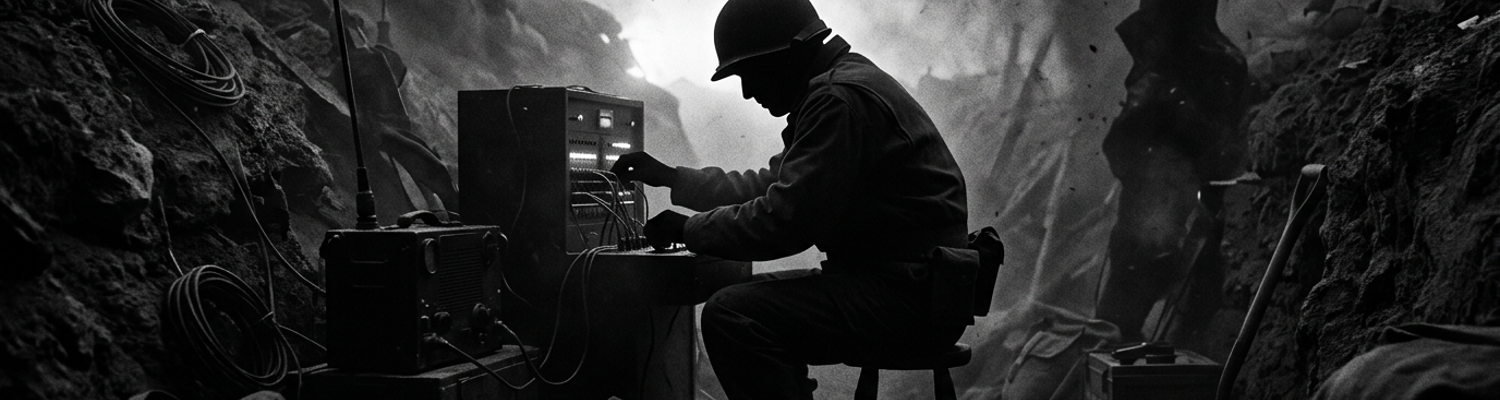
A close review of operational logs (NARA Record Group 338) indicates that the Department of the Army positioned Signal Corps detachments and tactical observation posts inside trench complex Baker. This position sat precisely four thousand yards south of the tower. Signal Corps teams from the 506th Signal Company and assigned observers for Exercise Desert Rock V occupied an unreinforced zigzag trench system carved five feet deep into the dirt. Enlisted linemen and radio operators brought SB-22/PT manual switchboards, EE-8 field telephones, and AN/PRC-10 transceivers into the dirt cutouts. Earthen revetments formed the only physical barrier between personnel and ground zero. Dust hung heavy in the air. The alkaline powder fouled the rotary dials and bound the spring-loaded binding posts of the line equipment. Technicians sat directly on the trench floor. They held their field equipment between their knees. Operators checked audio continuity to the rear every fifteen minutes and tested circuit loops with Simpson Model 260 volt-ohm meters. The operational plan instructed these men to crouch beneath the trench lip, face away from the tower, and hold their sound-powered telephone receivers against their ears through the blast shock wave.
No secondary shoring supported the dry dirt walls above their heads.
When examining the technical record, the operational hub required interfacing these forward trench runs with the rear command post at Control Point 1. This rear facility sat ten miles away on the volcanic rise of News Nob. Line crews connected the forward tactical wires to heavy multi-conductor cables at junction boxes positioned three hundred yards behind the trench lines. These terminals handled voice traffic alongside lines dedicated to blast telemetry. The telemetry lines carried low-voltage signals generated by piezoelectric pressure gauges, scratch gauges, and ionization detectors placed near the blast perimeter. Signal Corps technicians routed these sensor outputs into AN/TCC-7 carrier equipment and BD-71 switchboards mounted inside mobile communications vans. This setup fed oscilloscopes and automated pen recorders. Technicians struggled to balance line impedance across the splices. The temperature shift between the midnight freeze and the pre-dawn hours altered wire resistance by several ohms per mile. Lightning arresters and carbon-gap spark protectors were wired across every pair to divert early electromagnetic surges before the physical signal reached the telemetry bank.
The last continuity check at the junction boxes concluded thirty minutes prior to scheduled ignition.
Mach Stem Overpressure and Mechanical Wire Failure
When examining the historical record, weapons designers at the Los Alamos Scientific Laboratory had pegged Shot Simon to produce thirty-five kilotons of energy from atop its three-hundred-foot steel tower in Area 1. Firing circuits closed at zero-four-thirty hours Pacific Standard Time on April 25, 1953. The device unleashed an unpredicted forty-three kilotons. Thermal radiation vaporized the steel tower lattice within microseconds. The desert floor superheated into an expansive thermal precursor layer. Extreme ground temperatures accelerated the lower boundary of the expanding blast front. This created an irregular Mach stem that distorted baseline pressure calculations. Air Force and Army blast gauges recorded peak pressures climbing far beyond design specifications across every forward sector. Measurements later confirmed that the shock front carried twenty-three percent more blast energy than test directors (Test Group 7.1) had budgeted for the troop participation perimeter. The actual burst yield shot past safe engineering limits. The sudden surge in physical overpressure quickly overwhelmed the fortifications positioned four thousand yards south.
Steel revetment pins tore loose from the caliche basin.
Archival evidence shows that the Mach stem struck Trench Complex Baker eight seconds after detonation. The high-velocity blast wave drove directly against the open dirt parapets. Peak overpressure levels exceeded eight pounds per square inch along the forward earthen lip. Unreinforced dirt walls buckled inward under the downward force. Tons of dry sediment dumped across the communication bays where Signal Corps operators sat hunched over their equipment. Thousands of yards of WD-1/TT twin-conductor wire suffered immediate mechanical failure under the dynamic air load. Surface-laid lines running north to south were caught in the violent sweep. The blast stripped them clean of their extruded nylon jackets and stretched them until the inner galvanized-steel tensile strands snapped. Furrowed runs fared no better. Violent displacement of the desert crust severed wire splices and yanked line leads straight out of their spring-loaded binding posts on the SB-22/PT switchboards. Linemen found themselves pinned under collapsed earth. Their hands tangled in ruptured conductors while their EE-8 field handsets filled with choking alkaline powder.
Every forward audio circuit went completely dead.
A close review of operational logs indicates that the physical destruction of wire runs instantly severed tactical awareness between forward details and the Exercise Desert Rock V command post. Carrier frequency monitors registered an immediate flatline across every forward channel at Control Point 1 atop News Nob ten miles south. Staff officers lost all contact with the 2,450 soldiers sheltering in the forward zones. Switchboard operators at the rear BD-71 panels cranked hand generators to re-establish a dial tone. They received only cold silence and fluctuating ground resistance. Headquarters had no way to confirm whether forward trench sections had survived the blast wave or suffered total structural burial. Radiation monitoring teams could not transmit prompt dosage readings from the forward boundary. Maneuver commanders were unable to track the dangerous northward drift of the radioactive cloud. Without telephone lines, signal officers could not authorize troop movements, confirm casualty numbers, or issue withdrawal orders to the volunteer officer trench situated barely two thousand yards from ground zero.
Desert dust blinded the optical signal stations on the high ground.
Communications personnel inside the mobile carrier vans attempted emergency radio contact using AN/PRC-10 tactical sets. Dense atmospheric ionization and heavy dust plumes scattered high-frequency transmissions across Yucca Flat. Field commanders were left with zero voice telemetry and zero functional sensor links across an active atomic blast zone. At zero-four-thirty-three hours, the exercise director dispatched motorcycle runners into the dust cloud to physically locate the buried trench lines.
Atmospheric Ionization and Transceiver Component Short Circuits
Archival evidence shows that forward communications sections immediately initiated emergency backup procedures using vehicular and ground-mounted AN/GRC-9 radio sets once the landlines sheared apart. Inside the support pits flanking Trench Complex Baker, radio operators from the 506th Signal Company dug their hands through collapsed earthen revetments. They needed to reach the waterproof canvas covers of the RT-77 transceivers. Technical doctrine (Signal Corps Technical Manual TM 11-263) called for these low-power high-frequency sets to bridge division-level echelons over distances spanning two to twenty miles across the desert floor. Line crews dragged the thirty-pound metal radio cases into the trench corners. They hooked the equipment to DY-88 vehicular power converters installed in buried Dodge utility trucks. Soldiers wrestled fifteen-foot MS-116 whip antenna sections into MP-65 base mounts. They performed this task while kneeling in radioactive fallout. Two-man teams mounted GN-58 hand-crank generators on folding tripod legs. They spun the dual handles at the mandated sixty revolutions per minute to supply direct current to the receiver plates and transmitter filaments. Tuning knobs were unlocked across preset tactical frequencies between 2.0 and 12.0 megacycles. Operators tapped out continuous-wave Morse distress signals on J-45 leg keys. They attempted to raise Net Control at Control Point 1.
Nobody answered the manual telegraph keys.
A close review of operational logs indicates that the violent updraft pulled billions of cubic yards of radioactive silicate directly off the Yucca Flat caliche bed. The blast blew it through every unsealed casing. Microscopic alkaline particulate entered the AN/GRC-9 chassis through the stamped ventilation louvers and unseated rubber perimeter gaskets. Fine dust settled inside the sealed micro-switches of the T-17 push-to-talk microphones. This prevented keying relays from completing the primary circuit. Grit worked between the intermeshing brass plates of the main variable tuning capacitors. The resulting direct short circuits blew primary DC power fuses. Coarse sand jammed the spring-loaded ceramic wafer switches of the transmitter band-selector assemblies. The contacts locked mid-throw. Operators stripped the internal detent gears when they forced the knobs. Inside the transmitter power stage, convective heat dissipation collapsed as caked desert silt coated the glass envelopes of the 2E22 beam power amplifier tubes. Trapped heat boiled the internal solder connections within minutes. Technicians pulled hot tube shields off with bare fingers. They found the vacuum tubes cracked from extreme thermal strain and their getter mirrors turned chalk white.
Dust infiltrated the physical mechanics of every transmitter.
When examining the historical record, even surviving field radios with intact components were defeated by atmospheric ionization and thermal upheaval over the basin. Detonation of the forty-three-kiloton weapon formed a superheated particulate column that rapidly expanded upward. It filled the forward line of sight with millions of tons of dense, opaque dust. Free electrons stripped away by intense initial gamma and neutron radiation saturated the lower atmosphere. This created an artificial absorption layer directly across Area 1. High-frequency skywave signals aimed at the ionosphere were scattered and absorbed by this localized electronic barrier. Ground-wave signals traveling across the dry lake bed experienced severe dielectric breakdown. The superheated air boundary layer altered earth conductivity. Radio men at Trench Complex Baker swept their tuning dials across the entire 3.0 to 8.0 megacycle spectrum. They found only deafening white noise and static surges that pegged receiver decibel needles to the right. Signal attenuation exceeded sixty decibels across the operational band. The transmission erased before it reached the receiver. Command post transceivers on News Nob could not detect the weak tactical ground waves fighting through the churning thermal plume.
Forward signal logs at zero-four-thirty-six hours confirmed eighty-four minutes of complete radio blackout.
Prompt Thermal Pulses and Photographic Emulsion Desensitization
Archival evidence shows that optical recording units from the Air Force 1352d Motion Picture Squadron of Lookout Mountain Laboratory and field photo detachments of the Army Signal Corps occupied forward revetments. These positions sat three thousand five hundred yards south of Ground Zero. Technicians anchored heavy Mitchell high-speed 35mm motion picture cameras and Bell and Howell Eyemos onto concrete survey pedestals. They used reinforced steel tripods inside open-top timber bunkers. When the forty-three-kiloton fireball ignited, the prompt thermal pulse hit the forward optical housings before mechanical shutters completed their opening cycles. Coated front optical elements absorbed extreme thermal radiation. This induced sudden thermal gradients across the thick multi-element glass assemblies. Crown glass lenses expanded unevenly against rigid brass retainers. Internal shear stresses snapped objective elements across their diameters. Milliseconds later, the supersonic overpressure front slammed into the camera apertures. It drove pulverized caliche directly into the fractured front elements and blew stripped shutter timing gears into the camera bodies. Field personnel operating manual viewfinders threw their arms over their faces. High-velocity glass shards sprayed backward into the trenches.
Shattered objective lenses dropped straight onto the bunker floorboards.
When examining the historical record, physical damage to camera hardware was accompanied by severe radiation damage across thousands of feet of exposed and unexposed film stock. Operational planners placed photo bunkers inside the primary prompt radiation perimeter without constructing lead-lined magazine enclosures. Prompt gamma rays and high-energy neutron flux penetrated the unshielded aluminum magazine covers of the Mitchell and Fastax cameras. Ionizing radiation ripped through the silver halide gelatin emulsions of Eastman Kodak black-and-white negative stocks. This triggered widespread latent image fogging. The sudden exposure to tens of roentgens of prompt radiation altered the chemical sensitivity of the unexposed silver bromide crystals. The result was complete film desensitization. Laboratory technicians later ran test strips through processing tanks at the Lookout Mountain facility in Hollywood. The developed reels emerged entirely opaque or heavily mottled with dense radiation streaks. Critical documentary footage showing early fireball expansion, thermal shock propagation, and structural responses of forward tactical gear was rendered unreadable.
Ionizing radiation destroyed the emulsion layers within microseconds.
A close review of operational logs indicates that the complete collapse of field communications left the surviving photo teams physically trapped within the forward trench grid. They sheltered alongside isolated radio operators of the 506th Signal Company. Exercise directives required radiological safety monitors to issue clear evacuation codes over landlines or tactical radio networks prior to any vehicle movement across Area 1. Signal wires were severed and vehicular transceivers choked by alkaline dust. Forward monitors possessed no means to verify ambient fallout rates or coordinate extraction routes with the command center at News Nob. Radiac survey meters of the AN/PDR-27 type registered prompt gamma levels climbing above three roentgens per hour inside the trench bottoms. Staff officers at Control Point 1 could not receive the numbers. Transport drivers stationed three miles to the rear refused to push unarmored Dodge M37 trucks into the zero-visibility dust plume without authorization. Photographers and linemen huddled shoulder to shoulder against the collapsed trench revetments. They used surplus sandbags to cover their heads and waited for the dust cloud to clear.
Radiation safety monitors measured five roentgens per hour on the trench floor at zero-five-hundred hours.
Dynamic Air Load and M100 Water Trailer Fractures
Archival evidence shows that Chemical Corps detachments supporting Exercise Desert Rock V positioned eight 400-gallon M100 water trailers and 250-gallon water bowsers roughly three thousand eight hundred yards south of Ground Zero. Equipment planners parked these single-axle steel units along an unpaved egress spur. They sat behind low, unreinforced earthen berms flanking Trench Complex Baker. The unexpected forty-three-kiloton detonation unleashed an overpressure wave exceeding eight pounds per square inch. This force struck the broadside surfaces of the elliptical steel tanks with brutal lateral force. Welded tank seams fractured under dynamic loading. Structural rivets popped and external sheet metal buckled across the chassis frames. Discharge manifolds constructed from cast bronze snapped clean at the tank base. Internal anti-surge baffle plates tore loose from their mounting brackets. Severe ground roll tossed two trailers on their sides into the secondary communication ditches. They dumped eight hundred gallons of treated water into dry, cracked caliche. Pulverized soil instantly absorbed the lost inventory. Designated decontamination turnarounds turned into churning pits of alkaline mud.
Every forward washdown reservoir emptied into the dirt within seconds.
A close review of operational logs indicates that the sudden structural collapse of the bowsers destroyed all field radiological scrubbing capabilities across Area 1. Field safety manuals for the exercise (Chemical Corps Field Directive 4-11) dictated a rigid decontamination sequence. This required pressurized washdown sprays to displace beta-emitting particulate from personnel, communication equipment, and transport vehicles before movement south. Crews from the 506th Signal Company and supporting Chemical Corps teams hooked intake lines from trailer-mounted M3A1 power-driven decontamination apparatuses directly into the trailer drain cocks. Dry pump impellers seized as operators engaged the auxiliary gasoline engines without positive water head pressure. Friction quickly burned through rubber drive belts. Pump packing glands melted, filling the immediate assembly area with acrid smoke. Chemical personnel uncoupled useless two-inch delivery hoses from the sheared trailer fittings. They kicked aside fifty-five-gallon drums of unused detergent compound. No auxiliary tanker trucks had been stationed within three miles of the trench network to replenish the lost washdown reserve. Field scrubbing operations dissolved completely before forward monitors could log their initial dosimeter readings.
Decontamination personnel held spray nozzles that could not produce a single drop of water.
When examining the historical record, over two thousand soldiers evacuating the forward trenches found themselves trapped in dust-saturated field uniforms with no skin decontamination options. Heavy fallout from the radioactive cloud settled across Trench Complex Baker. The dust coated cotton herringbone twill trousers and M-1951 field jackets with billions of microscopic radioactive silicates. Maneuver directives strictly mandated that troops register under twenty milliroentgens per hour on AN/PDR-27 radiac meters before clearing the forward boundary. Chemical Corps safety monitors resorted to sweeping infantrymen with standard warehouse corn brooms and dry whisk brushes. They attempted to dislodge the heavy fallout. Dry bristles only fractured friable crusts into microscopic dust clouds. This resuspended active particles into the breathing zones of unmasked personnel. Sharp abrasive caliche worked beneath unbuttoned collar tabs and loose sleeve cuffs. Radioactive material ground directly against sweat-soaked dermal layers along the necks, armpits, and wrists of the men. Field commanders refused to strip personnel naked in thirty-knot desert winds that drove ambient dust across the staging lines. Convoys of open-bed six-by-six GMC trucks evacuated two thousand men back toward Camp Desert Rock.
Radioactive dust stayed embedded deep inside their uniform weave.
Carburetor Vapor Lock and Delayed Motorized Extraction
Archival evidence shows that the immediate extraction plan for forward maneuver elements collapsed. Exercise Desert Rock V command had retained only twenty-four M37 three-quarter-ton trucks and sixteen M135 two-and-a-half-ton cargo vehicles at the forward staging park near Yucca Lake airstrip. More than two thousand men sat stranded four thousand yards from Ground Zero. Drivers from the 232nd Transportation Truck Company attempted to start their engines ten minutes after the shockwave passed. Airborne caliche powder choked the oil-bath air cleaners, starving carburetors of oxygen. Fine silt clogged the unsealed vent lines of the Zenith carburetors. Float bowls flooded with unburned fuel, triggering widespread vapor lock across the vehicle line. Blast overpressure shattered safety-glass windshields across thirty forward transports. Jagged fragments sprayed across steering columns and shredded canvas cab roofs. Rear-echelon commanders at Camp Desert Rock, situated twenty-five miles to the south, refused to release auxiliary truck companies onto the radial access routes. They waited for radiation safety officers to certify that the main unpaved egress corridor along Mercury Highway was physically passable.
Forty engine blocks sat completely disabled by alkaline grit.
A close review of operational logs indicates that detachment personnel from the 506th Signal Company and 94th Signal Battalion waited pinned inside the perimeter of Trench Complex Baker. They remained there for nearly four hours without transport or command relief. Radioactive particulate drawn upward by the forty-three-kiloton fireball began dropping back onto Area 1 within twenty minutes of detonation. Fluctuating desert winds at eight knots carried the material southward. Signal operators occupied dirt cutouts directly beneath this falling particulate sheet. They possessed only standard cotton fatigues and field-issued ponchos for shelter. Radiological monitors utilizing AN/PDR-27C survey instruments recorded ambient gamma dose rates climbing from two roentgens per hour at zero-five-hundred hours to eight point five roentgens per hour ninety minutes later inside the open communication bays. Handheld instruments pegged repeatedly against their upper scale limits as beta-gamma contamination saturated the trench floorboards and equipment casings. Soldiers wrapped damp cotton undershirts across their mouths to filter breathing air. Fine radioactive dust entered the unshielded trench bays with every surface gust, coating exposed skin and collecting in sweat creases behind their ears.
Command relief never appeared on the horizon.
When examining the historical record, rear command posts were completely ignorant of forward dose rates until physical dispatch couriers rode directly through the contaminated sector to establish contact. Staff officers at Control Point 1 dispatched two motorcycle couriers from the 506th Signal Company mounted on modified Harley-Davidson WLA motorcycles. They ordered them to traverse the eight-mile expanse between News Nob and Trench Complex Baker without radio transceivers. Silt accumulation quickly fouled the exposed secondary chain drives. Primary drive chains slipped off rear sprockets every mile. Couriers wrestled eighty-pound machines through deep drifts of loose alkaline powder. Dust clouds reduced daytime visibility to five yards. Both riders abandoned their stalled motorcycles two miles north of Yucca Pass. They proceeded on foot through three-roentgen-per-hour radiation fields with handwritten status manifests strapped to their belts. The lead courier reached the south communication trench at zero-eight-twenty-five hours. He delivered physical coordinate sheets that confirmed forward troop locations, structural collapse of the wire networks, and rising radiation exposures.
Only physical hand delivery of paper coordinates bypassed the electronic silence across Yucca Flat.
Operational planners used this paper dispatch to assemble an emergency evacuation column. They composed it of surviving open-bed trucks from the 232nd Transportation Truck Company at zero-eight-fifty hours. Convoys advanced along the western boundary of Area 1 in low-gear four-wheel drive. Drivers maintained fifty-yard intervals to prevent dust from suffocating trailing radiators. Extraction teams arrived at Trench Complex Baker at zero-nine-fifteen hours. They loaded contaminated signal operators into unlined truck beds while radiological safety personnel recorded individual film-badge readings exceeding twelve total roentgens. Drivers immediately turned the vehicles south along the caliche wash toward the intermediate staging area at Well 3.
They did not decontaminate the vehicle tires.