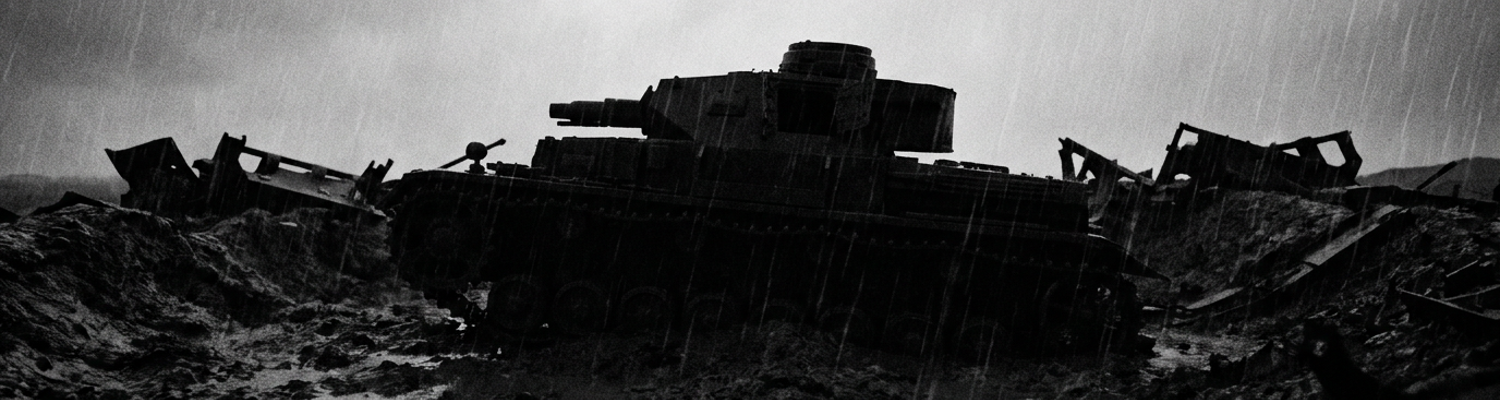

Post-Bombardment Armor Assessment at Gio Linh
Red laterite clay covered the equipment in heavy clods. Monsoon rains across northern Quang Tri province saturated the topsoil until the earth liquefied. Between squalls, the air settled into a heavy ninety-five-degree vapor laced with sulfur and wet ash. Visibility dropped to fifty yards through the fog. Water pooled in fresh craters. The terrain north of the Gio Linh outpost became an impassable swamp of churned sediment and splintered brush.
Nothing moved along the northern wire.
A close review of operational logs indicates that three M48A3 Patton tanks from Alpha Company, 3rd Tank Battalion sat stranded four hundred meters north of the main perimeter trench. Smoke drifted from the vented engine louvers of tank hull number twenty-two. A localized electrical fire had gutted the auxiliary generator wiring harness during the night engagement. Marine mechanics crawled across the slick olive-drab armor plates to survey the drive sprockets and torsion bars. They checked for structural metal fatigue caused by continuous recoil and deep mud suction. The Continental AVDS-1790-2A diesel powerplants had ingested large quantities of red silt through cracked intake housings. Two of the forty-seven-ton vehicles seized entirely. Recovery crews debated whether to scuttle the stranded hulls in place with thermite charges or attempt an evacuation under direct enemy fire. They knew M88 recovery vehicles could not traverse the saturated buffer without throwing their own tracks. (Vehicle maintenance logs recorded track tension failures across eighty percent of the active roster).
When examining the historical record of the 3rd Marine Division, combat engineers documented an obliterated defensive posture along Gio Linh's northern flank. The North Vietnamese Army 324B Division had expended hundreds of indirect rounds over a six-hour saturation bombardment. These strikes originated from concealed pits north of the Ben Hai River. Three layers of triple-standard concertina wire were flattened or buried under pulverized subsoil. Timber-reinforced fighting holes collapsed inward. The cave-ins suffocated fighting positions and buried AN/PRC-25 radio sets beneath wet sandbags. Deep craters measuring twelve feet across breached the perimeter berm at coordinate YD 218714. Interlocking fields of fire from M60 machine guns were wiped out across twenty-yard gaps. Communications wire running back to the battalion command bunker lay severed in over thirty separate locations along the forward trench line.
Ordnance disposal teams found the impact evidence etched directly into the armor plate.
Archival evidence shows that field armorers documented distinct ballistic signatures across the turrets of the surviving Pattons. The 82mm high-explosive mortar rounds employed by the 324B Division detonated on contact with the frontal hull slope. The blasts sprayed horizontal fan patterns of jagged steel fragments. These fragments stripped the heavy canvas dust covers from the 90mm M41 gun mantlets. Shrapnel gouged deep silver grooves into the cast steel armor shields protecting the gunner's primary periscope. Down along the chassis, heavier 120mm mortar rounds detonated in the surrounding mud. The upward blast pressure cracked track shoes and sheared guide pins off the T142 track assemblies. Fragment impacts shattered eight return rollers across two vehicles. They severed the hydraulic lines powering the searchlights mounted directly over the main gun mantlets. The left road wheel of the lead vehicle hung loose on a fractured suspension arm. A jagged piece of mortar casing wedged between the rim and the hull sponson locked it in place.
M50A1 Ontos Munitions Depletion and Blast Trauma
Across the eastern perimeter at Gio Linh, four M50A1 Ontos tracked vehicles from Bravo Company, 3rd Antitank Battalion sat motionless in excavated earthen revetments.
A close review of operational logs indicates that the tracked vehicles exhausted nearly their entire onboard allotment of 106mm M40A1C recoilless rifle ammunition before midnight. Hull storage within the M50A1 accommodated merely twelve rounds beneath the rear crew seat. The six pre-loaded tubes served as the primary immediately available firepower. When the ground assault developed along the northern tree line, crews discharged multiple full-battery salvos within ninety seconds. Loaders unlatched the rear hull doors and stepped out onto the saturated red clay. They broke open wooden ammunition crates stacked in exposed revetment corners. The Marines manually fed shells into blistering breeches under direct small-arms fire. Field supply records show that auxiliary ammo pits holding seventy-two pre-staged rounds at coordinate YD 216715 ran completely dry by 0300 hours. Replacement shipments from the battalion supply park never materialized. Road communications south along Route 561 back to the supply depot at Dong Ha stayed severed by 130mm artillery interdiction. The crews had zero reserve antitank rounds before sunrise.
Every external storage rack hung open and stripped bare.
Archival evidence shows that company armorers began tallying expended cartridge cases scattered across the revetment mud. Platoon logs recorded eighty-six empty casings for the XM581 flechette beehive round. Each projectile released over nine thousand high-tensile steel wire flechettes directly into dense infantry waves attacking at ranges under eighty meters. Technicians examining vehicle hull number fourteen documented severe carbon residue around the six muzzle faces. Blast erosion covered the .50-caliber M8C spotting rifle barrels. Friction from the continuous firing of flechette payloads melted the rubberized weather seals along the upper gun mounts. Ordnance personnel discovered sixteen split cartridge cases wedged tightly inside the lower right breech chambers. Armorers hammered the extractor levers free with steel drift pins. The rifles sat silent with unseated sliding-wedge breech blocks jammed open.
Violent backblast overpressure leveled the earthen revetment walls directly behind the vehicle exhausts.
When examining the historical record of the 3rd Medical Battalion, field reports revealed extensive blast trauma among all twelve crewmen assigned to the platoon. Repeated salvos from the six-tube array generated external overpressure exceeding one hundred and eighty decibels. The shockwaves shook the half-inch aluminum armor plates until internal instrument glass shattered. Marines suffered acute epistaxis and severe inner-ear hemorrhaging. Loaders sustained second-degree burns across their wrists and forearms from handling discarded brass casings. These casings registered temperatures above four hundred degrees Fahrenheit. Drivers inside the cramped center compartments inhaled toxic concentrations of carbon monoxide. The rapid backblast wash against the idling diesel engines produced this gas buildup. Field corpsmen administered intramuscular sedatives to treat uncontrollable muscle tremors. Physical exhaustion resulted from lifting thirty-seven-pound shells through waist-deep mud under incoming fire. Concussive pressure waves repeatedly detached their communications headsets and blew out the seals on their protective gas masks.
Medical intake sheets recorded that three gunners suffered bilateral eardrum ruptures.
Forward Air Controller Crater Analysis
A close review of operational logs indicates that ground forward air controllers from the 1st Air Naval Gunfire Liaison Company deployed north of the Gio Linh berm at 0630 hours. They carried engineer survey tapes across the liquefied earth to measure ordnance impact margins. Captain Robert Hastie paced off the distance between smoking craters and the revetted hull of tank number twenty-two. The closest crater rim measured precisely sixty-eight meters from the Patton's frontal glacis plate at coordinate YD 218716. Detonation overpressure violently displaced the tank's external stowage boxes. The blast sheared four suspension stop bumpers and compressed twenty yards of concertina wire into a mangled ball of scrap metal. Twelve paces to the west, another blast depression sat ninety-four meters from an excavated M50A1 Ontos position. The explosion showered the open fighting compartment with hundred-pound chunks of compacted subsoil. This debris disabled the vehicle's gun elevation jacks. Using steel calipers, air liaison teams recorded these measurements with grease pencils directly onto topographic map sheets. They needed to determine whether ordnance safety envelopes collapsed during the night strike.
Safety margins of five hundred meters were discarded entirely during the repulse.
Archival evidence shows that explosive ordnance disposal specialists examined the crater profiles left by five-hundred-pound Mark 82 low-drag general-purpose bombs dropped along the perimeter wire. Saturated monsoon mud radically altered the blast mechanics of the five-hundred-pound munitions. Fitted with standard M904E2 mechanical impact nose fuzes, the bombs penetrated between seven and eleven feet into the water-logged subsoil before the internal arming delay triggered detonation. Deep clay swallowed the high-velocity casing fragments. The mud captured ninety percent of the steel shrapnel that would have otherwise shredded friendly defensive lines on hard ground. In place of an expanding fragment envelope, the subterranean explosions generated massive hydrostatic shockwaves through the liquefied clay. Earthen shock rings surged through the topsoil. The pressure lifted and ruptured timber-reinforced fighting holes occupied by infantrymen from Golf Company, 2nd Battalion, 9th Marines twenty paces away. Five separate fighting holes caved in under twenty tons of ejected mud. The collapse suffocated two riflemen beneath overhead bunker stringers. The remaining crew scrambled to clear weapon chambers plugged with red sediment.
Saturated soil transferred high-explosive shockwaves horizontally through the trench lines.
When examining the historical record of the 3rd Marine Division, operational transcripts revealed severe difficulties in relaying coordinate adjustments beneath solid overcast cloud ceilings. The cloud base dropped to two hundred feet. Airborne forward air controllers flying Cessna O-1B Bird Dogs from Marine Observation Squadron 6 were unable to dive beneath the cloud base without drawing concentrated heavy machine gun fire. The 12.7mm mounts sat positioned north of the Ben Hai River. Air staff shifted terminal control duties to ground-based tactical air control parties. These teams operated AN/PRC-41 ultra-high-frequency radio sets from an exposed listening post at coordinate YD 219718. Controllers coordinated blind run-ins with Marine Attack Squadron 223 A-4E Skyhawks descending out of the low ceiling at three hundred and twenty knots. Heavy monsoon static distorted radio traffic across the 243.0 megahertz emergency band. Controllers calculated coordinate corrections by pacing compass headings from the burning wreckage of perimeter concertina coils. Strike aircraft corrected their flight vectors through five-hundred-meter blind dives. They released ordnance on estimated radar cross-bearings supplied by the AN/TPQ-10 radar installation at Dong Ha.
Telemetry logs from the Dong Ha radar bunker confirmed the final flight of Skyhawks released sixteen Mark 82 bombs through the overcast with a mean azimuth tracking error of eighty-five yards.
Illumination Flare Debris and Low-Altitude Ordnance Delivery
Expended aluminum flare tubes hung suspended in the tangled German steel ribbon.
Archival evidence shows that combat engineers clearing the perimeter at 0700 hours counted over one hundred and forty empty Mark 24 aircraft flare casings. These casings sat wedged into the triple-standard concertina wire surrounding the northern bunkers at coordinate YD 217717. United States Air Force C-47 flareships and Marine tactical transports dropped the flares continuously throughout the night. The thirty-six-inch-long steel and aluminum cylinders descended beneath sixteen-foot canvas parachutes. They provided two million candlepower of illumination over the Ben Hai River crossing points. The two-kilogram magnesium-sodium nitrate candles burned down after three minutes of flight. The twenty-five-pound discarded casings continued downward at terminal velocity. Dozens of these empty metal tubes plunged directly through overhead sandbag parapets. Others struck defensive barbed wire nets at eighty miles per hour. Heavy steel base plugs and trailing wire lanyards wrapped around concertina spirals. The debris snapped tripwires connected to perimeter M18A1 Claymore mines. Four defensive directional charges detonated prematurely. Ground crews found unburned residue from the barium nitrate starter cups smoldering against the bunker revetments. The chemical fires emitted acrid zinc chloride and toxic white smoke that choked Marines inside the communication trenches.
Every tripwire along sector four was severed before midnight.
A close review of operational logs indicates that flight leaders from Marine Aircraft Group 11 out of Da Nang and Marine Aircraft Group 12 out of Chu Lai abandoned standard dive-bombing doctrine. Cloud ceilings compressed to eight hundred feet above the DMZ. Standard operating manuals mandated a minimum release altitude of three thousand feet with a thirty-degree dive angle. This profile avoided fragmentation envelopes from Mark 82 five-hundred-pound bombs. Denied vertical clearance by the monsoon deck, A-4E Skyhawk pilots from MAG-12 executed high-speed flat-glide profiles. They crossed the southern lip of the Ben Hai River at four hundred knots barely six hundred feet off the ground. Flight leaders utilized snakeye retarder fins to delay weapon detonation. The aircraft skins still rattled under severe blast shockwaves upon pulling four lateral g-forces out of the release run. Concurrently, MAG-11 F-4B Phantoms carried out low-angle pop-up deliveries. The jets dived beneath the jagged cloud base for less than eight seconds to acquire visual ground references. North Vietnamese 12.7mm and 37mm antiaircraft positions on the northern riverbank engaged these low-altitude flight paths with grazing crossfire. The rounds riddled the tail sections of three Phantoms and punctured external fuel tanks before pilots could haul their flight controls back into the solid overcast.
Cloud bases forced jet engines into the lethal kill envelope of light antiaircraft guns.
When examining the historical record of the 3rd Marine Division, ordnance disposal teams surveying the forward defensive wire located jagged fragments of Mark 82 bomb casings. The metal scattered across an arc eighty yards deep inside friendly trench lines. High-explosive releases from the low-flying Skyhawks and Phantoms occurred less than one hundred and twenty meters from the perimeter bunkers. Tail-retarding fin assemblies and steel nose fuze adapters from the detonations propelled horizontally instead of burying into the earth. The debris cut through sandbag walls and sliced across M48A3 tank hull periscopes. Heavy forged-iron casing shards weighing up to six pounds skipped across the hard-packed laterite clay between fighting holes. The shrapnel punctured fifty-five-gallon drums of diesel fuel positioned near the command trench. Armorers found four unexploded M904 mechanical fuzes sheared clean off their bomb bodies. The fuzes sat exposed in the churned mud twenty paces from an active mortar pit. Blast shock sheared the telephone wires running between the tactical air control party and the forward observation posts. The battalion air officer signaled remaining air assets via hand-held smoke grenades tossed into the wire.
Forward Landing Zone Security and Litter Staging
Rifle fire cracked against the wet sandbags every two minutes from snipers hidden across the river.
Archival evidence shows that First Lieutenant Donald Vance of Golf Company, 2nd Battalion, 9th Marines designated a churned depression behind the southern artillery berm at coordinate YD 214711 as the emergency casualty collection point at 0715 hours. Knee-deep laterite mud made rapid lateral movement impossible. Four litter-bearers required six minutes to transport a single wounded man thirty yards through the thick red clay. Their boots pulled completely free of the suction with every third step. Combat engineers stacked wet subsoil sandbags four layers deep around a twenty-foot crater lip to protect the site from 82mm mortar fragmentation. North Vietnamese snipers armed with 7.62mm Mosin-Nagant and SVD rifles fired from elevated tree nests eight hundred meters to the northwest. Navy corpsmen crawled on their stomachs through six inches of standing rainwater to check tourniquets. Harassing mortar rounds dropped into the surrounding wire in three-round clusters every quarter-hour. The explosions showered the open crater with clay clumps and hot casing metal. Vance ordered two M60 machine gun teams to suppress the northern scrub. An AN/PRC-25 operator repeatedly transmitted emergency extraction requests to the Marine Aircraft Group 16 flight operations desk at Marble Mountain. The desk informed him that UH-34D Seahorse helicopters could not descend through the three-hundred-foot ceiling without direct visual ground markers.
The burning stench of hydraulic fluid hung over the forward collection point.
When examining the historical record of the 3rd Medical Battalion, field surgery logs documented devastating polytrauma among the crews pulled from the burning turrets of Alpha Company's M48A3 tanks. Shaped-charge warheads from shoulder-fired PG-2 projectiles pierced the three-inch cast armor on the left turret flank of tank hull number eighteen. The penetration sprayed molten metal droplets across the fighting compartment. High-pressure lines carrying flammable MIL-H-5606 petroleum-based hydraulic fluid ruptured instantly at twelve hundred pounds per square inch. The leak triggered a three-thousand-degree flash fire that engulfed the gunner and loader. Navy corpsmen used steel trauma shears to strip away melting nylon flak jackets. The synthetic fabric fused directly into raw subcutaneous fat across the men's chests and arms. Third-degree burns covered more than seventy percent of the tank commander's body. Jagged internal spall fragments shattered his femur and lacerated his femoral artery. Medical personnel cut open brachial veins to insert large-bore needles. They infused bottles of normal saline and dextran expanders directly on the ground because metal IV stands sank into the mire and fell over. Morphine tartrate Syrettes froze or clogged with fine sand. Corpsmen administered intramuscular injections of demerol through mud-streaked rubber stoppers while suctioning scorched airway tissue with hand-operated plastic aspirators.
Standard folding litters were useless in the mire.
A close review of operational logs indicates that the field dressing station exhausted its twelve canvas-and-aluminum litters within twenty minutes of the initial triage intake. The aluminum support feet dug into the soaked topsoil. The weight dropped wounded men directly into pools of stagnant oil-slicked water. Corpsmen improvised by cutting green ripstop nylon ponchos. They threaded heavy pine bunker timbers or fractured bamboo stakes through the reinforced eyelets to create flexible drag litters. These improvised stretchers skimmed across the mud surface. Technicians moved the casualties beneath the heavy overhanging sponsons of disabled M48A3 tanks parked along the southern berm to shield critical polytrauma cases from continuing mortar fragments and the drenching rain. The cast-steel vehicle sponsons extended four feet out over the upper track assemblies. This provided six feet of dry clearance and rigid armor deflection against descending shrapnel. Corpsmen placed layers of empty wooden .50-caliber ammunition crates directly atop the track shoes. The boxes created elevated wooden platforms where four burn casualties lay insulated from the freezing ground slush. Mechanics monitored battery voltages on surviving hull radios inside the tank while medical staff changed soaked pressure dressings under the protection of fifty tons of cold steel.
Emergency Night Evacuations by HMM-161 and HMM-363
A close review of operational logs indicates that flight crews from Marine Medium Helicopter Squadrons 161 and 363 initiated emergency night evacuation runs into Gio Linh at 0240 hours. Operating out of the forward airstrip at Dong Ha, pilots flew single-engine Sikorsky UH-34D Seahorse helicopters through dense ground fog. Flight instruments sat obscured by heavy rain. The aircraft relied on nine-cylinder Wright R-1820-84 radial engines that coughed under sudden throttle applications. Their exhaust collector rings glowed dull red against the darkness. Pilots maintained an altitude of less than seventy-five feet above the treetops along Route 561 to evade radar tracking from North Vietnamese battery sites north of the Ben Hai River. Cockpit crews flew with cabin defrosters blowing warm oily air across the Plexiglas windshields to combat condensation. They tracked dead-reckoning bearings between artillery impacts. Two UH-34Ds from HMM-363 sustained structural puncture wounds from 7.62mm small-arms fire directed upward blindly from tree lines flanking coordinate YD 212708. Cylinder-head temperature gauges spiked past two hundred and sixty degrees Celsius. Pilots pulled emergency collective pitch to clear ridgelines without visual horizon references.
Flight instruments gave no warning before aircraft crossed into active mortar envelopes.
Archival evidence shows that after-action debriefs concentrated heavily on landing gear sinkage inside unsecured landing zones along the southern perimeter berm. Saturated laterite clay offered no stable footing for the eleven-thousand-pound airframes. As flight leaders lowered collective pitch at touchdown point Alpha, the two forward high-pressure tires sank eighteen inches into the mire. The small unbraked tail wheel submerged completely past its axle housing. Suction from the thick red mud threatened dynamic rollover if a pilot attempted an uneven liftoff with cyclic trim misaligned. Rotor wash exceeding ninety miles per hour transformed the liquefied topsoil into a blinding spray. The mud coated rotor blade leading edges and clogged the forward carburetor air intake screens with gritty sediment. Copilots held partial engine power to keep ten percent of aircraft weight distributed across the rotor disc. This technique prevented the airframe from settling permanently into the swampy depressions. Flight logs from HMM-161 recorded two separate instances where crew chiefs had to chop away entangled communications wire from the tail wheel assembly using survival axes before the helicopter could break surface suction.
Every unsecured clearing along the perimeter remained within direct mortar range.
When examining the historical record of the 3rd Medical Battalion, casualty transfer records confirmed that all litter handoffs occurred under strict blackout conditions between 0315 and 0530 hours. Flight crews extinguished interior cabin dome lights and instrument panel illumination entirely to deny aiming marks to enemy snipers positioned across the river. Corpsmen directed litter teams across the open berm using shielded red-lens MX-991/U flashlights pointed straight at the saturated earth. Loaders hauled four litter patients and three ambulatory casualties through the UH-34D's right-side cargo door while the four-bladed main rotor spun continuously overhead at two hundred and twenty revolutions per minute. Thick blood pooled across the ribbed aluminum cabin floorboards. The fluid mixed with rainwater and red mud to create hazardous footing for the crew chief securing litter suspension straps. Medical tags wired to the wounded men's combat boots identified compound fractures, intracranial blast trauma, and thoracic shrapnel wounds requiring immediate surgical intervention. Crew chiefs recorded thirty-eight critical patient handoffs across five sorties before departing the perimeter for the field hospital at Dong Ha.
Flight log entries closed at 0610 hours with two helicopters grounded for engine valve failure.
Triage Protocols and Blast Trauma at Dong Ha Airfield
The aluminum AM-2 matting of the Dong Ha airstrip vibrated under the wash of descending rotors. Medical teams dragged wounded men toward the canvas tents of Company B, 3rd Medical Battalion.
When examining the historical record of the 3rd Medical Battalion, triage intake logs documented severe diagnostic confusion surrounding armored crewmen arriving from the Gio Linh sector. Tank crewmen from Alpha Company, 3rd Tank Battalion and Ontos loaders from the 3rd Antitank Battalion presented with profound neurological impairment without visible shrapnel penetrations. Blast overpressure generated by shaped-charge penetrations and internal vehicle detonations produced widespread barotrauma. The injuries featured bilateral tympanic membrane rupture, acute pulmonary contusions, and secondary cerebral edema. Navy medical officers separated incoming casualties into four strict sorting groups across two reinforced general-purpose tents at coordinate YD 232598. Technicians marked forehead skin with grease pencils. They categorized men into immediate, delayed, minimal, and expectant groupings based on respiratory stability and pupillary light reflexes. Tank drivers suffering from closed-space concussive shock exhibited severe lethargy and persistent bradycardia. They required immediate administration of intravenous fluids and continuous airway suctioning to clear thick bloody bronchial secretions caused by primary blast lung injury. Medical staff placed non-ambulatory crewmen on bare canvas litters resting atop wooden ammunition boxes. They kept their heads elevated thirty degrees to mitigate intracranial pressure while corpsmen checked baseline reflex responses every fifteen minutes.
Concussive overpressure inside buttoned vehicle hulls shredded respiratory tract tissue without puncturing utility uniforms.
Archival evidence shows that flight statistics compiled within the 1st Marine Aircraft Wing Command Chronology for the period recorded ninety-six dedicated emergency medevac sorties into the Dong Ha sector over forty-eight hours. Helicopter squadrons attached to Marine Aircraft Group 16 and Marine Aircraft Group 36 logged over two hundred and forty flight hours shuttling casualties directly from forward landing zones along the DMZ to the dirt-berm perimeter of Dong Ha. Flight leaders reported intense ground fire along low-altitude transit routes. Twelve airframes sustained structural damage from 12.7mm antiaircraft fire. Maintenance logs recorded three tail-rotor driveshaft assemblies fractured by ground-fire vibrations. Squadron records detailed the transfer of four hundred and twelve wounded personnel through the Dong Ha strip. Aircrews flew repeated instrument-only approaches beneath cloud ceilings that hovered seventy feet above the terrain. Ground support personnel at Dong Ha refueled incoming UH-34D helicopters with JP-4 fuel directly on the auxiliary parking apron. Medical personnel pulled litter cases through the side doors simultaneously. They kept turnaround intervals under three minutes to prevent parked aircraft from drawing registered artillery fire from batteries north of the Ben Hai River.
Aviation fuel lines stayed pressurized on the apron while corpsmen unloaded casualties under spinning rotor blades.
A close review of operational logs indicates that surgical teams at Dong Ha maintained continuous radio coordination with rear medical facilities to manage patient flow beyond the capability of forward operating tents. Surgeons assigned to the forward clearing station performed only damage-control procedures. These included tube thoracostomies for tension pneumothorax, external vascular clamping of severed extremities, and tracheostomies for patients with severe facial burns. Forward staff communicated by AN/PRC-47 high-frequency radios to request immediate aeromedical staging to the Naval Support Activity Hospital at Da Nang and the hospital ship USS Repose. The Repose maintained station twenty miles offshore at coordinate YD 650950. Patients stabilized with bilateral chest drains and fresh whole blood transfusions boarded Marine KC-130F transports from VMGR-152 on the main airstrip for direct twenty-minute flights to Da Nang's deep-water surgical suites. Dong Ha surgeons prioritized blast-shock cases with progressive intracranial hemorrhaging for direct UH-34D flights out to the Repose. Specialized neurosurgical teams aboard the ship possessed mechanical ventilators and radiographic diagnostic equipment unavailable at forward DMZ staging points. Coordination logs recorded forty-four critical patients moved out to the hospital ship's flight deck before midnight. The final patient transfer sheet recorded a core body temperature of ninety-three degrees Fahrenheit upon shipboard intake.
Armored Perimeter Close Air Support Doctrine Adjustments
Doctrine broke down against the mud of Gio Linh.
A close review of operational logs indicates that ground air controllers spent the morning redrafting combat clearance envelopes with grease pencils on acetate map overlays. Standard operating procedures from the Fleet Marine Force manual mandated a minimum abort distance of one thousand meters for five-hundred-pound Mark 82 low-drag bombs. This was reduced to five hundred meters only during declared emergency combat contingencies. Night engagements along the perimeter berm proved those safety envelopes unworkable against massed infantry assaults. Attack pilots from Marine Attack Squadron 223 dropped high explosives sixty-eight meters from revetted M48A3 tanks. The blasts collapsed defensive trench walls while leaving cast-steel armor hulls structurally intact. Air liaison officers from the 1st Air Naval Gunfire Liaison Company recalculated lethal blast radiuses based on saturated clay absorption rather than hard-packed earth. Field directives issued at 0830 hours officially reduced danger-close limits to two hundred meters for armored vehicles buttoned up against fragmentation. Napalm canisters received authorization at one hundred meters. Tank commanders accepted fractured periscopes, stripped searchlights, and concussive headaches as an operational trade-off to strip enemy sappers off the track assemblies.
Supply lines south of the DMZ ceased functioning before dawn.
After-action reports compiled by Force Logistic Support Group Bravo revealed widespread ammunition deficits across northern Quang Tri province. Inbound truck convoys from the 3rd Motor Transport Battalion stalled eight miles south of the perimeter. Direct 130mm artillery interdiction targeting the junction of Route 1 and Route 561 blocked their advance. The four M50A1 Ontos of the 3rd Antitank Battalion completely exhausted their allotment of 106mm XM581 flechette rounds. Crews sat with empty recoilless rifles while enemy small-arms fire swept the perimeter revetments. Main gun ammunition for the M48A3 tanks hit depleted levels. Alpha Company crews reported an average of six rounds of 90mm M336 canister and M71 high explosive remaining per vehicle. Emergency attempts to insert external pallet loads using CH-46A Sea Knight helicopters from HMM-165 disintegrated under intense 12.7mm machine-gun fire. Severed cargo release cables dropped two five-ton nets containing five hundred rounds of 90mm shells into unrecovered ravines at coordinate YD 205698. Frontline armor remained without Class V replenishment for fourteen continuous hours.
Tank commanders could not speak to the jets above them.
Archival evidence shows that communications interoperability failed because vehicle systems and strike aircraft used incompatible radio frequencies. Platoon commanders inside the M48A3 Pattons managed internal vehicle networks with AN/VRC-12 series frequency-modulated radios operating across the very-high-frequency band between thirty and seventy-five megahertz. A-4E Skyhawks from Marine Aircraft Group 12 and F-4B Phantoms from Marine Aircraft Group 11 carried ARC-51 sets tuned exclusively to ultra-high-frequency channels between two hundred and twenty-five and four hundred megahertz. Ground controllers established an improvised voice bridge. Tank gunners observing enemy trench mortars shouted targets over the vehicle intercom to their tank commander. The commander keyed an AN/PRC-25 set to notify the company command bunker. An air liaison officer inside the bunker transcribed coordinates into an AN/PRC-41 UHF transmitter to reach the orbiting flight leader. Tactical debriefs recorded that this multi-tiered manual relay produced transmission delays exceeding forty-five seconds per run-in. Misheard coordinates caused two attack runs to abort on final dive approaches. Enemy mortar positions shifted before ordnance could be placed on target.