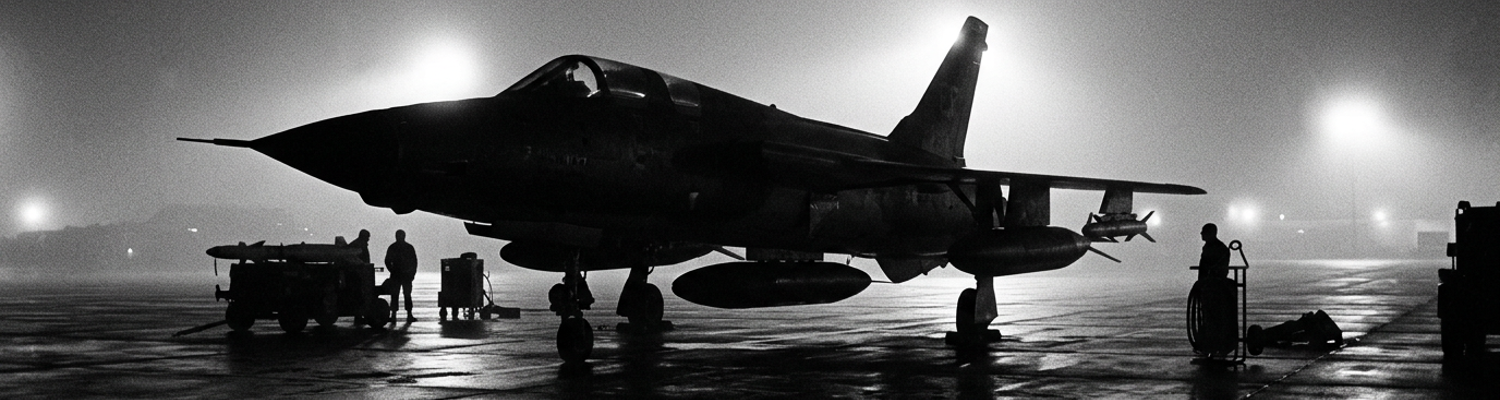

Border Air Operations and Route Package 5 Suppression
The number two bearing on the ALQ-105 electronic countermeasures pod liquid coolant pump disintegrated at 14,000 feet. Metal shards sheared through the primary return line. Dielectric fluid pressure plummeted from 120 pounds per square inch to zero in less than four seconds. This mechanical failure disabled the jamming transmitters mounted along the fuselage of the F-105G Wild Weasel. The aircraft belonged to the 17th Wild Weasel Squadron operating out of Korat Royal Thai Air Force Base. Without active cooling, the internal traveling-wave tubes rapidly overheated. This triggered a cascade of thermal circuit breakers in the rear cockpit. The electronic warfare officer reported the complete loss of localized radar jamming capability just as the aircraft crossed the Mekong River.
A master caution light illuminated exactly three minutes before the flight entered North Vietnamese airspace.
Archival evidence shows that in October 1972, F-105G Wild Weasel aircraft targeted North Vietnamese air defense networks along Route Package 5. This specific geographic zone covered the northwestern quadrant above the 20th parallel. It extended directly to the Chinese border buffer zone along the Red River. Planners in Washington restricted engagement areas to prevent dropping ordnance within twenty-five miles of the Sino-Vietnamese boundary. Henry Kissinger and Le Duc Tho were conducting highly classified peace negotiations in Paris during this exact month. They were attempting to finalize the framework for American withdrawal. Any navigation error near the railway hubs at Yen Bai threatened to trigger a direct diplomatic confrontation with Beijing. State Department cables from that week indicated any border incident would likely derail the impending ceasefire drafts entirely. The National Security Council monitored these flight paths closely. A misdirected bomb hitting Chinese territory would pull Mao Zedong's forces into a more active combat role just as the war was de-escalating. Command directives required the F-105G crews to fly specific hunter-killer profiles. These profiles deliberately skirted the edge of the restricted zones without crossing the boundary line.
Nixon's cabinet tracked these exact sortie coordinates on daily briefing boards.
Operations focused on suppressing SA-2 surface-to-air missile guidance radars threatening Allied strike groups. A close review of operational logs indicates the primary target was the SNR-75 Fan Song tracking system. This radar emitted G-band frequencies to guide thirty-five-foot-long V-750 missiles toward incoming F-4 Phantom II and A-7 Corsair II formations. The Wild Weasels utilized APR-35 and APR-36 Radar Homing and Warning systems to detect the Fan Song pulse repetition frequencies. The electronic warfare officer isolated the specific emission source. The pilot then launched AGM-78 Standard Anti-Radiation Missiles down the bearing. Weighing 1,360 pounds, the munitions carried a 214-pound blast-fragmentation warhead. This warhead was designed to destroy the radar dish and the adjacent command van. The political weight of these suppression missions factored heavily into the targeting approval process. Soviet technicians often manned the SA-2 sites in the northern sectors of Route Package 5 to train North Vietnamese operators. Killing a Soviet military advisor with an AGM-78 strike risked a severe response from Moscow. The White House sought Soviet diplomatic pressure on Hanoi to sign the peace accords at that exact moment.
The destruction of a single Fan Song command van neutralized the entire six-missile battery.
Strike packages operating in the northwestern sectors required this radar suppression to safely interdict rail lines bringing in Soviet-supplied heavy weaponry. Aircrews flying the F-105G operated under strict rules of engagement requiring visual identification of the radar sites before firing. The Pentagon issued this mandate to prevent accidental strikes on civilian infrastructure or third-party nationals traveling near the rail lines. Pilots had to visually confirm the star-shaped layout of the SA-2 sites. These sites were often dug into terraced hillsides or hidden beneath heavy jungle canopy. The aircraft flew at 500 knots. They descended to lower altitudes to draw the enemy radar emissions. The F-105G acted as deliberate targets for the surface-to-air missile batteries. The electronic warfare officer then analyzed the signal strength. This determined if the radar was in acquisition mode or actively tracking the aircraft for an imminent missile launch.
The AGM-78 solid-propellant dual-thrust rocket motor burned for precisely 4.5 seconds after separating from the wing pylon.
Hmong Intelligence Integration and Tactical Telemetry
Archival evidence shows that by November 1972, conventional command structures in Southeast Asia began actively deteriorating under the pressure of the Paris peace negotiations. The White House demanded absolute control over air strikes to avoid diplomatic incidents with Beijing or Moscow. Pilots of the 354th Tactical Fighter Wing operating out of Korat Royal Thai Air Force Base began receiving direct radio targeting coordinates. These coordinates came from indigenous Hmong partisans deep inside Laotian territory. This direct linkage bypassed the 7th Air Force Tactical Air Control Center in Saigon entirely. Hmong guerrilla units armed by the Central Intelligence Agency positioned themselves along the limestone karst ridges overlooking Route 7 near the Plain of Jars. These spotters broadcasted encrypted grid coordinates on pre-briefed UHF frequencies. They used PRC-25 man-pack radios powered by standard BA-386 batteries. F-105G Wild Weasel aircrews flying suppression sweeps ahead of the 354th TFW strike packages picked up these transmissions. The Hmong partisans identified mobile SA-2 launchers and ZSU-23-4 anti-aircraft artillery pieces as they rolled out of camouflage netting. Transmitting the exact latitude and longitude allowed the strike aircraft to adjust their inertial navigation systems in the air.
The PRC-25 radio weighed twenty-three pounds and had a maximum line-of-sight range of five miles.
A close review of State Department cables from this period reveals the severe diplomatic panic caused by this unauthorized communication channel. Defense Secretary Melvin Laird had previously assured the Senate Armed Services Committee that all air operations over Laos remained strictly compartmentalized from the CIA ground war. Allowing indigenous irregulars to directly task United States Air Force fighter-bombers violated the operational parameters established by the National Security Council. Soviet intelligence could intercept these UHF broadcasts. They could present the audio recordings at the Paris negotiating table. The North Vietnamese delegation could easily prove American escalation in the neutral Laotian theater. Nixon cabinet members feared this specific tactical arrangement would derail the impending ceasefire. Diplomatic fallout threatened to expose the full scale of the covert funding directed toward General Vang Pao and his army just as Congress prepared to slash the defense budget. CIA station chiefs in Vientiane repeatedly ignored directives from Washington to sever the radio link between the Hmong outposts and the Korat-based squadrons.
The 354th TFW continued logging the partisan-designated coordinates under the classification code of armed reconnaissance.
Ground observation posts provided real-time tactical telemetry to bypass conventional air intelligence delays. Standard reconnaissance protocols required RF-4C Phantom aircraft to photograph suspected SAM sites. The aircraft returned to Udorn Royal Thai Air Force Base to process the wet film. Intelligence officers then analyzed the negatives. They drafted target nominations and sent teletype messages to the Pentagon for approval. This bureaucratic cycle consumed up to forty-eight hours. North Vietnamese air defense battalions could pack up an SNR-75 Fan Song radar van and relocate the entire battery in under four hours. Hmong spotters established observation posts at elevations exceeding 4,000 feet along the Annamite Cordillera to solve this time discrepancy. These teams used M19 binoculars and M2 compasses to derive the exact azimuth and estimated range of the enemy radar dishes. Telemetry data went directly to the F-105G electronic warfare officers sitting in the rear cockpits. Aircrews cross-referenced the Hmong telemetry with their onboard APR-36 warning receivers to confirm the active emissions.
The electronic warfare officer manually input the azimuth data into the AGM-78 missile guidance system using a rotary dial.
This real-time telemetry pipeline stripped the Pentagon of its target vetting authority. Military analysts in Washington could no longer verify if the SAM sites identified by the Hmong were positioned near civilian infrastructure or Soviet advisory compounds. Planners in the White House relied on the 48-hour intelligence delay to carefully screen out targets that might provoke a large-scale geopolitical retaliation. Bypassing that delay meant the F-105G crews dropped 1,360-pound anti-radiation missiles based solely on the visual assessments of irregular partisans. State Department liaisons warned that a single munition impacting a Soviet command tent would halt the arms limitation talks in Geneva. Bypassing the conventional channels eliminated every fail-safe designed to prevent a wider international conflict. A Hmong observation post transmitted telemetry for an active Fan Song radar positioned exactly two miles from the Chinese border buffer zone during a November 14 mission. F-105G crews fired an AGM-78 down the bearing. The 214-pound blast-fragmentation warhead shredded the command van.
Ordnance Supply Crisis and AGM-45 Shrike Deficits
A high-pressure hydraulic line on the Mark 6 Standard Tensioned Replenishment Alongside Method winch ruptured at 2,800 pounds per square inch. Amber hydraulic fluid sprayed across the transfer deck of the fast combat support ship USS Sacramento. A steel transfer cable snapped under the sudden loss of tension. It violently dropped a wooden crate containing four AGM-45 Shrike anti-radiation missiles directly into the South China Sea.
The pallet sank in twelve seconds.
A close review of Seventh Fleet materiel manifests reveals the loss of those four missiles worsened an already severe deficit. Seventh Fleet replenishment ships experienced severe supply shortages of AGM-45 Shrike anti-radiation missiles throughout the fall of 1972. Aircraft carriers like the USS America and USS Kitty Hawk operated at Yankee Station at coordinates 19.016N 107.950E. They required continuous underway replenishments to sustain suppression missions against North Vietnamese air defenses. The AGM-45 Shrike weighed 390 pounds and utilized a passive radar homing head to track enemy emissions. The Mk 53 warhead contained 145 pounds of Composition B explosive surrounded by thousands of pre-formed steel fragmentation cubes. Carrier Air Wing pilots relied heavily on these weapons to destroy Fan Song radar installations protecting the rail lines south of Hanoi. The Sacramento and the ammunition ship USS Nitro arrived at Yankee Station in late October. Their magazines held less than fifteen percent of the requested Shrike inventory. This physical absence of ordnance immediately triggered alarm within the National Security Council. Henry Kissinger's negotiating strategy in Paris depended entirely on maintaining relentless aerial pressure on Hanoi. Navy A-7 Corsair II squadrons could not safely suppress the SA-2 batteries without the Shrikes. The Pentagon had to either halt strikes or risk heavy aircraft losses.
A downed naval aviator paraded through Hanoi threatened to destroy the fragile ceasefire framework completely.
Naval supply units struggled to maintain sufficient inventory during peak operational surges in late 1972. The escalation of Operation Linebacker required carrier air wings to fly up to 120 sorties a day. Ordnance planners at Naval Magazine Subic Bay in the Philippines exhausted their prepositioned stockpile of AGM-45s by the third week of September. Supply officers resorted to prioritizing the shipment of individual seeker heads and Mk 78 solid-propellant rocket motors from the Naval Weapons Station Concord in California. Military Airlift Command C-141 Starlifters flew these components across the Pacific to Clark Air Base. The aircraft required mid-air refueling over Hawaii to make the transit at maximum cargo weight. Ground crews at Clark unloaded the wooden crates using rough-terrain forklifts. This exposed the sensitive electronic seeker heads to high humidity and temperatures exceeding ninety degrees. Technicians assembled the weapons on the tarmac before trucking them down the Olongapo highway to the naval station. Task Force 73 could not load the ammunition ships fast enough to match the consumption rate of the carrier strike groups. The White House repeatedly ordered the Defense Department to mask this supply chain failure from the press and foreign intelligence services. Soviet military attaches in Washington might detect the emergency airlift of anti-radiation components. Moscow would realize the American air campaign over North Vietnam was mechanically unsustainable.
State Department analysts warned that this specific intelligence would prompt the Soviet Union to increase surface-to-air missile shipments to Haiphong harbor.
Archival evidence shows that by November, carrier strike planners began rationing the remaining AGM-45 inventory. Rules of engagement shifted to require pilots to visually identify a radar command van before firing. They could no longer launch preemptively based on electronic warning receiver tones. Naval commanders restricted the use of Shrikes strictly to high-threat corridors along Route Package 6. The A-7 Corsair II aircraft launched from the USS Enterprise carried only a single Shrike on their outboard starboard pylons instead of the standard two-missile loadout. Ordnance crews filled the empty port pylons with unguided Mk 82 general-purpose bombs to maintain aircraft weight and balance.
The Mk 78 rocket motor generated 4,600 pounds of thrust for two seconds.
Cross-Service Munitions Transfers at Korat Air Base
A close review of Seventh Fleet deck logs from November 12, 1972, reveals an unprecedented shift in ordnance distribution at Yankee Station. United States Navy and Air Force commanders executed emergency high-seas transfers to replenish depleted missile stockpiles across the carrier strike groups. Military Airlift Command C-141 Starlifters delivered Air Force-procured AGM-78 Standard Anti-Radiation Missiles to Naval Air Station Cubi Point in the Philippines. Naval stevedores utilized rough-terrain forklifts to load the 1,360-pound weapons onto the fast combat support ship USS Camden. The vessel steamed directly to coordinates 19.016N 107.950E to rendezvous with the USS Enterprise. CH-46 Sea Knight helicopters conducted vertical replenishments. They lifted the wooden crates from the Camden and lowered them onto the carrier flight deck. The National Security Council mandated this inter-service exchange to prevent a cessation of suppression strikes along the Laotian border. White House planners understood that any pause in F-4 Phantom II and A-7 Corsair II sorties would signal severe supply chain vulnerabilities to the North Vietnamese delegation in Paris. Diplomatic leverage depended entirely on maintaining uninterrupted bombing pressure over the railway hubs.
The CH-46 rotor downwash stripped the waterproof tarpaulins off the crates as they hovered fifty feet above the steel deck.
Air Force ordnance officers boarded the USS Enterprise via carrier onboard delivery aircraft to oversee the integration of USAF munitions into Navy magazines. These specialists brought specialized testing equipment required to calibrate the AGM-78 seeker heads. The Air Force variants differed slightly from Navy variants. Aviation ordnancemen manually rewired the LAU-7 umbilical connections to interface with the weapon pylons on naval A-7 Corsair II aircraft. State Department cables warned against publicizing this joint operation to the press or foreign attaches. Soviet satellites tracking fleet movements could not photograph the serial numbers on the missile bodies. Human intelligence assets at Subic Bay had already noted Air Force personnel loading ordnance onto Navy ships. Moscow might realize the United States military was forced to cannibalize its separate branch inventories to sustain the air war. Soviet negotiators would advise Hanoi to stall the peace talks. The White House ordered Pacific Command to classify all cross-service transfer manifests as top secret.
Naval aviators fired Air Force inventory out of pure operational necessity.
Korat Royal Thai Air Base operated as the primary joint materiel hub for cross-service anti-radiation missile exchanges on the Southeast Asian mainland. Located at 14.928N 102.082E, the installation housed the 388th Tactical Fighter Wing and its specialized Wild Weasel squadrons. C-130 Hercules aircraft from the 315th Tactical Airlift Wing landed daily on the 9,800-foot concrete runway. They brought Navy-procured AGM-45 Shrikes from the Seventh Fleet reserve depots directly to the Air Force bunkers. Congress had strictly delineated procurement budgets for the two branches. Mixing inventories constituted a direct violation of Title 10 statutes regarding service funding. Nixon's cabinet ignored these legal constraints. They directed the Defense Department to bypass standard accounting procedures entirely. The survival of the ceasefire framework outweighed domestic budgetary laws.
Munitions technicians worked twelve-hour shifts under floodlights to swap the Navy mounting lugs for Air Force pylon adapters.
Archival evidence shows that the 17th Wild Weasel Squadron required seventy anti-radiation missiles per week to sustain Route Package 5 operations. Navy supply chains temporarily possessed a surplus of specific AGM-45A-3 seeker heads physically tuned to the Fan Song G-band frequency. Air Force commanders at Korat authorized the immediate transfer of these Navy assets into their revetments along the eastern taxiway. Ordnance crews loaded the cross-branch weapons onto F-105G aircraft assigned to escort strike packages near the Chinese buffer zone. The two branches masked their individual supply failures from both the North Vietnamese air defense networks and the international press corps by pooling the munitions.
The Mk 53 blast-fragmentation warheads contained exactly 145 pounds of Composition B explosive regardless of the service branch stenciled on the casing.
Errant AGM-78 Strikes Along the Chinese Frontier
A close review of operational logs from November 1972 indicates an F-105G assigned to the 17th Wild Weasel Squadron engaged a suspected North Vietnamese SA-2 site near the railway hub of Lao Cai. The electronic warfare officer isolated a Fan Song G-band emission at an azimuth of 340 degrees. At an altitude of 18,000 feet, the pilot initiated the launch sequence for an AGM-78 Standard Anti-Radiation Missile mounted on the port inboard pylon. The weapon separated cleanly. It dropped for one second before the dual-thrust Mk 27 solid-propellant rocket motor ignited. Twelve seconds into the flight profile, the Maxson Electronics seeker head suffered a catastrophic logic failure. High-frequency vibrations from the rocket motor severed a millimeter-thick copper grounding wire on the primary circuit board. The internal target coordinate computer instantly lost synchronization with the incoming pulse repetition frequency of the enemy radar. Deprived of a continuous emission source, the missile gyroscopic gimbals locked into a neutral position. The weapon flight control system defaulted to a purely ballistic trajectory instead of executing its programmed self-destruct sequence.
The 1,360-pound munition accelerated past Mach 2.
Archival evidence shows radar operators aboard an EC-121 Warning Star aircraft orbiting over the Gulf of Tonkin tracked the errant missile on their scopes. The AGM-78 drifted three degrees off its original bearing. This carried it directly over the Red River. This waterway formed the physical boundary line between North Vietnam and the People's Republic of China. Flight path telemetry recorded by the EC-121 confirmed the weapon crossed into sovereign Chinese airspace at coordinates 22.516N 103.971E. The missile maintained an altitude of 4,000 feet as it passed over the mountainous terrain of southern Yunnan Province. It cleared the jagged limestone karsts by less than five hundred feet. Planners at the 7th Air Force Tactical Air Control Center in Saigon watched the tracking data in absolute silence. A direct strike on Chinese territory threatened to immediately halt the secret Paris peace negotiations by drawing Mao Zedong's military forces directly into the conflict.
The Mk 27 rocket motor exhausted its propellant after fifty-two miles of flight.
Descending at an angle of forty-five degrees, the weapon impacted a densely forested ridge just outside the Chinese city of Hekou. The exact point of detonation was a previously unmapped People's Liberation Army early warning radar outpost hidden beneath heavy canvas camouflage netting. Satellite reconnaissance flights had never photographed this specific installation due to persistent cloud cover and the thick jungle canopy of the Yunnan border region. The outpost consisted of a Soviet-supplied P-12 VHF search radar and an adjacent mobile command trailer housing six technicians. The AGM-78 impacted the soft earth exactly twelve feet from the primary antenna array. Detonating instantaneously, the Mk 53 blast-fragmentation warhead dispersed 145 pounds of Composition B explosive force. Thousands of pre-formed steel fragmentation cubes tore through the thin aluminum walls of the command van at supersonic speeds. The kinetic energy of the shrapnel shredded the internal oscilloscope displays, the radio transmission equipment, and the primary pneumatic controls.
The blast wave flipped the 12,000-pound trailer onto its side.
State Department cables declassified decades later reveal the immediate panic triggered by this border violation. Henry Kissinger received a flash-override message via the National Security Council secure teletype while sitting in his Paris hotel room. Intelligence analysts in Washington assumed the People's Liberation Army would interpret the strike as a deliberate American escalation and mobilize their southern border divisions in response. The White House ordered the National Reconnaissance Office to immediately retask a KH-9 Hexagon satellite to photograph the impact crater. CIA analysts needed to determine the exact extent of the damage to prepare a formal diplomatic apology through backchannels in Warsaw before Beijing could issue a public condemnation. The administration halted all Wild Weasel suppression missions north of the 21st parallel for forty-eight hours while waiting for the Chinese government to react.
The KH-9 satellite film capsule ejected over the Pacific Ocean three days later.
Emergency Diplomatic Negotiations Between Kissinger and Zhou
A close review of National Security Council communication logs from November 1972 details the immediate activation of high-level crisis management protocols following the border violation. Henry Kissinger operated out of a secure suite at the United States Embassy in Paris when the flash-override message arrived from Washington. An encrypted KL-7 teletype machine printed the preliminary damage assessment regarding the AGM-78 strike on the Chinese radar installation in Yunnan. Kissinger immediately ordered his deputy, Alexander Haig, to convene the Washington Special Actions Group in the White House Situation Room. This directive explicitly bypassed Secretary of State William Rogers and the standard diplomatic bureaucracy. The crisis protocols required absolute compartmentalization to prevent any leaks to the international press corps. White House staffers locked down all military situation reports originating from the 7th Air Force Tactical Air Control Center in Saigon. Kissinger instructed the Pentagon to immediately ground all F-105G Wild Weasel aircraft operating out of Korat Royal Thai Air Base. Pacific Command sent a coded flash message to the 388th Tactical Fighter Wing commanding officer. This halted all Route Package 5 suppression missions north of the 21st parallel.
The encrypted teletype transmission required exactly twelve seconds to reach the underground command center in Hawaii.
Archival evidence shows the administration feared this border violation would trigger a cascading geopolitical failure just as the peace accords neared completion. Kissinger directed CIA Director Richard Helms to compile a highly classified dossier detailing the precise mechanical malfunction of the Maxson Electronics seeker head. The National Security Council needed physical documentation to prove the missile strike was an accidental technical failure rather than a deliberate provocation. Analysts at Langley worked through the night to assemble telemetry data recorded by the EC-121 Warning Star aircraft that tracked the errant weapon. This file included the exact radar pulse repetition frequencies and the calculated ballistic trajectory of the munition after the internal copper grounding wire snapped. Kissinger planned to hand-deliver these technical schematics to Chinese diplomats before the People's Liberation Army could mobilize forces across the Red River.
Soviet intelligence operatives stationed in Hanoi monitored the sudden cessation of American air activity along the border zone.
Premier Zhou Enlai demanded immediate explanations through established diplomatic backchannels to contain the escalating crisis. State Department records indicate the Chinese leadership utilized their embassy in the Neuilly-sur-Seine suburb of Paris to bypass public United Nations channels. Zhou dispatched a secure cable from Beijing to Ambassador Huang Zhen. He instructed him to summon American military attache Major General Vernon Walters. The meeting occurred at a safe house in the French capital just fourteen hours after the blast-fragmentation warhead destroyed the P-12 VHF search radar. Huang presented a formal, typewritten demarche demanding the exact latitude and longitude coordinates targeted by the 17th Wild Weasel Squadron that morning. The Chinese premier required technical proof that the United States Air Force was not actively targeting early warning outposts in the Kunming Military Region. Zhou faced intense internal pressure from hardline factions within the Central Military Commission who viewed the strike as an act of war.
People's Liberation Army commanders in Yunnan had already moved three anti-aircraft artillery regiments to the border boundary.
When examining the historical record of these backchannel negotiations, the high specificity of the Chinese demands dictates the narrative. Zhou insisted on receiving the full flight profile of the F-105G aircraft. This included its altitude, airspeed, and the exact moment of munition separation. Managing the crisis required the Chinese premier to present these mechanical failure reports directly to Mao Zedong to prevent a retaliatory mobilization. Walters acted as the physical courier. He transported the CIA-compiled telemetry dossier from the American embassy directly to Huang's residence. The manila folder contained the EC-121 radar tracking plots and a technical breakdown of the AGM-78 gyroscopic gimbal failure. Chinese military engineers in Beijing spent forty-eight hours analyzing the American schematics to verify the ballistic trajectory aligned with an unguided descent.
The translated technical summary sat on Zhou's desk next to a piece of shrapnel recovered from the command van.
Geopolitical Fallout of Border Anti-Radar Operations
Archival evidence shows that by late November 1972, the State Department intercepted encrypted communications between Beijing and Moscow regarding American border incursions. The National Security Council immediately recognized the severe threat these Wild Weasel missions posed to the delicate Sino-American diplomatic rapprochement established earlier that year. President Richard Nixon and Henry Kissinger had signed the Shanghai Communique in February. This initiated a highly sensitive normalization process with the People's Republic of China during a tense phase of the Cold War. A misdirected AGM-78 or a downed F-105G crashing inside the Guangxi Zhuang Autonomous Region at coordinates 22.000N 106.000E gave the Soviet Union direct leverage to halt this diplomatic progress. Soviet diplomats in Geneva actively distributed intercepted radar tracking logs of American border flights to Chinese military attaches. They intended to prove Washington used the Route Package 5 suppression missions as a cover for electronic intelligence gathering against Chinese ballistic missile silos. The White House drafted emergency contingencies outlining the potential cancellation of secret trade agreements involving 400,000 tons of Midwestern wheat.
The Central Intelligence Agency stationed listening posts along the Taiwanese coastline to monitor Chinese air defense frequencies.
A close review of declassified memorandums reveals the exact diplomatic vulnerabilities targeted by Soviet intelligence. The Kremlin instructed its ambassador in Washington, Anatoly Dobrynin, to formally protest the proximity of American anti-radiation strikes to neutral borders. Moscow demanded immediate concessions. This maneuver forced the Nixon administration to expend diplomatic leverage defending its tactical air operations instead of finalizing the Paris peace accords. State Department analysts feared the Chinese Central Military Commission would deploy J-6 interceptor squadrons from the Mengzi Air Base to establish a sixty-mile buffer zone over North Vietnam. Such a deployment would force American F-4 Phantom II escorts into direct air-to-air engagements with Chinese pilots. Diplomatic consequences from a single dogfight between United States and Chinese forces threatened to permanently suspend the normalization process.
Washington stripped operational commanders in Saigon of their discretionary targeting authority.
Tactical Wild Weasel strikes forced Washington to implement stricter rules of engagement along foreign frontiers to contain the escalating geopolitical crisis. The Pentagon issued a classified directive mandating a complete overhaul of the AGM-78 Standard Anti-Radiation Missile firing protocols for the 17th Wild Weasel Squadron operating out of Korat Royal Thai Air Base. Prior operational rules allowed electronic warfare officers to launch munitions based solely on APR-36 warning receiver tones indicating a Fan Song radar lock. The new mandate required a physical visual identification of the radar dish by a secondary aircraft before any F-105G pilot could depress the firing stud. Strike packages had to maintain an altitude above 15,000 feet to limit the radar horizon and prevent anti-radiation seeker heads from acquiring early warning sites inside Chinese territory. Planners at the 7th Air Force Tactical Air Control Center restricted all approach vectors to a strict south-to-north heading.
This specific flight path forced the aircraft to face away from the Chinese border during their attack runs.
Aviation ordnancemen at Korat spent forty-eight hours rewiring the LAU-34/A launchers on the entire F-105G fleet to enforce these new directives. They installed a physical lockout switch in the rear cockpit. This was wired directly into the ALQ-105 electronic countermeasures pod interface. It required the electronic warfare officer to cut a one-millimeter copper safety wire before arming the missile. This mechanical delay ensured crews could not reflexively fire at sudden G-band emissions detected near the twenty-five-mile buffer zone. Pilots received updated tactical maps with the Chinese border demarcated in heavy red ink, overlaid with mandatory abort coordinates. If an aircraft inertial navigation system drifted by more than two miles, the crew had to immediately jettison their ordnance over the Gulf of Tonkin and return to base. Any pilot discharging a weapon within the restricted zone faced an immediate Article 32 hearing upon landing. The mandate was absolute.
The AGM-78 arming sequence now required five separate manual toggle actuations.