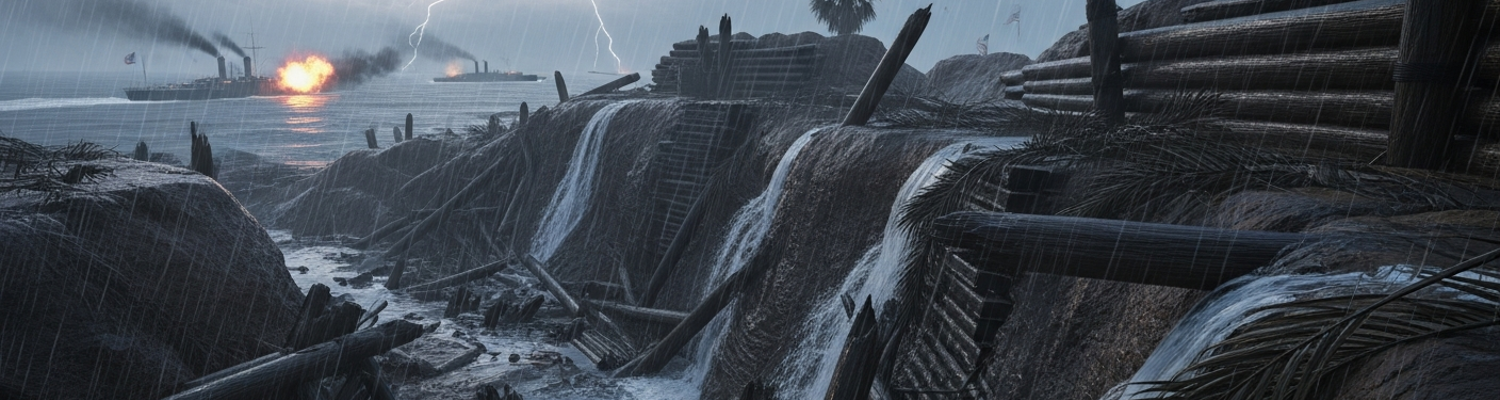

Confederate Defense Collapse Aftermath
Operational logs from the night of September 6-7, 1863. The final hours. After 58 days of constant siege and bombardment, Battery Wagner was no longer a defensible fortress. It was a pulverized ruin of sand and timber. Union sappers had pushed their trenches to the base of the fort’s walls. The garrison, subjected to shelling from land batteries and naval guns, was physically and psychologically broken. Resupply was a near-suicidal mission across open water raked by enemy fire.
General P.G.T. Beauregard, the overall Confederate commander in Charleston, acknowledged the inevitable. He reported to Richmond that the continuous 36-hour bombardment had disabled nearly all the guns. Evacuation was indispensable to save the remaining garrison. The order was given on September 4th, initiating plans for a clandestine nighttime withdrawal. On the night of the 7th, crews from the ironclads CSS Chicora and Palmetto State manned small boats. They began the perilous task of ferrying the exhausted soldiers from Cummings Point to safety on James Island. The remaining artillery pieces were spiked, their barrels clogged to prevent use by the enemy. As a final lethal parting gift, torpedoes, which were crude 19th-century landmines, were buried in the sand. They were intended to greet the first Union troops who would enter the abandoned works.
The evacuation was a success. When Union forces, preparing for a final grand assault, cautiously advanced the next morning, they were met with an unnerving silence.
The fall of Morris Island was a profound strategic defeat for the Confederacy. It fundamentally altered the character of the Charleston siege. For the Union, it was the operational success they had sought for months. Possession of the island’s northern tip gave Major General Quincy A. Gillmore’s forces a direct and commanding position over the primary shipping channel into Charleston Harbor. It placed their heavy siege artillery within effective range of the city and, critically, of Fort Sumter. Union engineers immediately began constructing new batteries to house powerful ordnance, including the 8-inch, 200-pounder Parrott rifle nicknamed the Swamp Angel. From these new positions, Union guns could systematically dismantle Fort Sumter, reducing it from a formidable artillery platform to a heap of rubble held only by infantry. Sumter would not be surrendered, but its offensive capabilities were largely neutralized. The siege transformed from a series of ground assaults into a prolonged war of attrition and bombardment targeting the cradle of secession. Over the next 545 days, Union batteries on Morris Island would hurl an estimated 22,000 shells into Charleston, five miles across the harbor.
The human cost to achieve this advantage was severe, particularly for the attacking Union forces. A tally of the campaign for Morris Island, from the initial landings on July 10 to the Confederate evacuation on September 7, underscores the nature of the fighting. The two major frontal assaults on Battery Wagner, on July 11 and July 18, were catastrophic failures that produced immense casualties. During the July 18th attack alone, which featured the 54th Massachusetts Infantry, Union forces suffered approximately 1,515 killed, wounded, and captured. The Confederate defenders in the fort lost only 174 men. The disparity was a grim testament to the strength of Wagner’s earthworks and the exposed nature of the beach approach. When accounting for the entire campaign of constant siege warfare, including losses from sharpshooting, disease, and incessant shelling, the total casualty figures paint a stark picture of the operation’s cost.
Relentless Union Bombardment Effects
Major General Quincy Adams Gillmore was an engineer. He saw war as applied physics. Having witnessed rifled artillery demolish the brick walls of Fort Pulaski in 1862, he intended to apply the same methodical, overwhelming firepower to the defenses of Charleston. Following the costly failures of direct infantry assaults against Battery Wagner in July, Gillmore abandoned the tactic of frontal attacks. His strategy shifted entirely to one of siege warfare, leveraging engineering and artillery to achieve what masses of men could not. This approach involved two parallel efforts: the physical reduction of fortifications like Sumter and Wagner through shelling, and the psychological demoralization of Charleston itself. The campaign became an exercise in applied physics. Gillmore’s forces pushed trenches ever closer to Confederate lines while his batteries engaged in a calculated process of destruction from a distance.
This new phase of the war was defined by a single, notorious weapon.
The Swamp Angel was an 8-inch, 200-pounder Parrott rifle, a massive cannon weighing over 16,500 pounds, specifically intended to bring the city of Charleston into range. Its placement was a significant engineering feat, requiring the construction of a special battery in the marshland between Morris and James Islands. Colonel Edward W. Serrell of the 1st New York Engineers oversaw the project. It involved driving long pine timbers deep into the mud to support a platform of crossbeams and over 13,000 sandbags. The gun platform itself was designed to float on the marsh, separate from the parapet, to absorb the shock of firing. On August 21, 1863, Gillmore issued an ultimatum to General Beauregard: evacuate Morris Island and Fort Sumter, or the city would be shelled. The deadline passed without a reply. At 1:30 a.m. on August 22, the Swamp Angel fired its first shot, aimed using compass bearings taken on the steeple of St. Michael’s Church. The shell traveled nearly five miles. The sound of alarms in Charleston could be heard back at the battery. The psychological shock on the city’s inhabitants was profound. A direct bombardment of a civilian center from such a distance was a new and terrifying development in warfare. The gun fired shells filled with an incendiary material called Greek Fire, intended to set the city ablaze. Its career was short. After firing just 36 rounds, the Swamp Angel burst its breech on August 23, likely weakened by premature detonations of the experimental incendiary shells. The gun was thrown from its carriage, ending its direct threat.
While the Swamp Angel’s service was brief, the overall Union bombardment was unceasing. The shelling of Fort Sumter, which began in earnest on August 17, saw nearly 1,000 shells strike the fort on the first day alone. A review of operational reports shows that between August 17 and September 2, Union batteries fired approximately 6,800 rounds at the fort. During one weekend, an estimated 4,000 shots were fired at Sumter, with about three-quarters finding their mark. This intense fire, coming from more than 30 heavy artillery pieces on Morris Island and supplemented by naval guns, systematically shattered the fort’s brick walls. By August 23, Fort Sumter fired its last six defensive shots. Its offensive capability was neutralized, and it was reduced to a heap of rubble held by infantry. The shelling of Charleston itself continued for 545 days, making it one of the longest sieges in military history. Even on days with less intense firing due to weather, Union batteries would still send over 100 shells toward the Confederate defenses. Over the entire campaign, Union guns would fire over 46,000 projectiles at Fort Sumter alone.
Union Naval Blockade Effectiveness
The South Atlantic Blockading Squadron in 1863 was a mixed fleet. When Rear Admiral John A. Dahlgren assumed command in July, he inherited a force intended to seal one of the Confederacy’s most important ports. The core of this force was a group of Passaic-class monitors like Weehawken, Catskill, and Montauk, each armed with heavy Dahlgren smoothbores in a single rotating turret. These vessels were augmented by the far more formidable presence of the USS New Ironsides, a massive 4,120-ton broadside ironclad. Unlike the monitors with their two-gun batteries, New Ironsides could bring a staggering volume of fire to bear from its fourteen 11-inch Dahlgren guns and two 150-pounder Parrott rifles. This ship functioned as both a heavy bombardment platform and a floating fortress intended to deter any sortie by Confederate ironclads from within the harbor. The rest of Dahlgren’s fleet consisted of more traditional wooden steam warships, such as the Canandaigua and Mahaska, which performed outer-ring patrol duties. This layered composition was by design; the powerful but slow ironclads formed an inner cordon to engage forts and enemy armor, while the faster wooden steamers formed a wide net to intercept runners.
The material impact of this naval cordon on Confederate war-making capabilities was significant, though not absolute. Archival evidence shows that while many goods still slipped through, the blockade created acute and persistent shortages of specific, high-bulk materials fundamental to the Southern military effort. By 1863, the flow of heavy ordnance, railway iron, and certain raw materials had been severely constricted. Confederate purchasing agents in Europe found it far easier to secure contracts for rifles and ammunition than for the heavy industrial machinery and railroad components necessary to sustain a long-term war. This forced a reliance on what could be captured or produced in the South’s limited industrial base. The blockade was particularly effective at stopping the importation of medicines and chemical precursors, leading to severe shortages of quinine for treating malaria, as well as ether and chloroform for surgery. This compelled the Confederate medical corps to establish laboratories to manufacture replacements from native plants. While over 600,000 small arms were successfully imported into the Confederacy over the course of the war, the blockade successfully choked off 95% of the South’s pre-war cotton exports, devastating its economy and ability to finance the conflict.
The business of blockade running was one of high risk and diminishing returns.
Early in the war, success rates for runners were high. By 1863 the odds were shifting dramatically. A close statistical analysis indicates the capture rate for blockade runners attempting to enter or leave ports like Charleston rose from approximately 1 in 10 in 1861 to 1 in 4 by 1863, and would continue to climb. A vessel’s service life was perilously short. The average runner lasted just over four successful runs, or two round trips. The runners themselves were a special breed of vessel, often British-built steamers designed for speed and a low profile. Painted a dull gray or black to be less visible at night, they aimed to use their speed to dash past the Union picket line during the darkest hours. Dahlgren’s squadron adapted. They began using a tighter, multi-layered patrol system, changing positions nightly to foil the runners’ intelligence and deploying small, swift picket boats close to shore to provide early warning. Even with these dangers, the potential profits were immense, leading owners to risk their ships for cargoes of luxury goods alongside vital war materiel. This dynamic forced the Confederate government itself to issue regulations in early 1864 requiring at least 50% of a runner’s cargo to consist of military goods, a tacit admission that free-market incentives were not always aligned with the strategic needs of the armies in the field.
Morris Island Supply Route Interdiction
Survival at Battery Wagner was measured in nightly supply runs. An examination of engineering and topographical maps from the period reveals why Morris Island was a logistical nightmare for its Confederate defenders. The island was a narrow, hostile strip of sand and impassable salt marsh. Supplies landed by boat from Charleston at Cummings Point, on the island’s northern tip, still had to transit three-quarters of a mile south to reach the main garrison at Battery Wagner. This journey took place on a sliver of beach, often only a few dozen yards wide at high tide, pinned between the Atlantic Ocean to the east and the swamp to the west. This terrain created a perfect, inescapable funnel.
There was no alternative route. No cover. No way to bypass the kill zone.
Moving heavy materiel like crates of artillery shells, barrels of black powder, or sacks of cornmeal across this expanse of deep, loose sand was exhausting, muscle-powered work. Every movement of supplies or men between the landing point and the fort was completely exposed to Union artillery observers and sharpshooters, turning the short journey into a regularly scheduled gauntlet of fire.
The Union blockade was not just offshore. A close review of operational logs from the South Atlantic Blockading Squadron shows a concerted effort to push naval assets into the tidal creeks and inlets west of Morris Island. This effectively created a two-sided siege. While the heavy ironclads like the USS New Ironsides bombarded Wagner from the ocean, shallow-draft gunboats and armed launches patrolled the narrow waterways separating Morris from James Island. These patrols were designed specifically to intercept the small Confederate steamers and barges that served as Wagner’s lifeline. To counter the cover of darkness, Union forces under General Gillmore deployed a novel weapon: the calcium light. These powerful chemical lamps, also known as limelights, were positioned to illuminate the water between the islands, stripping away the night and exposing the Confederate supply boats to Union gunners. Any vessel attempting the crossing was caught in a crossfire, targeted by the gunboats in the creeks and shelled by the larger warships in the main channel.
This created an almost impossible situation for the Confederate quartermasters. The task of supplying the fort fell to small, swift steamers like the Chesterfield and crews from the Charleston naval squadron, who made the dangerous run from the city under the cloak of night. They carried the basic elements of survival: ammunition, medical supplies, fresh water to supplement the island’s brackish wells, and food. A successful run only completed the first leg of the journey. Once unloaded at Cummings Point, every single crate and barrel had to be hauled by hand down the exposed beach to Wagner’s walls. Confederate reports document the extreme difficulty of these missions, with Union gunboats frequently disrupting and preventing the full offloading of stores. The combination of direct naval interdiction on the water and the geographically constrained, exposed nature of the island itself meant that supplying Battery Wagner was a battle of attrition that the garrison was destined to lose.
Depleted Resource Allocation Dilemmas
Confederate ordnance and quartermaster reports from late 1863 reveal a defensive network on the verge of systemic failure. The primary shortages were stark and absolute: heavy-caliber ammunition and repair lumber. While the Tredegar Iron Works and other domestic foundries struggled to produce field artillery rounds, they lacked the industrial capacity to forge the large-bore projectiles required by the coastal defense guns that were Charleston’s primary shield. With the Union blockade strangling the importation of European-made ordnance, each shell fired from a 10-inch Columbiad or a rifled Brooke cannon was an irreplaceable asset. This scarcity forced a severe rationing of defensive fire. Simultaneously, the demand for lumber became insatiable. The massive earth-and-timber fortifications that ringed the city required constant upkeep. A single hit from a Union Parrott rifle could shatter the pine and palmetto log revetments that gave the sand walls their structural integrity. Without a steady supply of heavy timbers to replace this splintered framework, the fortifications would literally begin to dissolve under the weight of sustained bombardment. The very railroad lines needed to bring this lumber from the interior were themselves a source of demand, requiring constant repair and consuming precious iron and wood that could have been used for the defenses.
The math of attrition was simple and brutal. This dual crisis of ammunition and lumber forced General P.G.T. Beauregard into a series of impossible command decisions. An examination of his operational directives shows a daily triage of logistical priorities, pitting the immediate needs of his soldiers against the long-term integrity of his fortifications. Every available wagon, barge, and rail car became a point of contention for his staff. A shipment of cornmeal and bacon sent to feed the starving garrisons on Sullivan’s Island was a shipment that could have carried the heavy timbers needed to repair a collapsing gun emplacement at Battery Gregg. Prioritizing the movement of sandbags and lumber meant the troops performing the back-breaking labor of repairs would do so on increasingly short rations. Malnourished soldiers lacked the physical stamina to maintain the defenses, and the deteriorating defenses demanded ever more work to remain functional. Beauregard’s appeals to slave owners to provide enslaved labor for the construction efforts could not overcome the fundamental deficit of materials and the food needed to sustain the workforce.
The direct operational impact of these shortages was visible in the physical state of the defenses. The great sand batteries, once lauded for their ability to absorb cannon fire, began to slump and fail. Without fresh lumber to rebuild the internal skeletons of the parapets, the sand walls lost their steep, shot-repelling angles. Earthworks designed to be 20 feet thick would flatten and spread after days of shelling, creating gentler slopes that would be far easier for an enemy infantry assault to scale. Gun platforms, which required stable, level foundations of buried timbers, became treacherous. The constant shock of Union shelling, combined with the recoil of their own firing, would shift the compromised foundations, dismounting the heavy guns and rendering them useless until they could be painstakingly re-leveled and remounted, a task that itself required more wood. The bombproofs, intended as safe shelters for the garrisons during bombardments, started to fail as their overhead beams, splintered and weakened, finally gave way under the tons of sand and earth above.
Dysentery and Malaria Epidemic Toll
Confederate medical and engineering reports from the Charleston defenses in 1863 reveal an environment perfectly engineered for pestilence. The low-lying barrier islands, including Morris and Sullivan’s, were a tactical nightmare of salt marshes, non-potable water, and sweltering humidity. Soldiers garrisoning the sand-and-timber forts lived in crowded, unsanitary conditions, with human waste and garbage disposal being rudimentary at best. This fostered swarms of flies and contaminated the limited fresh water supplies, which often came from brackish wells or rainwater cisterns struggling to serve entire garrisons. It was a textbook breeding ground for pathogens. Mosquitoes thrived in the stagnant water of the marshes, spreading malaria, while bacteria flourished in the contaminated food and water, leading to rampant outbreaks of what the soldiers called the bloody flux, or dysentery. The miasmatic air, which 19th-century surgeons incorrectly blamed for the fevers, was thick with the very real threat of mosquito-borne parasites.
This unseen enemy inflicted far more damage than Union artillery. The degradation of the fighting force was catastrophic. At any given time, a significant portion of the Confederate garrisons was too sick to perform its duties. With up to a quarter of the men incapacitated by chronic diarrhea, debilitating fevers, and ague, the operational effectiveness of entire regiments collapsed. Soldiers weakened by dysentery and wracked with recurring malarial chills lacked the physical strength for the back-breaking labor of repairing fortifications under constant bombardment. Gun crews operated at skeleton strength, unable to maintain a consistent rate of return fire. A review of unit records from similar Confederate deployments shows a direct correlation between spikes in disease and spikes in desertion, as men lost all hope in the face of sickness and starvation. For the defenders of Battery Wagner and the surrounding forts, the enemy was not just the Union army five hundred yards away, but the microscopic organisms inside their own bodies.
The one drug that could have saved them was nearly impossible to get. The Union naval blockade was a weapon of attrition, and its most effective target was the Confederate medical supply chain. Quinine, the only effective treatment for malaria, was derived from the bark of the South American cinchona tree and had to be imported. With Northern ships choking the sea lanes, the drug became one of the most valuable and scarce commodities in the South. One surgeon in Charleston reported having only 12 ounces of quinine to treat his patients during the first half of 1864, a period when a single small hospital would have required between 160 and 200 ounces to function. The Confederate Surgeon General’s office desperately sought substitutes, commissioning botanists to identify indigenous plants with similar properties. Concoctions of dogwood, poplar bark, and willow were tried, but all proved useless against the disease. In their desperation, some surgeons resorted to the external application of turpentine, a painful and largely ineffective treatment. The Confederacy’s inability to source this single medicine meant that a treatable illness became a chronic, wasting death sentence for thousands of its soldiers. Over the course of the war, disease would kill more than 164,000 Confederate troops, nearly double the 94,000 killed in combat.
Initial Fortification Doctrine Failure
An examination of Confederate military engineering theory in 1863, particularly the doctrine championed by General P.G.T. Beauregard for the defense of Charleston, reveals a sophisticated plan for a layered, mutually supporting network of strongpoints. The core concept was defense-in-depth, treating the harbor as a series of interlocking kill zones. This system relied on massive earthwork and masonry forts, Sumter, Moultrie, and the batteries on Morris and Sullivan’s Islands, to absorb punishment and shatter any naval assault. The forts were intended to be self-sustaining bastions, capable of surviving prolonged bombardment and isolation while inflicting disproportionate damage on an attacking fleet. The design was a direct response to the new realities of naval warfare; the April 1863 attack by Union ironclads had demonstrated that while masonry could be shattered, dispersed batteries firing from multiple angles could repel even armored warships. Beauregard’s strategy was to turn the entire harbor into a fortress, with channel obstructions funneling enemy ships into the crossfire of more than 385 guns positioned in three defensive rings.
The plans on paper were formidable. The operational readiness of these fortifications, however, fell dangerously short of the doctrine’s requirements. A close review of ordnance reports and garrison statuses from before the main Union offensive in July 1863 indicates a significant discrepancy between the planned defensive posture and the reality on the ground. Many gun emplacements were incomplete, and the garrisons lacked sufficient numbers of trained artillerymen to fully man the batteries. Fort Sumter, for example, had a total garrison of only about 550 officers and men to service its guns. The fortifications themselves, while impressive, were not finished to the specifications required for a protracted siege. Improvements were often limited to immediate priorities, such as adding protection for powder magazines, rather than comprehensive structural reinforcement. This gap between the blueprint and the build-out meant that the self-sustaining forts were, in fact, highly vulnerable from the very start. They were static, partially completed targets that could not withstand the systematic, scientific application of siege artillery that Union Major General Quincy Gillmore was preparing to unleash.
This fundamental weakness was fatally compounded by a catastrophic failure to anticipate the effectiveness of the Union naval blockade. Confederate leadership in both Charleston and Richmond operated under the assumption that the blockade would remain porous, allowing critical war materiel to get through. The defensive doctrine of repairable, resilient forts was entirely dependent on a steady stream of supplies: heavy timbers for reinforcing battered earthworks, replacement cannons for those disabled in combat, and, most importantly, the large-caliber projectiles needed for the coastal defense guns. A review of Confederate naval assets shows they were technologically inferior and too slow to seriously challenge the Union ironclads and break the blockade. The Union Navy, however, did not just form a loose cordon; it established a tight, multi-layered picket system that choked off the importation of the very items required to keep the forts functional. Without a reliable external supply of ordnance and engineering materials, Beauregard’s entire defensive network was a closed system with a finite lifespan. Every shell fired and every log shattered was a permanent loss.