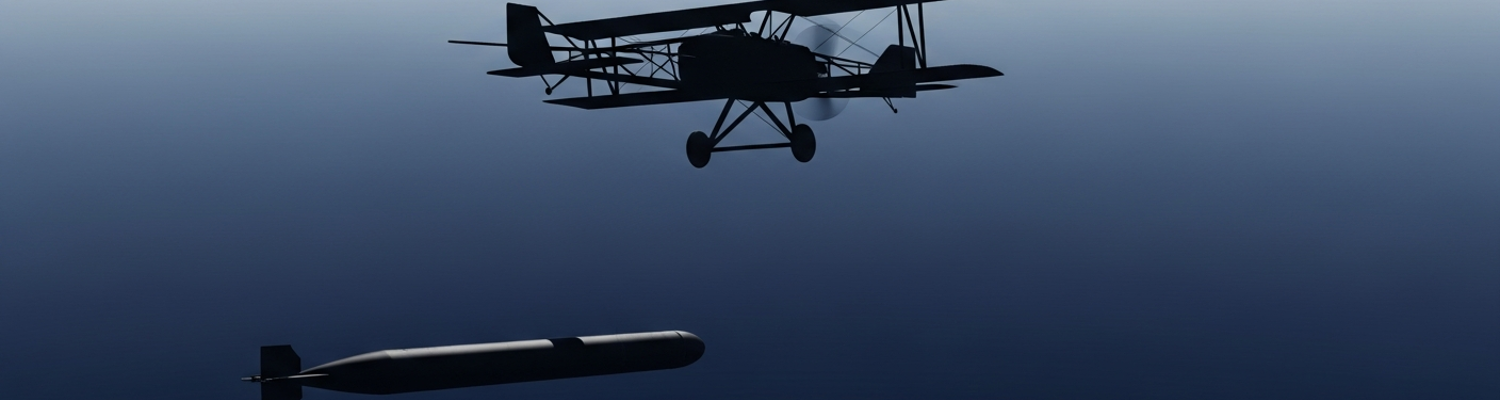

The salt-laced wind whipping across the flight deck of the USS Langley in the mid-1920s carried with it a dangerous idea. Below, slung in the belly of a lumbering Martin T3M biplane, sat a Bliss-Leavitt Mark 7 torpedo. This weapon, designed for the quiet depths frequented by submarines, was a stranger in the sky. To the men wrestling with this new form of warfare, the aerial torpedo was more than a weapon. It was a gamble, a high-stakes bet on the future of naval power that was fraught with maddening technical failures, intense doctrinal conflict, and the constant risk of a violent, watery grave.
The concept, championed by visionaries like Rear Admiral Bradley A. Fiske even before the Great War, was simple in theory but a nightmare in practice. Fiske had patented the idea of a torpedo-carrying aircraft as early as 1912, envisioning a fast, spiraling approach to evade ship defenses. The reality for the pilots and engineers of the interwar U.S. Navy was far less elegant. It was a brutal, hands-on struggle against the laws of physics, undertaken with fabric-skinned aircraft that strained to lift the heavy ordnance and with torpedoes that seemed determined to self-destruct. This period was not one of sleek, foregone conclusions. It was an era of trial and error, where every small success was paid for with repeated, spectacular failures.
Forging a Fragile Weapon
The initial challenge was the weapon itself. The Navy’s first choice, the Bliss-Leavitt Mark 7, was a 1,650-pound weapon designed to be pushed from a tube, not dropped from the sky. Its internal mechanisms were a delicate balance of systems never intended for aerial launch. A gyroscope, spun up by compressed air, provided directional stability. A hydrostatic piston and pendulum system was meant to maintain a set depth. These components, balanced for horizontal acceleration in calm water, were thrown into chaos by the vertical shock of a water entry from even a modest height. Early experiments at the Naval Air Station in Anacostia in 1920, dropping inert torpedoes from barges and cranes before ever risking an aircraft, often resulted in the weapon being badly damaged or breaking apart on impact. The torpedo's body, strong along its longitudinal axis, proved weak against perpendicular forces, causing it to shatter as it slapped the water.
Pilots found the Mark 7 terrifyingly unstable in the air. Its internal component balance made it prone to tumbling, making a clean water entry almost impossible. To have any chance of success, pilots of biplanes like the Martin T4M were forced to fly at what felt like a walking pace, just above stall speed, and barely a wingspan above the waves. The accepted drop parameters were a suicidal 50 feet of altitude at around 100 knots. Go too high or too fast, and the torpedo would plunge deep and bury itself in the mud, a phenomenon known as “diving.” Hit the water at the wrong angle, and its delicate gyroscopic stabilizers would be wrecked, causing it to run erratically or in circles.
Engineers at the Naval Torpedo Station in Newport, Rhode Island, worked feverishly to strengthen the weapon. They applied reinforcing bands to the torpedo body and attempted to redesign the depth control mechanism to withstand the initial impact. One early, desperate idea involved lowering the torpedo to the water on a cable before release, a method that predictably ended with the torpedo’s tail being ripped off by the waves. Another approach involved fitting wooden “air-tails,” box-like structures intended to stabilize the torpedo during its fall. These often broke apart in the slipstream or failed to detach properly upon water entry, sending the torpedo porpoising across the surface before it sank.
This reality spurred the Bureau of Ordnance in 1925 to initiate Project G-6, the first attempt to design a torpedo purely for aircraft. This weapon would become the infamous Mark 13. Yet, even this purpose-built torpedo was born into a world of doctrinal strife and budgetary neglect. Development was started, stopped, and restarted multiple times throughout the Great Depression. When it finally entered service in 1935, it was a weapon shorter and fatter than its foreign counterparts, a 2,216-pound beast with a longer range but a slower speed of just 33.5 knots. Critically, due to budget constraints and a misplaced sense of confidence, it was never fully tested at realistic combat speeds or altitudes. Its performance was theoretical, based on drops from slow, obsolete biplanes. This was a fact that would have devastating consequences for the first generation of pilots to carry it into war, men flying the much faster TBD Devastator. The weapon was a product of a bureaucracy that saw it as a problem to be managed, not a war-winning tool to be perfected.
Forging Pilots at North Island
The sandy expanse of Naval Air Station San Diego, known as North Island, became the epicenter for developing the tactics to match the technology. Here, under the relentless California sun, the Navy’s first dedicated torpedo squadrons, like Torpedo Squadron 1 (VT-1) and VT-2, began the hazardous work of turning theory into practice. Flying the hulking Martin T4M-1 and its successor, the Great Lakes TG-1, pilots spent countless hours attempting to perfect the imperfectable.
These biplanes were vast, slab-sided machines powered by a single Pratt & Whitney Hornet radial engine. A pilot of the era remarked that the T4M “takes off, cruises, and lands at 65 knots.” Its fuselage was so cavernous that crew members, typically a pilot, bombardier, and radioman-gunner, could move between positions, a small comfort during the long, tense practice runs over the Pacific. The pilot flew from an open cockpit, exposed to the elements, while the bombardier aimed the torpedo from a prone position in the belly of the plane, peering through a small window at the rushing water below.
The work was methodical and dangerous. Machinist Mate Thomas F. Cheek, an enlisted aviator with VT-2, recalled the severe limitations on live training. Pilots were supposed to make one live drop per year, but even this modest goal was rarely met. Most training involved “dry” runs against towed sleds or simulated attacks on battleships during fleet problems. The precious few live torpedoes, fitted with bright orange dummy warheads for recovery, were the only true measure of performance, and the results were often disheartening. Cheek described his first live drop in a TBD Devastator off San Diego: releasing the Mark 13 within the prescribed limits of 90 knots at 100 feet, only to watch it run true for about 150 yards before veering off course. The recovery boats would then have to chase down the errant weapon, a frustrating and time-consuming process.
These trials generated important data, not just on the weapon’s failures but on the human factors of an attack run. Pilots learned to read the wind and water by eye, developing a “seaman’s eye” for judging altitude when primitive instruments failed. They practiced coordinated “anvil” attacks, where two groups of torpedo planes would approach a target ship from different angles, forcing it to expose its broadside to one group or the other. They flew these patterns against fleet units and specially designated target ships, like the decommissioned, radio-controlled battleship USS Utah (AG-16), which provided a realistic, maneuvering target. It was the grinding, repetitive work of flying at the edge of the aircraft’s performance envelope, battling engine vibration and the constant fear of a ditching, that built the institutional knowledge of the torpedo squadrons. It was a curriculum written in near-stalls, aborted runs, and the constant, gut-wrenching uncertainty of whether the expensive tin fish would even work.
A Fleet Divided by Doctrine
While pilots wrestled with the practicalities of getting a torpedo into the water, a fierce debate raged within the Navy’s leadership. The central question was whether the future of naval airpower lay with the low and slow torpedo bomber or the high and fast dive bomber. This was not merely a technical argument. It shaped aircraft design, carrier doctrine, and the very identity of naval aviators.
Initially, naval aviation was seen as a support tool for the battle line. Carriers were scouts, their planes the eyes of the fleet, intended to find the enemy and spot the fall of shot for the battleships that would decide the engagement. However, influential figures like Rear Admiral William A. Moffett, the first chief of the Bureau of Aeronautics, saw the offensive potential. Fleet exercises in the late 1920s and early 1930s, which included successful mock attacks on Pearl Harbor and the Panama Canal, demonstrated the carrier’s striking power.
Within this emerging offensive mindset, two camps formed. Proponents of dive bombing, a tactic refined by figures like Lieutenant Commander Frank D. Wagner and Lieutenant Commander Maxwell F. Leslie, argued for its superior accuracy and the greater survivability of its aircraft. A dive bomber approached at high altitude, made a steep, high-speed dive, and released its ordnance at a point where it was a difficult target for anti-aircraft gunners. The bombs, while less likely to sink a heavily armored ship outright, could shred flight decks, destroy command centers, and start crippling fires, effectively putting a warship out of action. The unreliability and extreme vulnerability of early torpedo bombers and their weapons bolstered the dive bomber case significantly. The argument was so persuasive that the new carrier USS Ranger (CV-4), commissioned in 1934, was designed completely without torpedo storage or maintenance facilities, a stark vote of no-confidence in the torpedo plane.
On the other side, torpedo advocates argued that a single torpedo hit below the waterline was far more lethal than multiple bomb hits on the upper works. A torpedo struck a ship’s vitals, causing flooding that could lead to sinking or a catastrophic loss of stability. They believed that a coordinated attack, using dive bombers to suppress anti-aircraft fire and draw away enemy fighters, would allow the torpedo planes to deliver the decisive blow. They argued that the technical problems with the torpedo were solvable and that abandoning the weapon meant abandoning the most effective way to kill a capital ship. This camp pointed to the success of British torpedo planes at Taranto as proof of concept, a clear demonstration of what was possible.
This doctrinal schism directly influenced aircraft procurement. The Navy continued to invest in both types, leading to the development of the Douglas SBD Dauntless dive bomber and the Douglas TBD Devastator torpedo bomber. The TBD, when it entered service in 1937, was a leap forward: a monoplane with folding wings and an enclosed cockpit. It was significantly faster than the biplanes it replaced. Yet it was designed around the flawed Mark 13 torpedo and its restrictive launch parameters, shackling a modern airframe to an obsolete attack profile. Pilots had to slow their advanced aircraft to a crawl, making them easy targets.
Lessons Paid in Blood
The ultimate, brutal test of these competing ideas came at the Battle of Midway in June 1942. The experience of the TBD Devastator squadrons was catastrophic. Flying low, slow, and often without fighter cover, they were annihilated by Japanese fighters and anti-aircraft fire. The story of Lieutenant Commander John C. Waldron, who led Torpedo Squadron 8 (VT-8), became a legend of doomed courage. Knowing he was flying to his death, Waldron told his men, “If there is only one man left to make a final run, I want that man to go in and get a hit.” Every one of his fifteen aircraft was shot down. Only one man, Ensign George Gay, survived, clinging to a seat cushion in the water. Of the 41 Devastators launched from three carriers that day, only a handful returned, and they scored zero hits.
Yet, their sacrifice was not in vain. The relentless, suicidal attacks of the torpedo squadrons pulled the Japanese combat air patrol down to sea level, leaving the skies clear for the SBD Dauntlesses that arrived minutes later. The dive bombers, executing their attacks almost unopposed, turned three Japanese carriers into burning hulks in five minutes. Midway was a stunning victory for the dive bomber, but it was a victory enabled by the sacrifice of the torpedo pilots. It was a bloody vindication of the coordinated attack doctrine, even as it proved the obsolescence of the TBD and the early Mark 13. The interwar gamble had reached its violent, decisive climax.
The lessons, paid for in blood, were immediately applied. The Grumman TBF Avenger, a far more capable aircraft, and an improved Mark 13 were rushed to the fleet. Engineers at Newport and Pearl Harbor, working frantically, finally developed a fix for the torpedo. A simple plywood nose ring and a wooden tail shroud were added. This “pickle barrel” assembly protected the delicate warhead and fins, allowing the torpedo to fly straight and true through the air. It allowed for drops from over 200 knots at altitudes up to 2,400 feet, a world away from the suicidal profiles of the past. By late 1942, in battles like the Eastern Solomons, the new Avengers and the finally reliable Mark 13 began to score hits, at last fulfilling the deadly promise of the aerial torpedo.