
Standardizing the Undersea Arsenal
After World War I, the United States Navy confronted the unforgiving realities of the undersea domain. A series of submarine accidents, beginning with the loss of the USS F-4 in 1915, exposed a severe deficiency in the Navy's ability to operate below the surface. Early diving efforts were often ad-hoc, relying on commercially available equipment that lacked standardization and pushed divers to their physiological limits with little scientific understanding. The period between the wars became a crucible for developing a professional, institutional diving capability. Before 1912, Navy divers seldom operated below 60 feet. That year, Chief Gunner George D. Stillson initiated a program to test John Scott Haldane’s decompression tables and improve diving gear, with divers eventually reaching a record depth of 274 feet. This experimental work laid the foundation for the Navy’s first diving manual and the establishment of the Navy Diving School in Newport, Rhode Island.
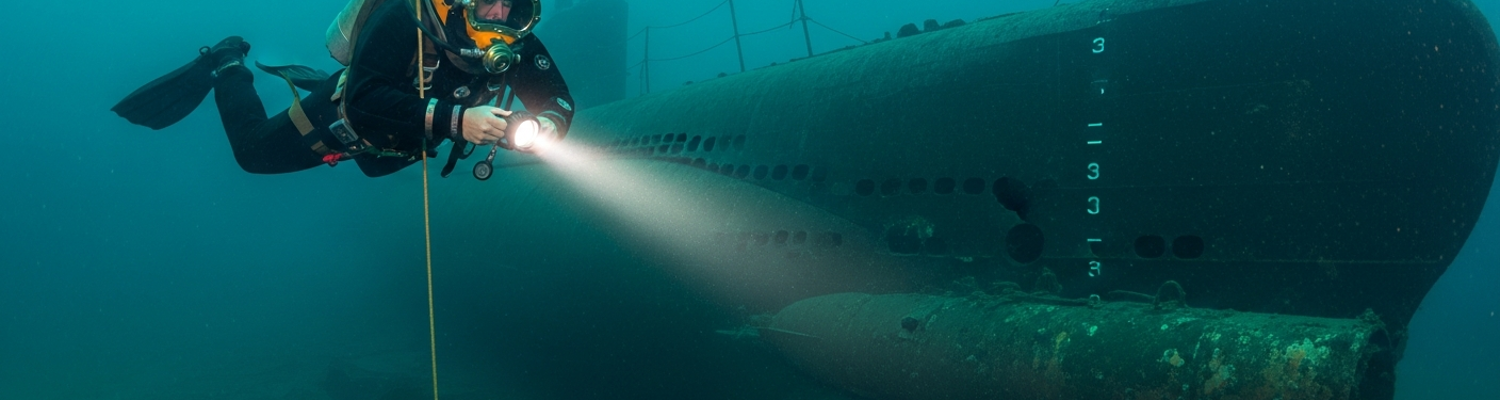
A defining development was the adoption and refinement of the U.S. Navy Mark V Diving Dress, a system that would become the global standard for naval underwater work for over six decades. First introduced in 1916 and produced by manufacturers like Morse, Schrader, and DESCO, the Mark V was a masterpiece of rugged engineering. Its helmet, a 55-pound assembly of spun copper and bronze, featured four glass viewports and a hinged faceplate. The complete suit, a heavy rubberized canvas dress, a leather weight belt with 84 pounds of lead, and 17.5-pound lead-soled boots, created a sealed environment against the crushing pressure of the deep. Air and communications lines fed from the surface through a thick umbilical. This umbilical included a critical non-return valve inside the helmet to prevent a catastrophic suit squeeze, a condition where a sudden loss of surface air pressure would cause the water pressure to violently crush the diver inside the rigid helmet and suit. The professionalization of diving was institutionalized with the re-establishment of the Naval School, Diving and Salvage, at the Washington Navy Yard after the 1927 loss of the submarine USS S-4. Here, sailors learned to master the Mark V and the unforgiving physics of their new workplace. They were not just salvage workers; they were becoming underwater technicians. The lessons from this era were clear: standardized, robust equipment and systematic training were essential for projecting naval power beneath the waves.
Squalus Recovery: Engineering Against the Abyss
The cold Atlantic waters off the coast of New Hampshire became the ultimate proving ground for the Navy’s deep-sea capabilities on May 23, 1939. The USS Squalus, a new submarine, suffered a catastrophic main induction valve failure during a test dive. It sank rapidly, settling on the seabed 243 feet below the surface. The accident instantly flooded the aft compartments, taking the lives of 26 men and trapping 33 survivors in the forward section. The Navy’s response mobilized a new generation of hardware and human expertise. At the center of the operation was Commander Charles “Swede” Momsen, an officer who had long championed submarine rescue innovations. He directed the complex effort from the submarine rescue ship USS Falcon (ASR-2). The primary tool was the McCann Rescue Chamber, a pear-shaped diving bell Momsen had helped develop. This nine-and-a-half-ton steel chamber could be lowered and sealed over a submarine’s escape hatch, allowing for a dry transfer of personnel.
Executing the rescue required divers to perform hazardous work at a depth that pushed the absolute limits of air diving. Working in the immense pressure, near-freezing temperatures, and total darkness, divers first had to locate the wreck and attach a steel downhaul wire to the forward escape hatch to guide the McCann chamber. To combat the debilitating effects of nitrogen narcosis, the “rapture of the deep” that impairs judgment at such depths, divers used a helium-oxygen (heliox) breathing mixture. This was a recent innovation from Momsen’s experimental diving unit, used for the first time in a real-world operation. Chief Machinist's Mate William Badders was one of the key divers who descended to the wreck. Over 13 hours, the McCann Rescue Chamber made four trips, pulling all 33 survivors from the wreck. The final ascent was fraught with tension when the downhaul wire jammed, forcing the surface crew to haul the chamber up manually. The successful rescue was a landmark achievement, but Momsen's work was not finished. He then led the 113-day salvage operation to raise the Squalus itself. This immense undertaking involved 648 individual dives. Divers used a newly developed tunneling lance, a long pipe that blasted high-pressure water, to excavate tunnels in the mud beneath the submarine's hull. Through these tunnels, they passed heavy lifting slings, which were then attached to large salvage pontoons. These pontoons were de-ballasted, and the submarine was painstakingly raised in stages. The operation provided an invaluable blueprint for complex, deep-water salvage, demonstrating that with specialized equipment, rigorous procedure, and trained personnel, the Navy could reclaim its assets from the abyss. The Squalus was later recommissioned as the USS Sailfish and went on to serve in World War II.
A World at War, An Ocean to Clear
The attack on Pearl Harbor on December 7, 1941, presented the U.S. Navy with the largest single salvage challenge in its history. The wreckage of sunken and damaged battleships choked the harbor, but within a week, a formal salvage organization was established under Captain Homer N. Wallin. This began an unprecedented underwater repair and recovery effort that would return many ships to the fight. Over the next two years, Navy divers spent approximately 20,000 hours underwater across 5,000 dives, facing hazards like unexploded ordnance, toxic gases, and jagged metal in near-zero visibility. The salvage of the USS California was a case study in this effort. Divers had to locate and patch over 150 holes in its hull. Then, a massive timber cofferdam was constructed around the ship's superstructure, allowing engineers to pump the vessel dry and refloat it. The battleships Nevada, California, and West Virginia, all sunk during the attack, were refloated, patched, and sent to mainland shipyards for complete reconstruction. These resurrected capital ships later provided critical naval gunfire support in campaigns across the Pacific. This massive effort demonstrated that forward-based salvage could rapidly restore combat power, a lesson that shaped naval logistics for the remainder of the war.
Across the Atlantic, Navy divers performed equally critical work clearing strategic harbors in the European Theater. As Allied forces advanced, retreating German and Italian troops systematically blocked key ports by scuttling dozens of ships in shipping channels, often with demolition charges and mines attached. Following the Normandy invasion, Navy salvage units were instrumental in opening the vital port of Cherbourg, France. The Germans had wrecked it with methodical precision, and its rapid opening was essential for supplying the Allied armies pushing into Europe. Divers worked in treacherous conditions, disarming booby traps on sunken vessels before they could even begin the process of cutting them up or refloiting them. Similar harbor clearance operations took place in Casablanca, Bizerte, Naples, and Manila. These units, often small and decentralized, operated from tenders and salvage vessels, living ashore like Seabees and working under arduous conditions. Their task was not just to raise wrecks but to clear the logistical arteries that supplied the Allied war machine.
In the Pacific, the island-hopping campaign depended on the ability to clear beachheads for amphibious landings. This mission fell to the newly formed Underwater Demolition Teams (UDTs). Composed largely of volunteers from the Navy’s Construction Battalions (Seabees), UDTs conducted reconnaissance and demolished natural and man-made obstacles. While salvage divers wore hundreds of pounds of gear to work on the bottom, UDTs operated with swim trunks, fins, and a diving knife, embodying a new, fast, and lightweight approach to underwater warfare. From Kwajalein to Okinawa, these “frogmen” ensured that landing craft could reach the shore, often working with explosives while under enemy fire. The work of both salvage divers and UDTs across two oceans underscored a fundamental lesson: control of the sea required mastery of the world beneath it. Their gritty, methodical work, far from the public eye, directly enabled the strategic mobility and logistical endurance that led to victory, establishing a lineage of underwater operational expertise that would eventually evolve into the modern U.S. Navy SEALs.