
Victory is not an ideal; it is a physical reality. It is ground taken and held. It is a fortress that cannot be breached and an enemy fortification that can be systematically dismantled. For the American Revolution, this physical reality was a foreign concept until it was imported. The war was nearly lost not for lack of courage, but for a fundamental ignorance of military engineering. The Continental Army could bleed, but it could not build. It could not besiege. It could not translate the abstract desire for freedom into the concrete control of territory. This is a lesson written in mud and timber, a warning about the bedrock of national power. Before the final victory at Yorktown, there was a quiet, intellectual revolution led by a French officer who understood that the ability to shape the battlefield is the ultimate expression of military will. The fate of the United States was decided not just by muskets, but by shovels, axes, and the unforgiving geometry of siegecraft.
The strategic cost of this engineering deficit was catastrophic. The loss of New York City in 1776 was a case study in failing to fortify key terrain against a professional amphibious force. A year later, the debacle at Fort Ticonderoga exposed the core of the problem. American commanders viewed the fort as the “Gibraltar of the North,” yet they failed to recognize the tactical importance of the overlooking Sugar Loaf hill (Mount Defiance). British General John Burgoyne’s engineers did. They laboriously dragged cannons to the summit, rendering the American position completely untenable without firing a single shot in anger. The Americans abandoned the fort, a massive blow to morale and a clear signal that they did not understand the three-dimensional battlefield. They were fighting a war of lines on a map while the British were fighting a war of topography and physics.
Importing a Science of War
The solution arrived in March 1777. Louis Le Bègue de Presle Duportail, a 33-year-old lieutenant colonel from the French Royal Corps of Engineers, landed on American shores. Recruited in Paris by Benjamin Franklin, he was a master of the methodical, mathematical school of siegecraft perfected by the French marshal Vauban. General George Washington’s army possessed a desperate need for his skills. A nominal engineering command had existed since June 1775 under Colonel Richard Gridley, but it lacked a corps of trained officers who understood the complex geometry of fortification and siege operations. Washington’s forces could erect crude breastworks, but they could not prosecute a formal siege or build defenses capable of withstanding European artillery.
Duportail and his three subordinate French engineers began an immediate, forceful professionalization of the army’s technical capabilities. Congress appointed him a colonel and Chief Engineer of the Continental Army in July 1777. His authority became absolute in May 1779 when, at his persistent urging, Congress authorized a formal Corps of Engineers. He was given command of all engineer officers and the newly created companies of “sappers and miners”—the enlisted specialists who would perform the dangerous work of digging trenches and clearing obstacles under fire. Duportail’s leadership was a systemic shock. He introduced the concepts of parallel trenches, zigzagging approach saps, angled bastions for creating interlocking fields of fire, and the precise construction of artillery batteries. He trained American officers, laying a foundation for a native engineering capability the nation desperately lacked. This was not a theoretical exercise; it was the direct application of military science that would first save the army from destruction and then deliver its most decisive victory.
Holding Ground at Valley Forge and West Point
The winter of 1777-1778 found the Continental Army shattered after defeats at Brandywine and Germantown. It withdrew to Valley Forge, a defensible plateau chosen by Washington to monitor the British in Philadelphia. Here, the new Corps of Engineers faced its first great test: turning a winter camp into a fortress. It became a laboratory for the army's emerging professionalism. The engineers laid out a defensive system of formidable strength. Two miles of fortifications transformed the camp, anchored by five earthen redoubts connected by trenches. Duportail himself drafted the topographical maps to site these defenses, including the key Fort Washington on a commanding hilltop.
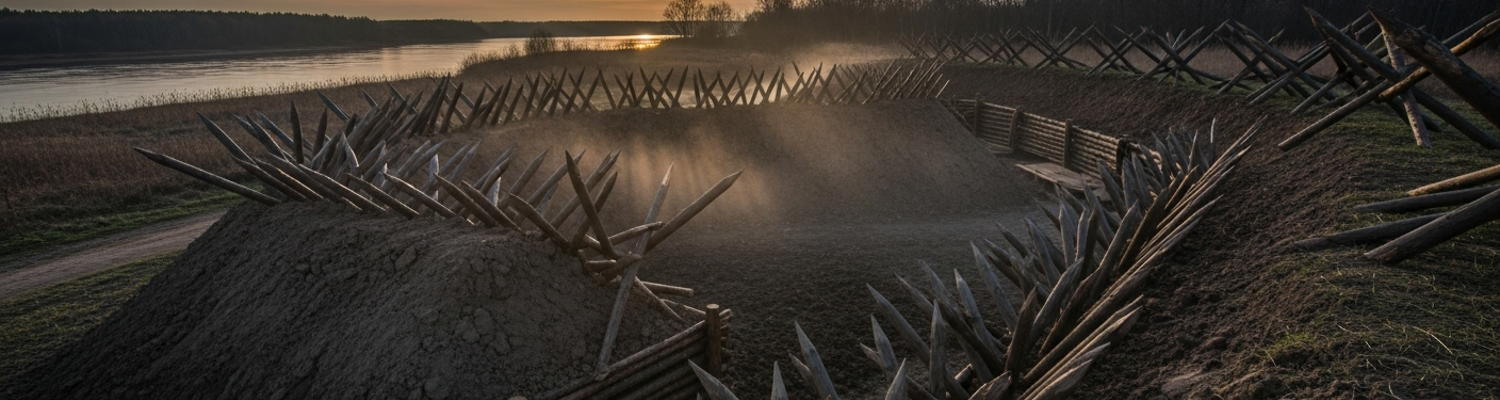
This was a massive construction project. The nearly 12,000 soldiers felled an estimated half a million board feet of timber to construct 1,500 log huts, creating the fourth-largest city in the colonies. To defend it, they dug deep ditches and erected obstacles called abatis—dense barriers of felled trees with their branches sharpened and pointed toward any attacker. These wooden spikes, embedded in earthworks, were designed to shred infantry formations and hold them in killing zones. The walls of the redoubts were reinforced with logs and gabions, wicker baskets filled with stone and soil. The finished encampment was so imposing that British General William Howe never risked an attack, ceding the Pennsylvania countryside to Washington.
While Valley Forge demonstrated defensive fortification, the work on the Hudson River showcased strategic area denial. Washington called West Point “the most important Post in America.” Its location at a sharp S-curve in the river forced sailing ships to slow, making them vulnerable to cannon on the heights. In 1778, Washington tasked the Polish engineer Colonel Thaddeus Kościuszko, with Duportail’s approval, to design a comprehensive defense. The result was Fortress West Point, a layered system of forts, redoubts, and batteries. The linchpin was the Great Chain, a 65-ton iron obstacle stretched across the river on April 30, 1778. Forged at the Sterling Iron Works, its massive links were floated on log rafts. A ship would have to brave a log boom and constant cannon fire just to reach it. Guarding this chain was a network of mutually supporting fortifications. On the main plateau sat Fort Arnold (later Fort Clinton), holding a garrison of 700. On the high ground behind it, engineers built Fort Putnam, a stone fort designed to rain “plunging fire” down on any land-based attack. The interlocking fields of fire from over 30 fortified sites made the complex virtually impregnable. The British understood this; their only attempt to take West Point came through the treachery of Benedict Arnold in 1780. The engineering had created a fact on the ground that military power could not overcome.
Executing the Yorktown Endgame
The culmination of the engineers’ war arrived in the fall of 1781. A British army under Lord Cornwallis had fortified the port of Yorktown, expecting support from the Royal Navy. A combined American and French army under Washington and Rochambeau marched south to trap him, while a French fleet under Admiral de Grasse blockaded the Chesapeake Bay, cutting off all hope of relief. Washington turned to his Chief Engineer, Louis Duportail, to design and execute the final act: a formal European-style siege.
The plan was a textbook application of Vauban’s science. The objective was to dig a series of trenches, or parallels, allowing heavy siege artillery to move ever closer until the British walls could be battered into submission. On the night of October 6, with a storm providing cover, 1,500 allied troops began digging the first parallel, a 2,000-yard-long trench roughly 800 yards from Cornwallis’s main line. American sappers and miners, alongside French troops, worked under the direction of engineers who had staked out the line. By October 9, the trench was complete, and the heavy guns of the “Grand French Battery” and American batteries opened fire. The bombardment was not a wild barrage; it was a methodical disassembly. Each cannon shot was a tool, chipping away at the structural integrity of Cornwallis's world.
To end the fight, the allies had to get closer. On the night of October 11, engineers laid out a second parallel, a mere 400 yards from the British works—point-blank range for siege cannon. Two advanced British earthen forts, Redoubt 9 and Redoubt 10, blocked the path. They had to be taken by direct assault. On the moonless night of October 14, French soldiers assaulted Redoubt 9 while a 400-man American column under Lieutenant Colonel Alexander Hamilton moved on Redoubt 10. At the very front of Hamilton’s force was its most vital component: a small party of sappers from the new Corps. Their only weapons were axes; their only mission was to run into a storm of musketry and hack a lane through the dense abatis. They were human breaching charges. With bayonets fixed and muskets unloaded to ensure surprise, the Americans stormed forward. The sappers breached the obstacles under fire, the infantry poured through the gap, and in less than 30 minutes, Redoubt 10 was in American hands.
The capture of the redoubts was the decisive action. Engineers immediately integrated the captured forts into the second parallel, constructing the “Grand American Battery” in the new, dominant position. From here, allied cannon could enfilade the entire British line, firing down its length with devastating effect. The British position became untenable. A desperate counterattack on October 16 failed. An attempt by Cornwallis to evacuate his army by boat was scattered by a storm. On October 17, a British drummer appeared on a parapet, beating the call for a parley. The surrender at Yorktown was not a miracle. It was the logical conclusion of a mathematical equation set in motion by engineers. This capacity, a fusion of technical knowledge, disciplined labor, and strategic foresight, is not a historical artifact. It remains the invisible foundation of sovereignty. The lines staked out in the Virginia mud were a declaration that independence is not simply won; it must be built, fortified, and defended on the ground.