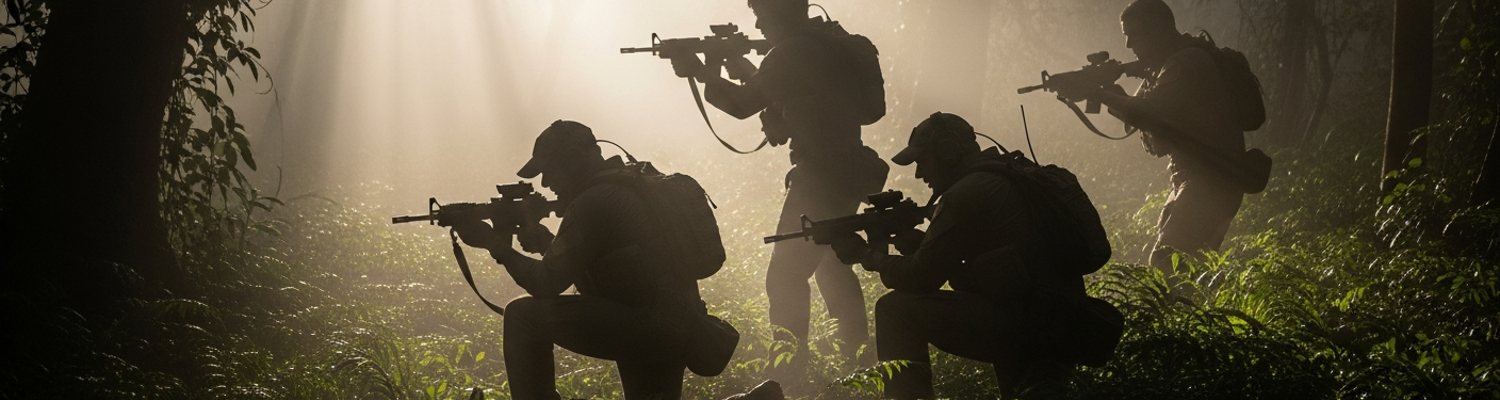

In the tense, bipolar landscape of the early Cold War, the United States Army confronted a new form of conflict. This war was fought not on conventional battlefields but in the shadows of political subversion and insurgency. The hard-learned lessons of World War II, particularly from the operations of the Office of Strategic Services (OSS), revealed a critical gap in American military capability. To counter Soviet expansionism and its support for 'wars of national liberation,' the Pentagon required a new type of soldier, a warrior-diplomat capable of operating deep within enemy territory, organizing resistance, and fighting a political-military battle. This strategic imperative led to the 1952 formation of the U.S. Army Special Forces, an elite unit that would become America's unconventional shield.
Forging a New Blade from Old Steel
The U.S. Army Special Forces was officially born on June 19, 1952, with the activation of the 10th Special Forces Group (SFG) at Fort Bragg, North Carolina. Its creation was not a spontaneous event but the culmination of determined efforts by a small cadre of influential officers, many of them veterans of the OSS. Foremost among them was Colonel Aaron Bank, a former OSS Jedburgh team leader who had parachuted into France to aid the resistance. Bank, widely recognized as the 'Father of Special Forces,' envisioned a permanent military force that would master the arts of unconventional warfare (UW).
Bank, along with other OSS alumni like Colonel Wendell Fertig and Lieutenant Colonel Russell Volckmann, who had led guerrilla forces against the Japanese in the Philippines, shaped the foundational doctrine of the new unit. This doctrine was a radical departure from conventional military thought. It centered on infiltrating small, highly trained teams into denied areas to organize, train, equip, and lead indigenous guerrilla forces. The primary mission of the 10th SFG was explicitly designed for the European context. Its purpose was to conduct partisan warfare behind the lines of the Warsaw Pact in the event of a Soviet invasion of Western Europe. The concept was a direct counter to the perceived Soviet strategy of using its own stay-behind networks.
The operational concept was complex, blending guerrilla warfare with psychological operations (PSYOP) and foreign internal defense (FID). The unit was initially established under the Army’s Psychological Warfare Center, headed by Brigadier General Robert McClure, reflecting the belief that the political and psychological dimensions of conflict were inseparable from the military ones. PSYOP was intended to erode an enemy’s will to fight and bolster the morale of allied partisans. FID, a mission that would grow in prominence, focused on assisting friendly governments to prevent and defeat insurgencies and subversion within their own borders. Recruitment for this new force reflected its unique mission. The Lodge-Philbin Act of 1950 enabled the enlistment of foreign nationals, particularly from Eastern European countries, who brought invaluable language skills and cultural knowledge of the anticipated operational areas behind the Iron Curtain. These men, combined with veterans of the OSS and elite airborne units, formed the core of 'The Originals' in the 10th SFG.
First Blood in the Shadows
The new doctrine was quickly put to the test. A year after its formation, in September 1953, the bulk of the 10th SFG deployed to Bad Tölz, West Germany, positioning themselves to execute their primary mission against the Soviet bloc. The remaining cadre at Fort Bragg formed the 77th Special Forces Group, which would later become the 7th SFG. While Europe was the main effort, the first combat deployments for Special Forces soldiers occurred in Asia. In 1953, ninety-nine graduates of the qualification course were sent as individual replacements to the 8240th Army Unit in Korea. There, they advised and assisted anti-communist North Korean partisans operating from islands off the coast, conducting raids and intelligence-gathering missions behind enemy lines. This experience, though small-scale, provided the first practical application of Special Forces' UW doctrine and validated the concept of working with and through indigenous forces.
A more significant and defining set of early operations took place in the Kingdom of Laos. Beginning in 1959, the United States initiated a clandestine mission to prevent a communist Pathet Lao takeover, a move deemed critical under the 'domino theory' that guided U.S. policy in Southeast Asia. The initial phase, codenamed Operation Hotfoot, involved the deployment of over one hundred personnel from the 77th and later 1st Special Forces Groups. Led by the legendary Lieutenant Colonel Arthur 'Bull' Simons, these teams operated in a covert capacity. They wore civilian clothes, carried civil service identification, and worked under the cover of the Programs Evaluation Office (PEO), a civilian-staffed agency that was the de facto replacement for a formal Military Assistance Advisory Group (MAAG) prohibited by the 1954 Geneva Accords.
Their mission was to train, advise, and equip the poorly led and ill-disciplined Royal Laotian Army (FAR). The SF teams, often split into smaller elements, spread across Laos’s five military regions, providing technical and tactical training. They taught everything from basic marksmanship to small-unit tactics, facing a Laotian force plagued by low morale, corruption, and a tendency to avoid direct conflict. The effort expanded beyond the FAR to include working with ethnic minorities. Under Operation Pincushion and through CIA channels, Green Berets began training Hmong and other hill tribesmen, organizing them into guerrilla units to fight the Pathet Lao and their North Vietnamese backers. Here, the force multiplier concept proved its worth. Small SF teams created effective fighting forces from motivated local populations, achieving results the FAR could not.
In 1961, the Kennedy administration made the U.S. commitment overt. The mission was renamed Operation White Star, and the Green Berets donned their uniforms as the PEO became a formal MAAG. The deployment in Laos was a mixed success. Special Forces prevented an immediate communist victory and demonstrated their capacity for FID and UW in a complex political environment. However, the operation drew the U.S. deeper into a convoluted conflict. The 1962 Geneva Accords officially neutralized Laos, leading to the withdrawal of the White Star teams. The war simply went back into the shadows, with the CIA taking over and continuing to use SF-trained Hmong fighters in a long, brutal, and ultimately unsuccessful secret war. The Laos experience became a template, for better and for worse, for the advisory effort unfolding in neighboring Vietnam.
Concurrently, the 1st Special Forces Group, activated on Okinawa in 1957, became the hub for unconventional operations throughout the Pacific. Its first detachments arrived in South Vietnam that same year. These teams were tasked with training the nascent South Vietnamese Army's Ranger companies. By 1961, with President Kennedy's approval, Special Forces began establishing the Civilian Irregular Defense Group (CIDG) program. This initiative focused on organizing and training ethnic minorities in the remote highlands, particularly the Montagnards, to defend their villages against Viet Cong infiltration. These CIDG camps became a cornerstone of the early American strategy in Vietnam, serving as centers for intelligence gathering, surveillance, and offensive operations, demonstrating the FID mission on a massive scale and setting the stage for the larger conflict to come.
The Crucible of Pineland
The ability of a twelve-man Operational Detachment Alpha (ODA) to operate autonomously in hostile territory was not an accident. It was the direct result of a grueling and transformative selection and training pipeline. Before a soldier could even begin the Special Forces Qualification Course (Q-Course), he had to pass Special Forces Assessment and Selection (SFAS). This phase was designed to weed out candidates who lacked the psychological resilience, maturity, and raw intelligence required for the job. It was less about physical strength and more about observing how a man handled stress, ambiguity, and teamwork when pushed to his absolute limit.
The Q-Course itself was designed to forge a unique operator, distinct from any other soldier in the Army. The training went far beyond conventional infantry skills, instilling deep expertise in five core areas, represented by the MOS (Military Occupational Specialty) of the NCOs on a team: Weapons (18B), Engineering (18C), Medical (18D), and Communications (18E). Weapons Sergeants mastered a vast array of U.S. and foreign arms. Engineer Sergeants became experts in demolition and construction. Communications Sergeants learned to operate a variety of radios, ensuring the team’s lifeline to the outside world.
The Special Forces Medical Sergeant (18D) training was, and remains, one of the most intensive medical courses in the military. It created a paramedic-level expert capable of performing minor surgery, administering preventative medicine, and managing the health of both the team and their indigenous partners. This skill was often the key to gaining access to and building rapport with local populations in austere locations. All team members were cross-trained in each other’s basic skills, ensuring redundancy and adaptability. Language and cultural training were paramount, enabling operators to build the trust necessary to organize and lead foreign forces.
The entire process culminated in an immersive unconventional warfare exercise called Robin Sage. First known by other names like Cherokee Trail, this exercise dropped student-led ODAs into the fictional country of 'Pineland,' a vast area of rural North Carolina. There, they had to link up with a guerrilla force (played by other soldiers and civilian volunteers) and lead them in a campaign against an occupying power. Robin Sage was the final test. It forced candidates to apply all their skills in a realistic, unscripted environment that demanded self-reliance, ingenuity, and the ability to navigate complex human and political dynamics. The soldier who emerged was a new breed, the product of a vision born in the ashes of WWII and forged for the long, twilight struggle of the Cold War.