
A Forgotten Victory and a Squandered Lesson
In the autumn of 1919, Rear Admiral Joseph Strauss submitted his final report on the clearing of the North Sea Mine Barrage. His force of 82 ships and over 4,000 men had spent five grueling months neutralizing the colossal minefield the Allies had laid to trap German U-boats. The operation was a grim, hazardous success. The U.S. Navy’s own purpose-built Lapwing-class minesweepers, rugged 187-foot steel ships displacing 950 tons, had been instrumental. Their endurance and seakeeping qualities, products of wartime urgency, proved the value of a dedicated, oceangoing minesweeping fleet. They had located and destroyed thousands of American Mk 6 antenna mines, a weapon so sensitive that many had self-detonated in winter storms. The sweepers methodically severed mooring cables and destroyed the horned mines with rifle fire as they surfaced, a nerve-wracking process that validated their design and the training of their crews.
Yet, the institutional memory of this achievement vanished with the ink on Strauss's report. A powerful wave of isolationism and a political mandate for a "return to normalcy" drove a swift, deep demobilization. By 1922, the U.S. Navy’s manpower was slashed from its wartime peak of over half a million to just 137,000. The vast fleets of specialized vessels were laid up in reserve. The 54 ships of the Lapwing class, the Navy’s first true fleet minesweepers, were scattered. Some were decommissioned entirely. Others were converted to perform duties as seaplane tenders, salvage ships, or gunboats in places like the Yangtze Patrol. USS Gannet (AM-41) became a survey ship. USS Pelican (AM-27) was converted into a submarine rescue vessel. This dispersal of assets also meant the dispersal of expertise. The hard-won knowledge of mine warfare, from sweep tactics to logistical support, was allowed to atrophy, kept alive only by a handful of prescient officers within the Navy’s technical bureaus. The triumph in the North Sea became a historical footnote, planting the seeds of a profound unpreparedness for the next global conflict.
The Lean Years of Doctrinal Stagnation
Throughout the 1920s and into the late 1930s, the U.S. Navy’s mine warfare capability withered on the vine. The interwar period was defined by severe fiscal constraints and the strategic limitations imposed by the Washington and London Naval Treaties. These agreements focused exclusively on capital ships, battleships and aircraft carriers, leaving the development of auxiliary fleets to fester. Within the Naval War College, strategists gamed out grand fleet engagements decided by 16-inch guns, while the unglamorous work of clearing sea lanes was relegated to an afterthought. No new classes of dedicated minesweepers were designed or procured for nearly two decades. The Navy’s operational plans rested on the flawed assumption that, in a future war, civilian fishing trawlers and coastal vessels could be rapidly converted for the task, just as they had been in 1917. Planners failed to appreciate that the character of mine warfare was about to change fundamentally.
This stagnation occurred as potential adversaries pushed technology forward. German and British engineers, unconstrained by the same strategic blind spots, were developing influence mines. By the mid-1930s, Germany had a functional magnetic influence mine, the Luftmine Typ A (LMA), designed for aerial delivery. By 1940, an acoustic version was ready for deployment. These weapons did not require a ship’s hull to make physical contact. They rested on the seabed and were triggered by the magnetic signature of a steel hull passing overhead or the specific acoustic frequency of its propellers and machinery. This technological leap made conventional sweep gear, which used Oropesa floats and serrated wires to cut the mooring cables of buoyant contact mines, completely ineffective. The U.S. Navy, with its shoestring budget for mine countermeasures, had no answer. The Naval Ordnance Laboratory, the primary American mine warfare test station in Solomons, Maryland, began its vital work with a skeleton crew of one officer and one enlisted man. This systemic neglect ensured that when war finally arrived, the fleet would be caught dangerously behind in equipment, ships, and doctrine.
A Desperate Scramble for a Fleet
The crisis in Europe beginning in September 1939 was a violent wake-up call. The Royal Navy, caught completely off guard by German magnetic mines dropped in the Thames Estuary, suffered immediate shipping losses. The frantic British effort to understand and counter this new threat, including the heroic recovery of an intact mine from the mudflats at Shoeburyness, exposed the U.S. Navy’s two-decade-long capability gap. The urgent need for a modern mine warfare fleet could no longer be deferred. The response was an eleventh-hour development and shipbuilding program of immense scale.
The Bureau of Ships (BuShips) initiated design work on two parallel tracks. The first was a new class of steel-hulled fleet minesweepers. The keel for USS Raven (AM-55), the prototype, was laid at the Norfolk Navy Yard on June 28, 1939. Commissioned in November 1940, the Raven was a 220-foot, 810-ton vessel designed specifically for the new reality of naval warfare. It served as the direct template for the Auk-class, the ships that would form the backbone of America’s offensive minesweeping effort. Displacing 890 tons, the Auks were fitted with a robust diesel-electric propulsion system. This drive train was selected not for speed, which was a modest 18 knots, but for its ability to generate the massive electrical power required for magnetic sweep gear. Armed with a single 3-inch/50 caliber gun and anti-aircraft machine guns, ninety-five of these capable ships would be constructed between 1941 and 1945.
Simultaneously, the Navy recognized the need for a smaller, more numerous vessel for coastal and harbor clearance. The solution was the Auxiliary Motor Minesweeper, or YMS. The keel for YMS-1 was laid on March 4, 1941. These were intentionally simple 136-foot, 270-ton vessels built with wooden hulls and powered by diesel engines. The wooden construction was a deliberate choice to reduce the ship's own magnetic signature, making it less vulnerable to the very weapons it was designed to hunt. Their design facilitated rapid mass production at 35 smaller yacht and boat yards across the country, bypassing the already-strained major naval shipyards. This decentralized production was a feat of industrial mobilization. Over 480 of these yard minesweepers were built for the U.S. Navy, with hundreds more provided to Allied nations under Lend-Lease. This sudden explosion of shipbuilding was a direct admission of the profound neglect of the preceding twenty years.
Trial by Fire and the Price of Adaptation
The new fleet and its green crews were thrown immediately into the fight. Doctrine was often developed on the fly and disseminated to training centers in Yorktown, Virginia, and Little Creek, Virginia, where reserve officers and enlisted men learned their hazardous trade. As early as 1942, YMS boats were sweeping for suspected enemy mines off American ports like Charleston and Jacksonville. The more capable Raven and the first of the Auks were deployed to support Operation Torch, the Allied invasion of North Africa, in November 1942. There, and in every subsequent amphibious operation, they performed their perilous mission. They were the unseen guardians who went in first, clearing the paths for invasion fleets and ensuring vital supply lines remained open. The unofficial motto of the minesweeping crews became a simple statement of fact: "...wherever the fleet goes, we've been."
Crews learned to master complex and dangerous equipment under combat conditions. For magnetic mines, they streamed a pair of buoyant electrical cables, the LL sweep, which passed a powerful 3,000-amp current into the water to create a magnetic field that would detonate mines at a safe distance astern. For acoustic mines, they towed a device known as the "hammer box," an underwater noisemaker that mimicked the sound signature of a larger ship. The work was slow, methodical, and filled with constant tension. A single missed mine could mean disaster for a troopship or a battleship following in the swept channel.
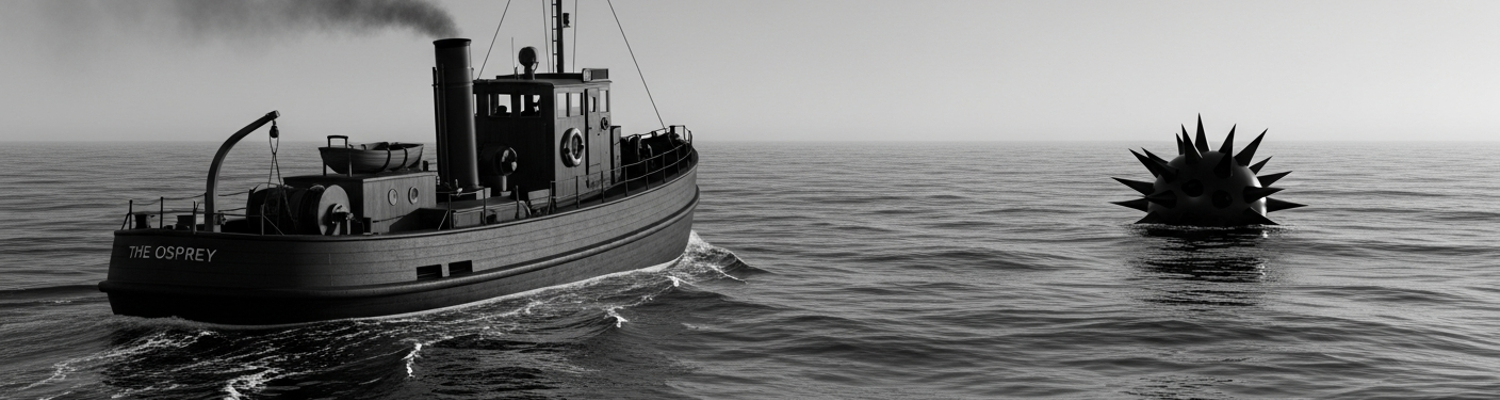
The price of this rapid, wartime adaptation was paid in steel and lives. On June 5, 1944, the day before the Normandy landings, USS Osprey (AM-56), sister ship to the Raven, struck a German mine while clearing the approach channels for the Utah Beach assault force. She sank in less than five minutes with the loss of six crewmen. In the Pacific, during clearance operations at Balikpapan, Borneo, in June 1945, a dense and expertly laid Japanese minefield combining magnetic, acoustic, and pressure-activated mines claimed seven YMS minesweepers in a matter of days. Their wooden hulls were not enough to protect them from the influence of their own engines and equipment against these advanced weapons in shallow water. Despite the losses, the men and ships of the mine force proved their value. Through ingenuity and relentless effort, they adapted, they learned, and they cleared the way. The story of the interwar minesweeper fleet is a stark cautionary tale of how easily vital military capabilities can be discarded in peacetime. It is also a powerful acknowledgment of the perseverance of the planners, engineers, and sailors who, when faced with a critical failure in foresight, raced against time to build a weapon from almost nothing and sail it directly into harm's way.