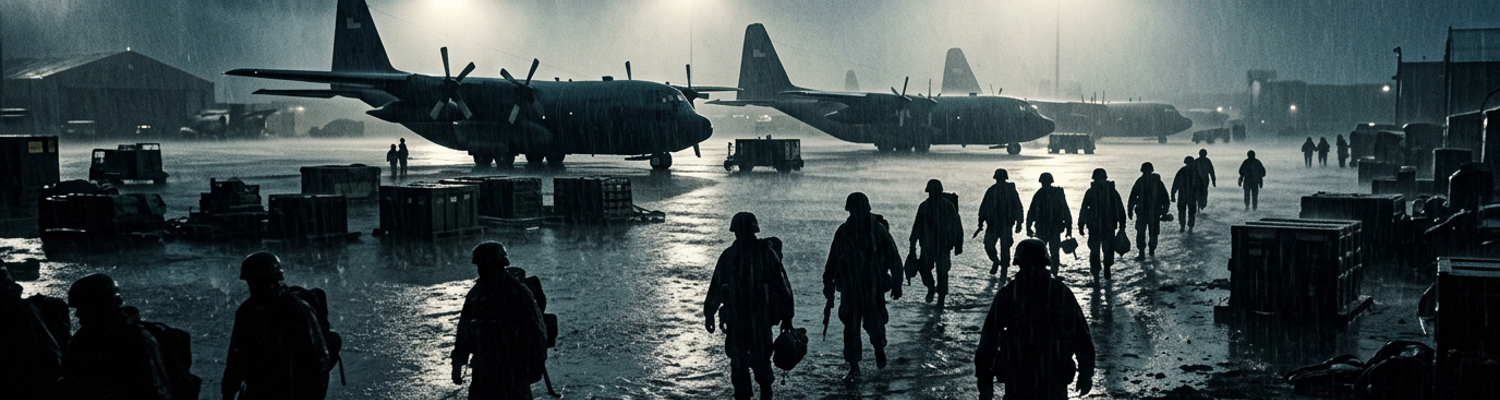

Immediate Aftermath at Sunlight Field Runways
Carpenter's Mate Second Class John V. Vance spent thirty minutes wiping hydraulic residue from the landing gear linkage of an Interstate TDR-1 assault drone. Tropical squalls tore through Banika Island. He tightened a single three-eighths-inch castellated nut on the port shock strut. He wiped grit from the exposed oleo tube. He packed his grease gun into a steel chest. Minutes later, four inches of equatorial rain inundated Sunlight Field. The deluge stripped the binding silt from the crushed-rock revetments. It drowned open electrical pits across the strip.
Water destroyed the equipment before Japanese anti-aircraft batteries could engage.
When examining the historical record from mid-1944, the immediate aftermath across the Russell Islands was defined by a heavy silence. This silence blanketed the forward staging points of the 35th Naval Construction Battalion. Exhausted Seabees emerged from palm-log bunkers around Sunlight Field into stagnant eighty-eight-degree air. They found their work sites completely immobilized under standing pools of runoff. Engine bays stood open. Their wiring harnesses were soaked. Radio frequency calibration tents set up near Renard Sound had collapsed under the weight of accumulated rain.
No engines turned over.
Generators sat dead in six inches of mud. Their magneto housings were waterlogged. Technicians stood motionless along the flooded drainage ditches cut through the coconut groves. The camp perimeter at Renard Sound recorded zero vehicular movement for four hours. Diesel fuel drums floated past the motor pool apron.
A close review of operational logs indicates that emergency engineering survey parties from the 35th Battalion deployed onto the flight line before the downpour had fully receded. Survey teams pushed steel dynamic cone penetrometers directly into the runway axis at Sunlight Two. They recorded bearing pressures that had dropped well below the six-thousand-pound requirement needed for loaded aircraft.
Banika's native volcanic clay subgrade had liquified beneath the five-inch veneer of compacted brain coral.
Whole twenty-foot stretches of the main taxiway exhibited severe shear failure. Heavy washouts cut lateral ruts eight inches deep across the dispersal turnouts. The three-ton twin-engine TDR-1 drones could not cross these gaps. Their tricycle undercarriages would collapse. Field engineers measured surface depressions exceeding four inches along the central spine. This was the exact path where the heavy TBM-1C Avenger control ships were scheduled to taxi. Pavement thickness gauges confirmed that the crushed coral had washed off the crowned centerline directly into the flanking culverts. Bare clay was exposed across forty percent of the taxi track.
Every foot of the staging area had turned into a structural hazard.
Archival evidence shows that Commander Robert F. Jones received the engineering reports at field headquarters. He initiated immediate operational halt orders to all Project Option forward staging detachments. Priority dispatch traffic went out across the Commander Aircraft South Pacific communications net. This order froze the scheduled combat runs against the Japanese garrison at Rabaul. Ground crews disconnected auxiliary power units from the drone battery trays. They pulled the radio control receiver crystals. They locked the guidance transmitters inside mobile command vans.
Forward staging personnel on Green Island and Stirling Island were ordered to suspend fuel bunkering operations. They halted all munitions loading on the assault craft. Test flights slated for dawn were canceled outright. Mechanics pushed the drones into dispersed revetments to prevent their wooden airframes from rotting in the standing water. Communications logs confirm that every remote control team from Guadalcanal to the Treasury Islands ceased transmitter checks by eighteen hundred hours.
Subsoil Liquefaction and Coral Runway Collapse
The subsurface failure at Sunlight Two began when ninety-six hours of continuous monsoon precipitation saturated the montmorillonite volcanic clay base beneath the primary runway. Field personnel of the 35th Naval Construction Battalion had laid down an eight-inch mantle of crushed brain coral directly over this unsealed clay layer during dry weather conditions in 1943.
Heavy rainfall forced hydrostatic pressure to build within the uncompacted subgrade.
The lateral open drainage trenches along the eastern tree line choked on volcanic silt. Trapped groundwater could not percolate downward through the bedrock. It could not exit through the blocked ditches. Soil core samples extracted along the three-thousand-foot mark showed that excess pore-water pressure reduced the effective shear strength of the clay to zero. Solid foundation earth turned into a viscous slurry. The weight of the overlying crushed coral pushed downward into this fluid mass. The stone aggregate sank unevenly across a four-hundred-yard sector. Survey teams recorded elevation drops of up to fourteen inches along the centerline within six hours of the storm peak.
Compacted coral gave way to liquid mud.
This subgrade displacement rapidly destroyed the pierced steel planking laid across the runway surface. Marston matting panels were designed to distribute surface loads across firm ground through interlocking side bayonets and slots. These panels buckled as the supporting coral ballast washed out from underneath. Cletrac M2 high-speed tractors and six-ton fuel servicing trucks moved toward the revetments. Their weight forced thirty-pound steel sheets to flex downward into the mud pockets. The lateral locking tabs snapped under bending fatigue.
Deprived of base support, adjacent ten-foot steel sections bent upward at forty-five-degree angles.
Jagged transverse ridges formed across the main takeoff strip. Maintenance crews attempted to realign the decking with sledges. They found that the underlying mud welled up through the rows of eighty-seven punched holes per plank. The traction surface was covered in grease-like silt. Mobile crane units attempting to lift the warped panels snapped their outrigger plates against the soft shoulders. Heavy aircraft tugs sheared their drive axles when their dual tires broke through the sheared interlocking seams.
The steel skin tore itself apart under every passing wheel.
This mechanical degradation of the runway surface made safe flight operations an impossibility for Special Task Air Group One. The Interstate TDR-1 assault drone required a flat surface for its long takeoff run. The aircraft relied on a delicate fixed tricycle landing gear system with narrow low-pressure tires and wooden structural members. Carrying a two-thousand-pound Mark 13 aerial torpedo brought the twin-engine drone to an all-up operating weight of nearly eight thousand pounds.
Test pilots and radio-control operators attempted staging maneuvers.
The nosewheel assemblies encountered the undulating Marston matting. They sank repeatedly into structural depressions. Sudden vertical shocks transferred into the wooden forward fuselage mounts. Rolling resistance increased by more than three hundred percent over the submerged steel sections. The twin 220-horsepower Lycoming O-435 engines could not accelerate the aircraft to its required sixty-five-knot rotation speed within the four-thousand-foot runway limit.
Three production airframes sustained cracked wing spars and fractured oleo scissors before reaching five hundred yards.
Propeller tips on two drones struck warped Marston edges. The wooden laminate blades shattered. Debris sprayed into the staging revetments. Flight operations ceased across Sunlight Field before a single armed drone could leave the island. Commander Jones formally suspended all flight trials on Sunlight Two at twenty-one hundred hours. Field engineers reported that forty percent of the runway base had suffered structural displacement.
Replacement pierced steel planking had to be diverted by barge from Tulagi. Seabee bulldozers were forced to strip the ruined coral crust down to the wet clay subsoil over an area covering twelve thousand square yards. Technical inspection tags filed that evening confirmed that salt-laden mud slurry had penetrated the wheel bearings. The lower control horn pivots and lower antenna fairings of all eighteen operational TDR-1 airframes parked along the staging apron were compromised. Repair crews drained seventy gallons of contaminated fuel from apron bowsers. These bowsers had settled into standing water above their wheel hubs. Base ordnance officers canceled the planned munitions hoist operations for the morning strike schedule.
Flooding of Mobile RCA Television Receiving Vans
Three mobile telemetry vans belonging to Special Task Air Group One sat parked along the western edge of Sunlight Two when the cloudburst broke. These trailers contained the specialized RCA-designed ground telemetry stations. They received line-of-sight television broadcasts sent from the nose cameras of airborne TDR-1 assault drones. The equipment was built into insulated steel bodies mounted on standard six-by-six truck chassis.
Heavy runoff cascaded down from the adjacent coconut plantations.
The water overwhelmed the shallow gravel trenches dug around the vehicle wheels. Water rose fourteen inches above the axle hubs within thirty minutes. Rubber gaskets around the rear double doors had deteriorated under months of tropical heat. Torrents of rainwater mixed with volcanic sediment forced past the door seals. Inundation entered through unsealed roof vents and uncaulked bulkhead ports meant for external coaxial cables. Gallons of water dumped across the lower equipment racks.
Steel battery boxes mounted on the vehicle floorboards shorted out on contact with the rising tide.
The primary direct-current converter units and twenty-four-volt auxiliary charging banks drowned under six inches of stagnant silt-heavy water. Brine and volcanic silt submerged the lower power transformers within forty minutes of the storm front. The physical environment immediately triggered severe dielectric breakdown throughout the unsealed television chassis. Inside the damp vans, atmospheric relative humidity reached saturation. Condensation beaded across the exposed glass envelopes of the vacuum tube banks. The outer surfaces of the nine-inch cathode-ray displays were covered in moisture.
Technicians attempted to restart auxiliary power to assess component integrity.
The high-voltage circuits supplying five thousand volts to the cathode-ray tube acceleration anodes suffered catastrophic dielectric collapse. Arcs jumped six-inch gaps across phenolic tube sockets. Terminal strips were scorched. Delicate wiring harnesses vaporized. Salt-crusted moisture across the unsealed mica capacitors and carbon composition resistors formed conductive paths to ground. Breakers tripped. Primary transformer windings melted. Plate voltages on the 6AC7 video amplifier stages dropped to zero as ceramic insulators cracked under thermal and electrical stress.
High-voltage rectifiers blew their filaments in rapid succession.
Acrid smoke filled the sealed interior compartments. The primary video monitoring screens went dead. High-voltage flashovers fractured three cathode-ray tube glass necks before technicians cut the main circuit breakers. Base technicians and civilian RCA field engineers launched desperate technical recovery efforts. They needed to salvage the sensitive airborne video demodulator units pulled from the flooded trailers. Demodulators operated on high-frequency intermediate channels that required exact capacitance and inductance values. Moisture trapped inside the intermediate-frequency transformer cans rendered them unable to separate synchronizing pulses from picture video signals.
Lacking replacement subassemblies on Banika Island, Navy aviation radio technicians dismantled the sealed chassis.
They constructed field-improvised heating coils using lengths of nichrome resistance wire salvaged from wrecked Douglas SBD dive bomber cabin heaters. Radio operators wound the raw resistance wire around porcelain radio antenna insulators. They anchored the assemblies inside cylindrical sheet-metal stovepipes. Technicians hooked these heating elements to a small two-stroke Onan generator parked outside under a canvas tarp. They used a hand-cranked forge blower to force dry superheated air across the damp coils and circuit boards.
Crews spent five hours blowing hot air directly over the tuning slugs.
They dried the wax-dipped paper capacitors and RF coils to drive trapped water out of the component windings. Inspection records at dawn showed that twelve demodulator filter chokes suffered permanent coil failure from localized thermal shock.
Degradation of 56-Megacycle Remote Command Linkages
Naval staff officers with Commander Aircraft South Pacific had identified persistent radio frequency degradation over the Solomon Sea a full year before STAG One deployed to the Russell Islands. Official June 1943 South Pacific naval war diaries documented that the very-high-frequency radio carrier waves tuned to fifty-six megacycles suffered rapid power losses. This occurred whenever transmitters broadcast through saturated maritime air masses.
Communications engineers operated out of Henderson Field on Guadalcanal and the naval advanced base on Tulagi.
They tracked radio frequency signal drops exceeding twelve decibels over distances of less than fifteen nautical miles during morning squalls. High atmospheric absolute humidity caused dielectric absorption and scattering along the direct line of sight. Microscopic water droplets were suspended between sea level and four thousand feet. Signal strength charts filed in the June logs recorded that receiver signal inputs repeatedly dropped below the five-microvolt threshold necessary to activate mechanical control relays.
The fifty-six-megacycle wave front scattered across ambient moisture gradients.
Receiving apparatus on target drones starved of adequate field strength. Signal loss meant unguided flight. Physical moisture intrusion inside the external antenna assemblies crippled the mechanical link between receivers and control surfaces. Technicians mounted cast-aluminum antenna coupling boxes onto the upper plywood fuselages of the Interstate TDR-1 airframes. This matched the impedance between the quarter-wave whip antennas and the internal coaxial transmission lines.
Ambient temperatures on the Sunlight Field flight line regularly swung from seventy-four degrees Fahrenheit during downpours to over one hundred degrees under midday sun.
This temperature shift drew water vapor through deteriorated neoprene perimeter gaskets. Trapped vapor condensed on the internal porcelain standoff insulators and silver-plated contact clips. Conductive liquid bridges formed across the terminals. High-frequency RF energy discharged directly to the grounded casing rather than radiating into the receiver circuitry. The standing wave ratio skewed past four to one. Audio-frequency command filters were configured to decode specific pitch tones for left rudder, right rudder, and throttle retard. They received fragmented bursts of carrier noise instead of continuous instructions.
Servo actuators responded to these intermittent dropouts by kicking control surfaces into hardover positions.
The surfaces snapped back to neutral. This destabilized the drone during low-altitude engine run-ups. Flight crews operating modified Grumman TBM-1C Avenger control aircraft faced severe operational telemetry failure risks when attempting to maintain station behind the unmanned airframes. Naval air group engineers had replaced the standard dorsal gun turret of each TBM-1C with an operator station. This station housed an RCA television monitor, a control stick console, and twin fifty-six-megacycle command transmitters.
High-density tropical air created severe thermal inversion layers during formation flights along the coast of Pavuvu and the Russell Islands.
These layers refracted the directional transmissions beamed between the lead Avenger and the drone. Radio operators in the rear cockpit watched the returned television telemetry signal break up into heavy horizontal tearing and snow. This happened whenever the drone drifted into wet cloud bases. The remote pilot relied entirely on line-of-sight visual feedback from the drone nose camera to correct pitch and roll. Five seconds of telemetry dropout blinded the operator at speeds above one hundred forty knots.
Flight records from July trials show that two test drones entered uncontrolled shallow dives into Ironbottom Sound.
Telemetry loss prevented the TBM-1C flight officer from initiating radio command trim corrections. Maintenance logs recorded four completely burned transformer coils in the Avenger transmitter racks before morning inspections ended.
Emergency War Diary Dispatches and Technical Records
Inside the sodden administrative tent of Special Task Air Group One pitched near Sunlight Two, technical officers worked through the night of July 28, 1944. They typed damage assessments directly into the unit war diary. Water dripped from the saturated ridgepole onto the steel platens of Underwood standard typewriters. Standard naval message blanks wrinkled in the humidity.
Lieutenant Commander James E. Dobson dictated entries between generator surges.
He cataloged thirty-two distinct airframe and avionics system failures sustained across eighteen Interstate TDR-1 drones within ninety minutes of the cloudburst. Yeomen hammered keys to record burned-out azimuth steering servos. They logged fractured sitka spruce wing ribs and short-circuited radio receiver power boxes. Every page logged mechanical ruin in standard Bureau of Aeronautics ledger formatting.
Technicians in grease-streaked dungarees brought in ruined parts from the flight line.
They dumped cracked phenolic terminal blocks and sheared steering pushrods directly onto the plotting tables. They verified each serial number before entry. Typewriters rattled inside the tent while drowned generators sputtered outside in the mud. STAG-1 maintenance personnel documented unprecedented galvanic destruction across the electrical interconnections of both the assault drones and the control equipment. Interstate Aircraft had assembled the TDR-1 airframes using off-the-shelf civilian commercial components. These components were never treated for equatorial service.
Standard Amphenol multi-pin plugs featured non-marinized brass contact pins and unanodized cast-pot-metal shells.
These had been inserted into exposed aluminum junction boxes along the lower fuselage. Relative humidity settled at ninety-eight percent under ambient temperatures exceeding ninety degrees Fahrenheit. Condensed salt-heavy moisture formed persistent electrolytic pools inside the pin sockets. Technicians recorded copper and brass pins developing dense crusts of green verdigris within twelve hours of atmospheric exposure. Cadmium plating on internal chassis screws flaked off completely after forty-eight hours.
Galvanic reactions bonded steel fasteners permanently to aluminum baseplates.
Insulation resistance values between adjacent terminal lugs degraded to zero point zero five megaohms. These values were rated for hundreds of megaohms during factory testing in California. The degradation caused direct voltage cross-feeds. These cross-feeds triggered premature rudder solenoid activations and cooked the sensitive silver relay contacts. Salt spray corroded the brass pins before mechanics could finish their second flight-line inspection.
Base communications personnel funneled urgent priority dispatches from Banika Island through the fleet radio hub at Tulagi.
These messages went directly to the Chief of the Bureau of Aeronautics, Rear Admiral DeWitt C. Ramsey, and the Bureau of Ships in Washington. Encrypted operational cables detailed the severe physical vulnerability of remote-controlled weapon systems operated under South Pacific equatorial conditions. Base leadership warned naval planners that civilian electronic design specifications could not withstand forward-area deployments. These deployments lacked sealed maintenance hangars, forced-air dehumidification systems, and hermetically sealed component housings.
Early combat drones required factory-level waterproofing.
They needed silicone-sealed wiring runs and gold-plated electrical contacts before remote-control guidance could function across maritime forward zones. Technical dispatches stressed that airframes made from resin-bonded wood softened and warped along their glue lines within seventy-two hours of sustained humidity. This shifted the drone center of gravity and bound the elevator cables inside their guide pulleys. Teletype machines in Washington took down the failure reports twelve thousand miles away from the Solomon Sea.
Engineering reports sent to naval bureau chiefs documented that airborne television gear broke down faster than ground crews could unpack replacement chassis from wooden crates.
Twenty-four spare RCA image iconoscope tubes shipped in standard crates from Pearl Harbor. Twelve arrived with fractured glass envelopes caused by handling across rough coral transfer points. Eight others suffered internal vacuum failure due to moisture penetrating their unsealed metal-to-glass seals during sea transit. Bureau of Aeronautics planners received flight trial cancellation notices. Five consecutive drone test launches failed due to receiver signal degradation before reaching three hundred feet altitude.
STAG-1 technical officers closed the July war diary dispatch ledger with an inventory confirmation.
Only three airframes out of eighteen retained reliable remote guidance controls. Zero spare radio demodulators were operational on the island. The final dispatch log recorded serial number 33916 scrapped for parts at twenty-three hundred hours.
Equatorial Staging Doctrine and Forward Base Redesign
The mechanical breakdown at Sunlight Field forced the Bureau of Aeronautics to discard its baseline forward-basing assumptions for Project Option. Standard open-air maintenance tents and canvas revetments could not protect unsealed vacuum tube guidance electronics against South Pacific vapor pressure. Bureau planners in Washington received urgent dispatches from Banika Island demanding insulated maintenance quarters capable of maintaining continuous environmental control.
Navy procurement officers at the advanced supply depot on Espiritu Santo acted immediately.
They diverted twelve commercial Carrier Freon-12 refrigeration compressors from fleet hospital stores directly to Special Task Air Group One base facilities. Mobile maintenance huts were redesigned as double-walled twenty-by-forty-foot Quonset structures. These were lined with Celotex insulation boards and sealed with heavy asphaltum roofing mastic. Inside these pressurized repair shelters, mechanical dehumidifiers and circulating blowers held ambient relative humidity below fifty percent. Internal temperatures stayed near seventy degrees Fahrenheit.
Ground crews held delicate assemblies inside these conditioned spaces until the final staging sequence.
Technicians kept RCA image iconoscope camera tubes, frequency-determining quartz crystals, and wire-wound relay banks inside heated wooden drying cabinets until one hour before flight testing. Electronics rotted without dry air. The subsoil failure at Sunlight Two compelled the Chief of the Bureau of Yards and Docks to issue emergency construction revisions to all Naval Construction Battalions operating in the Solomon Islands.
The 35th Battalion abandoned its standard practice of laying six-inch coral crusts directly over unstripped topsoil.
New engineering orders mandated the excavation of native montmorillonite clay deposits down to solid limestone bedrock across all projected runway footprints. Where bedrock lay beyond ten feet below grade, Seabee operators had to lay a foundation bed of split coconut logs interlaced with wire mesh. This was topped with eighteen inches of quarry-run heavy river aggregate. Perimeter drainage design underwent a total structural overhaul. Engineers replaced shallow open ditches with six-foot-deep trapezoidal drainage canals graded at a two-percent fall.
They backfilled the trenches with graded coarse gravel around eight-inch perforated asphalt-coated corrugated steel pipes.
Runways received a mandatory twelve-inch crowned sub-base of crushed brain coral. This was compacted with twelve-ton sheepsfoot rollers and sealed with two coats of hot liquid asphalt to prevent water absorption. Interlocking Marston matting was then anchored across the water-impermeable base with four-foot steel pins driven on eighteen-inch centers. Mud swallowed airfields that lacked deep sub-base drainage. Base command staff methodically compiled Banika Island environmental data into revised operational manuals before launching combat strikes against Japanese positions across the Northern Solomons.
Technical officers logged hourly temperature swings, radio wave attenuation rates, and atmospheric moisture spikes between 0600 and 1800 hours.
The resulting charts showed that fifty-six-megacycle command carrier signals lost nearly twenty decibels of signal strength when penetrating maritime rain bands over open water. Naval aviators incorporated these exact transmission limits into their planning when Special Task Air Group One transferred forward to Green Island and Stirling Island in August 1944. Strike coordinators restricted combat missions to narrow morning intervals between 0800 and 1100 hours. They struck before afternoon solar heating spawned heavy convective squall lines over Bougainville.
Grumman TBM-1C control aircraft were ordered to maintain tight radio line-of-sight orbital positions.
They flew no further than seven nautical miles behind the expendable Interstate TDR-1 airframes. Mechanics packed twenty-pound bags of blue cobalt-indicating silica gel around the nose camera compartments. They sealed the ignition wire runs with liquid neoprene sealant right on the taxiway. These revised procedures enabled four production TDR-1 assault drones to strike Japanese antiaircraft batteries and beached supply freighters at Cape Esperance and Kahili during combat trials two months later.
Strike packages operated under cloud bases at twelve hundred feet without losing control linkage.
Mechanics on Green Island discarded forty saturated silica gel bags immediately after each operational sortie. Flight logs recorded zero command telemetry dropouts during the September strikes against the Ballale Island airstrip revetments. Drone serial number 33924 hit its selected gun position squarely at two hundred knots. It was guided entirely by television signals transmitted across five miles of clear morning air. Field maintenance teams burned the wet packing crates behind the flight revetments at noon.