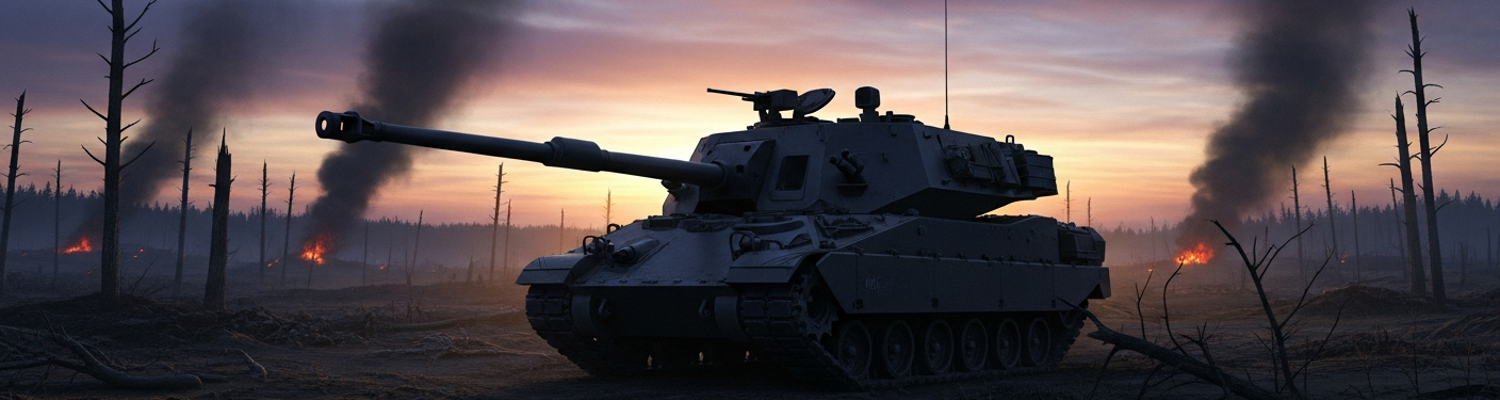

The interwar period found the U.S. Army grappling with the ghosts of the last war, its doctrine shaped by the static slaughter of World War I. The concept of modern armored warfare, a rapid and violent storm of steel, was a vague storm cloud on the horizon, one that senior leadership largely misinterpreted. The slow, mechanically unreliable tanks of 1918, designed to crawl across no-man's-land in support of infantry, had created a fixed perception of the threat. This institutional inertia would force a brutal and hurried evolution in American anti-tank capability when confronted with the reality of the German blitzkrieg. The journey from vulnerable infantry sections armed with glorified cannons to dedicated tank-killing formations was a desperate one, marked by inadequate equipment, radical doctrinal shifts, and immense human cost. It was a race to adapt or be annihilated, a trial by fire that would fundamentally reshape the American way of war.
The False Security of the Towed Gun
The U.S. Army entered the Second World War clinging to a flawed defensive philosophy, embodied by its primary anti-tank weapon, the 37mm M3 gun. First introduced in 1940, the M3 was a direct descendant of interwar thinking that viewed tanks as infantry support weapons to be engaged from fixed, concealed positions. Based partly on the German PaK 36, the American design was light, weighing just over 900 pounds, and could be towed by a jeep, a key requirement for a theoretically mobile army. Its development was rooted in the lessons of a previous generation of warfare, emphasizing ambush and static defense. The doctrine called for infantry regiments to establish static anti-tank platoons, whose crews would dig in their guns at likely avenues of approach, camouflage their positions, and wait for enemy armor to stumble into their pre-registered fields of fire.
This doctrine proved tragically insufficient against the German Blitzkrieg. In North Africa, during the initial engagements of Operation Torch and the subsequent Battle of Kasserine Pass in February 1943, the M3’s limitations became painfully clear. Under the disorganized command of Major General Lloyd Fredendall, American forces were poorly positioned and unprepared for the speed and violence of a combined panzer assault. The M3's 37mm M74 Armor-Piercing round, capable of penetrating about 36mm of rolled homogeneous armor at 500 yards, simply bounced off the frontal armor of the newer German Panzer III Ausf. J (with 50mm of frontal armor) and Panzer IV Ausf. F2 (with its upgraded 50mm front plate). American soldiers, dug into positions like the Faid Pass, recounted watching their shots strike German tanks and ricochet harmlessly, creating bright sparks before the panzers continued their advance unscathed, machine guns blazing.
The ethical dilemma was stark and immediate. Commanders at the company and battalion level were forced to send men into battle with a weapon they knew was outmatched. The M3, which performed adequately against the lightly armored Type 95 Ha-Go tanks used by the Japanese in the Pacific, was a death sentence for many of its five-man crews in the European and Mediterranean theaters. The psychological toll on these gunners was immense. They were tasked with holding the line against machines that their best weapon could not reliably harm. This strategic miscalculation placed the moral weight of survival not on sound doctrine or superior technology, but on the courage and desperation of soldiers armed with a demonstrably inadequate tool. The human cost at Kasserine was severe, a brutal lesson in the price of underestimating an evolving threat. Production of the M3 ceased in 1943, its role hastily taken over by the larger British 6-pounder (produced in the US as the 57mm Gun M1) and other solutions, but its legacy as a symbol of initial unpreparedness was already forged in the North African dust.
A Rocket in the Individual Soldier's Hands
As the inadequacy of towed anti-tank guns became obvious, a revolutionary weapon was making its battlefield debut, shifting the burden of anti-armor defense to the individual soldier. The M1 "Bazooka" was born from American ingenuity and battlefield necessity. In 1942, under the direction of Colonel Leslie Skinner, the U.S. Army Ordnance Corps was tasked with developing a delivery system for a new 2.36-inch M10 grenade. This projectile used a shaped-charge warhead, a concept based on the Munroe effect, which focused the energy of an explosion into a narrow, high-velocity jet of molten metal capable of piercing armor far thicker than its caliber would suggest. The initial delivery method was a failure, but during a demonstration, a lieutenant named Edward Uhl, frustrated with the proposed system, attached the grenade to an inert practice rifle grenade and fired it from a simple steel tube. The result was a startling success, and the weapon was rushed into production.
The bazooka first saw combat during Operation Torch in November 1942. Hastily issued to troops, many of whom had received only rudimentary instruction, its initial performance was mixed. The early M6 rockets were unreliable, and their battery-powered ignition system was sensitive to moisture and temperature extremes. Yet, the potential was undeniable. For the first time, a two-man infantry team, a gunner and a loader, could carry the power to destroy a 30-ton tank. This fundamentally altered infantry anti-armor doctrine, moving away from a reliance on static, crew-served artillery pieces. An infantry squad was no longer helpless in the face of armor. It now possessed an organic, portable solution that could be brought to bear anywhere on the battlefield.
This empowerment came with a heavy psychological price. The bazooka was a close-range weapon. Its effective range was realistically only about 150 yards, and accuracy dropped off sharply beyond that. Its use required a soldier to stand his ground, wait for a tank to get perilously close, and expose himself to direct machine gun and cannon fire. The weapon’s signature back-blast, a gout of flame and smoke extending over 15 feet, was also a significant danger to anyone behind the gunner and instantly revealed the team’s position to the enemy. Equipping an individual with such a potent yet dangerous weapon placed an immense burden on them. They became the sole arbiters of their squad’s survival against an armored assault. The Germans were so impressed by captured bazookas that they reverse-engineered the design to create their own larger, more powerful Raketenpanzerbüchse, nicknamed the Panzerschreck. Despite its initial flaws, the bazooka was a tactical success, with nearly 500,000 M1, M9, and M18 models produced during the war. It represented a critical shift in warfare, one that armed the individual with unprecedented power and responsibility.
The Cult of the Tank Destroyer
In parallel with individual weapon development, the Army pursued a unique and controversial solution to the panzer threat: the Tank Destroyer doctrine. Championed by Army Ground Forces commander General Lesley J. McNair, an artilleryman by trade, this concept was a direct response to the perceived lessons of the German Blitzkrieg in 1940. The core idea was not to fight tanks with other tanks, which were to be reserved for infantry support and exploitation. Instead, a new class of specialized, highly mobile vehicles would counter massed enemy armor breakthroughs. These "tank destroyers" were to be held in a centralized reserve, ready to move quickly to the point of crisis. The doctrine was aggressive and offensive in nature, summarized by the mantra "seek, strike, and destroy."
The primary embodiment of this philosophy was the M10 Gun Motor Carriage, often called the Wolverine by the British. Built on the reliable chassis of the M4 Sherman tank and powered by a General Motors 6046 twin diesel engine, the M10 mounted a powerful 3-inch (76.2mm) M7 gun in a pentagonal turret. This gun could defeat the armor of most German tanks in 1943. To adhere to the doctrine’s emphasis on speed and mobility, critical trade-offs were made. The M10 featured only thin armor, with a maximum of 38mm on the hull front and just 19mm on the sides and rear. Its turret was open-topped. This design choice was intended to save weight and improve the crew’s situational awareness, but it left them dangerously vulnerable to artillery airbursts, mortars, and infantry attacks from above. The turret’s traverse was a slow, manual hand-crank. It took a full 80 seconds for a complete 360-degree rotation, a potentially fatal flaw in a fast-paced, multi-directional tank engagement.
The M10 first saw combat in Tunisia in March 1943 at the Battle of El Guettar. While its gun proved effective, the doctrine itself often clashed with battlefield reality. The independent Tank Destroyer battalions were organizationally separate, creating friction with armor and infantry commanders who wanted direct control over these powerful assets. Field commanders like George S. Patton often ignored the doctrine, attaching TD battalions directly to his divisions for continuous support. The M10s were frequently used as mobile fire support or as ad-hoc assault guns, roles for which their light armor and open tops were ill-suited. The ethical complexity of the Tank Destroyer doctrine lay in its very philosophy. It prioritized the destruction of enemy armor above the protection of its own crews, creating a force of hunters whose primary defense was speed and aggression, not steel. This high-risk approach was further evolved with the lightning-fast M18 Hellcat and the heavily armed M36 Jackson, which mounted a 90mm gun to counter late-war German heavy tanks. The doctrine was officially abandoned after the war, but its aggressive spirit left a lasting mark.
A Legacy of Violent Adaptation
The painful lessons learned from the static 37mm guns, the individual empowerment offered by the bazooka, and the specialized aggression of the Tank Destroyer doctrine illustrate a military in the throes of a violent, high-stakes transformation. The journey was not linear. It was a chaotic process of trial and error played out on the battlefields of North Africa and Europe. Each solution addressed a different facet of the problem. The towed gun represented a failed static defense. The bazooka democratized anti-tank warfare, making it an infantryman's fight. The tank destroyer represented a specialized, centralized response built on speed and firepower. This period of frantic adaptation, while costly in both lives and material, laid the essential groundwork for the combined arms tactics that would ultimately secure victory. The path forward was paved with the recognition that survivability, firepower, and mobility must exist in a delicate, ever-evolving balance, a principle that continues to shape armored doctrine today.