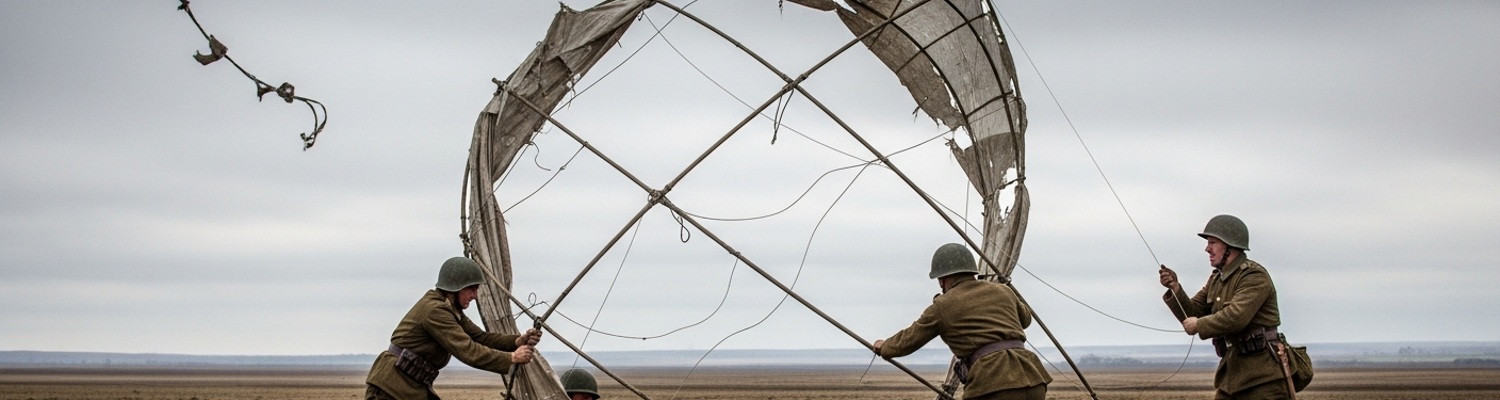

In the final decades of the nineteenth century, the United States Army sought a decisive advantage on a battlefield defined by smokeless powder and trench warfare. The high ground of the sky promised an answer. Memories of the Union Army’s Balloon Corps during the Civil War, while groundbreaking, were colored by the logistical realities of hydrogen gas generators, vulnerable silk envelopes, and the immense ground crews required to support a single, stationary observation point. As the nation industrialized during the Gilded Age, the Army Signal Corps, under the pragmatic leadership of Chief Signal Officer Brigadier General Adolphus W. Greely, required a cheaper, more portable, and readily deployable method to place an observer or a camera over the battlefield. The Corps found its potential solution not in complex engines, but in the engineered simplicity of the kite.
A Cheaper Path to the High Ground
The initial impetus came from civilian innovators, not the military establishment. William A. Eddy, a New York journalist and accountant with a fervent interest in meteorology, emerged as a central figure. Eddy refined the tailless diamond kite, a design based on Javanese models, which offered superior stability in variable winds. His work at the Blue Hill Observatory in Massachusetts, where he used kite trains to lift meteorological instruments, captured the Army's strategic imagination. In 1894, Eddy successfully flew a train of five of his kites, hoisting a thermograph to an altitude of 1,500 feet and proving the immense lifting power of a multi-kite system. The Signal Corps, tasked with battlefield communications and intelligence, saw the clear military application. Balloons were expensive, temperamental, and demanded significant ground support. Kites, by contrast, were simple, easily transportable, and could be launched by a small team with minimal equipment. This realization ignited a period of intense experimentation throughout the 1890s. The Signal Corps initiated its own trials, directly leveraging the work of Eddy and other pioneers like Lawrence Hargrave of Australia. Hargrave’s invention of the cellular or box kite in 1893 was a structural revolution. His design, noted for its exceptional stability and raw lifting force, became a cornerstone of military kite systems. Army engineers often used Hargrave’s box kites in tandem with Eddy’s diamond kites to form powerful and reliable trains capable of operating in a wide range of wind conditions.
The Unblinking Eye on a Wire
The core of the system was the kite train. A single kite was often insufficient to lift the heavy cameras and photographic plates of the era and remained highly susceptible to sudden gusts or lulls in the wind. By flying multiple kites on a single, high-tensile line, operators could generate the necessary lift and create a remarkably stable aerial platform. The tether itself was a piece of advanced technology, typically hardened piano wire or steel cable, chosen for its high strength-to-weight ratio. A typical reconnaissance train might consist of seven to ten large Hargrave box kites, each contributing to the overall pull required to hoist a payload of fifty pounds or more to altitudes exceeding 2,000 feet. Managing this train was a physical ordeal. Ground crews used heavy, purpose-built winches to pay out and reel in the wire, fighting against thousands of pounds of tension. A snapped line could send the entire apparatus, camera included, crashing to earth and posed a significant danger to personnel below. Suspended from this wire-tethered platform was the Army’s new eye. These were not simple hand-held devices. The preferred instrument was a panoramic camera, specifically the Al-Vista, first mass-produced in 1898. These cameras used a spring-powered, swing-lens mechanism that rotated across a curved film plane, capturing a wide field of view perfect for mapping terrain or surveying enemy fortifications. The primary challenge lay in triggering the shutter from the ground. Signal Corps technicians devised several ingenious methods. The simplest involved a long, slow-burning fuse lit just before launch, which would eventually trip the shutter. A more advanced and reliable system used an electrical signal sent up the conductive kite wire to a small electromagnet that operated the shutter release. To confirm a successful exposure, some systems would automatically drop a small white flag, signaling to the ground crew that the mission was complete and the entire apparatus could be painstakingly reeled in. The resulting images, captured from an unprecedented perspective, offered immense tactical value. An altimeter was often included in the payload to record the kite’s exact height at the moment of exposure, allowing cartographers to properly scale the photographs for creating accurate maps of enemy positions, trench lines, and hidden artillery batteries.
Hoisting an Observer Skyward
While camera-lifting demonstrated the feasibility of remote aerial reconnaissance, the ultimate objective for many within the Signal Corps was to lift a human observer. A man in the air, equipped with powerful field glasses and a telephone line running down the kite’s tether, could provide real-time intelligence, direct artillery fire, and report on troop movements far more effectively than a single, static photograph. This ambition led to the development of massive man-lifting kite systems. U.S. Army Lieutenant Hugh D. Wise was an early American proponent, successfully designing and flying in a system of his own creation using Hargrave box kites in 1897. The most prominent figure in the Army’s man-lifting program, however, was Captain Charles DeF. Chandler, a Signal Corps officer who would later command the Army’s first air force. These man-lifting rigs were complex and imposing, consisting of trains of large, winged box kites, such as those designed by Samuel F. Cody, an American showman and inventor who did extensive work with the British Army. The observer sat in a small wicker basket or a simple boatswain's chair suspended far below the main kite train, a perilous position entirely dependent on the strength of the wind and the integrity of the wire. These experiments, conducted at posts like Fort Myer, Virginia, and Fort Monroe, were fraught with danger but proved the concept. An observer could be lifted hundreds of feet, affording a commanding view of the surrounding landscape. The development represented the absolute peak of military kite technology, pushing the physical limits of what could be achieved with fabric, spruce wood, and wire.
A Fleeting Supremacy
The Spanish-American War in 1898 provided the first potential combat test for the new technology. The Army actively considered using kites for reconnaissance over the Spanish defenses in Cuba, particularly around Santiago. While records indicate extensive experimentation and preparation, their actual use in combat was minimal, if it occurred at all. The war was swift, and the dense jungle terrain of Cuba was not always conducive to kite operations. However, the very existence of this capability had a subtle impact on international military thought. The potential for an unseen eye in the sky introduced a new psychological dimension to warfare, undermining the traditional security of fortifications and the secrecy of troop movements. The work of the U.S. Army was part of a broader, quiet international race for aerial supremacy before the airplane. The British Army, advised by Samuel Cody, developed a sophisticated man-lifting system used for artillery spotting. The French and Russian armies also ran extensive photographic and man-lifting kite programs, all seeking the same tactical advantage.
The kite’s tenure as a primary reconnaissance tool was destined to be short. While the systems had proven the concept of aerial surveillance, they were heavily reliant on consistent wind and were difficult to control with any precision. By 1908, the Signal Corps’ attention had shifted dramatically. At Fort Myer, the same post where Chandler’s kites once flew, Orville Wright demonstrated the astonishing capabilities of the Wright Military Flyer. This new machine offered powered, controllable, and stable flight, rendering the kite almost instantly obsolete for primary reconnaissance roles. Captain Chandler himself transitioned from a key figure in the kite program to a pioneer of military aviation, becoming one of the Army's first pilots and the commander of the Signal Corps Aviation School at College Park, Maryland. The legacy of the Army’s kite program was not one of battlefield victories, but of crucial groundwork. The Signal Corps’ experiments in the 1890s built an institutional understanding of aeronautics, aerial photography, and meteorological observation. This foundational knowledge, born from the simple kite, proved invaluable as the Army entered the age of powered flight, ensuring that when the airplane arrived, the U.S. military already had men who knew how to use the sky.