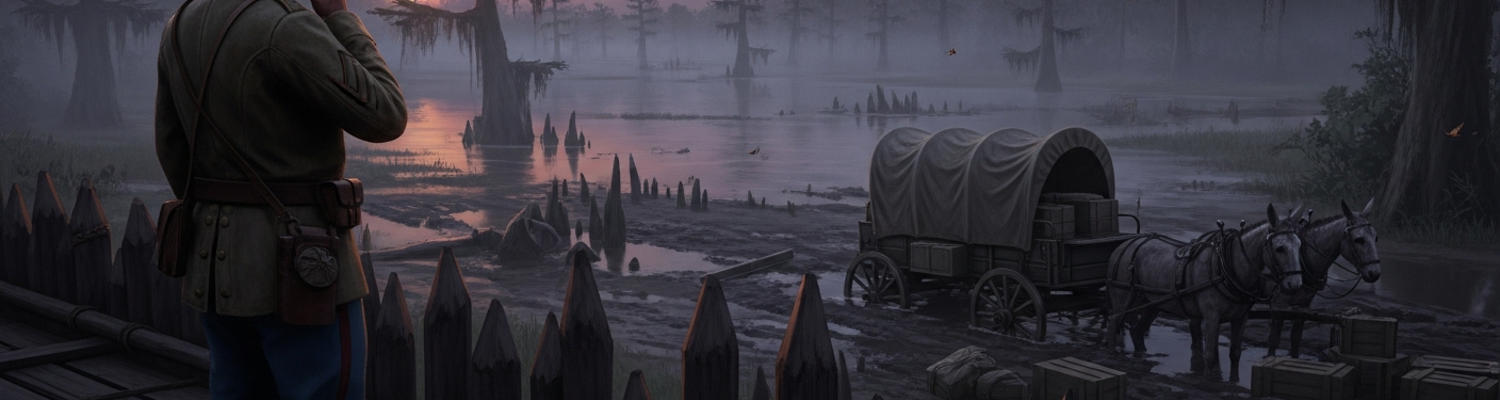

The Fevered Garrison
For the United States Army in the decades following the War of 1812, the most persistent enemy on the frontier carried no weapon. As America pushed its boundaries into the marshy southern territories and the river valleys of the West, its soldiers marched directly into landscapes rife with endemic disease. Malaria, then known by names like intermittent fever, bilious fever, or ague, became a relentless adversary. It incapacitated entire garrisons with its brutal cycle of violent chills, searing fever, and drenching, debilitating sweats. At remote outposts from the Florida peninsula to the Arkansas Territory, the summer and fall months brought a predictable wave of sickness that shattered operational capacity. Fort Gibson in the Indian Territory earned the grim moniker “the graveyard of the Army” for the sheer number of soldiers who succumbed to fevers within its walls. The Second Seminole War, beginning in 1835, became a case study in microbial warfare. Soldiers arriving from northern states possessed no immunity and proved exceptionally vulnerable. The psychological toll of the disease, particularly the potent Plasmodium falciparum strain common in the South, was immense. Medical officers documented cases of psychosis, severe depression, and delirium among fever-stricken troops. Colonel John F. Lane, a promising officer, complained of “great distress in his head” during the epidemic of 1836 before taking his own life. His death was a stark example of how the disease broke morale and command structures. The Army’s medical understanding was primitive. Physicians of the era attributed the sickness to “miasma,” a foul vapor believed to rise from swamps and decaying vegetation. Early treatments often involved bloodletting, blistering, or administering toxic mercury-laden compounds like calomel, which frequently did more harm than good. In this environment of flawed theory and dangerous practice, one substance stood alone as an effective weapon: quinine. Derived from the bark of the South American Cinchona tree, it was the only drug that could interrupt the disease's brutal cycle and keep a soldier on his feet.
Procurement Under Scarcity
The Army’s demand for quinine was intense, but its acquisition was a constant struggle. For most of the early 19th century, the world’s entire supply of Cinchona bark originated in the Andean forests of Peru, Bolivia, and Ecuador. These nations, recognizing the value of their monopoly, outlawed the export of Cinchona seeds and saplings. This policy forced the Army’s medical purveyors into a long and fragile international supply chain. The raw bark, of inconsistent quality depending on the tree species and harvesting method, traveled from the mountains to the coast, across the Atlantic, and finally to processing houses in Europe or the eastern United States. The isolation of the alkaloid quinine sulfate in 1820 by French chemists made standardized dosing possible, a major medical advance. This did not solve the fundamental supply problem. The raw bark remained the critical bottleneck. Domestic manufacturing capacity was limited. The Army depended on a few private chemical firms, like the Philadelphia-based Rosengarten & Powers, to process the imported bark into usable medicine. Any disruption, from political instability in South America to transatlantic storms, could cause severe shortages and wild price spikes that wrecked the budgets of the Army Medical Department. Surgeon General Thomas Lawson, who led the department from 1836 to 1861, repeatedly warned of the precariousness of the supply in his official reports. The experience of the Second Seminole War transformed quinine from a useful medicine into a strategic military asset. After learning of the French army’s successful use of high-dose quinine as a prophylactic in Algeria, U.S. Army medical officers began applying the same methods in Florida. The results were dramatic. The Surgeon General’s office declared the practice would “revolutionize the treatment of fever in this country.” The Army’s desperate need for the drug solidified its essential role in military planning for the rest of the century.
The Perilous Supply Line
Securing a contract for quinine was only the first obstacle. Delivering the fragile medical stores to isolated frontier garrisons presented a severe logistical ordeal. The Army’s supply system in the post-1812 era was a patchwork of military and civilian efforts. While Secretary of War John C. Calhoun’s reforms after the war had created a military-run Subsistence Department for food, the Quartermaster Department still relied heavily on civilian contractors for transporting all goods, including vital medical supplies.
This system was notoriously unreliable. Contracts were awarded through sealed bids, but the process was susceptible to corruption and failure. The journey itself was fraught with peril. A shipment of quinine began in a Philadelphia laboratory, packed in glass bottles within wooden crates filled with sawdust. It traveled by wagon to Baltimore, then by coastal schooner to a depot in New Orleans. From there, it was loaded onto a shallow-draft steamboat for the long trip up the Mississippi and then the Arkansas River toward Fort Smith or Fort Gibson. Each leg of the journey presented unique dangers. River travel was slow and subject to low water, sandbars, and submerged trees known as snags that could rip a hull open. Steamboat boiler explosions were a common and deadly occurrence. From the final river landing, contracted wagon trains hauled the goods overland on rudimentary, often unmapped trails. These wagons, battered by rough roads, frequently caused breakage, rendering a portion of the precious cargo useless.
There were no dedicated medical logistics units. At the destination, the post surgeon and a hospital steward were responsible for the entire medical inventory. They received the crates, took stock of the losses, and managed the dispensary. When their limited stores ran out, as they often did, there was little to be done but send another requisition back down the perilous supply line and watch men sicken while they waited for a resupply that might not arrive for months.
Disease as a Strategic Factor
The availability and quality of quinine directly determined the operational effectiveness of Army units in malarial regions. A direct correlation existed between the contents of the medicine chest and the combat readiness of a regiment. Fevers could reduce a force to half its effective strength in a matter of weeks. Post surgeons submitted monthly reports on sickness and disease to the Surgeon General in Washington, creating the nation’s first public health data sets. These reports, filled with entries for “intermittent fever,” were stark indicators of a post’s viability. A garrison prostrated by malaria could not patrol, construct fortifications, or project force.
For commanders, the quinine supply dictated strategic decisions. The Second Seminole War provides the clearest example. The U.S. entered the conflict to enforce Indian Removal, but Seminole warriors used the swamps and hammocks of Florida as a strategic ally. The debilitating effect of malaria on U.S. troops initially stymied American efforts. The Army's ability to sustain campaigns through the sickly summer and fall seasons depended entirely on its capacity to dose its soldiers with quinine. Commanders like Zachary Taylor and Winfield Scott had to factor massive, predictable losses from disease into their operational planning. The decision to establish, abandon, or reinforce a frontier outpost could hinge on the prevalence of fever and the reliability of the quinine supply.
The Mexican-American War (1846-1848) saw these lessons applied on a grand scale. As U.S. forces under General Scott prepared to march from Veracruz, a known hotbed of yellow fever and malaria, to Mexico City, the Army Medical Department procured massive quantities of quinine. It was issued prophylactically to thousands of soldiers, a logistical feat that would have been impossible just two decades earlier. While sickness still took a heavy toll, the systematic use of quinine prevented a catastrophic collapse of the army and was a key factor in the campaign's success.
The persistent struggle to procure and transport quinine was more than a medical challenge, it was a central factor in the U.S. Army’s ability to secure and hold territory. The survival of soldiers and the success of American expansion often depended not on their rifles, but on the bitter powder in the surgeon’s medicine chest.