
The Necessary Instrument
The surrender of General Emilio Aguinaldo in March 1901 and the formal American declaration of victory in July 1902 did not pacify the Philippine archipelago. The United States Army, a conventional force built to fight other armies, was ill-suited for the task that followed. It found itself occupying a territory of more than 7,000 islands where residual revolutionary units, local strongmen, and bandit groups, collectively known as ladrones, operated with near impunity. A different kind of force was necessary, one that could operate in the ambiguous space between war and law enforcement. The U.S. Philippine Commission, led by William Howard Taft, recognized this operational gap. On July 18, 1901, the commission passed Act No. 175, giving birth to the Philippine Constabulary, an insular gendarmerie designed to impose order where the Army could not and local police were nonexistent.
Its mandate was direct: suppress sedition, put down insurrection, and enforce the law. The organization was built from the ground up by U.S. Army officers, men who understood military discipline and logistics. The Commission selected Captain Henry T. Allen of the 6th U.S. Cavalry as the first Chief of the Constabulary. Allen, a West Point graduate, had proven his administrative and operational capability as the military governor of Leyte. He was given the immense task of recruiting, training, and deploying a force that could win control of the countryside. The initial structure was provincial, with each province authorized a force of up to 150 men. A critical strategic decision was to recruit enlisted men from the local population, leveraging their knowledge of the terrain, dialects, and social networks. This was intended to build a degree of local trust and provide an invaluable intelligence advantage.
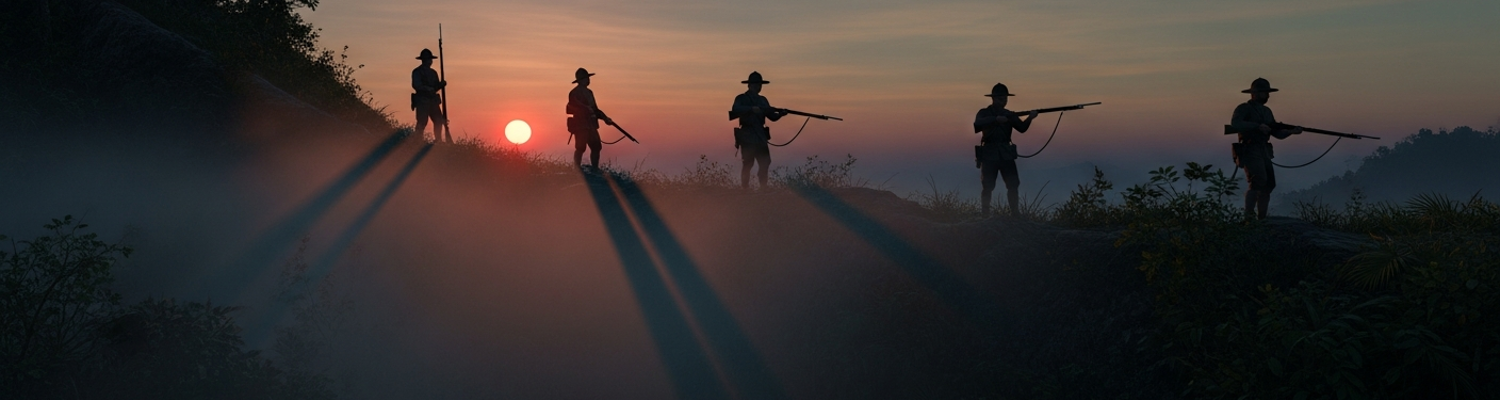
The officer corps, however, was exclusively American at its inception. By the end of 1901, 180 U.S. Army officers and experienced non-commissioned officers were commissioned into the Constabulary to lead the new Filipino units. These men were issued Krag-Jørgensen carbines and Colt revolvers, equipped with campaign hats and khaki uniforms, and sent into the provinces to build a force from scratch. They were not just commanders but also trainers, administrators, and the direct representatives of American civil authority in remote areas. This structure, American command over Filipino manpower, created a powerful tool for colonial governance, an instrument immediately tested in the smoldering conflicts across the islands.
The Crucible of Counter-Guerrilla War
The Philippine Constabulary was not a peacetime police force. It was born from conflict, and its first decade was a relentless series of small-unit actions and brutal counter-guerrilla campaigns. Its operational character was a unique hybrid. In the mountains and jungles, it functioned as a light infantry force, hunting down armed groups. In the towns and villages, it acted as a national police, investigating crimes, enforcing civil law, and supporting the nascent local governments. This dual function required extreme flexibility and resilience from its men. A Constabulary patrol could spend a week tracking an insurgent band through dense jungle, engage in a sharp firefight, and then be tasked with enforcing quarantine measures during a cholera outbreak or providing security for a provincial tax collector.
The Constabulary’s primary military mission was the destruction of remaining revolutionary cells and powerful bandit gangs. They pursued leaders like Macario Sakay, a former Katipunan general who established his own “Tagalog Republic” in the mountains near Manila. Constabulary units, using their superior local intelligence and relentless patrolling, systematically dismantled Sakay’s network. His campaign ended in 1906 not in a battle, but through a controversial act of deception where he was lured into a meeting under a promise of amnesty, only to be arrested, tried for banditry, and executed. This event demonstrated the Constabulary's pragmatic and often ruthless approach to pacification.
The most severe test of the Constabulary’s military capacity occurred in the south, in the Moro Province of Mindanao and the Sulu Archipelago. Moro groups, with a distinct culture and a long history of resisting any outside rule, fought fiercely against American control. Here, the Constabulary often operated in direct support of or alongside U.S. Army units in major combat operations. The Battle of Bud Dajo in March 1906 was a grim example. Hundreds of Moro villagers, including women and children, fortified the crater of an extinct volcano, defying American authority. Viewing this as an insurrection, a combined force of U.S. Army soldiers and Constabulary units under Colonel J.W. Duncan surrounded the mountain. After attempts at negotiation failed, the position was assaulted. The result was a massacre, with nearly all the defenders killed by artillery, machine guns, and rifle fire. Seven years later, in June 1913, a similar engagement unfolded at Bud Bagsak. General John J. Pershing, then governor of Moro Province, personally led a force of Philippine Scouts and U.S. Army infantry against another fortified Moro position. The fighting, which Pershing called the fiercest he had ever witnessed, resulted in the complete annihilation of the defenders. In these violent encounters, the Constabulary proved its function as a hard-power instrument of American policy, capable of engaging in sustained, high-intensity combat at the frontiers of colonial control.
The Deliberate Path to Filipinization
While serving as the armed hand of American colonial rule, the Philippine Constabulary carried within its structure the mechanism for its own transformation. The reliance on Filipino enlisted men from the very beginning made the development of indigenous leaders a logistical and political necessity. Henry Allen and other senior American officers recognized that long-term stability could not be maintained by a foreign-led force. The process of “Filipinization” began almost immediately. Within the first month of its existence, Jose Velasquez and Felix Llorente were commissioned as the first Filipino third lieutenants.
This process was formalized and accelerated with the establishment of the Constabulary School. Initially located in Manila and later moved to the cooler climate of Baguio, the academy trained both American and Filipino officer candidates. The curriculum blended military tactics, discipline, and firearms training with criminal law, investigation procedures, and civil administration. It created a professional cadre of officers who understood both military and police functions. The number of Filipino graduates steadily increased, and they began to assume greater responsibility within the force.
A key figure in this transition was Rafael Crame. Born in Malabon, Crame joined the Constabulary in 1902 and quickly distinguished himself as an effective field commander. He rose through the ranks on merit, earning a reputation for his successful campaigns against bandit groups in central Luzon. His promotions were markers of the force's evolution: captain in 1905, lieutenant colonel by 1907, and full colonel by 1914. Crame's career demonstrated to both Filipinos and Americans that indigenous leadership was not just possible, but highly effective.
The political tide turned decisively with the passage of the Jones Act by the U.S. Congress in 1916. The act served as a new organic law for the Philippines and contained the first formal commitment from Washington to grant the Philippines eventual independence. Under the progressive Governor-General Francis Burton Harrison, the policy of Filipinization was aggressively implemented across all branches of the government. This policy coincided with America’s entry into World War I, which created a demand for experienced American officers to return to the U.S. Army. As American officers departed for Europe, their positions in the Constabulary were filled by experienced Filipinos like Crame. The culmination of this policy came in December 1917, when Colonel Rafael Crame was appointed Chief of the Philippine Constabulary, the first Filipino to command the force. By this time, the officer corps was overwhelmingly Filipino. The organization created by Americans to pacify the archipelago was now fully in Filipino hands. It stood as a powerful symbol of the shift toward self-governance. The Constabulary's legacy would continue, forming the nucleus of the new Philippine Army upon its creation in 1935 and ultimately serving as the direct predecessor to the modern Philippine National Police, providing a durable model for building a national security apparatus from the ground up.