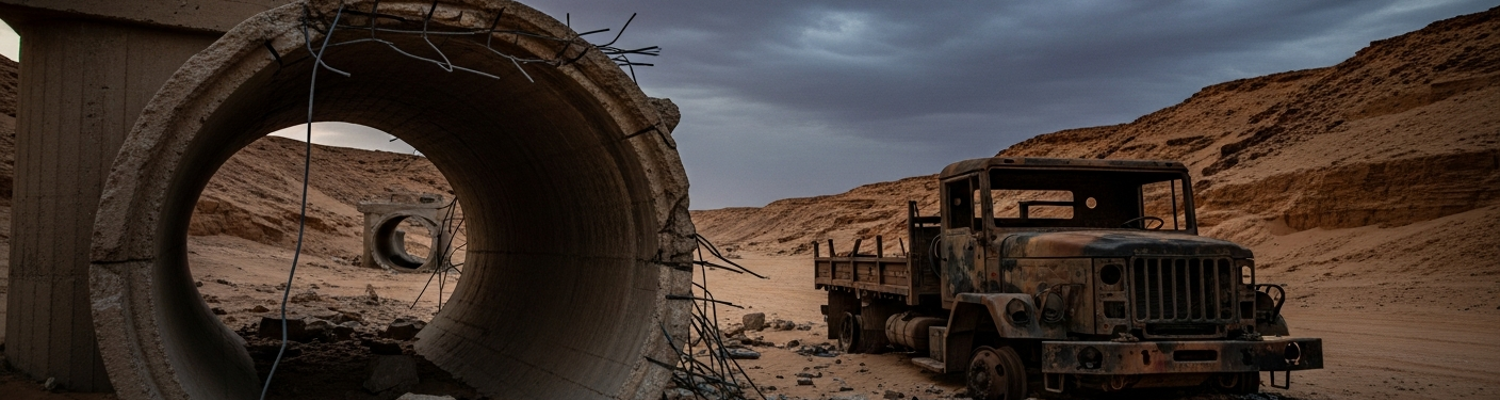

By the third quarter of 1967, U.S. Army engineering detachments in the Al-Dahna desert theater were experiencing a rate of non-combat equipment attrition higher than any other American formation in the region. The operational tempo, paired with extreme environmental factors, produced a ruinous failure rate for the M123 prime movers and M172 lowboy trailers that formed the logistical spine of the campaign. A review of maintenance logs (Logistical Support Command, After-Action File 77-B) shows that for every ten supply convoys dispatched, three suffered mission-ending mechanical breakdowns. Particulate ingestion in engine blocks and catastrophic tire failure on abrasive rock surfaces were the primary culprits. This mechanical decay formed the backdrop to a strategic directive with far-reaching consequences. In October 1967, Military Assistance Command, Vietnam (MACV), in concert with its regional counterparts, issued Operational Directive 19-G. The mandate was a high-priority order for the immediate construction of a graded, all-weather road through the Wadi Rasha corridor. This was a direct response to the failure of aerial resupply, compromised by the recent introduction of Soviet-supplied ZPU-2 anti-aircraft guns among local insurgent forces. Low-and-slow C-123 Provider drops had become a suicidal exercise.
The order was for a road.
This new supply artery was deemed essential for the viability of Forward Operating Base Phoenix. Archival evidence shows FOB Phoenix was the lynchpin of regional intelligence and interdiction efforts, perched precariously within Anvil's Gap, a narrow pass through the Jebel Akhdar mountain range. The base provided a surveillance footprint over the primary smuggling channel for Warsaw Pact weaponry. Before the mandate, the FOB was sustained by air, a method subject to violent seasonal shamal winds that could ground flights for weeks. More to the point, the sensitive electronic components for the base’s AN/MPQ-64 Sentinel radar and TRC-170 troposcatter communication arrays required handling that high-altitude parachute drops could not guarantee. The loss of a single pallet of these fragile components could blind the entire surveillance network.
Topographical surveys reveal the difficulty of the task. FOB Phoenix was positioned at coordinates 24°46'N, 48°14'E, chosen for its commanding view, not its accessibility. The mandate charged the 54th Engineer Battalion with carving a 70-kilometer route, designated Route Alaska, directly through the Wadi Rasha. This ancient riverbed was a geological nightmare, composed of shifting sand dunes and transitioning to tire-shredding shale and massive limestone deposits. The engineers’ D7 bulldozers and Caterpillar 631 scrapers, designed for Southeast Asia, were ill-suited for the abrasive terrain. They struggled constantly with overheating and hydraulic failures in the 120-degree Fahrenheit heat. The construction of Route Alaska was an engineering gamble against a hostile environment, undertaken with equipment pushed far beyond its operational limits.
Responsibility for executing the road construction fell to the 54th Engineer Battalion. This unit, more accustomed to European defense scenarios, confronted a unique set of challenges. Operational logs show the primary obstacle for Route Alaska was not the deep sand, but the dozens of intersecting dry washes and arroyos. Standard doctrine called for corrugated steel pipe culverts, but supply chain realities meant delivering the required tonnage of steel would take months, a delay MACV would not tolerate. This forced the battalion’s S-4 and S-3 sections to find an alternative. The solution emerged from a stateside research initiative at the U.S. Army Engineer Research & Development Center: a new magnesium phosphate-based concrete formula, designated XM-17 Fast-Set. Unlike traditional Portland cement requiring days of hydration, XM-17 promised usable strength in under six hours. The 54th, seeing a way to meet the timeline, lobbied for and received authorization for field adoption. They became the first U.S. Army unit to employ the experimental mix under active operational conditions.
The plan centered on the culverts.
Without robust culvert systems, Route Alaska would wash away in the first flash flood. The engineers planned to use the XM-17 mix to pre-cast culvert sections on-site, allowing them to leap-frog construction down the line. In theory, the rapid-cure properties of the magnesium phosphate composite were ideal. The chemical reaction was exothermic, generating its own heat to accelerate curing, and it required significantly less water than traditional mixes, a benefit in a desert where water was rationed. Provisional field manuals provided with the initial XM-17 pallets, however, had wide margins for error in water-to-powder ratios and ambient temperature tolerances. The engineers of Charlie Company, 54th Engineers, discovered that the 120-degree ambient temperatures caused the exothermic reaction to accelerate uncontrollably. This flash setting resulted in cracked, unsound culvert sections and wasted entire pallets of the specially-flown-in material. It was an act of chemistry performed in the sand, with bulldozer operators attempting to replicate laboratory conditions under forward-deployed strain.
This improvisation was driven by pressure from higher command. Timelines for Route Alaska were based on strategic desperation, not engineering reality. Declassified message traffic from late 1967 reveals daily inquiries from MACV headquarters demanding progress reports measured in kilometers. The commander of the 54th Engineer Battalion, Lieutenant Colonel David R. Hughes, was informed that the regional intelligence network depended on his unit’s pace. This pressure cascaded down the chain of command, forcing the decision to bypass slow-curing concrete structures and commit fully to the unproven XM-17 system. Battalion material specialists filed reports questioning the deployment of the experimental concrete without more localized testing, but these concerns were overruled. Speed eclipsed certainty. By the first week of November 1967, M54 5-ton trucks were hauling hundreds of newly cast XM-17 culvert sections forward for installation along the next 30-kilometer stretch of Route Alaska.
Operational logs from the 54th Engineer Battalion reveal a near-total absence of systematic on-site material stress testing for the pre-cast XM-17 culvert sections. Standard Army Corps of Engineers doctrine mandated a quality control process for field-mixed concrete, including core sampling and compressive strength tests (per specification ASTM C39) to ensure the material met load-bearing specifications. Under pressure from MACV, these procedures were bypassed. Archival evidence shows Charlie Company was equipped with Schmidt hammers, rebound devices used to estimate concrete hardness, but their use was sporadic and the data was not methodically recorded. The primary method of quality control devolved into visual inspection. If a freshly-cast culvert section appeared free of major surface cracks after its six-hour cure, it was deemed fit for installation. There was no equipment on-site for proper load testing or for analyzing the internal structural integrity of the concrete.
The desert did not care about their schedule.
The Al-Dahna environment had a catastrophic effect on the XM-17 magnesium phosphate concrete. The formula was highly exothermic, generating significant internal heat. In the 120-degree ambient temperatures of the Wadi Rasha, this process spiraled. The accelerated hydration reaction caused a violent thermal differential between the core of the concrete and its rapidly drying surface. This led to widespread thermal stress fracturing and pop-outs, where aggregate near the surface would explode out of the concrete matrix. The arid climate and high winds wicked moisture from the surface of the curing sections faster than anticipated. This rapid evaporation starved the chemical bonding process of the water needed for complete hydration. The result was not a monolithic, crystalline structure, but a brittle, porous material with a chalky consistency and severely compromised compressive strength. The 54th Engineers were unknowingly producing hundreds of dimensionally accurate but fundamentally flawed culvert segments.
These deficiencies were invisible to the naked eye.
The limited testing regimen ensured that deep structural weaknesses went undetected. The micro-fractures and poor internal bonding were not apparent on the surface. A culvert section could appear solid while being riddled with internal faults. The first tangible evidence of this systemic failure occurred on November 9, 1967, at a crossing designated Arroyo 14-B, approximately 45 kilometers down Route Alaska. An M123 prime mover, with an empty weight of over 14 tons, was transporting a Caterpillar D7 dozer, weighing an additional 30 tons. The combined gross vehicle weight of over 90,000 pounds far exceeded the actual load-bearing capacity of the improperly cured concrete. As the M172 lowboy trailer carrying the dozer passed over the center of the span, the primary culvert section, identified in after-action reports as C-113, failed. It did not crack or bow. It shattered. The concrete disintegrated into powder and fractured chunks, causing the trailer and its cargo to drop into the dry wash, severing the new supply route.
The failure at Arroyo 14-B on November 9, 1967, was a prelude to the systemic collapse of Route Alaska. Repair efforts were immediately complicated by a sudden, un-forecasted meteorological event. On the evening of November 11th, the remnants of a tropical cyclone from the Arabian Sea regenerated, pushing an intense band of thunderstorms deep into the Al-Dahna desert. The system stalled over the Jebel Akhdar mountain range, dumping an estimated four inches of rain into the Wadi Rasha’s drainage basin in under three hours, an amount equivalent to the region’s annual average. The wadi became a violent, high-velocity channel. The torrent of water, laden with sand and rock, created a situation of extreme hydrostatic shock against the newly installed XM-17 culverts. The brittle, improperly cured magnesium phosphate concrete, already riddled with micro-fractures, could not withstand the sudden pressure. The culvert sections shattered. After-action reports from aerial reconnaissance describe the structures disintegrating as if made of glass. Within hours, the flood had scoured out the foundations of more than a dozen crossings, leaving behind impassable chasms.
The enemy was watching.
The natural disaster provided a tactical opportunity that insurgent forces, identified in signals intelligence intercepts as the As-Saqr Brigade, were quick to exploit. Their sapper teams had been monitoring the construction, noting the predictable placement of the culvert systems. The flood had done much of their work, destroying numerous structures and exposing the surviving culverts by washing away the compacted earth fill. On the night of November 12th, as the 54th Engineers attempted to assess the flood damage, multiple small insurgent teams moved along the remaining 40 kilometers of the route. They did not require sophisticated munitions. Their primary tool was the Soviet-supplied TM-46 antitank mine, a simple pressure-fused device containing over five kilograms of TNT. In many documented cases, the charges were not even buried. Sappers placed the mines directly against the exposed, compromised concrete of the culverts and detonated them with command wires. The brittle XM-17 sections offered negligible resistance, shattering completely under the focused blast.
This resulted in a logistical decapitation.
A post-event survey mission, flown by a UH-1 helicopter from FOB Phoenix on the morning of November 13th, documented the full extent of the destruction. The preliminary report, sent via high-priority burst transmission, was stark. Of the 58 culvert crossings installed along Route Alaska, 41 were classified as completely destroyed. Analysis indicated that hydraulic pressure from the flash flood accounted for the failure of approximately 18 of these crossings. The remaining 23 were assessed to have been destroyed by deliberate enemy demolition, the tell-tale craters and blast signatures clearly visible from the air. In less than 36 hours, a combination of environmental conditions and enemy action had erased over 70 percent of the nearly completed supply artery. The route was now a disconnected series of graded dirt patches leading to impassable gullies.
The destruction of Route Alaska on November 13, 1967, triggered an immediate crisis. With FOB Phoenix isolated and its supplies dwindling, MACV ordered an emergency ground relief effort. A composite convoy was assembled with elements of the 54th Engineer Battalion and a security contingent from the 1st Battalion, 32nd Infantry Regiment. The mission, Task Force Anvil, was to force a path to the stranded outpost. Their lead element was 2nd Platoon, Company C, of the 1/32nd Infantry. The operational order shows the convoy’s objective was to reach the destroyed crossing at Arroyo 17-C and create a temporary bypass. This decision reflected a fundamental misreading of the tactical situation; command believed the route’s failure was primarily due to the flood, underestimating the extent of the As-Saqr Brigade’s follow-on demolitions.
It was a fatal miscalculation.
The ambush was initiated at 14:30 hours on November 14th as the convoy navigated the narrow confines of the wadi. Insurgent forces had established a kill box, occupying the high ground on both sides of the canyon. The lead M54 cargo truck was struck by an RPG-7, instantly blocking the route. As 2nd Platoon dismounted, they were caught in interlocking fire from multiple DShK heavy machine guns and 82mm mortars. Archival evidence shows the platoon was pinned in the open, with vehicle wreckage providing the only cover. For six hours, they were systematically cut down. The open, rocky terrain of the wadi floor offered no concealment. Attempts to call in close air support were negated by the ZPU-2 threat, and the narrow topography made low-level attack runs by F-4 Phantoms hazardous. By the time insurgent fire slackened at dusk, the relief force was broken. The after-action report for Company C, 1/32nd Infantry, reveals a 60% casualty rate for 2nd Platoon. The final tally listed eleven killed and twelve wounded. The engineers suffered comparable losses, their heavy equipment left burning in the wadi.
The tactical disaster sealed the strategic fate of FOB Phoenix. Declassified MACV message traffic from the evening of November 14th shows a stark shift in planning. The destruction of Task Force Anvil demonstrated that a ground link could not be re-established. The base was a liability. The high command issued the execute order for Operation Last Light, the emergency evacuation and deliberate destruction of the facility.
The withdrawal began the next night.
Over two nights, a skeleton force from the 54th Engineers was flown into the doomed base by CH-47 Chinook helicopters in complete darkness. Their sole mission was to place demolition charges. Following protocols to deny an intelligence windfall to Soviet technical advisors, the engineers rigged the AN/MPQ-64 Sentinel radar, the TRC-170 troposcatter communications arrays, and all cryptographic equipment with high explosives. Priority was given to evacuating personnel and destroying sensitive material. On the final flight out, the engineers triggered the charges. A series of controlled detonations reduced the outpost to rubble. The abandonment of FOB Phoenix, a direct consequence of a flawed concrete formula and a shattered relief convoy, represented a total collapse of the U.S. position in the sector.