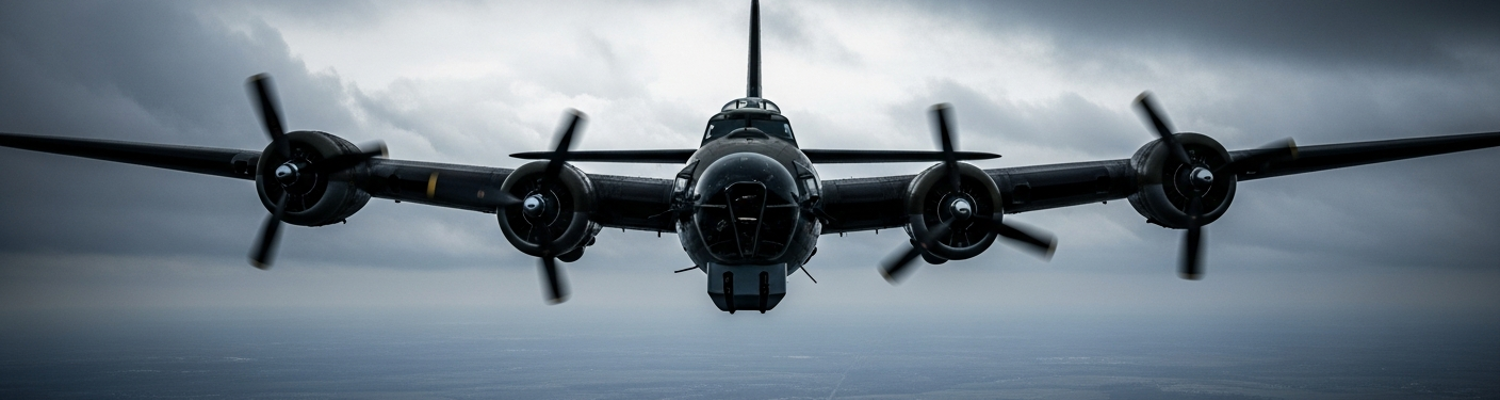

In the humid, intellectually charged air of Maxwell Field, Alabama, a cadre of instructors at the Air Corps Tactical School (ACTS) spent the 1930s waging a quiet insurgency. While the Army General Staff viewed airpower as little more than flying artillery for ground forces, men like Donald Wilson, Haywood S. Hansell, and Kenneth Walker envisioned a different future. They were formulating a radical theory of warfare, one that could win wars from the air and justify the Air Corps' existence as an independent service. This concept, born from intense study and debate, became known as the 'industrial web theory'. Its central premise was both elegant and brutal. A modern industrial nation, they argued, was a complex, interconnected system, a web of dependencies. This system could be paralyzed not by the blunt-force trauma of attacking armies or the terror of bombing cities, but by surgically severing its most critical economic arteries. Their doctrine was a direct refutation of contemporaries like Italy’s Giulio Douhet, who advocated for breaking civilian morale through widespread attacks on population centers. The ACTS instructors saw such methods as inhumane and, more critically, strategically inefficient. Their studies, using the American economy as a template, identified specific choke points whose destruction would cause cascading failures throughout an enemy’s war machine. They targeted electrical power grids, transportation networks, petroleum refineries, and niche manufacturing sectors like ball bearing production. This vision promised a new kind of war, one won cleanly and decisively from miles above the battlefield, a stark contrast to the bloody attrition of World War I trench warfare. The school's motto, 'Proficimus More Irretenti' (We Make Progress Unhindered by Custom), perfectly captured their rebellion against established military dogma.
The entire intellectual edifice of the industrial web theory rested on a single, unproven capability: high-altitude, daylight precision bombing. The physical object that made this theory seem attainable was the Norden bombsight. Developed for the U.S. Navy by Dutch-American engineer Carl L. Norden, the device was a marvel of mechanical complexity, a highly classified analog computer built of gears, gyroscopes, and levers. Early models like the Mark XI and the subsequent Mark XV (designated the M-series by the Army) were treated with a reverence bordering on the mystical. Inside the cramped confines of a bomber's nose, the bombardier would peer through a telescope while inputting data for altitude, airspeed, and wind drift. During the final, tense moments of the bomb run, the Norden’s internal gyroscopes provided a stable reference plane, calculating the precise release point. When linked to the aircraft’s C-1 autopilot, the Norden could even fly the bomber, making minute adjustments to the rudder and ailerons to keep the crosshairs locked on target. This mechanical promise was the linchpin of the precision doctrine. It fueled claims, often exaggerated for public consumption, of dropping a bomb into a pickle barrel from 20,000 feet. The Air Corps leadership, desperate for a strategic mission, embraced the Norden as technological proof that their theories were sound. Security surrounding the device was absolute, with armed guards, signed secrecy oaths, and even thermite charges intended to destroy the sight in case of a crash. Yet the Norden was a delicate, temperamental instrument. Its gyroscopes required long minutes to spin up and stabilize. Turbulence or the slightest evasive maneuver could throw off its intricate calculations, forcing the bombardier to start over. Its design forced long, straight, predictable bomb runs, turning the bombers into slow-moving targets for enemy fighters and anti-aircraft artillery. Maintenance was a constant nightmare, and operational reliability remained a persistent challenge.
To validate the potent combination of their new doctrine and the Norden's supposed accuracy, the Air Corps conducted a series of bombing and gunnery trials throughout the 1930s. The vast, flat expanse of Muroc Dry Lake in California, later Edwards Air Force Base, provided an ideal real-world laboratory. Starting in 1933, Lt. Col. Henry 'Hap' Arnold, then commander at March Field, used the site to push his crews and their machines. These exercises grew in scale, culminating in a massive war game in May 1937 involving over 300 aircraft, nearly the entire combat strength of the Air Corps. Outlines of battleships and industrial targets were drawn in chalk on the hard-packed earth. These were not simple practice runs. The exercises attempted to simulate combat, with defending anti-aircraft units from San Pedro providing opposition. The results of these early trials, sometimes informally grouped under the name 'Project A', were deeply sobering. Even under the perfect, clear-sky conditions of the Mojave Desert, with no enemy fighters to harass them and only simulated ground fire, the gap between the theory of precision and the reality of bombing was a chasm. Official reports often obscured the raw data with optimistic language, but the facts were stark. From high altitude, hitting a specific point target was exceptionally difficult. The celebrated Norden, operated by crews still learning its complexities, could not deliver on its promise. In later combat, the average circular error probable (CEP), the radius within which 50 percent of bombs fell, would be a staggering 1,200 feet, a universe away from the 75-foot CEP claimed in controlled, low-altitude tests. This harsh reality check, however, did little to dampen the institutional momentum. The doctrine had taken on a life of its own. The failures at Muroc were framed as training deficiencies to be overcome, not as fundamental flaws in the technology or the strategic concept itself. The service was already procuring the B-17 Flying Fortress, an aircraft designed explicitly to execute the mission of high-altitude daylight precision bombing. The faith remained unshaken.
This gap between demonstrated capability and doctrinal belief was codified into a blueprint for war in the summer of 1941. In a pressure-cooker environment, a team of former ACTS instructors, including Harold George, Kenneth Walker, Laurence Kuter, and Haywood Hansell, were summoned to Washington. Working for the Air War Plans Division, they drafted AWPD-1 in just seven days. It was a direct translation of the industrial web theory into an operational plan for war against Germany. The document was breathtaking in its ambition, listing 154 specific targets across German industry, grouped into primary systems like electrical power, transportation, and petroleum. It calculated the exact number of bombers and sorties required to destroy them, predicting a swift victory within six months. This plan marked a sharp divergence from the path of its primary ally, the Royal Air Force. After suffering devastating losses in early daylight raids, the RAF had shifted entirely to a strategy of night area bombing, conceding that precision under combat conditions was impossible with their technology. The USAAF, however, held fast to its doctrine, dispatching the Eighth Air Force to England to prove it. The theory was tested and nearly broken in the hostile skies over Europe. The concept of the self-defending bomber formation, the 'combat box', proved tragically inadequate against determined Luftwaffe attacks. The infamous Schweinfurt-Regensburg mission of August 1943, targeting critical ball bearing factories, resulted in the loss of 60 B-17s and nearly 600 airmen. A second raid on Schweinfurt in October cost another 60 bombers. The pure vision of the ACTS theorists, of a clean victory achieved by a few precise blows, dissolved in the brutal reality of a long, attritional air war. True effectiveness came only later, with the overwhelming weight of thousands of bombers and, most importantly, the arrival of long-range escort fighters like the P-51 Mustang. The escorts were the missing piece of the puzzle, the one element the original doctrine had failed to properly value. They proved that before precision bombing could be effective, air superiority had to be won.