
In the summer of 1941, German military power seemed to be at its zenith. Axis armies controlled Europe from the French coast to the Soviet border. In North Africa, Rommel's Afrika Korps had pushed British forces back to Egypt, beginning the siege of Tobruk. German aircraft based in Greece and Crete contested the Mediterranean. The United States was not yet officially at war, but the strategic outlook was grim.
President Franklin D. Roosevelt acted unconventionally. On July 11, 1941, a presidential order created the Office of the Coordinator of Information (COI). A review of the historical record confirms this was a direct response to the fragmented state of American intelligence. The existing agencies, the Army’s G-2 and the Office of Naval Intelligence (ONI), were notoriously poor at collaboration. They hoarded information and viewed each other as rivals. No central body existed to analyze and synthesize intelligence for the President. Roosevelt appointed William Donovan, a decorated World War I veteran and lawyer, to lead the new organization. Donovan's mandate was to create an agency that could overcome this institutional paralysis. The COI was established within the Executive Office of the President, granting Donovan direct authority that bypassed the entrenched military hierarchies.
The COI's initial directive was to gather information related to national security and conduct "supplementary activities" as requested. This phrasing masked a more aggressive purpose. Donovan envisioned a service combining intelligence analysis with covert action. A core component was the use of black propaganda, a new concept for American strategy. This involved creating and disseminating subversive material designed to appear as if it originated from within enemy territories, sowing confusion and eroding morale. The Foreign Information Service (FIS) was established within the COI under playwright Robert Sherwood to execute this mission. The challenges were immediate: recruiting personnel fluent in necessary languages, obtaining powerful radio transmitters, and developing psychologically sophisticated content.
By late 1941, the COI began deploying its first operatives to the Mediterranean and North Africa. Small teams were dispatched to cities like Tangier in Morocco and Cairo in Egypt. These early agents traveled under diplomatic or commercial cover, posing as vice-consuls, businessmen, or journalists. Their initial tasks were foundational intelligence gathering. They mapped Axis troop dispositions, identified Vichy French sympathizers, assessed local political currents, and contacted potential anti-Axis resistance networks. In Cairo, a hub of British military activity, COI personnel worked to establish an independent American intelligence network, a task complicated by German air raids and the constant threat of Rommel's army. These first deployments laid the groundwork for the clandestine radio war to come.
Months before Pearl Harbor, the United States was already engaged in a silent war in the Mediterranean. By autumn 1941, the Roosevelt administration, operating through the COI, had dispatched its first clandestine operatives into North Africa. These were not uniformed soldiers but pioneers of a new type of warfare. Marine Colonel William Eddy, a World War I veteran and Arabic scholar, was a key figure. Initially posted as a naval attaché in Cairo, he was redirected by William Donovan to establish the COI's primary North African station in the International Zone of Tangier, Morocco. From this post, Eddy and a small team began building an American intelligence network from nothing. These actions were legally perilous; had they been discovered, the operatives could have been executed as spies. The mission received its authority directly from the executive office, bypassing the cautious military intelligence branches.
The work was low-technology and dangerous.
Operatives in cities like Cairo, Algiers, and Casablanca found a region reeling from conflict. The physical infrastructure was in decay. Ports like Benghazi and Tobruk were frequently bombed, their harbors choked with wrecked piers and sunken ships. Inland, paved roads gave way to often impassable desert tracks. Operational logs indicate that intelligence gathering was a matter of cultivating human sources, navigating the treacherous political landscapes of Vichy-controlled territories. Information was gathered through meetings in cafes, payoffs to disgruntled officials, and direct observation of Axis movements. Communications were a constant problem. With telegraph lines cut and radio transmissions easily intercepted, intelligence was often ferried out via slow diplomatic pouches. Every piece of data came at high personal risk.
The strategic purpose was twofold: undermine Axis military operations and assess the loyalties of Vichy French authorities in Morocco, Algeria, and Tunisia. The primary military target was Rommel's Afrika Korps. COI agents tracked Axis supply lines, reporting on the flow of fuel, ammunition, and reinforcements across the Mediterranean. Concurrently, the COI ran a political intelligence operation aimed at the 120,000-strong Vichy French Armistice Army. The United States needed to know which French commanders were loyal to Pétain and which might be persuaded to join the Allies. Agents like Eddy's team worked to identify and secretly contact sympathetic officers. This was preparatory work for Operation Torch, the Allied invasion of North Africa. The intelligence on beach gradients, coastal gun emplacements, and French military morale would prove decisive in November 1942.
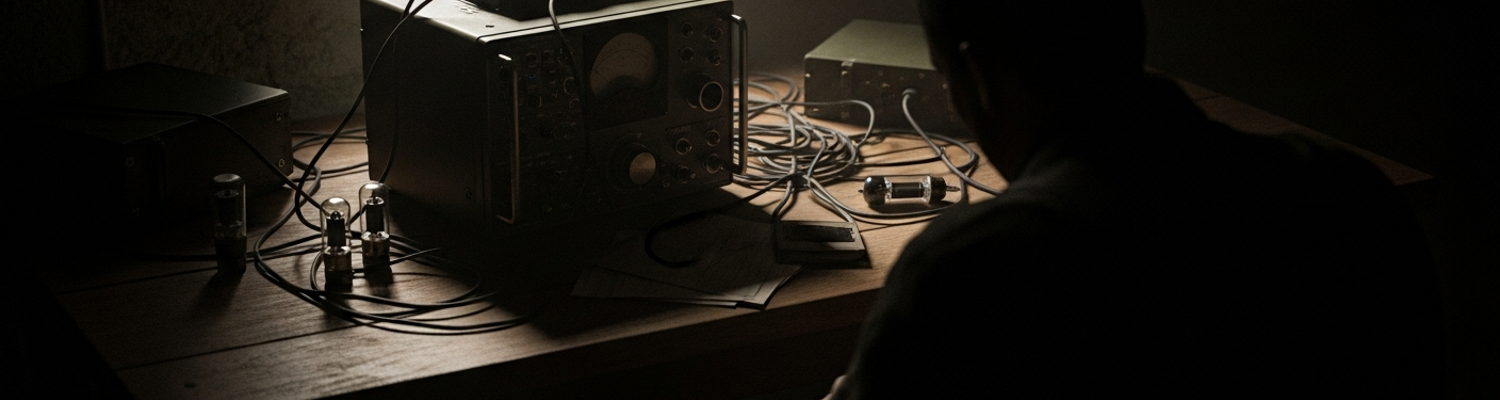
The reliance on shortwave radio transceivers formed the mechanical backbone of the COI’s clandestine war. For an agent in Vichy-controlled North Africa, the radio was the sole link to any friendly authority. The primary instrument was often the cumbersome SCR-284, a set designed for vehicle or fixed-station use. Field reports show its main component, the BC-654 transmitter and receiver, weighed nearly 45 pounds. The complete field kit, with a hand-cranked GN-45 generator and antennas, could exceed 100 pounds, requiring several men to carry. This was not sleek spy-craft. It was brute-force communication dictated by available technology. The sets were fragile; archival logs show jeep transport over rough tracks frequently damaged the vacuum tubes and internal wiring. Agents in humid coastal cities reported moisture fouling the electronics, while those in the desert battled sand that stripped gears in the hand-crank generators.
It was their only voice.
Maintaining a link between these isolated agents and COI headquarters was a high-stakes procedure. Communication occurred during rigidly scheduled windows. A review of operational logs reveals a daily life dictated by these "skeds." An agent in Casablanca had to find a secure location, assemble the bulky radio, and string out a long-wire antenna without attracting attention. The agent then manually cranked the generator, a physically demanding task that produced a potentially compromising noise. All transmissions were in Morse code, with messages encrypted using one-time pads. The process was slow, and every second on the air increased the danger. German counterintelligence units, the Funkabwehr, were proficient at radio direction-finding (DF), using mobile listening posts to triangulate a signal’s origin. An operator who transmitted for too long was broadcasting their own location. A missed sked at the COI listening post in Cairo or London triggered immediate anxiety. It could mean equipment failure or the capture of the agent.
Geography and enemy technology made this reliance on shortwave an unavoidable necessity. There were no secure alternatives. Vast distances separated a COI agent from their handlers. Conventional communication lines were controlled by Vichy authorities and monitored by the Abwehr. Diplomatic pouches were too slow for time-sensitive intelligence. Shortwave radio was the only technology capable of vaulting over these obstacles, bouncing signals off the Earth’s ionosphere to cross deserts and oceans. This method, skywave propagation, allowed a low-power transmitter in North Africa to be heard thousands of miles away, making real-time intelligence reporting possible. Without this capability, the preparatory work for Operation Torch would have been impossible.
The standard-issue SCR-284 radio set was fundamentally unsuited for clandestine work. Its BC-654 transceiver was a heavy, power-hungry unit built around fragile vacuum tubes. Operational logs from COI teams in North Africa reveal a constant struggle against equipment failure. The delicate filaments within the tubes could not withstand shocks from transport over desert tracks. When a tube failed, there was no military supply line for a replacement. Agents became scavengers, searching radio repair shops in Casablanca and Algiers for compatible civilian tubes. This was a dangerous gamble. A mismatched tube could destroy the radio's circuits, and repeated purchases from the same shop were a security risk. In documented cases, agents cannibalized parts from European domestic radios, modifying the BC-654's internal wiring.
This was a war of parts.
Powering these machines was a separate challenge. The GN-45 hand-crank generator was poorly designed for covert operations. It was heavy, required two men to operate efficiently, and produced a loud, distinctive whine. Its internal gears were susceptible to sand. Field agents developed unauthorized, high-risk solutions. Some teams acquired civilian car batteries, using complex connections to step up the voltage. This required constant recharging, forcing agents to run vehicle engines or access the local electrical grid. Archival evidence shows some COI teams tapped directly into municipal power lines, a hazardous procedure that risked electrocution and discovery.
The antenna, the operator's voice, demanded creative engineering. The standard SCR-284 antenna was a long-wire system, often over 100 feet. Erecting such a wire was like putting up a sign. Agents had to hide antennas in plain sight. In the casbahs of Tangier and Algiers, operators disguised wires as laundry lines. Other teams concealed antennas inside chimneys. A review of field manuals indicates operators also used existing metallic structures, such as bed frames or rain gutters, as crude antennas. Every transmission was a gamble against German Funkabwehr direction-finding teams.
Finally, the environment itself was an adversary. In coastal cities, humid, salt-laden air caused corrosion on terminals. Agents coated connections with beeswax or lacquer and packed radio cases with silica gel from civilian packaging. Inland, the threat was dust and sand. Fine particles penetrated the BC-654's housing, shorting out circuits. Operators fabricated dust covers from scavenged canvas and meticulously cleaned their sets daily. The constant vibration from vehicle transport necessitated internal modifications, with agents using rubber or cloth to brace vacuum tubes and other components.
The operational life of a COI radio operator was governed by an unseen enemy on the airwaves. A review of German counterintelligence records indicates the Funkabwehr had established a sophisticated presence across the theater. Their mission was not just to block transmissions but to hunt operators. Using networks of direction-finding (DF) stations, they plotted the origin of any clandestine signal. Every press of a Morse key sent a signal to enemy listening posts, which would take bearings. Multiple bearings allowed for rapid triangulation, pinpointing the operator’s location with accuracy. The Funkabwehr also engaged in active jamming, broadcasting noise or false signals on frequencies used by Allied agents.
This was a war for the spectrum.
An agent who stayed on the air for more than a few minutes was inviting an artillery strike or a Gestapo raid. This threat forced COI operators into a rigid routine. Transmission windows were kept short. Messages were compressed and encoded before the operator touched the radio to minimize on-air time. Still, the game was relentless. A change in frequency might buy a brief window of clear communication, but the Funkabwehr would sweep the bands, hunting for the new signal. Some German units specialized in Funkspiel, or radio games, where they would capture an agent and force them to transmit under duress, sending false intelligence back to Allied headquarters.
Compounding this external threat was a failure of internal support. The COI was a new civilian agency and possessed no independent logistical pipeline. Archival evidence shows that obtaining basic replacement parts was a bureaucratic ordeal against the established priorities of the U.S. Army and Navy. A request for new vacuum tubes for a damaged SCR-284 in Algiers would begin a journey through multiple, competing commands. The request would travel from the field agent to the COI station chief, then to London, before arriving in Washington D.C. There, it entered the machinery of the War Department’s supply services, which were already strained. The logistical chaos of the initial Operation Torch landings was a clear indicator of the disarray that plagued Allied supply efforts. A handful of vacuum tubes for a spy's radio ranked far below tank parts or ammunition.
The parts often never arrived.
Even if a request was approved, components began a perilous journey across the Atlantic against German U-boats. The Battle of the Atlantic was at its height, with mounting merchant shipping losses. A single torpedo could send a crate of needed radio parts to the bottom of the ocean. This forced desperation on the ground. The environment accelerated the need for repairs. The cycle of environmental damage and the breakdown of the supply chain meant operators were left to their own devices, forced to scavenge, improvise, or fail.
The most significant impediment to the COI’s clandestine radio war was not the German Funkabwehr but the institutional hostility of its own allies. Declassified memos reveal a deep mistrust of William Donovan’s new civilian agency by the established military intelligence services. The Army’s G-2 and the Navy’s ONI were organizations built on rigid hierarchy and a doctrine that defined intelligence as direct, tactical support for uniformed armies. The COI, by contrast, was an alien entity staffed by what career officers dismissively called amateurs: academics, lawyers, journalists, and financiers. This collection of Ivy League graduates gave rise to the derisive nickname that they were "Oh, So Social," a reflection of the military's contempt for their unconventional backgrounds.
It was a clash of worlds.
Military intelligence saw its role as identifying enemy order of battle. Donovan’s vision, modeled on the British Special Operations Executive (SOE), involved espionage, political subversion, and black propaganda. Many American generals viewed these activities as irregular and dangerously outside their control. This philosophical divide created a toxic operational environment. Archival records show that in North Africa, G-2 and ONI actively opposed COI operations, viewing them as an encroachment on their territory. They refused to share intelligence, competed for the same local informants, and worked to isolate the COI from the formal command structure. General Douglas MacArthur banned the COI’s successor, the OSS, from his entire area of command. This infighting meant American intelligence was at war with itself.
This institutional suspicion translated into direct animosity toward COI operatives in the field. Regular Army and Navy officers looked upon COI agents as reckless adventurers. Even a figure like Marine Colonel William Eddy, the COI’s chief in Tangier, was regarded with suspicion despite his rank. His mission to gauge Vichy French loyalties for Operation Torch was seen as political meddling, not proper military work. The COI’s methods were a point of friction. The use of large sums of cash to buy information and the cultivation of contacts among criminal elements offended the sensibilities of the professional military establishment. Generals like Eisenhower and Patton eventually recognized the value of the intelligence provided by these networks for the Torch landings, but this acceptance came late. For the agents on the ground, this meant operating without the trust or support of the very military forces they were trying to assist.
The most crippling manifestation of this inter-agency warfare was bureaucratic obstruction. Because the COI was a civilian agency, it had no independent logistical authority and was dependent on the Army and Navy for all equipment. A field agent’s request for replacement vacuum tubes became an exercise in futility. The requisition had to pass through a labyrinth of hostile commands. This institutional friction was not passive. A review of the period shows a pattern of deliberate obstruction, where COI requests for transport, weapons, or radio parts were delayed, rerouted, or lost. This forced COI operatives into a state of perpetual scarcity, compounding the dangers of their mission. While British SOE agents could rely on a more integrated supply system, COI agents were often left to fend for themselves.
The operational cycle for a COI agent in North Africa was a descent into uncertainty. Field reports reveal a recurring pattern of high-risk intelligence gathering followed by agonizing periods of silence. An operator might spend weeks tracking a German panzer unit. This data would be painstakingly encrypted onto a one-time pad. The operator then had to execute a high-stakes transmission, setting up the SCR-284 radio, cranking the noisy GN-45 generator, and tapping out the Morse code message as fast as possible, knowing German DF teams were likely listening. Once the final dot and dash were sent, the agent would dismantle the equipment and vanish.
Then the waiting began.
This was a corrosive void. Weeks could pass with no confirmation that the message was received or acted upon. The agent was left to wonder if the vacuum tubes had failed, if a German jamming station had blocked the signal, or if the intelligence had arrived too late. This lack of feedback created a sense of futility. The isolation was absolute. Operators had no way of knowing if the convoy they reported was attacked or if their political intelligence influenced Allied strategy. This silence bred doubt in their equipment and their own command structure.
The vacuum of information was often broken by the worst possible news: the loss of another agent. Because COI teams were small, the capture or death of a single operator was a catastrophic, personal blow. Word would filter through the remaining network. The loss immediately amplified the paranoia of every survivor. A key question was whether the captured agent’s codes were compromised. The Germans were proficient at Funkspiel, or radio games, where they would take over a captured agent's radio and transmit under duress. Every subsequent message from headquarters had to be viewed with suspicion.
Every dead agent was a ghost on the airwaves.
This visceral reality of casualties took a heavy toll on morale. The psychological strain was intense, comparable to that of frontline combat troops but compounded by extreme isolation. The death of a colleague was a direct confirmation of their own precarious position. It reinforced the knowledge that there was no rescue. Survival depended entirely on their own wits and the fragile reliability of their equipment. This led to a state of hypervigilance and emotional exhaustion, where trust in their own network began to fray.
For the clandestine radio operator, the primary instrument of their work was also a source of great mental strain. The job combined technical, intellectual, and psychological pressures. The operator was confined for hours in a hidden, often squalid location. The work itself was intensely demanding, requiring flawless encryption and decryption of messages using one-time pads, where a single mistake could render a transmission unintelligible. This was performed under the constant, imminent threat of discovery and death.
The machine demanded a price.
The radio operator was the most vulnerable member of any clandestine circuit. Their transmissions were a beacon for German DF teams. This knowledge created a crushing operational tempo, forcing them to send messages in short, frantic bursts. The operator strained to hear incoming signals through a hiss of static and deliberate enemy jamming, all while listening for the sound of boots on the stairs. This combination of intense concentration, physical isolation, and mortal danger led to documented cases of burnout, anxiety disorders, and severe depression. The very act of communication, their only link to a friendly world, was inextricably tied to the threat of their own destruction.