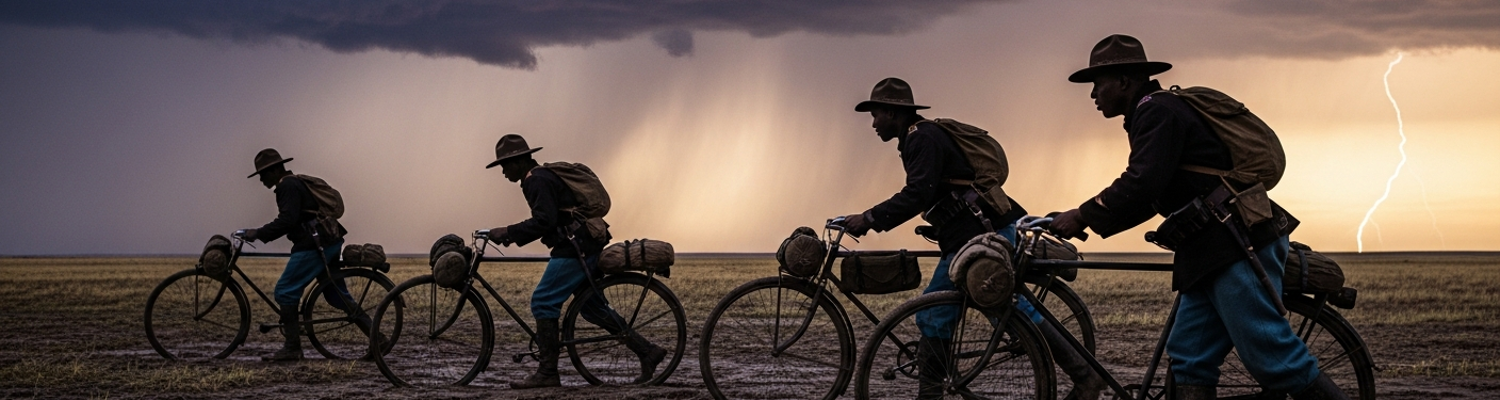

The final decades of the nineteenth century presented the United States Army with a crisis of purpose. The vast American frontier was closing, the brutal Indian Wars were receding into history, and the service found itself caught between the hard-won traditions of horse and saddle and the unsettling promise of new technology. The national “bicycle craze” was in full swing, with millions of civilians taking to the roads on their new machines. It was in this era of transition that one of the Army's most peculiar and demanding experiments took shape, the 25th Infantry Bicycle Corps. This was not simply a test of a new machine. It was a direct, if unspoken, challenge to the primacy of the cavalry and a glimpse into a future of warfare where forage and water might be replaced by steel and rubber.
A Challenge to Horse and Saddle
The idea found its champion in a young, ambitious officer, Second Lieutenant James A. Moss. A recent West Point graduate assigned to the 25th Infantry Regiment at Fort Missoula, Montana, Moss was keenly aware of European armies experimenting with bicycle troops. He saw the bicycle not as a recreational toy but as a potential tool of war. It promised stealth, speed on good roads, and a logistical footprint that a horse could never match. A bicycle needed no feed, no water, and was nearly silent in operation. These were compelling arguments for an Army accustomed to the immense logistical burden of maintaining cavalry formations in the remote West. Moss envisioned a new type of soldier, a mounted infantryman who could move faster and more quietly than his marching comrades.
His proposal found a receptive ear in Major General Nelson A. Miles, the forward-thinking Commanding General of the Army. Miles, who had witnessed the speed of cyclists in urban areas, believed the bicycle would be of “great value in military operations.” With the approval of his regimental commander, Colonel Andrew S. Burt, Moss officially formed the Bicycle Corps in 1896. Its ranks were filled by volunteers from the 25th Infantry, a segregated regiment of seasoned African American soldiers, collectively known as Buffalo Soldiers. These men were professional soldiers, many of them veterans of frontier duty, whose discipline and physical conditioning were well established. Forty soldiers initially volunteered for the demanding duty, from which a core group would be selected for the most arduous tests.
The machines for this new type of soldier were specially constructed. A.G. Spalding & Bros., a major sporting goods manufacturer, saw the public relations value and provided the bicycles at no cost to the government. These were not lightweight consumer models. The Spalding Military Special bicycles featured heavy, reinforced steel frames, robust front forks, and solid gear cases to protect the chain and sprockets from dust and mud. They were fitted with Christy anatomical saddles for comfort on long rides. Weighing about 32 pounds unladen, the bicycles were modified with luggage carriers for bedrolls and knapsacks. Fully loaded with a soldier's gear, a Krag-Jørgensen rifle, and 50 rounds of ammunition, the total weight approached 59 pounds. After a series of punishing training rides, including an 800-mile round trip to Yellowstone National Park in August 1896, Moss was ready to propose the ultimate test of man and machine.
Across the Spine of the Continent
On June 14, 1897, Moss led his chosen detachment out of Fort Missoula. The mission was audacious, to pedal 1,900 miles to St. Louis, Missouri. The corps consisted of 20 enlisted men, Moss, Assistant Surgeon James Kennedy to monitor the men's health, and a reporter, Edward “Eddie” Boos, whose dispatches would bring national attention to their journey. The route was deliberately chosen to present a catalog of the West’s worst conditions, a true trial by ordeal. The challenges began almost immediately. Crossing the Rocky Mountains, the men encountered steep grades that forced them to dismount and push their heavy machines for miles. Summer snow still lingered at higher elevations. Descending was just as perilous on the primitive, rutted roads, demanding constant focus to avoid a catastrophic crash.
On June 25th, they reached the Custer National Cemetery on the 21st anniversary of the Battle of the Little Bighorn. The arrival of 22 soldiers on bicycles to a place defined by a famous cavalry action was a poignant moment, a symbol of the changing military landscape. As they moved into Wyoming and onto the Great Plains, the mountains gave way to a different kind of trial, oppressive heat and choking alkali dust. The water, when found, was often tainted, leading to sickness among the men. Lt. Moss himself fell ill for a time, but the corps pushed on. The most formidable obstacle arose in Nebraska. There, the corps encountered the Sandhills, a vast region of deep, loose sand where cycling was impossible. For 185 miles, the soldiers dismounted and trudged through the sand, pushing or carrying their bicycles in temperatures that soared to 110 degrees Fahrenheit. Private Rout, one of the soldiers, later recounted this as their greatest difficulty. The final leg of the journey through Missouri brought torrential rains, turning the unpaved roads into a thick, impassable gumbo mud that clogged their wheels and chains, forcing them to walk for miles along railroad tracks, balancing on the ties. Despite the hardships, the daily routine was grueling. They averaged nearly 56 miles per day over 34 days of actual travel. Finally, on July 24, 1897, after 41 days on the road, the exhausted but disciplined corps rolled into St. Louis, where they were greeted by a large crowd and escorted into Forest Park.
The Bicycle Against the Cavalry Mount
The journey was a monumental feat of endurance, but its true purpose was analytical. From a purely logistical standpoint, the experiment revealed significant flaws in the technology of the day. Equipment failures were constant. Tire punctures were a daily occurrence, and the eight different types of experimental tires tested, including pneumatic and cushion-filled varieties, offered no perfect solution. The wooden rims on some early models warped and fell apart in wet conditions. Broken frames, pedals, and handlebars required the ingenuity and skills of the unit’s mechanic, Private John Findley, to repair in the field, often with scavenged materials. The resupply plan, which involved shipping provisions by rail to points roughly 100 miles apart, generally worked but highlighted the bicycle’s dependence on existing infrastructure, a luxury not always available on the frontier.
When placed against the horse, the bicycle presented a complex set of trade-offs. Its advantages were clear. It was a fraction of the cost of a cavalry mount and required no expensive forage, a massive logistical benefit that could untether small units from ponderous supply wagons. For reconnaissance and courier duty, its silent operation offered a level of stealth impossible for a troop of clattering horses. On the good roads they seldom found, the cyclists could travel faster than infantry and nearly as fast as cavalry over long distances, without tiring their mount. However, the disadvantages were severe and ultimately decisive. The bicycle was entirely dependent on the quality of the road surface. In the sand, mud, or snow that characterized much of the American West, it was worse than useless, becoming a heavy burden to be carried. It could not ford rivers with the ease of a horse, nor could it carry the same load. A horse could carry a trooper, his fighting gear, and several days of supplies. A bicycle could barely manage the man and his immediate necessities. Critically, a horse offered a degree of cover and a stable firing platform in a skirmish, a benefit wholly absent with a bicycle. The experiment implicitly questioned the cavalry’s monopoly on reconnaissance and rapid movement. It suggested that a cheaper, stealthier force could perform some of its missions. This line of inquiry, however practical, would have been viewed with deep institutional skepticism by the established and politically powerful cavalry branch, which saw its role as central to the Army’s identity and prestige.
A Footnote in the Age of Engines
In his final report, Lt. Moss remained a staunch advocate for the bicycle. He acknowledged the difficulties but concluded that “the durability, as well as the practicability of the bicycle as a machine for military purposes, was most thoroughly tested.” He argued that for certain operations, particularly in regions with fair roads like those found in Europe or the eastern United States, the bicycle had a definite place. He even requested permission for another, even more ambitious ride, from Fort Missoula to San Francisco, to test the machines in a different climate and terrain.
The War Department denied the request. The looming Spanish-American War in 1898 shifted the Army’s focus entirely. The 25th Infantry was soon deployed to Cuba, where they fought with distinction at the Battle of El Caney, proving their mettle in conventional infantry combat without their steel steeds. The bicycle experiment, for all its grit and determination, became a footnote. The dawning age of the internal combustion engine promised a solution to the mobility problem that would soon render both the horse and the bicycle obsolete for most military purposes.
The 25th Infantry Bicycle Corps was a product of a unique moment in military history. It represented a bold, if ultimately unsuccessful, attempt to leapfrog technology. The experiment’s failure was not due to the men, whose endurance and professionalism were beyond question, but to the limitations of the machine itself and the unforgiving terrain of the Gilded Age frontier. It stands as a fascinating case study of military innovation confronting the dual realities of technology and tradition.